To avoid these ads, REGISTER NOW!

Boiler water will not circulate thru one Zone?

Garage Dog

Well-known member
Joined
Dec 28, 2012
Messages
633
Location
Minnesota
The cold is biting me in more way than one,

I have a relatively new propane boiler in the basement and base board heat for a two story house with one circulation pump, spirovent, expansion tank and three zones in my house. Two zones on the main floor and one zone on the second floor.

As propane costs have quadrupled (don't get me started) I tried to shut some doors and turn down the the thermostats in the part of the house we use the least. Bad idea, I froze a pipe in a poorly insulated corner of the house and split a copper pipe, system pressure drops, big mess.

As there are some complications to repairing the split pipe and the related mess, I decided to isolate the zone with the split pipe so I can run the other two zones as the temp is about -10F and repairing the split pipe will take some time.

Unfortunately the system didn't have isolation valves for the individual zones, so I had to bleed down the entire system and sweat in a new valve on the supply side of the damaged zone loop and rely on a manually closed zone valve on the return end of the zone to isolate the leaking pipe(zone).

I then re-filled the system and brought it up to pressure (15 psi) everything holds, leaking zone with split pipe is successfully isolated.

Then I have the second floor thermostat call for heat. Zone valve opens, boiler kicks on, circulation pump kicks on and base board on the second floor warms up just as it should. Things are looking up.

Next I have the thermostat for the remaining zone on the main level call for heat. Zone valve opens, circulation pump is running, but none of the baseboard on the main level heats up???


The only logical reason I can think of is an air lock in that zone on the main level, as the other zone on second floor works fine. There are no manual bleeders anywhere in this system to bleed air out of the zones (just the Spirovent at the boiler).

So if in fact I have an air lock in one zone, how do I get the air out and allow the water to circulate?

BTW - I am confident that the pipe for the zone on the main level that will not circulate water is not frozen. Again, there is only one pump for the entire system and it is working.

Any tricks to getting the air out of the zone that will not circulate?

Any potential problems I am overlooking or haven't considered?

Thanks for any suggestions,

GD
 
Last edited:
To avoid these ads, REGISTER NOW!

anthony666

Well-known member
Joined
Dec 29, 2007
Messages
987
Location
kirkfield ontario
you got an air lock .. drain it down again and sweat in some hose bibs on tees so you have a way to flush the lines .. put them at the end of the runs, up against a ball valve so there is no option for the air to go anywhere but out .. the advantage of using a hose bib is you can screw a hose on and direct the water out into a convenient drain

have fun and don't wait too long or you'll be doing more frost repairs :beer:
 
OP
G

Garage Dog

Well-known member
Joined
Dec 28, 2012
Messages
633
Location
Minnesota
Thx Rockhead,

The diagram and process described in your link make perfect sense and that is in fact what I think needs to be done... I tried, but I can't make it work, there is unfortunately something I don't quite understand.

I think I need to take a couple pictures and provide a little more info so you can all see how the system is configured.

BTW - it is a Weil-McLain CGa Boiler, White-Rodgers 1311 zone valves and a Taco pump.

Thanks,

GD
 

Jackfre

Well-known member
Joined
Dec 26, 2010
Messages
4,411
Location
N CA
Do you have any (coin) vents on the ends of the baseboard units inside the enclosures? If not, you need to follow Anthony's suggestion...right now. You may as well do it for all three zones.
 
OP
G

Garage Dog

Well-known member
Joined
Dec 28, 2012
Messages
633
Location
Minnesota
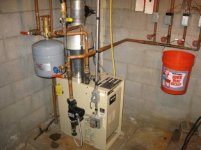
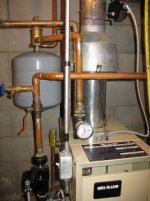
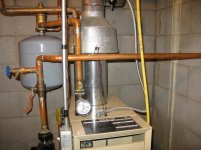
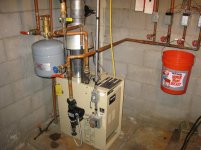
Hopefully the description below and three images of the boiler set-up will clarify what sort of system configuration/components I am working with...


This how I understand the system to be configured
:

#1. Coming out of the top of the Weil-Mclain CGa boiler is what I assume to be the boiler output with a Pressure and Temp Gauge>

#2. Next in line is the SpiroVent and Expansion Tank>

#3. Next is a Inline 1" Ball Valve with an orange handle>

#4. Next the pipe branches off to the 4 different zones running thru a Series of Baseboard Radiators (I may have initially stated there are 3 zone, I don't use the zone in the basement so I originally omitted that one)>

#5. After passing thru the baseboard Radiators, the circulating water returns to 4 Individual Zone Valves>

#6. Below the zone valves are 4 Individual Bib/Spigot Bleeder Valves with red handles (which I think are for bleeding the individual zones)>

#7. After the bib valves the four pipes converge into a Single 1" Copper Pipe>

#8. The Single 1" Copper Pipe runs back over to the boiler and there is a Bib/Spigot Bleeder Valve with a blue handle>

#9. After the bleeder there is a second Inline 1" Ball Valve with an orange handle>

#10. Below the ball valve is the Taco Circulation Pump>

#11. Below the circulation pump is another Bib/Spigot Bleeder Valve>

12. Last the pipe returns into the side of the Boiler.

Note: On this boiler, what I call the "make-up/water supply" is fed into the top of the boiler.

There are no "coin vents" at the end of any baseboard radiators.


So here is what I tried doing with the zone that I think has an "airlock" and and needs to be bled or purged:

A) System pressurized and the furnace and circulation pump off.

B) Open only the one zone valve for the zone I am trying to purge/bleed.

C) Shut off 1" ball valve above (#9) above circulation pump.

D) Opened the bib/spigot bleeder valve below the zone valve for the individual zone that won't heat up.

E) Open the make-up/supply water valve to increase pressure and try to push fresh supply water through the only zone that is open - from the boiler, thru the zone baseboard radiators, thru the zone valve and theoretically out the bib/spigot bleeder under the zone valve - as the water/air should not have any place else to go because of closing valve #9...

Water trickles out the open spigot bleeder below the zone valve for a bit and then nothing. I only ran the pressure up to about 40 psi. - should I run the pressure higher?

I would think that if nothing else water would come out of the open spigot and the system pressure would drop - but it doesn't...

So - now that you have a few pics, a description of how I think it works, I what I have tried, what am I doing wrong?

Thanks for any insight,

GD
 

Attachments

  • FL DIY Boiler Pic2.jpg
    FL DIY Boiler Pic2.jpg
    47.9 KB · Views: 43
  • FL DIY Boiler Pic3.jpg
    FL DIY Boiler Pic3.jpg
    55.1 KB · Views: 40
  • FL DIY Boiler Pic4.jpg
    FL DIY Boiler Pic4.jpg
    56.5 KB · Views: 32
Last edited:

anthony666

Well-known member
Joined
Dec 29, 2007
Messages
987
Location
kirkfield ontario
bigger pics would help

basically you have a hybrid of new school and old school .. a single pump on the return side is from the era right after steam boilers .. i'd leave it there

the big problem is you need to have ball yalves after your hose bibs on the individual returns or there's nothing to force the air bleed out fully .. you'll bleed and bleed it and never flush all the air out
 

brewchief

Well-known member
Joined
Sep 20, 2008
Messages
2,370
Location
Michigan
Are you 100% sure the zone valve is opening?
Your method of bleeding the zone sounds right from what I can see in the pics, I'm betting you have a frozen zone.
 
OP
G

Garage Dog

Well-known member
Joined
Dec 28, 2012
Messages
633
Location
Minnesota
bigger pics would help

I will load some larger images.

basically you have a hybrid of new school and old school .. a single pump on the return side is from the era right after steam boilers .. i'd leave it there

Other than replacing a zone valve, the system configuration seems have worked fine until now

the big problem is you need to have ball yalves after your hose bibs on the individual returns or there's nothing to force the air bleed out fully .. you'll bleed and bleed it and never flush all the air out

I do understand how "to have ball valves after your hose bibs on the individual returns" would be the best set-up. However, immediately after individual bib bleeders there is a few feet of 1" pipe and then a 1" ball valve that stops the water from continuing to return to the boiler.

The only other alternative path would be to essentially reverse direction of normal flow and back up through the other zone valves, but with all the other zone valves closed those paths should be blocked as well...?

They managed to bleed the zones when this boiler was installed - I must be missing something.

GD
 

anthony666

Well-known member
Joined
Dec 29, 2007
Messages
987
Location
kirkfield ontario
also, i wouldn't count on the make up water supply to have enough jam to purge everything .. if i didn't have my purge cart in the truck i'd use a washing machine hose or a female to female hose adapter and a garden hose .. i'd connect it as close as possible to the city water inlet or well pump and i'd make that air my ***** in short order

basically you have to get as much pressure into the pipes as possible and give the air no possible way to go but out
 

anthony666

Well-known member
Joined
Dec 29, 2007
Messages
987
Location
kirkfield ontario
looking at picture 3, i'd sweat that ball valve out above the pump, and do my cut there, reuse the ball valve & save the cost of a coupler :beer:
 

volleyball

Well-known member
Joined
Aug 29, 2011
Messages
4,127
Location
NY, not NYC
I'd work on repairing permanently or temporarily the split pipe. There are saddles that bolt on that seals splits. Not as good as repair but good for now.
Maybe that closed zone helped burp the other two and that is why it doesn't bleed.
Plastic on all the windows and anything else you can do to seal up leaks is better than shutting off heat to any room with a pipe in its wall.
 
To avoid these ads, REGISTER NOW!

Rockhead261

Well-known member
Joined
Aug 28, 2013
Messages
1,911
Location
10509
Open the zone valve manually with the lever on the bottom or just crank all four thermostat to the max

Sent from my SCH-I545 using Tapatalk
 
OP
G

Garage Dog

Well-known member
Joined
Dec 28, 2012
Messages
633
Location
Minnesota
Gentlemen,

I wanted to test my bleeding / purging theory on the zone for the second floor that is working - unfortunately it purged just as I thought it would...

This suggests to me that I have a blockage in the problem zone that isn't allowing it to purge. Hard as it is to believe, the zone that won't purge must be frozen in the basement somewhere. What else could cause a blockage?

I put a construction heater in that end of the basement and am going to keep it around 70* through this evening - the main level where this zone is located has never gone below 60* - must be in the basement where the pipe gets close to the rim joist before jumping up to a run of baseboard...

Anthony - I understand the more pressure idea but I would have to put in another bib/spigot to supply a higher pressure past the first 1" ball valve (#3) other wise the water will just push backwards blow the pressure relief valve on the boiler.

The attached images should now be larger if you click on them.

Thanks for all the feedback,


GD
 

Attachments

  • White-Rodgers Zone Valve.jpg
    White-Rodgers Zone Valve.jpg
    90.3 KB · Views: 22
  • Boiler Pic5 LF.jpg
    Boiler Pic5 LF.jpg
    94.4 KB · Views: 17
  • Vert Boiler Pic4 More Pixels.jpg
    Vert Boiler Pic4 More Pixels.jpg
    102.6 KB · Views: 19
  • Boiler Pic3 LF.jpg
    Boiler Pic3 LF.jpg
    96 KB · Views: 21
  • Boiler Pic2 LF.jpg
    Boiler Pic2 LF.jpg
    86.4 KB · Views: 28

anthony666

Well-known member
Joined
Dec 29, 2007
Messages
987
Location
kirkfield ontario
Anthony - water will just push backwards blow the pressure relief valve on the boiler

yea, sorry man .. full pressure purges should always be done with the boiler isolated .. the power should be off to the boiler .. close all air vents in the system .. make sure the light is on in the mechanical room and that the house isn't on fire :beer:
 

Jackfre

Well-known member
Joined
Dec 26, 2010
Messages
4,411
Location
N CA
Anthony, what do you think of the expansion tank position. I think it should be relocated to the suction side of the circ., the point of zero pressure. Its current position can contribute to air separation. It has been a while for me on these things, but I think Dan Holahan covers it pretty well in his "Pumping Away" book.
 

anthony666

Well-known member
Joined
Dec 29, 2007
Messages
987
Location
kirkfield ontario
Anthony, what do you think of the expansion tank position. I think it should be relocated to the suction side of the circ., the point of zero pressure. Its current position can contribute to air separation. It has been a while for me on these things, but I think Dan Holahan covers it pretty well in his "Pumping Away" book.

on paper i agree .. ideally it should go right behind the circ pump

but in this case i'd leave it, for a couple reasons .. first; in order to move the pump you gonna be chopping stuff up and adding a bunch of couplers, at that point you may as well re pipe it, $$$$ .. second .. that's a fairly old system, or at least old school .. we have no idea what exactly is between the rads and the boiler, could be black iron with horse hair joints, could be plumbers pex, could be garden hose .. i like that the pump is low in the system, it means it's gonna stay wet
 
OP
G

Garage Dog

Well-known member
Joined
Dec 28, 2012
Messages
633
Location
Minnesota
Thanks to everyone who gave me suggestions, ideas and feedback - the zone now circulates properly. :bounce:

I ran a couple heaters in the basement yesterday and overnight. Turned it on this morning and it works fine again. I must have had a frozen pipe in the basement somewhere. So now two of the three zones work - enough to heat the house along with the wood burner.

--------------------------------------------------------------------------

The problem remains I still have one zone that I isolated because of a split pipe (see attached image). :( The pipe froze because of closing off a small room with lots of windows. My fault but now I have to fix it, but what is an acceptable way to fix it? Basically repair or replace:
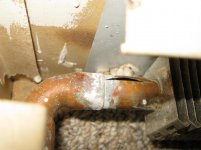
Option 1: I could repair the split by dismantling the baseboard far enough to splice in a section of pipe where the split is.

Option 2: Some people would suggest that because it was cold enough to freeze in the corner both sections of baseboard in that room are compromised (i.e. potential for failure at a later date), maybe damaged where I can't see it behind the radiator fins and should be replaced.

There are two sections of baseboard in this room one is 6' 10" and the other is 5' 8". The longer section of baseboard is easily accessible, the shorter one with the split on the end goes behind a large cabinet that is very heavy and full of stuff, thus I can't even inspect the whole length of the shorter section of baseboard without spending a day removing it... (see attached image)

So what do you think likelihood is that there could be another split I can't see or that is compromised to a point that could fail at a later time?

One last question - I have a number of sections of baseboard that I pulled out of three season porch that was like new. So are the dimensions of residential baseboard radiators standard? Can I cut an 8' section of the reclaimed baseboard I have down to the lengths I need?

Thoughts?

Thanks,

GD
 

Attachments

  • Split Radiator 2014.jpg
    Split Radiator 2014.jpg
    71.5 KB · Views: 17
  • FL Office Radiators.jpg
    FL Office Radiators.jpg
    97.2 KB · Views: 9

mygarageone

Well-known member
Joined
Oct 16, 2013
Messages
2,691
Location
Munising , Mich
Thanks to everyone who gave me suggestions, ideas and feedback - the zone now circulates properly. :bounce:

I ran a couple heaters in the basement yesterday and overnight. Turned it on this morning and it works fine again. I must have had a frozen pipe in the basement somewhere. So now two of the three zones work - enough to heat the house along with the wood burner.

--------------------------------------------------------------------------

The problem remains I still have one zone that I isolated because of a split pipe (see attached image). :( The pipe froze because of closing off a small room with lots of windows. My fault but now I have to fix it, but what is an acceptable way to fix it? Basically repair or replace:

Option 1: I could repair the split by dismantling the baseboard far enough to splice in a section of pipe where the split is.

Option 2: Some people would suggest that because it was cold enough to freeze in the corner both sections of baseboard in that room are compromised (i.e. potential for failure at a later date), maybe damaged where I can't see it behind the radiator fins and should be replaced.

There are two sections of baseboard in this room one is 6' 10" and the other is 5' 8". The longer section of baseboard is easily accessible, the shorter one with the split on the end goes behind a large cabinet that is very heavy and full of stuff, thus I can't even inspect the whole length of the shorter section of baseboard without spending a day removing it... (see attached image)

So what do you think likelihood is that there could be another split I can't see or that is compromised to a point that could fail at a later time?

One last question - I have a number of sections of baseboard that I pulled out of three season porch that was like new. So are the dimensions of residential baseboard radiators standard? Can I cut an 8' section of the reclaimed baseboard I have down to the lengths I need?

Thoughts?

Thanks,

GD

Yes , you can cut to any length you need. That peace that has the split will most likely be enlarged a long way back . So cut it back a couple of ft the get to some regular size tube.
 

brewchief

Well-known member
Joined
Sep 20, 2008
Messages
2,370
Location
Michigan
The fins will come off easy with a sharp utility knife, I have found that where ever there are no fins is going to be the easiest spot for it to burst so check the ends and corners extra close.

If you have extra baseboard just use the fin tube to replace what you have if needed, no need to swap out the whole thing.

Once you get everything fixed consider adding antifreeze to the system, it will prevent the same thing from happening again.
 
OP
G

Garage Dog

Well-known member
Joined
Dec 28, 2012
Messages
633
Location
Minnesota
The fins will come off easy with a sharp utility knife, I have found that where ever there are no fins is going to be the easiest spot for it to burst so check the ends and corners extra close.

If you have extra baseboard just use the fin tube to replace what you have if needed, no need to swap out the whole thing.

Once you get everything fixed consider adding antifreeze to the system, it will prevent the same thing from happening again.

Interesting idea brewchief - question is; I have heard that adding antifreeze reduces the efficiency of the system - any validity to that?

Truth is this system really shouldn't need antifreeze (nice insurance policy though), but I am contemplating the design for a system that would include a loop out to the garage at the cabin. That would either require antifreeze or a heat exchanger which is not 100% efficient either.

Thoughts?
 

wdw

New member
Joined
Feb 9, 2014
Messages
1
you could use a variation of option 1. Get a stick of sil phos, rough up the split with sand cloth, or another abrasive, squeeze the split together and tap it closer together( apply some heat if necessary). A pply heat 'til red hot, or sil phos flows. Use standard safety measures, this will be a little hotter than you are used to. It will be stronger than pre split. Have fun. Dennis
 

Jackfre

Well-known member
Joined
Dec 26, 2010
Messages
4,411
Location
N CA
Water is the preferred heat transfer medium. Once you decide that water is not good outside the pipe and decide to protect the system you can add antifreeze. You have to be careful on newer, AL & SS heat exchanger boilers what antifreeze you use. It is less of an issue with the older CI systems.

Basically, Antifreeze reduces the freeze point and raises the viscosity, meaning you may have to increase the circulator(s) on the system. As most wet systems are way over pumped you may be ok. Don't go over 50/50 on the mix. You have to have a method of charging the system to get the fluid into the system. You have to pump it in some fashion. I would suggest that you get a system cleaner. Hydro-solv or Fernox make them and flush/clean the system really well prior to adding antifreeze. I have a little Wayne transfer pump that works well, Antifreeze needs to be maintained. You need to check its Ph periodically. Having a clean system to start with will give you better system life and AF life. Check the system cleaner for compatibility on your system components...absolutely!
 
To avoid these ads, REGISTER NOW!
Top Bottom