To avoid these ads, REGISTER NOW!

New garage - very dissapointed!!!

carcajou

Well-known member
Joined
Dec 7, 2012
Messages
879
Location
SW Alberta
Your pics will save your ***, congratulations on taking them. Doomed right from the start, it is now a do over. Don't settle for anything less.

Radrush is right on the mark. Sorry for your loss.
 
Last edited:
To avoid these ads, REGISTER NOW!

Moose97

Well-known member
Joined
Jul 11, 2013
Messages
2,802
Location
North Central Texas
Foundation was done by a concrete contractor. If there was plans, I never saw any. Builder said it was his best concrete guys.

Get an engineer in on this to design a fix (if there is one) and make sure he inspects the work. I wouldn't trust this contractor.

If the foundation system was designed by an engineer it's not his fault that your contractor didn't follow the plan. Your beef is not with the engineer; your beef is with your contractor.

You need to call a company that specializes in foundation repair and remediation. This looks a fairly easy fix.

Is that vertical crack in the CMU on the corner nearest that big tree?

I didn't say it was his fault but his design (if there was one) and he needs to be in on the problem and the solution.
 

Garage Dog

Well-known member
Joined
Dec 28, 2012
Messages
633
Location
Minnesota
Think considering the magnitude of the problem, I should start discussing w/ an attorney to just get my ducks in a row? My gut tells me that's where it's headed anyway.

I'm thinking of having a foundation company come out and give a professional opinion so I can have another opinion on what they want to do. I have sorted and printed off many of these suggestions so I'm prepared when they come out. However, it's been 2 days I they have not responded.

I appreciate all the comments. Please only constructive comments, no bashing.

Thanks.

Sorry to hear of your problems Tempest,

Two days is nothing - take your time on this, you have an expensive problem that needs to be properly corrected by someone.

A number of the posts suggest potential causes and solutions - I would speculate that some weighted combination of causes listed added up to the failure you are currently looking at.

First - have a "professional" with credentials determine what the real cause(s) of the failure is and provide opinion on acceptable remedies.

That means a report that from an Engineer or maybe an Architect documenting all problems (with testing to back it up) and a suggested remedy will give you a much stronger position to negotiate or take further action from. This will not be cheap but probably needed if you want an acceptable remedy.

They will not care what the folks on GJ think regardless of how smart we are. ;)

That way if the contractor tells you they are going to (as an example) they will core fill some cells as a remedy and all will be OK - you have an educated response based on a credible third party that says (again as an example) - the base under the footing is not properly compacted, there is to much organic material in the fill behind the wall and the CMU is not built to code, etc.

Bottom line is you need to have a solid understanding of what an acceptable remedy is - before discussing potential remedies with the contractor.

Second - carefully review your contract(s) with the contractor and understand what the contractor and subs are obligated to do under the terms of the contract. You need to be able to articulate how the contractor is in breach or your contract.

Only you can decide if you need legal council at this point, but it sounds like you already figured that out. I would gathering some additional information and facts, then get have an initial consultation to give you some direction.

Lots of other suggestions some mentioned above but for starters:

Talk to the city and verify a permit was pulled and what inspections were done, what inspections where supposed to be done. (make copies of everything)

Print out and understand local building codes that apply.

Copy of contractor's liability insurance.

Try to communicate in writing and document everything as you go.


Good Luck

GD
 

mhm993

Well-known member
Joined
Jan 13, 2008
Messages
516
Good luck to the OP.

Boy oh boy, this is a lesson learned. I'm taking daily photos for the next contracted project. Having proof of construction is remarkable in figuring this out.
 

Kevin54

MEMBER EMERITUS
Joined
Jan 12, 2005
Messages
29,341
Location
Urbana, Ohio
DSCN9716_zps8bcfb6c5.jpg


Right here is a large portion of your problem. Piles of loose dirt. Then it just looks like they walked around on it and spread it out some. You never ever want to have loose soil under a slab. When i had my garage foundation put in, and when I had the wifes building's foundation put in....footers were dug, rebar laid, wrapped around the corners, and footer concrete poured. 2 days later they laid block.

In each case, the topsoil was scraped off including sod. You never want sod or turf under your slab.

Also in one pic, you show that there is a crack at the end of your control joint. That will happen as they can't get the saw up against the foundation. Almost everyone will do it, and mine did also. That is no big deal and can be filled. Also the slab cracking at the control joint all the way through, that will also happen and no huge deal, AS LONG AS THERE IS REBAR to keep one slab from dropping lower than the other slab. Wire won't keep one from dropping or cracking, rebar won't keep a slab from cracking, BUT it will keep on slab from dropping lower than the other. And fiberglass will not keep your slab from cracking. PROPER PREP IS THE ONLY WAY TO KEEP THINGS FROM HAPPENING.

I have a sidewalk that is maybe 70' long. I dug it down about a foot or so, then had gravel put down. The Bobcat had a 5' wide bucket, the sidewalk is 3'. I had the gravel down for a year before I poured the sidewalk. I rand rebar down through where the sidewalk was going, doubled up at where each control joint was going to be. It's been down, close to 12 or 13 years no and not one crack. I forgot to pin the sidewalk to the concrete at the garage, and it will raise up maybe an inch in certain parts of the winter with frost heave, but no cracks.

And I understand, that when you go to build a garage, it's not possible to have crushed stone down for a year before ever pouring a slab, but compaction is the key to having a flawless slab. I can go around my garage and thump the floor with a spud bar and tell you where every hollow spot is underneath due to settling. But the control joints have kept the slab from cracking where it shouldn't.

Good luck with your quest, and DO NOT let the contractor put you off until next week, then the next week. Because if you do, he'll drag his feet until October, then tell you that you're screwed. I have a buddy that is pretty damn sharp. He had a house built that was the house from hell. Everything went wrong. When he couldn't get any satisfaction from the contractor, he finally called the State's Attorney General. It ended up that the contractor had to buy the house back, and then some for the inconvenience caused.

But whatever you do, DO NOT let the contractor put you off, and do not let him cut corners to repair the problem.

If anything, other than tearing it completely down......tell him to put a proper foundation in behind the current foundation, slide the garage back after things are in proper, then repair the old foundation proper. You'll be setting back a little further, but would have a nice parking area in front of the new garage. And make sure things are compacted proper.
 

tomd

Well-known member
Joined
Apr 8, 2011
Messages
469
Your pics will save your ***, congratulations on taking them. Doomed right from the start, it is now a do over. Don't settle for anything less.

Radrush is right on the mark. Sorry for your loss.

I agree with this completely
 
OP
T

Tempest 455

Well-known member
Joined
Dec 22, 2013
Messages
83
OP - I'm dying to know if you can dig down to the top of the footing where the CMU is cracked and see if the footing is actually cracked. Dig down to top of footing, clean off, take picture, post picture. Thanks.

I will see what I can find out this weekend.

I received some feedback from them. They asked I fill out a warranty claim to explain the problems. I used some feedback/comments from here to explain the problem.

I have also called a local foundation expert to come out and look at it.

Will update as I know more.
 

tomd

Well-known member
Joined
Apr 8, 2011
Messages
469
I wonder how/if the bottom course is locked to the footing? I don't see a key way or rebar.
(see day 3 photo)
 

rburke65

Well-known member
Joined
Nov 10, 2007
Messages
12,349
Location
Canfield, Ohio
Yes the footer look as if they hardly excavated any depth at all. I'd have them doze the whole thing and start over....with a different contractor. Yes, get an Attorney. What a shame
 

David C

Well-known member
Joined
Mar 10, 2014
Messages
157
Location
Northern California
You have gotten a lot of suggestions and comments and most of them are good but as usual with free information you get what you pay for. Some of it has been well intended but erroneous.

It appears that you have a major problem that is not going to be adequately corrected by some quick, simple, or cheap, repair. If you want a good garage at the end of this process you probably will need to be patient, meticulous, and proceed in a thoughtful manner. The following are suggestions:

Inform the general contractor that you have a problem and ask him what he suggests. This is not the time to get angry or frustrated even though you have every right to. You should not let him make any kind of repair yet. He should be expressly told you are not ready for him to do anything you simply want to advise him of the problem and see if he has any recommendations. He has made to many errors and has a vested interest in reducing his costs for you to take his unchecked advice.

Engage the services of a well referenced local structural engineer, and if you have them in your state, a geotechnical engineer. Inquire around before you pick one. Like any professional there are those that are good and those that shouldn’t be in the business. Get all the required information from your consultants, including a written report, before making any decisions. Do not allow any repairs to proceed without a repair design prepared by, or approved by, your engineers.

Then with all of information you can discuss a repair design and who is going to pay for the repair design and the subsequent repair. You probably shouldn’t start discussing attorneys with the contractor, there is no need for any implied threat, (he knows you are not stupid and if your aren’t satisfied you have the lawsuit option). However you might consult an attorney about your legal position and obtain recommendations on how to document your decisions and expenditures. For your attorney meeting you would assemble all of the contractual information you have made with your contractor.

At this point it can go a lot of directions and there is little point in exploring all of those pathways.

The following is based upon what can be seen and inferred from your photos and is intended to explain the above recommendations. Admittedly a few photos are not sufficient to make any conclusive statements or recommendations, which is why you need to hire local professionals.

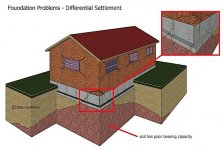
From what you show in your pictures it appears that the CMU, (concrete masonry units) are unreinforced. While it might be possible that horizontal reinforcing was added outside of your photographs it is clear there is no vertical reinforcing hooked into your concrete foundation and extending up into the CMU cores. This is one of the reasons you are seeing failures. And by the way the failures are likely to worsen.

Other posters above have correctly suggested that the CMU walls are acting as retaining walls. Without some vertical reinforcing the strength of a solid grouted CMU is likely insufficient to resist the retaining wall forces developed by the construction and occupation of your building.

It can’t be seen if the CMU was solid grouted later, or what the grouting situation was. Without grout, reinforcing does not provide any strength. FYI, it is common practice in most areas of the country to solid grout every CMU cell in retaining wall stems. It is also common practice to connect 8” CMU with concrete construction and suggestions to the contrary may be thinking of something else. Also it is very likely that 8” CMU would have been perfectly adequate for this project.

It should be noted that your CMU retaining walls are horizontally loaded by the soil backfill below the slab, the slab self weight, and the surcharge of your parked vehicles. Your retaining walls appear to be failing due to lack of reinforcing. Other causes such as foundation settlement can’t be determined from the photographs.

Other things your design professionals should explore are the soil conditions under the poured concrete footings, and the compaction of fill below your slab. Your building is on a slope and if someone removed soil for your house pad and pushed it over to where you built your garage, without compacting it, you might have settlement issues with the footings. Settlement below the perimeter footings or in the under the slab on fill might not be occurring yet but could occur later, even after you make retaining wall repairs.

There seems to be significant construction errors to suggest that you should explore all of the possible construction problems before you proceed with a repair. You likely will only get one bite at the repair apple.

Sorry to see this, be patient, and it will work out.
 

excavator

Well-known member
Joined
May 12, 2013
Messages
167
This foundation would have been fine on level property and no step footings.
Plain and simple there is no outside backfill support at the floor level.
There is also no floor piers attached to the 8 inch walls.
Many times the plans are copied from another job and engineer never visits the property to see the grade change and the fall off in this case.
 
OP
T

Tempest 455

Well-known member
Joined
Dec 22, 2013
Messages
83
Thanks for the above suggestions. To clear up the issue of fill from the house, the foundation from the house was built 25 years ago. So, the foundation of the house is not recent. House sort of, 9 years because of a fire.

The garage was the recent addition. The driveway has been there 9 years and the soil had not been disturbed since.

Thanks again for comments. The more I'm prepared with data the better.
 
OP
T

Tempest 455

Well-known member
Joined
Dec 22, 2013
Messages
83
Was the inside fill sand or soil?

Appeared mostly crushed stone.

Keeps getting better and better. Did some more measuring and the entire slab has settled almost 1" on the side w/ the failing wall. The other side is still the original height.
 

ctgoodman

Well-known member
Joined
Mar 1, 2010
Messages
315
Location
Salisbury, NC
Oh, this thread turns my stomach. I hate to see someone in this situation. Any word form the contractor or the folks responsible for the wall and backfill?

I worked for a masonry contractor back in the early 90's. We built several retaining walls even a little higher than this. It was his practice and was way over code at the time in NC was rebar imbedded in the concrete footer every two feet. Oh it was a pain to lay block over those. Then durawall on every course. then the entire wall was filled with cement. He also on some of the taller walls would build in internal rebar reinforced piers that tied into he outside wall. On occasion even used galvanized cable and anchor points inside the backfilled area. I was just always amazed at what length he went to. We then would backfill on a few inches at a time and tamped it all down. I can still remember running the plate tamp for days on end.

Bottom line is they cut a lot of corners that are now no easy or cheap task to fix.
 

ctgoodman

Well-known member
Joined
Mar 1, 2010
Messages
315
Location
Salisbury, NC
I think someone mentioned the permit and inspection. I know around here they would have had to have plan approval on the foundation and the footing would need to be inspected before being poured and the foundation inspected before construction of the framing part. Hope fully that is similar there and you should be able to get those signed off inspections. They should have never passed that. It would not have passed here.
 

James E

Well-known member
Joined
Jun 21, 2010
Messages
16,507
Location
Raleigh, NC
Appeared mostly crushed stone.

Keeps getting better and better. Did some more measuring and the entire slab has settled almost 1" on the side w/ the failing wall. The other side is still the original height.

Oof. Same situation as the guy a few months ago with the gravel landslide--except his foundation failed before they'd poured the slab and built the garage.

Your foundation wall is being pushed out by the weight of the dirt and the garage slab on top of it. The rear wall has already failed as it has separated at the corners and probably tilted off the footers. I recommend that you rope off about ten feet around the back of that building and keep your kids away from it. The other guy's foundation let go with a bang.

Good luck.
 
OP
T

Tempest 455

Well-known member
Joined
Dec 22, 2013
Messages
83
Oof. Same situation as the guy a few months ago with the gravel landslide--except his foundation failed before they'd poured the slab and built the garage.

Your foundation wall is being pushed out by the weight of the dirt and the garage slab on top of it. The rear wall has already failed as it has separated at the corners and probably tilted off the footers. I recommend that you rope off about ten feet around the back of that building and keep your kids away from it. The other guy's foundation let go with a bang.

Good luck.

Are there any pics of this or link to thread?
 
To avoid these ads, REGISTER NOW!
OP
T

Tempest 455

Well-known member
Joined
Dec 22, 2013
Messages
83
Thanks, I will read through it.

Update: I dug out my contract and it states "yes" for engineering inspection letter on foundation. That could mean anything. Will see what they say on Monday.
 

metalhead212121

Well-known member
Joined
Mar 21, 2010
Messages
2,898
Tempest 455- I feel for you man! I really do.

Heres a quick rundown of **** Id dealt with similar to this:

Never did my homework for the garage floor... End result is that my floor isnt 100% straight. Ive learned to live with it. I got a lot of weight on it and I havent had any cracks but again its not 100% level. I dont have any rebar it it either. I dont think I wanna know how important rebar is.....

Had a guy redo my screen door. What a POS that thing is! Hate looking at it.

Had a electrican come in and do some minor work for me. I helped him do the work so I could get a better understanding of how to do wiring. He didnt charge me anything but I later found out the word he did wasnt up to code. :shocking:

Sent my firebird out for a rollbar installed along with other work. That guy brings new meaning to the word HACK! With all the other times I got shafted I figured I was in a "better" spot to send work out. I talked to a lot of people trying to find someone to do my rollbar. I felt the guy I picked was the most capable of doing the job. To this day I still havent driven the car. As god as my witness I'll set the car on fire before I hire somebody to work on my car.

LAST but certainly NOT least... take a look at the "Contractor Woes" thread here that I started about my steps.... What a nightmare... its still going on. :mad:

Can't say it enough... I feel for you!
 

Zeke

Well-known member
Joined
Aug 13, 2009
Messages
17,176
Location
Long Beach CA, the sewer by the sea.
Just saw this thread. I'd have the local jurisdiction out and have them red tag the building. Then I'd tell the contractor how it's gonna be. Either he removes the building or you will have it removed to satisfy the lien.

Maybe you're way out in the country where no one from any building dept cares. If that's the case I really do feel sorry for you. Let this be a lesson to all that don't know anything about construction. Written by a general building contractor licensed since 1981 with 11 years of experience before that.

No need to further discuss what's wrong. There is no fix that would satisfy me.
 

Kevin54

MEMBER EMERITUS
Joined
Jan 12, 2005
Messages
29,341
Location
Urbana, Ohio
Thanks, I will read through it.

Update: I dug out my contract and it states "yes" for engineering inspection letter on foundation. That could mean anything. Will see what they say on Monday.

Talk to your local building Inspector as soon as you can to see if things actually were inspected. If it was supposed to be, and it wasn't, that's just a little more ammo in your box for Court. Hopefully it doesn't come to that, but with a lot of builders or contractors today, it seems like it always ends up there. And again, like i said before, document everything with pics. You say your floor has dropped already....get pics.

A little off thread, but still deals with courts......when i first got divorced, my wife and I rented a house in my hometown. There were all sorts of problems with the house. We found a house to buy, so I called the landlord and told him that we had a chance to buy a house and was going to move, knowing that I would lose my deposit.

We moved out, and next thing you know, we are going to court. He made accusations that we used 16D nails to hang pictures, that we had a dog in the house, the dog destroyed the inside of the house. blah, blah, blah.

Since he took us to court, he got to speak first. He was asking for $3000 in damages and lost rent because we moved early.

The Judge listened to him spew out lie after lie. When he asked us about something, I answered yes sir or no sir and presented pictures. Every sngle lie he made, our pics proved he was lying. Then when the Judge called his witnesses in, they didn't know how to answer. We won and hardly even had to say a word. The pics did all of the talking.

So if you do eventually have to head to court, make sure you have pics of every single thing wrong. And not just the foundation, but anything with the garage. If it goes to the point of court, he's going to lie to save his ***, so you may as well have more ammo than you ever will need. If a stud is out of plumb, have a half a dozen pics showing it. If the floor dropped, have a dozen pics, If there is a slight gap at the door, show a few pics with light showing through the closed door. And again, IF it goes to court, don't be the nice guy. He's going to do everything in his power to make you look like the biggest ************* that ever hit this planet. So you need everything in your power to make him look like an idiot.
 
OP
T

Tempest 455

Well-known member
Joined
Dec 22, 2013
Messages
83
Talk to your local building Inspector as soon as you can to see if things actually were inspected.

Great idea. My wife just said the same thing before I saw your response. We had to go down to the clerks office back when we started this to fill out paperwork. I'm going to stop in Monday AM and ask about the inspection.

She also suggested I mention that I have a structure that I think is unsafe and see if the county will send someone out to inspect as well.

Will update as I have more info.
 

Kevin54

MEMBER EMERITUS
Joined
Jan 12, 2005
Messages
29,341
Location
Urbana, Ohio
Great idea. My wife just said the same thing before I saw your response. We had to go down to the clerks office back when we started this to fill out paperwork. I'm going to stop in Monday AM and ask about the inspection.

She also suggested I mention that I have a structure that I think is unsafe and see if the county will send someone out to inspect as well.

Will update as I have more info.

Oh....most definitely :thumbup: Fill them in on everything. When it comes to a problem like you are having, getting an inspector on your side will only work to your advantage. They will also be able to tell you who else you need to get in touch with. An Inspector can make a contractors life a living hell!!!!
 

Average_Joe

Well-known member
Joined
Mar 13, 2011
Messages
209
Location
Summerville, SC
There is another thread on here somewhere with a similar issue, except that guys back foundation wall fell down the hill before the slab was poured!
 

Yamaguy

Well-known member
Joined
Apr 13, 2013
Messages
188
Location
Southwest Chicagoland
I have no real experience in doing foundation work, but to me With all of this talk about tons of rebar and filling the blocks why not just throw up some forms and pour concrete? To me block walls seem old school, and even in modern days the DIY approach to foundation walls... Not meaning to offend anyone, just wondering.
 

Zeke

Well-known member
Joined
Aug 13, 2009
Messages
17,176
Location
Long Beach CA, the sewer by the sea.
I'm wondering about the inspector angle. I suppose if plans were approved that didn't include any steel or compaction testing, the inspector 'inspected' only what he could, namely location and compliance with size and height limits. For sure if an inspector thought the construction was substandard he could stop work but they don't seem to make field adjustments to the plans frequently.

At least here locally and in my experience. Inspectors have the leeway to override some approved plans when they see that something is obviously wrong. But if all the details are missing they are not about to set out and stipulate what really is an engineer's job.

An inspector is a referee interpreting the rules as they apply to the game. As we know, the game is not always the same in all parts of the country.

I have no real experience in doing foundation work, but to me With all of this talk about tons of rebar and filling the blocks why not just throw up some forms and pour concrete? To me block walls seem old school, and even in modern days the DIY approach to foundation walls... Not meaning to offend anyone, just wondering.
Good question. Did you notice that the workers were able to ready the pad for concrete in 5 days? Hand built forms would have added time and money. The type that are used in basement walls that are assembled and set by a crane are expensive.
 
Last edited:

NitroSun

Well-known member
Joined
Nov 19, 2013
Messages
150
Location
Tierra Verde, Fl
Call a lawyer ASAP. You should be able to find someone reasonably close that specializes in defective construction. There maybe certain legal steps that need to be taken to document and preserve evidence. For example, getting another contractor to do destructive testing which is not bulldozing but breaking down the structure block by block to prove every defect. Insurance companies, contractors, subs, engineers, municipalities probably should be informed in writing by certified mail. I'm no expert but at this point I wouldn't trust anybody.
 

stage20

Well-known member
Joined
Nov 5, 2013
Messages
3,722
Location
pcola FL
You need to contact an attorney before you fill oug a warrnty claim. This may put you in acceptance of the building. Hate to see this.
 

ford33

Well-known member
Joined
Feb 26, 2011
Messages
2,118
Location
Chicago, IL. USA
I would not sign anything now with the contractor. Talk to the contractor first and see what they will do for you. Also, contact a lawyer for consultation. Learn what your options are legally. You don't file any legal papers yet you are just seeking a legal opinion.
 

Chaznsc

Well-known member
Joined
Apr 9, 2013
Messages
6,535
Location
SC
My gut feeling is that the garage was built on fill that was not properly compacted. Agree with the others on documenting the problem with good, date stamped photographs. Any conversations with the contractor should be documented with a memo for the record made immediately after.

^^^^ this in spades..... settlement issue.
 

Zeke

Well-known member
Joined
Aug 13, 2009
Messages
17,176
Location
Long Beach CA, the sewer by the sea.
Sorry, Radrush, I was talking about a city or county inspector, not a inspector that has a 'client'. I can say that if a shear panel nailing schedule is not quite being followed due to some vagueness the inspector can indeed tell the framer what he will accept and what he won't including the height of the driven nail. I have never read anything about the height of the driven nail on a set of plans nor have I seen the allowable tolerance as to how close of how far from the edge of the sheathing the nails must be placed. These are, as you say, field observations and the 'referee' has the say.

Once again, the inspector of the jurisdiction has little to no say as to the quality of the workmanship and reports to no one as such. He either signs the card or notes changes needed. If no rebar was called for the inspector doesn't inspect for rebar. But he can, again as you say, ask for clarification from any number of people involved. If he feels that engineering has been overlooked due to errors on the plans (take for example the topography not being correctly stated and the elevations not to scale), he will stop the work.

I've seen this happen until the plans were either understood as drawn or corrected. You do know that architects many times draw what can't be built. On my last job which was drawn and submitted to the City of Los Angeles (they don't come any tougher than L.A.) we were stopped 6 times for mistakes on the plans that didn't jive with the inspector, had to submit changes (as you say) to continue work. We had to employ registered deputy inspectors at certain phases who again either signed off or didn't. And when they arrived they always laid down what they wanted to see in advance.

I don't know what you are trying to tell me, but I know what I've had to do over the years to please my inspectors.
 

Mach5

Well-known member
Joined
Apr 30, 2011
Messages
292
Location
Phoenix, AZ
Consult a lawyer with construction litigation/construction defect experience. The first thing that lawyer will instruct you to do is to properly document your warranty claim. "Properly document" will depend upon your contract/warranty language regarding notices. Continue to keep a detailed phot record. I would wait to do any destructive testing until after you consult the lawyer. You may need to allow the contractor to be present during such testing and/or allow him to do his own testing.

Sent from my SPH-L710 using Tapatalk
 

rodm1

Well-known member
Joined
Feb 17, 2008
Messages
2,270
Think considering the magnitude of the problem, I should start discussing w/ an attorney to just get my ducks in a row? My gut tells me that's where it's headed anyway.

I'm thinking of having a foundation company come out and give a professional opinion so I can have another opinion on what they want to do. I have sorted and printed off many of these suggestions so I'm prepared when they come out. However, it's been 2 days I they have not responded.

I appreciate all the comments. Please only constructive comments, no bashing.

Thanks.

I would agree, It would be a good idea to get one before moving forward. They could at least give you direction. You could all sow contact the township and see what they have to say. They most of the time are reluctant to help. Sorry to see this I hate hiring contractors because of this.
 
Last edited:

radrush

Well-known member
Joined
Oct 30, 2010
Messages
828
Location
Atlanta, GA
My gut feeling is that the garage was built on fill that was not properly compacted.

^^^^ this in spades..... settlement issue.

There is some speculation that the spoils from the excavation of the original house were placed in the area of the driveway and the new garage. Since the foundation was dug into the side of the hill along the side of the driveway this is a concern. However, the short side of the building has steps in the footings which leads me to think the contractor dug down to firm-ish soil subgrade.

If the soil subgrade under the footing deflects, from the weight of the building, CMU walls tend to crack in a sideways sort of pattern. See pics below.

This guy has a straight up and down crack right at the corner. From the pics he posted you can see that the corner of the CMU wall had one vertically grouted cell. The short side CMU wall is effectively "tied back" along its length but the the long side CMU wall has little resistance to lateral load and appears to be being pushed out by the gravel fill under the garage slab on grade.

On another note...if the soil subgrade under the footing was less than ideal the weight of a properly constructed CMU retaining wall might have caused it to deflect.

Contractors have got learn that all of the pieces of the puzzle work together to support the load. This is a super lightweight building so it doesn't need much of a footing. However, it needs a strong footing to support the weight of a properly constructed CMU retaining wall. A CMU retaining wall needs vertically reinforced cells, rebar that is doweled out of the footing and properly consolidated grout that ties it all together. A CMU retaining wall needs horizontal bond beams, rebar that is continuous around the corners and properly consolidated grout, that transfers the lateral load across more vertically reinforced cells.

Too bad we don't have a picture of the CMU wall right after the SOG was placed and before they started building the stick framed walls. It would be interesting to know if the weight of the wet concrete played a part in the wall's demise.
 

Attachments

  • cracked CMU3.jpg
    cracked CMU3.jpg
    79.1 KB · Views: 278
  • cracked CMU1.jpg
    cracked CMU1.jpg
    45.4 KB · Views: 214
  • cracked CMU2.jpg
    cracked CMU2.jpg
    112.4 KB · Views: 227

David C

Well-known member
Joined
Mar 10, 2014
Messages
157
Location
Northern California
I think you are either missing the point or I am misunderstanding what significance your 25 year old house has on the soil conditions below your garage. You might not be considering that piled up soil with included organic material does not self consolidate in 25 years. It might not be adequately consolidated even if you drove your car over it for a number of years.

My suggestion was, and remains, that since your contractor has made a number of significant errors you should obtain review of the entire project before you proceed. That would include the soil conditions below the footings, as well as the other obvious issues.

Incidentally that puddle of concrete overpour in the center of your garage used for a work surface appears to be poured over loose soil removed for your footings. Just because there is concrete on top does not mean that the soil below will not consolidate and settle.

Sometimes it is hard for a building owner, even one who is very smart, to understand all of the design consideration and construction processes that go into even a very simple structure such as your garage. Additionally there are a lot of suggestions in this thread, most of which are pretty thoughtful, but it might be hard to assemble all of this info a coherent policy. For these reasons you should obtain professional expertise and shift from listening to these many voices to listening to your professionals.

By the way Hoffman and Radbush are pretty much spot on with their comments. You might print them out and use them to check that your professionals have given their ideas due consideration during the coming months.
 
To avoid these ads, REGISTER NOW!
Top Bottom