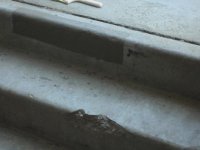
I have a garage floor that was newly poured approx 6 months ago. We put a nice trench drain at the rear of the 18' stall. The concrete is now chipping and spalling at the joint in which it meets edge of the poly trench drain. For reference the drain is a Tuf-tite tr-1. I can only imagine this will get much worse as time proceeds, especially now with the deterioration. What can I do to fix, this evolving problem?? I need help!!


You are using an out of date browser. It may not display this or other websites correctly.
You should upgrade or use an alternative browser.
You should upgrade or use an alternative browser.
Concrete deterioration/crumbling at Trench Drain
- Thread starter theeld
- Start date

LegacyIndustrial
ALLIANCE MEMBER
That edge was probably worked a little wet or some water collected there making it very weak.
I would chip out any residual weakness and carefully apply some epoxy patch(light gray) into the void.
It will look different but will be very strong.
Cement based patches are weak and will be a reoccurring issue for you .
Sent from my iPhone using Tapatalk
I would chip out any residual weakness and carefully apply some epoxy patch(light gray) into the void.
It will look different but will be very strong.
Cement based patches are weak and will be a reoccurring issue for you .
Sent from my iPhone using Tapatalk
Last edited:
Do you have any products you would recommend for an epoxy patch from Legacy?? On a whim, I masked a sample bit between the drain and end of damage and put some sikaflex self leveling sealant down in the masked area (including the joint where concrete meets drain) to see if that would work. It looks good (when masked nicely), wonder if it will hold up.
LegacyIndustrial
ALLIANCE MEMBER
Yes that is an option as well.
I have seen folks broadcast sand in the wet product too, like a broadcast. Hides the shiny sealant a bit.
I have seen folks broadcast sand in the wet product too, like a broadcast. Hides the shiny sealant a bit.
Yes that is an option as well.
I have seen folks broadcast sand in the wet product too, like a broadcast. Hides the shiny sealant a bit.
In the event that the sikaflex doesnt do the job, do you have anything at Legacy for the epoxy patch that you suggest??
LegacyIndustrial
ALLIANCE MEMBER
Here are a few choices:
Pourable filler, commonly used on bridges and parking decks:
http://legacyindustrial.net/cart/hd829-pourable-epoxy-joint-filler-p-96.html
or
Repair Mortar:
http://legacyindustrial.net/cart/epoxy-concrete-patch-2-gal-hd110-p-90.html
If you use the repair mortar, pick light gray as it will do better against UV.
The natural version will amber over time.
I commonly use HD110 in the bright UV light of Florida with great results on small patching and transition jobs despite what others claim.
Here is a link to a transition area repair, outside, it still looks the same.
http://legacyindustrial.blogspot.com/2013/02/exterior-door-threshold-transition.html
Cement based patches are great if you like to repeat yourself every year.
Pourable filler, commonly used on bridges and parking decks:
http://legacyindustrial.net/cart/hd829-pourable-epoxy-joint-filler-p-96.html
or
Repair Mortar:
http://legacyindustrial.net/cart/epoxy-concrete-patch-2-gal-hd110-p-90.html
If you use the repair mortar, pick light gray as it will do better against UV.
The natural version will amber over time.
I commonly use HD110 in the bright UV light of Florida with great results on small patching and transition jobs despite what others claim.
Here is a link to a transition area repair, outside, it still looks the same.
http://legacyindustrial.blogspot.com/2013/02/exterior-door-threshold-transition.html
Cement based patches are great if you like to repeat yourself every year.
pauls340
Well-known member
I've seen that kind of damage before especially around plastic trench drains that flex against the area with high water/cement (w/cm) ratios. Extra water gathers there. I would chase the damaged area with an angle grinder, come back about an inch from the drain and lay down a row of duct tape, then rebuild the edge with Mg-Krete Fine. Mix it to a smooth peanut butter consistency. Put as much weight as you can on the steel trowel to taper it to zero. We cup grind the edge and when you epoxy over it you can't see the repair.
Attachments
Last edited: