To avoid these ads, REGISTER NOW!

Reed 404A arrived - Did I screw up?

Lombie

Well-known member
Joined
Dec 30, 2013
Messages
80
Location
Arizona
Evening,

Thanks to the Vise Flu that runs rampant through the GJ forum, I finally succumbed and purchased a Reed 404A from a seller in another state.

The vise arrived today via UPS and it looks to be in very good shape overall consistent with the seller's comments, greasy and dirty, but not rusted (as the photos make it look) or cracked.

However, I'm concerned about 2 issues that I'd appreciate feedback on:

1) The pin that holds the swivel jaw in place, which is visible in the photos when I purchased it, is missing. I haven't addressed it with the seller yet, but I will. I expect he'll say it was included when he shipped it and, indeed, the box arrived with a small hole in it, so it might have fallen out. If I end up having to find one, can anyone recommend a good source or will I need to have one machined?

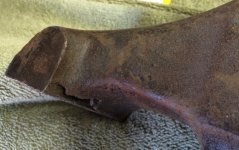
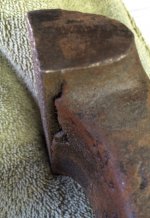
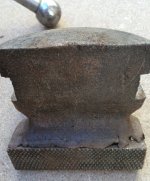
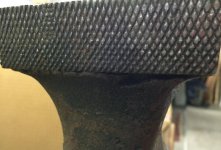
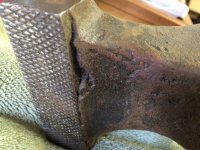
2) Potentially more significant, there's a "knock-down" look on the undersides of each of the jaws that I'm hoping isn't a repair. The tops of the jaws look great down through the necks, where I'd expect to see evidence of whatever damage would have required the repair. This is the first vintage vise I've purchased, so I'm hoping it's just the way they were cast in "those days," but I'm not able to make that assessment.

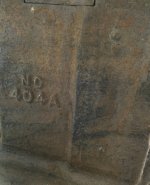
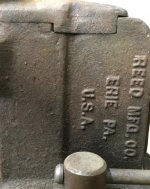
Finally, the vise doesn't have any dates on it whatsoever that I can see on the outside. Any idea how that ranks it in the age spectrum?

Thanks in advance, guys.

Max photos attached to this post. I'll upload the sides next to show how it was stamped to hopefully approximate a date of mfg.
 

Attachments

  • Dynamic Jaw 2.jpg
    Dynamic Jaw 2.jpg
    109.4 KB · Views: 148
  • Dynamic Jaw 3.jpg
    Dynamic Jaw 3.jpg
    79.9 KB · Views: 117
  • Dynamic Jaw 4.jpg
    Dynamic Jaw 4.jpg
    93 KB · Views: 143
  • Swivel Jaw Underside.jpg
    Swivel Jaw Underside.jpg
    138.8 KB · Views: 127
  • Side of Swivel Jaw.jpg
    Side of Swivel Jaw.jpg
    139.7 KB · Views: 423
  • Vise.jpg
    Vise.jpg
    113.1 KB · Views: 122
  • Dynamic Jaw Detail.jpg
    Dynamic Jaw Detail.jpg
    76.4 KB · Views: 94
To avoid these ads, REGISTER NOW!
OP
L

Lombie

Well-known member
Joined
Dec 30, 2013
Messages
80
Location
Arizona
Here are the sides.

Thanks!
 

Attachments

  • Underside.jpg
    Underside.jpg
    91.9 KB · Views: 49
  • Side 2.jpg
    Side 2.jpg
    112.8 KB · Views: 52
  • Side 1.jpg
    Side 1.jpg
    64.4 KB · Views: 57

bl00

Well-known member
Joined
Oct 6, 2006
Messages
1,014
Location
Chantilly, Virginia
Old Reeds had the jaws cast in place, so that's probably the way it came. If it bothers you then fill it with JB Weld, sand and paint. Somebody on her might already have the measurements for the pin and can make one for you. You could make your own if you have a grinder. Search out an old post from user Catalyze. He made a nice looking Prentiss pin with a grinder.
 

Fretters

Well-known member
Joined
Jan 25, 2014
Messages
4,217
Location
South Yorkshire, England
Like bl00 says, I think you're worrying over nowt there. :) I wouldn't give that rough edge casting a second thought. It all seems sound enough. With regards to the pin, you could even just put a length of rod in a drill and run it whilst you take a file to it, if you don't have a lathe. A bit of trial, error and patience will usually get you there.
 
OP
L

Lombie

Well-known member
Joined
Dec 30, 2013
Messages
80
Location
Arizona
As a not-so-proud owner of a $40 Athol paperweight that WAS welded, I have reason to be a tad gun shy... :thumb up:

Still curious if anyone can ballpark a date of manufacture?
 

Filson

Well-known member
Joined
Jun 14, 2013
Messages
1,218
Location
NE WA
My Reeds do not have the same issue as yours below the jaw faces. To me, that's a warranted concern of yours.

The pin will be replaceable and wouldn't be too big of a worry, though it ***** you lost the original.

As for the date - hard to pin it down exactly, but I would guess in the 20's-40's range.

Did the seller show the damage/deformity below the jaw faces? If you paid a premium for it - I would ask for a full refund and continue looking. If it's damaged, than it was not advertised appropriately. If it's a deformity issue from the making - I would worry about other structural issues throughout the part.

I hate to say it, but to be completely honest with you, I would seek to get my money back, unless it was bought cheap (say, under $100 including shipping). Best of luck
 

SweetD

Well-known member
Joined
Feb 8, 2010
Messages
3,265
Location
Rhode Island
I own, have owned, and have looked at a LOT of old vintage USA-Made vises, and I have never seen a casting deformity below the jaw set that looks like that. It almost looks like a really old weld repair...not sure what else to say...!

Dave
 
OP
L

Lombie

Well-known member
Joined
Dec 30, 2013
Messages
80
Location
Arizona
The seller specifically said there were no evidence of cracks or welds.

I was worried when I first saw the markings, but there's no evidence of damage or repairs to the top or sides of the jaws (if it didn't crack why weld it?) and it's on both jaws. So I was hoping that the casting process was the issue and that it was normal. Sounds like it could have been part of the casting process, but is far from normal.

That's my kind of luck.

Initial worrying...validated

Thanks guys.
 

Filson

Well-known member
Joined
Jun 14, 2013
Messages
1,218
Location
NE WA
The seller specifically said there were no evidence of cracks or welds.

I was worried when I first saw the markings, but there's no evidence of damage or repairs to the top or sides of the jaws (if it didn't crack why weld it?) and it's on both jaws. So I was hoping that the casting process was the issue and that it was normal. Sounds like it could have been part of the casting process, but is far from normal.

That's my kind of luck.

Initial worrying...validated

Thanks guys.

The spot where vise jaws "sit" on can quite frequently be chipped off in the area of concern that we're talking about (don't hammer on your vise). Anyway, very rarely will you see any issues on the side or top of the jaws, when the bottom area has been broken away in this fashion. So when looking at the sides or top, it may look fine (though you may see some hammer marks in the metal on top), it's the bottom that takes the brunt of the force.

I don't think that vise would of passed quality control back in the day. They would have just melted it down and made one again. My guess, is that someone long ago was beating on something and it chipped in a weird fashion, with some attempt to repair it.

I'm 95/5 leaning towards damage vs manufacturing issues. I would talk to the seller and work towards getting my money back.
 
OP
L

Lombie

Well-known member
Joined
Dec 30, 2013
Messages
80
Location
Arizona
Does anyone know if there's a certain year where Reed stopped printing dates on their vises?
 

Filson

Well-known member
Joined
Jun 14, 2013
Messages
1,218
Location
NE WA
Most do not. More I think about it - I can't recall ever seeing a Reed with a date printed on it, though I may very well have just not been paying attention.

Your vise looks very late 20's to early 40's to me, and there is no way to pin down the exact year it was made.
 
To avoid these ads, REGISTER NOW!

Outlawmws

Well-known member
Joined
Aug 9, 2011
Messages
39,274
Location
The Badlands
With the notable exception of Wilton, most vise companies did NOT put mfg dates on their vises. Patent dates, yes, but that will only tell you a vise is not older that that date.

The real question is if anyone knows the date range the 404A's were made.

And I don't think the "damage" below the jaw inserts is anything to worry about at all. That thin edge of casting is NOT structural at all. Did it come off in use? Probably. Was it abused to make it break? Probably not. Thin edgings of cast flash like that will always flake or chip.
 
OP
L

Lombie

Well-known member
Joined
Dec 30, 2013
Messages
80
Location
Arizona
The real question is if anyone knows the date range the 404A's were made.

Online, I can only find reference to 404's and 404 1/2's. I haven't found any others marked "404A". Wondering if that helps ID the age?

-Lombie
 
OP
L

Lombie

Well-known member
Joined
Dec 30, 2013
Messages
80
Location
Arizona
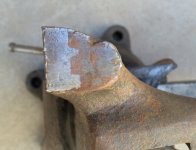
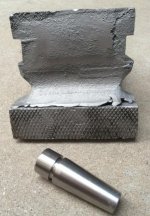
Wanted to post a couple of pics of the bead-blasted swivel jaw to see if naked pics add any clarity to the repair vs chipping issue.

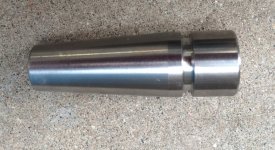
Couldn't resist posting few pics of the pin that I had fabricated for it, to replace the lost original... :thumbup:

-L
 

Attachments

  • Blasted 1.jpg
    Blasted 1.jpg
    84.4 KB · Views: 80
  • New pin.jpg
    New pin.jpg
    142.9 KB · Views: 57
  • Pin and jaw.jpg
    Pin and jaw.jpg
    60 KB · Views: 71
  • Pin and jaw 2.jpg
    Pin and jaw 2.jpg
    89.6 KB · Views: 66

Charles (in GA)

Well-known member
Joined
Jan 11, 2006
Messages
12,489
Location
50 mi south of Atlanta
I think it is apparent that the jaws are NOT part of the casting. They may be cast in place with the remainder of the vise, but they are clearly separate parts, possibly very good replacements. Not sure how they may be attached.

Charles

attachment.php
 

ganymede

Well-known member
Joined
Nov 29, 2012
Messages
2,332
Location
New England
Agree with outlaw.
I just looked under my 203 1/2a and it's got a couple of really tiny chips. There's probably lots out there that have them. No one one notices because it's a spot most people don't look .
 

454ragtop

Well-known member
Joined
Mar 24, 2008
Messages
5,011
Location
Carver, MA
Looks like steel jaws that were cast in place to me, don't see anything to worry about. If it really bothers you, you could clean up the rough castings carefully with a grinder, not sure it's worth the effort.
Jim
 

Carla

MEMBER EMERITUS
Joined
Nov 27, 2010
Messages
672
Here are the sides.Thanks!

Hello, Lombie,

I had to go take a close look at a couple of my Reed vises before answering you.

Firstly, the jaws. I've never seen any printed information or photos of the technique the Reed, Hollands,and Athol foundries used to cast the jaw steels 'in situ' when the jaws were cast.

It would appear that some technique might have been used in which the steels were brought to a red heat, fluxed, and placed into the mould immediately before pouring the iron (actually, allegedly, a so-called 'semi-steel', or cast iron with a significant scrap steel content in the melt) of the jaws.

One of the jaws of my 404 Reed shows a very slight bit of the 'failure to completely fill out the mould', of which yours is a rather graphic example.

From what little I have been able to read on the subject, the principle was to 'weld' or 'fuse' the jaw steels into the cast iron of the jaws, as the jaw castings were poured.

As we know, the technique, however they did it, worked well, as very few Reed vises are found in which the jaw steels have come loose from the jaw castings, even under the extensive abusive battering resulting in the deep scarring often seen on these old vises.

If, indeed, the jaw steels on your 404 are not loose, or appearing to be actually cracked away from the iron of the jaw castings, your vise is as strong and serviceable as any other Reed of its era.

That condition is a 'cosmetic' problem, and, yes, it can make one feel a bit insecure about the 'quality control' standards when it was made.

All I can say is 'probably, almost certainly', that the jaw steels were correctly welded to the jaw castings for their full width, and the pour just didn't quite fill out the mould, which was considered 'acceptable' by the QC workers at the Reed works, at the time.

You can deal with the 'appearance' issue by glass-blasting the jaws, and filling with a steel-powder epoxy, such as 'Devcon Plastic Steel', then shaping to suit and painting. You will need to glass or grit-blast to clean bright metal to get the epoxy to adhere adequately.

The real nuisance problem with your vise, as with many others, is the deep serrations in the jaw steels, which leave 'idiot marks' in finished work.

I've already noted, elsewhere in this thread, the technique for fixturing the jaws to bring them accurately flat, parallel, and to a high finish, in the surface grinder.

The missing taper pin for the swivel jaw can be readily re-made.

A simple way to do this is to get a basic 'Acraglas' kit from Brownells, which will include epoxy resin, herdener, and release agent. Clean the parts well, clamp the jaws together firmly, having previously plugged the bottom of the taper hole in the stationary jaw by any expedient method. Improvise a short 'collar' around the taper hole in the back jaw assembly, apply release agent to the full depth of the hole, then mix and pour the epoxy.

When the material has cured, remove it, and you will have a 'sample part' with which to set the compound or taper attachment of the lathe to the correct angle to make a replacement taper pin which will fit correctly.

Alternatively, measure the top and bottom of the tapered holes in the main stationary casting and the swivelling upper jaw component, not the difference, then look in the taper formulary in you 'American Machinists Handbook' or 'Machinery's Handbook' to determine the taper in degrees.

With this figure, set the compound or taper attachment, and make a trial part, apply a light coating of prussian blue to the taper bore, and try the part. Noting where the blue is transferred to the trial part, adjust the taper as necessary, until you have the taper correct, then turn the finished part.

Yet one more alternative would be to do as I did on my cute little 403-1/2 Reed, which was missing its taper pin. With the jaws clamped firmly, I put the vise in the Bridgeport, and indicated in the taper hole. Then, I used a #2 Morse taper reamer to re-ream the hole, until it cleaned up full depth.

Making the replacement pin was easy, as I could set the taper attachment by using a standard #2 Morse taper lathe centre as the 'sample part'.

I would suggest tapping the finished taper pin part 1/4-20, fitting a forged eye-bolt, and doing a clean, nice-looking weld around the shoulder of the eye-bolt.

In use, tap the taper pin gently with a copper hammer to firmly set it, to keep the jaws parallel, but the eye-bolt allows easy use of any suitable tool or scrap of round stock to free the jaw pin, and allows you to hang the jaw pin on any convenient hook to keep it from being mis-placed, when you need to use the swivelling jaw feature of your vise. This is not 'original restoration' of course, just another 'old toolmakers trick' I was shown, years ago.

As to the year of mfg. of your vise, I can only guess......if I remember correctly, a patent was good for 17 years, so, with the last patent date of 1914 on the earlier Reed vises, it would seem plausible that they removed the patent date from the patterns in 1931.........but thats only a guess, I don't have any actual info.

The patent for the later style nut retainer was secured in late 1938, after which that patent number was added to the stationary jaw patterns.

That........purely at a guess......would suggest a time-frame of 1931 to 1938 for production of the one you have.

In short, aside from the 'ick' factor of the ugly castings, you appear to have a high quality old vise, well worth a careful restoration, and careful use in service.

Enough for now?

(or should I say 'and so endeth the sermon for today???)

cheers

Carla
 
Last edited:

Fretters

Well-known member
Joined
Jan 25, 2014
Messages
4,217
Location
South Yorkshire, England
Another one here on the still not a problem viewpoint. There's a lost of cast gear out there which is not as well finished as you might think at first glance. Casting flaws were not uncommon, not by any means. I've worked on some stuff which almost seemed to have more filler than cast metal, (slight exaggeration, but you get the gist :D). If that was use related damage, it would likely be a lot worse than it is, and there's not enough empty space to be of any detriment to use.
 

rsanter

Well-known member
Joined
Dec 22, 2007
Messages
18,521
Location
visalia ca
i think it depends on what you paid for it.
if you got a good deal then dont worry too much but it you paid top dollar then talk to the seller.
the way I would fix it would be to silver solder the joind between the vise and the jaw then the rest is nothing but cosmetic if you want to epoxy it from there

bob
 
OP
L

Lombie

Well-known member
Joined
Dec 30, 2013
Messages
80
Location
Arizona
Thanks to all for your feedback. :beer:

I think I'm going to leave the jaws in their current condition. They've lasted many, many years in tougher service conditions than I ever intend to put them through. Also, I take some personal satisfaction in the reminder that, while vintage vises may not have been made to today's cosmetically-perfect standards, they can bear the scars of service and still perform as well as they did the day they were forged. In a functional tool, cosmetics should take a back seat.

Carla, I go back and forth between wanting to say, "THANKS!" and "Sorry for taking so much of your time." and "WOW." So I'll keep it simple: I appreciate your input and your expertise. :)

I have a message in to Reed Mfg to see if they can tell me anything about the "A" model, which is elusive to me online. I'll share what I learn, if anything.

I do have one more question for someone who's disassembled a 404. Does it have 1 locking pad (I think that's what it's called - the "toothy" piece that governs the swivel function) or 2? I've seen 2 on larger Reeds, but mine only had 1...
 

Carla

MEMBER EMERITUS
Joined
Nov 27, 2010
Messages
672
Thanks to all for your feedback. :beer:

I think I'm going to leave the jaws in their current condition. They've lasted many, many years in tougher service conditions than I ever intend to put them through. Also, I take some personal satisfaction in the reminder that, while vintage vises may not have been made to today's cosmetically-perfect standards, they can bear the scars of service and still perform as well as they did the day they were forged. In a functional tool, cosmetics should take a back seat.

Carla, I go back and forth between wanting to say, "THANKS!" and "Sorry for taking so much of your time." and "WOW." So I'll keep it simple: I appreciate your input and your expertise. :)

I have a message in to Reed Mfg to see if they can tell me anything about the "A" model, which is elusive to me online. I'll share what I learn, if anything.

I do have one more question for someone who's disassembled a 404. Does it have 1 locking pad (I think that's what it's called - the "toothy" piece that governs the swivel function) or 2? I've seen 2 on larger Reeds, but mine only had 1...

Hi, Lombie,

I have three of those Reed vises, 403-1/2, 404, and 404-1/2. ranging in vintage from the early '30's to the early '60's sometime, one of the last of the old Reed 4xx version production, and have inspected/refinished a few more, one time and another (actually I had my helper doing the cleanup/refinish work, I just inspected them carefully......this was back some years ago when my partner and I were dealing is surplus stuff.)

The 404 I have is approx 1938-40-ish production. with the patent number for the nut adjuster in the raised cast lettering of the back jaw........I think they discontinued the 404 sometime during the war, possibly from a War Production Board order to simplify their product line. All the war-time and post-war catalogue listings for the 400 pattern I've seen are for the 403-1/2, 404-1/2, and 406.

All of the 400 series Reed vises I've seen had only one toothed locking lug, on the right hand side as one faced the vise in normal use.

cheers

Carla
 
Last edited:
To avoid these ads, REGISTER NOW!
Top Bottom