To avoid these ads, REGISTER NOW!

Insulation between rafters? 12x18 roof keep the loft space

JonathanLaporte

Well-known member
Joined
Apr 16, 2014
Messages
172
Location
Montreal, Quebec, Canada
I want to insulate my garage.

I need some info as im a total noob in this.

I would like to insulate between the rafters to keep my little loft space accessible.

What do you guys think?

I might bloc the airflow to the roof that way?
 
To avoid these ads, REGISTER NOW!

sands35

Well-known member
Joined
May 29, 2012
Messages
936
Location
St. Joseph, MI
Ridge and soffit vents? If yes, you will want to put in foam baffle to provide ventilation between the roof deck and the insulation.

12x18 sounds more like a shed than a garage. If no vents then just put up insulation (or think about adding ventilation.

You could spray foam it, but then you introduce other problems with moisture management. Good luck replacing roof decking in 20 years as well.
 

sands35

Well-known member
Joined
May 29, 2012
Messages
936
Location
St. Joseph, MI
Ah - I missed that you only have soffit vents. You can install a ridge vent or you can install through roof vents.

Plenty of DIY vids on Youtube.

Literally an afternoon job assuming you have basic tools and can swing a hammer.
 
OP
J

JonathanLaporte

Well-known member
Joined
Apr 16, 2014
Messages
172
Location
Montreal, Quebec, Canada
Ah - I missed that you only have soffit vents. You can install a ridge vent or you can install through roof vents.

Plenty of DIY vids on Youtube.

Literally an afternoon job assuming you have basic tools and can swing a hammer.

I can swing a hammer.

What would you suggest as for the type? Ridge ou roof?
 

Steve in Mi

Well-known member
Joined
Mar 13, 2007
Messages
1,042
Location
Mid Michigan
I can swing a hammer.

What would you suggest as for the type? Ridge ou roof?

The ridge vent will be better for the whole area.

Some will use a 3/4" X 3/4" (or even 1" X 1") strip running along the sides of each rafter @ the roof sheeting interface and then apply rigid foam board to span between rafters. Depending on your construction and pocketbook this can give you an inch airspace, an inch of foam board and 3.5"of fiberglass in 2" X 6" rafters.
 

sands35

Well-known member
Joined
May 29, 2012
Messages
936
Location
St. Joseph, MI
Yes, but ideally you should have a small "attic" space to let air move around in the underside of the ridge area.

Post a pic of your roof joists? Do they have rafter ties or collar ties or ...?

How insulation is set depends on the type of joist you have.

http://www.bpa.gov/energy/n/energy_tips/weatherization/figures/figure3.19ad.gif

If you don't do ridge vents, then some way to move air between the joists is needed. A "collar tie" set with a ~4" gap to the bottom of the joist peak would work.

Having done both, the ridge vents are easier to do, even though they look more involved. There is a lot less messing around with shingles. It is easier to get it water tight.

Aside a hammer, the only other tool needed is some sort of a saw to cut a ~3" gap at the ridge. Circular saw set to the right depth is perfect for that.
 
Last edited:
OP
J

JonathanLaporte

Well-known member
Joined
Apr 16, 2014
Messages
172
Location
Montreal, Quebec, Canada
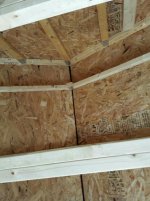
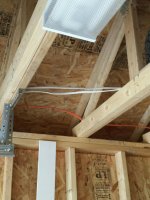
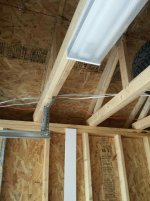
THose are the one. But they have a loft space built in now.

IMG_20140507_173814.jpg
 
OP
J

JonathanLaporte

Well-known member
Joined
Apr 16, 2014
Messages
172
Location
Montreal, Quebec, Canada
Yes, but ideally you should have a small "attic" space to let air move around in the underside of the ridge area.

Post a pic of your roof joists? Do they have rafter ties or collar ties or ...?

How insulation is set depends on the type of joist you have.

http://www.bpa.gov/energy/n/energy_tips/weatherization/figures/figure3.19ad.gif

If you don't do ridge vents, then some way to move air between the joists is needed. A "collar tie" set with a ~4" gap to the bottom of the joist peak would work.

Having done both, the ridge vents are easier to do, even though they look more involved. There is a lot less messing around with shingles. It is easier to get it water tight.

Aside a hammer, the only other tool needed is some sort of a saw to cut a ~3" gap at the ridge. Circular saw set to the right depth is perfect for that.

I would say more like the 3.19D
 
OP
J

JonathanLaporte

Well-known member
Joined
Apr 16, 2014
Messages
172
Location
Montreal, Quebec, Canada
Yes, but ideally you should have a small "attic" space to let air move around in the underside of the ridge area.

Post a pic of your roof joists? Do they have rafter ties or collar ties or ...?

How insulation is set depends on the type of joist you have.

http://www.bpa.gov/energy/n/energy_tips/weatherization/figures/figure3.19ad.gif

If you don't do ridge vents, then some way to move air between the joists is needed. A "collar tie" set with a ~4" gap to the bottom of the joist peak would work.

Having done both, the ridge vents are easier to do, even though they look more involved. There is a lot less messing around with shingles. It is easier to get it water tight.

Aside a hammer, the only other tool needed is some sort of a saw to cut a ~3" gap at the ridge. Circular saw set to the right depth is perfect for that.


So cut 3" at the top, between rafters right not trough them.
Them apply the ridge.
 

sands35

Well-known member
Joined
May 29, 2012
Messages
936
Location
St. Joseph, MI
Buy the ridge vent and read the supplied instructions. (Big box retailers sell them). It should give a specific dimension for the gap to cut at the ridge.

DO NOT CUT the rafters. Set a circular saw at the right depth to *just* cut through the roof deck. If you nick the rafter by a 1/16", that would be OK, just not a 1/2". Plan on destroying the blade cutting through the shingles ($8 or so).

Use roofing nails to fasten down any shingles that you have cut to ensure they are secure. The top end will be covered with the ridge vent anyway. Then cap with matching ridge shingles - either purpose bought or cut from 3-tab shingle.

The ~3" gap should be 6-10" inside the end rafters - the gap doesn't need to go to the end. It only needs to ventilate the attic space, not the gable soffit space. Ridge vents typically stop before the end of the roof.

======
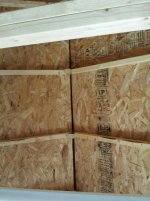
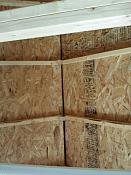
Are you using the open bays for storage? You say "loft space". That is the open spot to the left and right of the center post on the truss?

Before you posted the picture of your trusses, I assumed that they where simple rafters with a ceiling or collar tie. But you have Fan trusses. Why not hang insulation on the ceiling joist? Then you only need the foam trays at the soffit vent and not all the way up to the ridge.

Are you planning on dry walling the interior?
 
Last edited:

James-W

Well-known member
Joined
Feb 3, 2013
Messages
12,432
Location
Southeastern Wisconsin
What are you planning on storing up there? It doesn't appear that the trusses allow for much storage space. Are you planning on putting plywood on top of the trusses to set stuff on for storage? If you are, then wouldn't it be more practical to insulate at the ceiling level instead of at the roof? I guess I don't quite understand what you are trying to accomplish.
 
OP
J

JonathanLaporte

Well-known member
Joined
Apr 16, 2014
Messages
172
Location
Montreal, Quebec, Canada
Buy the ridge vent and read the supplied instructions. (Big box retailers sell them). It should give a specific dimension for the gap to cut at the ridge.

DO NOT CUT the rafters. Set a circular saw at the right depth to *just* cut through the roof deck. If you nick the rafter by a 1/16", that would be OK, just not a 1/2". Plan on destroying the blade cutting through the shingles ($8 or so).

Use roofing nails to fasten down any shingles that you have cut to ensure they are secure. The top end will be covered with the ridge vent anyway. Then cap with matching ridge shingles - either purpose bought or cut from 3-tab shingle.

The ~3" gap should be 6-10" inside the end rafters - the gap doesn't need to go to the end. It only needs to ventilate the attic space, not the gable soffit space. Ridge vents typically stop before the end of the roof.

======
Are you using the open bays for storage? You say "loft space". That is the open spot to the left and right of the center post on the truss?

Before you posted the picture of your trusses, I assumed that they where simple rafters with a ceiling or collar tie. But you have Fan trusses. Why not hang insulation on the ceiling joist? Then you only need the foam trays at the soffit vent and not all the way up to the ridge.

Are you planning on dry walling the interior?

Dry wall or pressed wood I don't know for now.
 
OP
J

JonathanLaporte

Well-known member
Joined
Apr 16, 2014
Messages
172
Location
Montreal, Quebec, Canada
What are you planning on storing up there? It doesn't appear that the trusses allow for much storage space. Are you planning on putting plywood on top of the trusses to set stuff on for storage? If you are, then wouldn't it be more practical to insulate at the ceiling level instead of at the roof? I guess I don't quite understand what you are trying to accomplish.

I know its not much, but enought to store a compressor up there,
Camping stuff and winter tires.
 

sands35

Well-known member
Joined
May 29, 2012
Messages
936
Location
St. Joseph, MI
Keep in mind that if you use kraft faced insulation you will need to put up some sort of firebreak (i.e., drywall, OSB or plywood) if you sell the house. If you use unfaced, then it will look like @ss in a few years.

I know storage space is premium in a small space, but the simplest solution is to simply hang insulation on the ceiling rafter and then drywall it (after electrical work - still need a ridge or gable vent). Doing it this way will allow using a gable vent rather than a ridge vent.
 
OP
J

JonathanLaporte

Well-known member
Joined
Apr 16, 2014
Messages
172
Location
Montreal, Quebec, Canada
Buy the ridge vent and read the supplied instructions. (Big box retailers sell them). It should give a specific dimension for the gap to cut at the ridge.

DO NOT CUT the rafters. Set a circular saw at the right depth to *just* cut through the roof deck. If you nick the rafter by a 1/16", that would be OK, just not a 1/2". Plan on destroying the blade cutting through the shingles ($8 or so).

Use roofing nails to fasten down any shingles that you have cut to ensure they are secure. The top end will be covered with the ridge vent anyway. Then cap with matching ridge shingles - either purpose bought or cut from 3-tab shingle.

The ~3" gap should be 6-10" inside the end rafters - the gap doesn't need to go to the end. It only needs to ventilate the attic space, not the gable soffit space. Ridge vents typically stop before the end of the roof.

======
Are you using the open bays for storage? You say "loft space". That is the open spot to the left and right of the center post on the truss?

Before you posted the picture of your trusses, I assumed that they where simple rafters with a ceiling or collar tie. But you have Fan trusses. Why not hang insulation on the ceiling joist? Then you only need the foam trays at the soffit vent and not all the way up to the ridge.

Are you planning on dry walling the interior?

Do you remove the asphalt shingles first before cutting?
 
To avoid these ads, REGISTER NOW!

LifeLongWNYer

Well-known member
Joined
Oct 23, 2013
Messages
1,231
Location
South of Rochester, NY
Ridge and soffit vents?
You could spray foam it, but then you introduce other problems with moisture management. Good luck replacing roof decking in 20 years as well.

Humm, what does this mean? Do you mean that spray foam is more likely to require the replacement of the deck in a few years, OR that it simply makes the replacement of the deck more difficult WHEN it needs replacement?


.
 

sands35

Well-known member
Joined
May 29, 2012
Messages
936
Location
St. Joseph, MI
No, if done properly, spray foam doesn't cause roof sheets to rot. It needs to be thick enough so you don't get condensation.

Every roof I've done required several roof sheets to be replaced. After 20-30 years, you are going to get water on the wood and it's going to rot, spray foam or not.

Spray foam is a fantastic adhesive. Taking up roof deck is going to be major PITA if not nearly impossible without doing other damage. At a minimum, the foam will likely need to be re-sprayed.
 
Last edited:

sands35

Well-known member
Joined
May 29, 2012
Messages
936
Location
St. Joseph, MI
Do you remove the asphalt shingles first before cutting?
I don't think it matters. You will need to do some shingle repair anyway. Probably simpler to remove the top course of shingles. They should be able to be pulled up by hand and the nails removed with a demo bar pretty easily. I'd plan on replacing the top 1-2 shingle courses (i.e., have shingle packages ready to go so you don't have to run to the store in the middle of the job). You can return the unused packs later.

Removing the shingles will make a more accurate cut depth through the roof sheet and you can see any nails in the deck that way too.
 

sands35

Well-known member
Joined
May 29, 2012
Messages
936
Location
St. Joseph, MI
That is typical for a roof build. You need a ~1.5" gap for it to vent. Read the instructions on Big Box ridge vent. Open up the slot with a jig / reciprocating / circular saw. Just don't cut the rafters. The slot doesn't have to go to the end truss. Stop ~6 inches short and run the ridge vent to the end truss.
 

Steve in Mi

Well-known member
Joined
Mar 13, 2007
Messages
1,042
Location
Mid Michigan
Other pic uploadfromtaptalk1403636630394.jpg

Where oh where are the BUILDING POLICE?

Someone doesn't understand the concept of ENGINEERED TRUSS!

By removing the main vertical support brace any snow load rating the trusses had is out the window and now you want to go up on that roof to work on the peak. NOT A GOOD IDEA IMHO!!!!!!!!!!!!!!!!!!!!!!!!!!
 

Attachments

  • JL Rafter .jpg
    JL Rafter .jpg
    6.5 KB · Views: 113
Last edited:
OP
J

JonathanLaporte

Well-known member
Joined
Apr 16, 2014
Messages
172
Location
Montreal, Quebec, Canada
Where oh where are the BUILDING POLICE?

Someone doesn't understand the concept of ENGINEERED TRUSS!

By removing the main vertical support brace any snow load rating the trusses had is out the window and now you want to go up on that roof to work on the peak. NOT A GOOD IDEA IMHO!!!!!!!!!!!!!!!!!!!!!!!!!!

Well its a shed and not a garage... Any one think that it's a bad idea?
 
OP
J

JonathanLaporte

Well-known member
Joined
Apr 16, 2014
Messages
172
Location
Montreal, Quebec, Canada
That is typical for a roof build. You need a ~1.5" gap for it to vent. Read the instructions on Big Box ridge vent. Open up the slot with a jig / reciprocating / circular saw. Just don't cut the rafters. The slot doesn't have to go to the end truss. Stop ~6 inches short and run the ridge vent to the end truss.

Hi.

I have a problem now.

I've started to insulate the walls. Almost done with it. Now if I want to insulate the ceiling, I have to install a a spacer to let the air go around right?

I found out that my truss are made of 2x3 and if I want to insulate I have no place to install a plywood the close the insulation...

Do you understand what I mean?
 

sands35

Well-known member
Joined
May 29, 2012
Messages
936
Location
St. Joseph, MI
You will need to install 2x4 doublers on the bottom of the shed rafters. I'd use the cheapest nailing plates, 2 per doubler, one near each end to hold the 2x4s up. If the rafters are longer than a third in the middle.

R13 will leave ~2 inches of air gap between the top of the insulation and the roof deck. R30 is probably the minimum garage insulation, but that is ~6" thick and you have a shed, not a garage. R13 will be fine.

You will also need to have some sort of soffit vent.
 
OP
J

JonathanLaporte

Well-known member
Joined
Apr 16, 2014
Messages
172
Location
Montreal, Quebec, Canada
I
You will need to install 2x4 doublers on the bottom of the shed rafters. I'd use the cheapest nailing plates, 2 per doubler, one near each end to hold the 2x4s up. If the rafters are longer than a third in the middle.

R13 will leave ~2 inches of air gap between the top of the insulation and the roof deck. R30 is probably the minimum garage insulation, but that is ~6" thick and you have a shed, not a garage. R13 will be fine.

You will also need to have some sort of soffit vent.

OK can you sent me a pic of this or a draw... I cant really figure it out...
 
Last edited:
OP
J

JonathanLaporte

Well-known member
Joined
Apr 16, 2014
Messages
172
Location
Montreal, Quebec, Canada
You will need to install 2x4 doublers on the bottom of the shed rafters. I'd use the cheapest nailing plates, 2 per doubler, one near each end to hold the 2x4s up. If the rafters are longer than a third in the middle.

R13 will leave ~2 inches of air gap between the top of the insulation and the roof deck. R30 is probably the minimum garage insulation, but that is ~6" thick and you have a shed, not a garage. R13 will be fine.

You will also need to have some sort of soffit vent.

I did the ridge vent today.

Went well. Roof felt solid event with the modification of the truss.

I reinstalled the cap shingle the I've removed and I hope they gonna stick well...

As for the other question... Can you elaborate on the insulation with 2x3?
 

sands35

Well-known member
Joined
May 29, 2012
Messages
936
Location
St. Joseph, MI
Good the ridge went ok.

Though a wider angle photo would make it simpler to describe. I may have missed your shed construction on your 1st photo. (Didn't see the ceiling joist)

The simple answer is you can insulate on the ceiling joist or the roof rafter. Ceiling joist if you want to finish it with osb or drywall. Roof rafter if you want storage space, but finishing it will be difficult. Your call.

If you do roof rafter, the you need to install vent trays to allow air movement between the insulation and roof deck. Putting in extra wood on the bottom of the rafter to allow a place to staple up insulation would help.

It is a shed, so i'd do rafters and have more storage.
 
Last edited:
OP
J

JonathanLaporte

Well-known member
Joined
Apr 16, 2014
Messages
172
Location
Montreal, Quebec, Canada
Good the ridge went ok.

Though a wider angle photo would make it simpler to describe. I may have missed your shed construction on your 1st photo. (Didn't see the ceiling joist)

The simple answer is you can insulate on the ceiling joist or the roof rafter. Ceiling joist if you want to finish it with osb or drywall. Roof rafter if you want storage space, but finishing it will be difficult. Your call.

If you do roof rafter, the you need to install vent trays to allow air movement between the insulation and roof deck. Putting in extra wood on the bottom of the rafter to allow a place to staple up insulation would help.

It is a shed, so i'd do rafters and have more storage.
That's what I tought!

I might just put insulation at the rafter and call it done since it's not a garage as the city call it so I don't think it's mandatory to install something over the insulation.

What do you think now as for the insulation?

Styrofoam?

Thanks for your help!
 

sands35

Well-known member
Joined
May 29, 2012
Messages
936
Location
St. Joseph, MI
I'd do rolls or batts of fiberglass if only so it's simpler to squeeze between the trusses. Krafted faced will stay cleaner longer and provides a way to staple it up.

Put in these:

http://www.lowes.com/pd_135598-7522...L=?Ns=p_product_qty_sales_dollar|1&facetInfo=

Then I'd run furring strips under the insulation and perpendicular to the rafters to hold it all up. 1x2s are cheep and effective for this.

OR

Foam would work and you can avoid using the vent trays if you are good with ensuring about 1" of space between the top of the foam and the roof deck. Use spray foam to seal and glue them up. I'd use EPS as it's ~1/2 the price of XPS for the same insulation R value. You can even paint it with a water based paint if you want to clean up the appearance.
 
Last edited:

pattenp

Well-known member
Joined
Jun 4, 2008
Messages
10,175
Location
Virginia - USA
Since you asked... yes, it was not the smartest thing to do. With a 12 foot span and now you plan to store stuff up there, the roof could start to sag over time. Under a heavy snow load the roof deck where you removed the cross bracing could fail. You said the roof felt solid when you were walking on it, but a good load of snow is a lot heaver than you are.

Well its a shed and not a garage... Any one think that it's a bad idea?
 
OP
J

JonathanLaporte

Well-known member
Joined
Apr 16, 2014
Messages
172
Location
Montreal, Quebec, Canada
Since you asked... yes, it was not the smartest thing to do. With a 12 foot span and now you plan to store stuff up there, the roof could start to sag over time. Under a heavy snow load the roof deck where you removed the cross bracing could fail. You said the roof felt solid when you were walking on it, but a good load of snow is a lot heaver than you are.


Ok I've asked for other advice and none where that bad. I'll install a king post to a few truss.
 
OP
J

JonathanLaporte

Well-known member
Joined
Apr 16, 2014
Messages
172
Location
Montreal, Quebec, Canada
Since you asked... yes, it was not the smartest thing to do. With a 12 foot span and now you plan to store stuff up there, the roof could start to sag over time. Under a heavy snow load the roof deck where you removed the cross bracing could fail. You said the roof felt solid when you were walking on it, but a good load of snow is a lot heaver than you are.

I was thinking of doing something like this which is a comon type of truss no?

truss-room.gif
 
To avoid these ads, REGISTER NOW!
Top Bottom