To avoid these ads, REGISTER NOW!

mounting subpanel to allow future expansion

stevepsd

Well-known member
Joined
Feb 17, 2010
Messages
47
Location
Idaho!
I have a weird question......

I am having a shop built that will be drywalled & spray foam insulated (2x6 exterior walls) and the basic wiring will be romex run thru the walls as normal. However I will be adding additional circuits as I build out the shop (mill, lathe, lighting, etc) over time.

I do not know where I will need additional circuits located as it will depend on the equipment (size, placement, etc), same for lighting & switches. I anticipate that the additional circuits will be added using surface mounted electrical conduit & boxes

I have not talked to the electrician yet (mainly because am building this & the house from 800 miles away - and will be making monthly trips to check on things and we just broke ground - waiting on the builder to talk to the electrician )but I am thinking that the panel can just be surface mounted (not flush) and use knockouts on the back for the romex wiring or maybe a built-out box on the bottom of the panel to protect the romex then use the normal bottom knockouts?

Has anyone done this or have other ideas? I might be over-thinking this well.....

Thanks.
 
To avoid these ads, REGISTER NOW!

rockwithjason

Well-known member
Joined
Jan 8, 2006
Messages
2,633
Location
Las Vegas
I usually mount a jbox half in and half out of the wall above the panel and run a few conduits to the panel. That way i can go where ever i want with what ever i want
 

BillK

Well-known member
Joined
Aug 24, 2006
Messages
9,348
Location
Beautiful Southern Maryland
Steve,
When I finished the walls of my attached garage on the house, instead of sheetrocking the section directly above and below my electric panel, I just found some regular wall paneling and ripped it to fit across the two studs. I used screws in each corner to hold it in place so it can be removed easily to run more circuits up to the garage attic and into the house if needed. I did not insulate that section but I really don't think it affects it much.

I have had to use it twice now and it really makes it easy :)
 

Attachments

  • garage panel.jpg
    garage panel.jpg
    147.6 KB · Views: 98

Mustang51js

Well-known member
Joined
Jan 24, 2014
Messages
1,734
Location
Haskell nj
Depending on where you put the panel you may have to surface mount it anyway,some inspectors won't let you recess the panel if there's a room above the room it's going in. You could just surface mount it and build a box around the panel for future access.
 
To avoid these ads, REGISTER NOW!

MTW

Well-known member
Joined
Aug 6, 2013
Messages
294
Location
SE Michigan
Option 1. Have the whole job surface mounted, for complete accessibility.

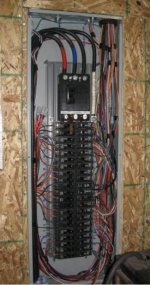
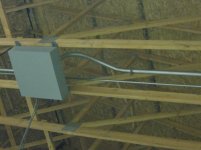
Option 2. Flush Mount panel as standard. Run large conduit (concealed) to attic space. Poke out conduit to large ceiling surface mounted box. Surface branch from there to any location you need.

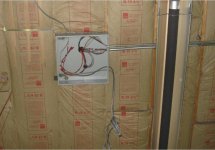
Option 3. Flush Mount panel as standard. Run several conduits underground to the remote walls. Install deep (6 or 8") sheet metal pull boxes in the walls, extending past the drywall finish for surface mounted conduit extensions. If you use PVC for the underground be sure to bond the metal boxes at the outer ends of the runs.

Flush Panel With Ceiling Conduits.jpg
Attic Fed Ceiling Box.jpg
Attic Fed Ceiling2 Box.jpg
Attic Fed Ceiling3 Box.jpg
Attic Fed Ceiling4 Box.jpg
Flush Panel With Ceiling Conduits2.jpg

MTW Ω
 
Last edited:

Charles (in GA)

Well-known member
Joined
Jan 11, 2006
Messages
12,489
Location
50 mi south of Atlanta
If you use PVC for the underground be sure to bond the metal boxes at the outer ends of the runs.

MTW Ω

And to add to this, you cannot run Romex in conduit when it is in a slab. It is considered a wet location and Romex is not allowed. In conduit in walls, Romex would be OK (but not worth the trouble).

Charles
 

72Anthony

Well-known member
Joined
May 22, 2010
Messages
296
Location
Houston, TX
I would also consider installing the "insides" up side down so that the terminals for the supply cables are at the bottom of the panel. Many panels allow you to do this. This allows more space at the top of the panel for routing wires up into the attic or conduit on the wall.
 

Eriehunter

Well-known member
Joined
Mar 14, 2014
Messages
189
I would run a few spare conduits out of the panel to the attic space or stub them somewhere convenient to get on to them later. I'm not a big fan of running 1 oversize conduit and then pulling a bunch of wires through it, you will most likely have to derate the conductors depending on how many conductors you have in it.
 
To avoid these ads, REGISTER NOW!
Top Bottom