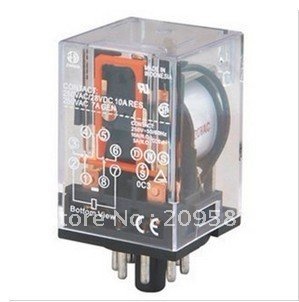
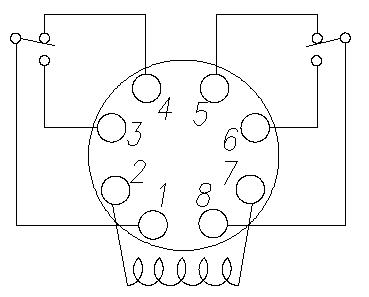
To understand how a relay works, you must understand how a switch works since a relay is just a switch that is operated by electricity rather than moving a lever, pressing a button, etc. I'll try to make this as simple and direct as possible with some Google images.
Here's a simple switch diagram:
Just think of it this way- you have two wires leaving your breaker panel and they're heading towards the light bulb. One is called the "neutral" and the other is the "hot" coming off of the breaker. The neutral goes to one terminal on the bulb completely uninterrupted. The hot wire goes to one terminal on the switch, then leaves the other terminal to continue on to the light bulb. Electricity must have a continuous and complete circuit for it to flow. If the wire is cut, the electricity can't flow through it. It doesn't shoot out the end of the cut wire like water does from an open hose. The switch is what "cuts" the circuit open to stop the flow of electricity. You move the lever up, and the metal contacts inside the switch connect one terminal on the switch to the other, completing the circuit so the electricity can flow to the light bulb and illuminate it. Simple, right?
Now, a relay does the same thing as far as the switching portion. But, instead of a mechanical lever, it has a solenoid that is energized by a different source of power. The purpose of a relay is to place the load onto a circuit that is designed to support it. By "load", I mean amperage. All electrical devices require a certain amount of amperage to operate. If the total number of amps on one circuit, whether it be from one device or many, exceeds the number of amps that the breaker will allow, then that circuit is what is called "over loaded" and the breaker will trip to prevent a hazard. Look at voltage and amperage as voltage being horsepower and the amperage being the torque. The horsepower is basically an operating number. What actually gets the job done is the torque. The torque is what pushes the power through the drivetrain and out to the wheels to propel the car. Or, in this case, the amperage is what pushes through the wires to illuminate that bulb or spin that motor. The problem is that the conductors (the wires) must be large enough to let the amount of amps push through. The wires coming off of the Logic Board send 120 volts to the bulb, but they are only big enough to support the amount of amperage that bulb places on the circuit. Of course, there is a certain amount of headroom as a safety factor. Due to this safety factor, it may be robust enough to power one or two more similarly-sized lights, but it is still essentially "over loaded". It's just not over loaded enough to heat up the wiring enough to start a fire or burn that portion of the Logic Board. At least not in the short time periods that it's actually turned on.
With a relay, the hot wire feeding the bulb(s) is cut by the contacts in the relay (the switching portion of it). The coil in the relay is what moves the contact to cut ("open") or complete ("close") the circuit. The power that went to the bulb on the operator is now just powering this small col in the relay. Instead of the electricity going through a filament in the bulb to heat up and create light, it's merely going through a coil to create a magnetic field that moves the contactor inside the relay. This is an even smaller load for the operator than what the bulb was.
This is about the simplest pic I could find:
Referring to how this diagram is drawn and labeled, the operator's light circuit sends power to the coil inside the relay. This is the "Command" and "Ground or Hot" labels. The two wires that went to the bulb on the operator would go to these two. The energized coil moves a contactor, labeled as "pivot", to connect the two contacts (the red ovals). This completes the circuit, letting the electricity that's coming into the relay on the "Hot" terminal, pass on to the extra lights connected to the "Load" terminal.
BTW, for you engineers and smarter people, I realize the horsepower/torque relation isn't exactly the most accurate. But, coming from a car guy, that's the best way I could explain it in a simple form.