To avoid these ads, REGISTER NOW!

Stranded Wire vs Solid Wire

600SL

Well-known member
Joined
Apr 26, 2012
Messages
1,801
Location
Connecticut
Anything wrong with using stranded wire instead of solid wire. I can by stranded in 200' rolls but I have to buy solid in 500' rolls. I want to run #10 in my garage for 230V and 115V receptacles.

Pros, Cons, is it even legal, I have never seen stranded wire > #8 used in a building.
 
To avoid these ads, REGISTER NOW!

frankush

Well-known member
Joined
Oct 23, 2011
Messages
1,156
Location
IL
Nothing wrong with it. It's very uncommon to see 10 solid around here.
 

SALIV8

Well-known member
Joined
Dec 11, 2008
Messages
2,114
Location
chicago and s/w michigan
Stranded wire is my preferred choice. Solid at larger sizes can be a ***** to pull with long runs, lots of bends, etc.

Stranded is rated for better conductance also.

Win win
 

ddawg16

Well-known member
Joined
Jul 11, 2008
Messages
21,005
Location
S. California
Yes, you can use it....but it's usually ran in conduit since you don't have a protective sheath. If the wire is behind drywall....should be fine as long as it's protected.
 
OP
6

600SL

Well-known member
Joined
Apr 26, 2012
Messages
1,801
Location
Connecticut
Why do you want to use #10 for 115V circuit?

I will probably go #12 solid on the 115s. But on the 240's I have 4 powered conductors going through EMT and will be taking a derating. Since I never know what I might plug in better to go 10 on these.
 

Norcal

Well-known member
Joined
Mar 16, 2008
Messages
13,796
Why use 10 AWG, there is more disadvantages then there are advantages, harder to work with, 15 & 20A devices are not really designed for 10 AWG, need larger boxes, a 10 AWG grounding conductor HAS to be used w/ 10 AWG ungrounded (hot) conductors, see 250.122(B).


BTW, 115 & 230V are rated voltages for motors & welding equipment, 120 & 240V are the normal supply voltages.
 

Syberia

Well-known member
Joined
Jan 13, 2014
Messages
1,451
Location
Perris, CA
Nothing wrong with using stranded. It's easier to work with and pull through conduit than solid. Just please use spade connectors on the ends and don't attempt to just tighten the strands under the screws on your outlets.
 

alfredeneuman

Well-known member
Joined
Mar 3, 2011
Messages
4,596
Location
Fullerton, CA
Just please use spade connectors on the ends and don't attempt to just tighten the strands under the screws on your outlets.

Devices such as switches or receptacles are not tested or UL listed with spade terminals.

A better plan would be to use pigtails of the proper size wire for the device.
 

Charles (in GA)

Well-known member
Joined
Jan 11, 2006
Messages
12,489
Location
50 mi south of Atlanta
I will probably go #12 solid on the 115s. But on the 240's I have 4 powered conductors going through EMT and will be taking a derating. Since I never know what I might plug in better to go 10 on these.

EDIT: by "But on the 240's I have 4 powered conductors" do you mean four individual wires? or four circuits of three wires hot-neutral-hot each, meaning 12 individual wires??? Indeed, with wires, you would need #10 to maintain the 20 amp rating of the circuit.

****

De-rating means nothing with four current carrying conductors. For derating you use the 90°C column of the tables (assuming the wire itself is 90°C rated and if its new THHN, it is), and #12 THHN wire for pulling in conduits is rated at 30 amps at 90°C. The derating for 4 to 6 current carrying conductors is 80% of capacity, thus 30 amps x .8 = 24 amps, so you are still golden. Even with 7 to 9 current carrying conductors, the derating is 70% of capacity, thus 30 x .7 = 21 amps, so you are still OK. Generally, you need to get above 9 current carrying conductors in a conduit for derating to become a problem. (which is 50% of capacity or 15 amps for the 12 gauge THHN)

Charles
 
Last edited:
OP
6

600SL

Well-known member
Joined
Apr 26, 2012
Messages
1,801
Location
Connecticut
Don't know what I was drinking when I posted.

The 240 circuits will be two 3 wire circuits total of 6 current carrying conductors. Load on the neutral will essentially be unknown so down sizing the neutral is not an option.

The 120 circuits will be two (possibly 3) 2 wire circuits.

From what I have read and according to some recent discussion on this sight I cannot use the 90°C column unless the terminations CB's or receptacles are rated for 90°C. According to the NEC if they are not marked I should assume 60°C

Therefore 10ga is only good 30 amps derated in this case to 24 amp and 12ga is only good for 20 amps derated in this case to 16 amps. As it stands now this is a 10ga solution using 60 cu-in 3 gang junction boxes.
 
OP
6

600SL

Well-known member
Joined
Apr 26, 2012
Messages
1,801
Location
Connecticut
Nothing wrong with using stranded. It's easier to work with and pull through conduit than solid. Just please use spade connectors on the ends and don't attempt to just tighten the strands under the screws on your outlets.

Can you recommend a good spade connector and source. The ones I use from the auto parts store with the red, blue and yellow insulation just don't seem appropriate for building wire.

Also are there different spades for stranded vs solid wire.
 
To avoid these ads, REGISTER NOW!
OP
6

600SL

Well-known member
Joined
Apr 26, 2012
Messages
1,801
Location
Connecticut
Devices such as switches or receptacles are not tested or UL listed with spade terminals.

A better plan would be to use pigtails of the proper size wire for the device.

In this case each receptacle will be about 5 ft below a j-box. Essentially there will be a 5 ft pig tail going up the conduit to the j box. Depending if I bring 2 or 5 wires down, I may just use the 12 ga wire I currently have left over.
 

exmaxima1

Well-known member
Joined
Jun 25, 2011
Messages
6,353
Location
Midwest
Stranded wire is my preferred choice. Solid at larger sizes can be a ***** to pull with long runs, lots of bends, etc.

Stranded is rated for better conductance also.

Win win

Yes, stranded is more flexible and easier to pull. And it is less likely to crack if used in an application that has vibration, such as wiring up machines (or an air compressor).

The issue of "better conductance" is not really applicable at 60 hz line frequency. NEC says both solid and stranded are the same, and any measurable differences don't occur until approaching a Mhz. You use stranded for its mechanical advantages.
 

Syberia

Well-known member
Joined
Jan 13, 2014
Messages
1,451
Location
Perris, CA
Can you recommend a good spade connector and source. The ones I use from the auto parts store with the red, blue and yellow insulation just don't seem appropriate for building wire.

Also are there different spades for stranded vs solid wire.
I use the yellow ones from Home Depot; they fit right under the screw. Rated for 600 volts.

I'm pretty sure they're meant for stranded wire only; there's no real reason to use one for solid though since it fits under the screw.
 
Last edited:

Labradorian

Well-known member
Joined
Nov 5, 2013
Messages
315
Location
Pembroke, ON
Can you recommend a good spade connector and source. The ones I use from the auto parts store with the red, blue and yellow insulation just don't seem appropriate for building wire.

Also are there different spades for stranded vs solid wire.

May I ask where you are using these spade connectors exactly?, there is a reason that you can buy these things in the automotive store.

You don't normally use these in typical house/building 120V+ wiring. Maybe for a doorbell maybe.

But not with receptacles and panels and light switches, etc. not a code violation but not industry practice.

Spade connectors with the crimping end are designed for stranded wire, I'm not sure what you would put on a solid wire, as the crimping style won't stay on a solid wire very well.
 
Last edited:

Stuart in MN

Well-known member
Joined
Sep 8, 2005
Messages
23,519
Location
Minneapolis
That's not what I was asking. I've run solid in conduit.
In the other post ddawg16 said, stranded is usually ran in conduit.
Wanted to know if he was saying it's ok to run stranded like romex
inside a wall.

OK, I understand...no, you never run individual conductors (like THHN/THWN) in a wall without a conduit or some type of raceway.
 
OP
6

600SL

Well-known member
Joined
Apr 26, 2012
Messages
1,801
Location
Connecticut
May I ask where you are using these spade connectors exactly?, there is a reason that you can buy these things in the automotive store.

You don't normally use these in typical house/building 120V+ wiring. Maybe for a doorbell maybe.

But not with receptacles and panels and light switches, etc. not a code violation but not industry practice.

Spade connectors with the crimping end are designed for stranded wire, I'm not sure what you would put on a solid wire, as the crimping style won't stay on a solid wire very well.

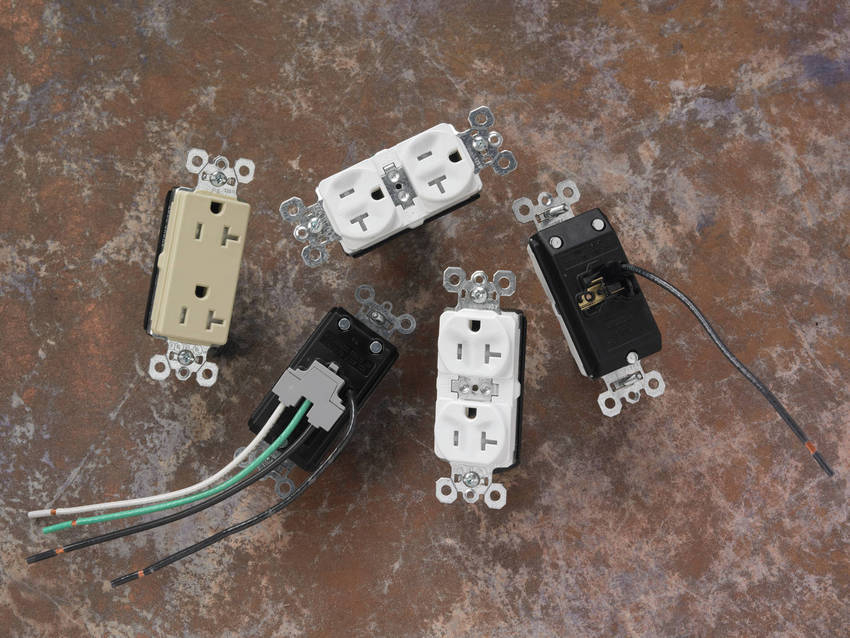
For me its because I'm a ground user. Not that its required in EMT but I do prefer to use a ground. Therefore in any one J box there may be up to 5 grounds that I would like to put on a loop terminal and just screw down with the bonding screw. As far as the duplex receptacles go, the new ones I have been getting have a sort of folded square washer edge under the screw that holds a wire nicely even if its stranded. Some of the ground posts on the receptacles still have just a screw which really needs a spade or loop.
 

TheEquineFencer

Well-known member
Joined
Jan 15, 2009
Messages
9,278
Location
Farmville, NC 27828
For me its because I'm a ground user. Not that its required in EMT but I do prefer to use a ground. Therefore in any one J box there may be up to 5 grounds that I would like to put on a loop terminal and just screw down with the bonding screw. As far as the duplex receptacles go, the new ones I have been getting have a sort of folded square washer edge under the screw that holds a wire nicely even if its stranded. Some of the ground posts on the receptacles still have just a screw which really needs a spade or loop.

:thumbup::thumbup::thumbup:
I second running another ground and not using the EMT as the ground. If you happen to hit the EMT or it comes loose inside a wall and you don't know it, you've lost your ground and might get the shock of your life from it. If you're lucky, you'll live to tell about it.
 

Charles (in GA)

Well-known member
Joined
Jan 11, 2006
Messages
12,489
Location
50 mi south of Atlanta
Devices such as switches or receptacles are not tested or UL listed with spade terminals.

A better plan would be to use pigtails of the proper size wire for the device.

Best plan is to use switches and receptacles with backwiring that clamps the wire under a serrated pinch plate when you tighten the screw. Works well with solid or stranded, won't come loose.


The issue of "better conductance" is not really applicable at 60 hz line frequency. NEC says both solid and stranded are the same, and any measurable differences don't occur until approaching a Mhz. You use stranded for its mechanical advantages.

I started to mention this, but decided not to start an argument. Indeed, the AC cycles has to be way on up there, far beyond any normal electrical circuit we deal with, before the stranded wire has any better conducting capabilities than solid.

Charles

attachment.php


attachment.php
 
Last edited:
OP
6

600SL

Well-known member
Joined
Apr 26, 2012
Messages
1,801
Location
Connecticut
Best plan is to use switches and receptacles with backwiring that clamps the wire under a serrated pinch plate when you tighten the screw. Works well with solid or stranded, won't come loose.
Charles

Those are the washers I was talking about. I like them.:thumbup:
 
To avoid these ads, REGISTER NOW!
Top Bottom