
You are using an out of date browser. It may not display this or other websites correctly.
You should upgrade or use an alternative browser.
You should upgrade or use an alternative browser.
romex in conduit or not?
- Thread starter BFalfa
- Start date
Charles (in GA)
Well-known member
The best would of course to run the wiring and install boxes and then install the wall panels. Install lots of receptacles on lots of circuits to allow for any circumstance and any possibly layout of "stuff" in the building. If you think you may have a mice or vermin problem you would be best to learn how to bend conduit and install a complete conduit system. You will never have wiring issues if done correctly.
Charles
Charles
looking to run electric in my new pole building. I plan to put white tin on the interior of the building and would it be best to run the wiring on the inside of the walls or to run it in conduit on the outside? pros/cons?
The short answer is no. It is not allowed by code to run romex in conduit in most states. You should run stranded wire from a spool of the appropriate grade
15a 14g
20a 12g
30a 10g
40a 8g
guess what gauge you need for 50 amp lol.
Stuart in MN
Well-known member
Contrary to popular belief, you can run Romex in conduit as long as the conduit is sized properly. However, there's usually no good reason to do so - if you're going to use conduit, use individual THHN/THWN wire.
P.S. Underground you can run direct bury romex but it has to be insulated against damage where it comes up through the concrete or in conduit if it comes up outside of the building. I usually find it easier to bury conduit using sweeps be cause it give me the ability to add circuits if needed later if you oversize the conduit. IE what happens 6m down the road when you cant power the new piece of machinery you bought. No problem if you ran over-sized conduit, If you didn't...... Dig another trench.
Contrary to popular belief, you can run Romex in conduit as long as the conduit is sized properly. However, there's usually no good reason to do so - if you're going to use conduit, use individual THHN/THWN wire.
I wish you would tell my inspectors that lol
6AWG
And you wind the prize....... ERRRRR, UHHHHM, What was the prize again??? lol
On the serious side I've always had my customers jobs inspected. It reduces my liability if anything ever goes wrong. I have tried installing romex in conduit(I didn't have any singles) and it got rejected by the inspector, I had to remove all of the romex and remove all of the sheathing before he would pass it. So going by the code for the 3 different states I've done electrical contracting in I feel fairly safe saying it is a no no. The reason is in romex there is no room for the wire to expand and contract as it heats and cools, whereas single wires in conduit are allowed extra space and more airspace to cool the wires.
Rock knocker
Well-known member
- Joined
- Aug 14, 2014
- Messages
- 704
I wish you would tell my inspectors that lol
Ask for a code reference.
Charles (in GA)
Well-known member
Article 334 of the NEC does not make any mention of prohibitions on the use of NM cable in conduit, and even mentions the use of conduit sections in unfinished basements to protect NM where exposed below floor joists of the floor above.
In Chapter 9 -- Tables, in the back of the NEC it gives information on calculating the area of cables and cords that are to be installed in conduits. The installation of cables and cords in conduit systems is mentioned in several places in the notes to the tables on the first page of Chapter 9.
The stripping of the jacket off of NM and the use of the wire derived from this is questionable at best, as the wire inside NM does not have any markings to identify it, as required by the code. It might even be possible to make a case for the use of marked THHN in boxes as jumpers and such instead of scrap pieces cut from NM as the NM wire has no markings.
Of course, NM cannot be put in a conduit that is outside or placed in a slab, as these are clearly defined in the code as wet locations, that NM is not approved for.
While I don't participate in the Mike Holt forums, I do know that this subject has been beat to death on there, and I don't think they will even allow discussion about it any more. There is simply no code references that can be given that are a blanket prohibition on the use of NM in conduit.
Charles
In Chapter 9 -- Tables, in the back of the NEC it gives information on calculating the area of cables and cords that are to be installed in conduits. The installation of cables and cords in conduit systems is mentioned in several places in the notes to the tables on the first page of Chapter 9.
The stripping of the jacket off of NM and the use of the wire derived from this is questionable at best, as the wire inside NM does not have any markings to identify it, as required by the code. It might even be possible to make a case for the use of marked THHN in boxes as jumpers and such instead of scrap pieces cut from NM as the NM wire has no markings.
Of course, NM cannot be put in a conduit that is outside or placed in a slab, as these are clearly defined in the code as wet locations, that NM is not approved for.
While I don't participate in the Mike Holt forums, I do know that this subject has been beat to death on there, and I don't think they will even allow discussion about it any more. There is simply no code references that can be given that are a blanket prohibition on the use of NM in conduit.
Charles
And you wind the prize....... ERRRRR, UHHHHM, What was the prize again??? lol
On the serious side I've always had my customers jobs inspected. It reduces my liability if anything ever goes wrong. I have tried installing romex in conduit(I didn't have any singles) and it got rejected by the inspector, I had to remove all of the romex and remove all of the sheathing before he would pass it. So going by the code for the 3 different states I've done electrical contracting in I feel fairly safe saying it is a no no. The reason is in romex there is no room for the wire to expand and contract as it heats and cools, whereas single wires in conduit are allowed extra space and more airspace to cool the wires.
You cannot skin out NM cable & use it in conduit, it's just scrap wire as the conductors are not marked so not recognized by code, when they are in the NM cable sheathing they are part of a recognized cable product.
NM cable cannot be in a conduit that is outdoors or underground as those are wet locations & NM cable is for dry locations only.
To the OP, you might consider MC, metal clad cable it is subject to the same requirements for protection from physical damage as NM cable but with a little thought that can be overcome & is a decent wiring method.
Ask for a code reference.
I suppose it goes back to where local codes have to AT LEAST meet NEC local codes can be more strict than NEC they just can't be less strict. So if they wanted too they COULD decide that 12g copper wasn't enough for 20 amp, you now have to run 10g for a 20amp circuit. How the local bureaucracy interprets the NEC whether it seems right or wrong is what we have to deal with. Not whether we think they are right or wrong.
justsam
Well-known member
looking to run electric in my new pole building. I plan to put white tin on the interior of the building and would it be best to run the wiring on the inside of the walls or to run it in conduit on the outside? pros/cons?
Not sure how your original post caused a flurry of Romex in conduit arguments, since you did not even mention the type of wire/cable.
I would run Romex inside the walls, where it will be protected and not require conduit. This method would be a bit cheaper, and easier unless you have some conduit bending experience.
Some folks like the more "Industrial" look of external wiring, which of course must be in conduit. I would use individual conductors such as THHN/THWN. The external conduit does give more flexibility in terms of adds/changes.
Rock knocker
Well-known member
- Joined
- Aug 14, 2014
- Messages
- 704
I suppose it goes back to where local codes have to AT LEAST meet NEC local codes can be more strict than NEC they just can't be less strict. So if they wanted too they COULD decide that 12g copper wasn't enough for 20 amp, you now have to run 10g for a 20amp circuit. How the local bureaucracy interprets the NEC whether it seems right or wrong is what we have to deal with. Not whether we think they are right or wrong.
What ever they do, and whatever they require, it has to be written down and adopted by the politicians. These local codes aren't an oral tradition, they are law and hence aren't secret.
ddawg16
Well-known member
Charles covered it very well.
It's a common topic on another forum I'm on....
As for inspectors....Some know better....others don't.
With that said.....
I'd never run NM in conduit....it's a ***** to pull. If you have conduit....then just run THHN/THWN stranded wire. It's a lot easier to pull.
When you get to the outlets, use pigtails with solid wire. It's easier to terminate the outlets using solid wire.
It's a common topic on another forum I'm on....
As for inspectors....Some know better....others don't.
With that said.....
I'd never run NM in conduit....it's a ***** to pull. If you have conduit....then just run THHN/THWN stranded wire. It's a lot easier to pull.
When you get to the outlets, use pigtails with solid wire. It's easier to terminate the outlets using solid wire.
Not sure how your original post caused a flurry of Romex in conduit arguments, since you did not even mention the type of wire/cable.
Maybe because it's in the TITLE of the thread??

"romex in conduit or not?"

Cmreschke
Well-known member
Um I don't have my book in front of me but isn't #8 good for 50 amps? Sorry for off topic.
Yes as others have said it is NOT a violation but it is a pain in the ***.
Yes as others have said it is NOT a violation but it is a pain in the ***.
Um I don't have my book in front of me but isn't #8 good for 50 amps? Sorry for off topic.
Yes as others have said it is NOT a violation but it is a pain in the ***.
THHN is,8 AWG NM cable is only good for 40A.
TheEquineFencer
Well-known member
looking to run electric in my new pole building. I plan to put white tin on the interior of the building and would it be best to run the wiring on the inside of the walls or to run it in conduit on the outside? pros/cons?
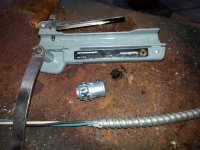
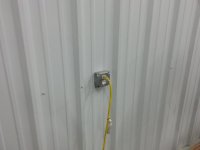
I'd say it depends on what you want it to look like, and of how cost effective you want it to be. It also depends on if you want to allow for future expansion. I ran a 3/4 EMT conduit around the the top behind my PBR panels, then dropped down from them with BX cable, some call it AC or MC, it's the kind with the flexible metal covering, then dropped into my wall receptacles through the back side using "snap-it" connectors at both ends of the cable. The connectors cost more, but they sped the installation up a lot. Then when I wanted to run the outside lighting circuit, I just pulled more wire though the conduit that was in place and used box extensions to stay within box fill and to give me more room to work. I also used over size deep boxes at the on the 3/4 conduit at the behind the panels. It made for a neat clean installation.
Attachments
600SL
Well-known member
I ran my lighting wiring on the inside with conduit, but all my plugs will be on the outside.
As far as NM in conduit, this stuff looks like its made for that. Available with or without ground. Not sure what the difference is between this and NM is besides the stranding. But it is THHN inside.
http://www.wireandcabletogo.com/Tray-Cable-THHN-PVC/
As far as NM in conduit, this stuff looks like its made for that. Available with or without ground. Not sure what the difference is between this and NM is besides the stranding. But it is THHN inside.
http://www.wireandcabletogo.com/Tray-Cable-THHN-PVC/
wssix99
Well-known member
I wish you would tell my inspectors that lol
Since when did inspectors have to understand code?
Zeke
Well-known member
You can also use flex conduit along with EMT with some connections. If it's in the wall and not seen that will save you some time fussing with the bender. Conduit bending is an art and it takes skill and practice to look nice.
alfredeneuman
Well-known member
As far as NM in conduit, this stuff looks like its made for that. Available with or without ground. Not sure what the difference is between this and NM is besides the stranding. But it is THHN inside.
http://www.wireandcabletogo.com/Tray-Cable-THHN-PVC/
^^^ THIS
TC needs be inside conduit for protection when it's not used in a cable tray.
It's stranded wire, so it's a breeze to pull. It doesn't cost that much more than price of the individual wires. It has a thinner jacket than NM
It's listed for Direct Burial due without conduit to it's THHN/THWN insulation.
Last edited:
wyliesdiesels
Well-known member
And you wind the prize....... ERRRRR, UHHHHM, What was the prize again??? lol
On the serious side I've always had my customers jobs inspected. It reduces my liability if anything ever goes wrong. I have tried installing romex in conduit(I didn't have any singles) and it got rejected by the inspector, I had to remove all of the romex and remove all of the sheathing before he would pass it. So going by the code for the 3 different states I've done electrical contracting in I feel fairly safe saying it is a no no. The reason is in romex there is no room for the wire to expand and contract as it heats and cools, whereas single wires in conduit are allowed extra space and more airspace to cool the wires.
How is it that an inspector fails you for romex in conduit and passes conductors that were stripped from a romex cable? Smh

Rock knocker
Well-known member
- Joined
- Aug 14, 2014
- Messages
- 704
I have tried installing romex in conduit(I didn't have any singles) and it got rejected by the inspector, I had to remove all of the romex and remove all of the sheathing before he would pass it. So going by the code for the 3 different states I've done electrical contracting in I feel fairly safe saying it is a no no. The reason is in romex there is no room for the wire to expand and contract as it heats and cools, whereas single wires in conduit are allowed extra space and more airspace to cool the wires.
Are you an electrician? I don't know any electrician in the world who would let an inspector make up stuff like no romex in conduit but require a blatant code violation like stripped romex without calling their bluff.
The expansion stuff is something I've never heard before, and doubt I will again
Last edited:
Rock knocker
Well-known member
- Joined
- Aug 14, 2014
- Messages
- 704
Man! The thought of notching out all those metal panels for the boxes! No thanks!
Surface mount for me.
Nicely ran surface mount metal conduit can look very professional
wyliesdiesels
Well-known member
Are you an electrician? I don't know any electrician in the world who would let an inspector make up stuff like no romex in conduit but require a blatant code violation like stripped romex without calling their bluff.
The expansion stuff is something I've never heard before, and doubt I will again
yeah ive never heard that one either!
600SL
Well-known member
[/b]
yeah ive never heard that one either!
If that were true romex would be illegal in the first place.
zmaxmotorsports
Well-known member
Are you an electrician? I don't know any electrician in the world who would let an inspector make up stuff like no romex in conduit but require a blatant code violation like stripped romex without calling their bluff.
The expansion stuff is something I've never heard before, and doubt I will again
Weve done it that way around here for years in unfinished basements.
alfredeneuman
Well-known member
P.S. Underground you can run direct bury romex but it has to be insulated against damage where it comes up through the concrete or in conduit if it comes up outside of the building.
It's not legal to use it outside, much less underground directly buried or not.
I've never heard of the expansion theory either.
Rock knocker
Well-known member
- Joined
- Aug 14, 2014
- Messages
- 704
Weve done it that way around here for years in unfinished basements.
Done what? NM is an assembly, so when you strip the outer cover, you have no idea what type of conductor is left. While it is common to use it as a quick alternative to THHN when none is available, it is a violation. What is hard to believe, is that an electrical inspector would require an electrician (Eaglewolf?) to do this questionable violation to correct the use of NM in conduit, when there is no code reason to do so
Zeke
Well-known member
It's not legal to use it outside, much less underground directly buried or not.
I've never heard of the expansion theory either.
He said direct bury. I think one can use DB if buried deep enough with the use of conduit risers.
alfredeneuman
Well-known member
He said direct bury. I think one can use DB if buried deep enough with the use of conduit risers.
That's not what he said. He said Romex.
The only way to do that would be to use UF cable.
There is no such thing as DB cable.
wyliesdiesels
Well-known member
That's not what he said. He said Romex.
The only way to do that would be to use UF cable.
There is no such thing as DB cable.
People interchange direct bury romex and uf romex all the time!
Cmreschke
Well-known member
That would not be a violation.