To avoid these ads, REGISTER NOW!

How to Insulating Pole Barn Garage??

maxpower_454

Well-known member
Joined
Aug 5, 2011
Messages
58
Hi, I'm new to this site but have been looking around here and the rest of the internet for a while now but still have not nailed down the best way to insulate a pole barn with metal roof and siding.

I'm having 30' X 40' X 12' one built next week by pioneer and would like to know what the best affordable way is to insulate it and resolve any moisture problems. SPRAY FOAM IS OUT OF THE QUESTION. I am not having them install the double bubble vapor barrier because that's ridiculously expensive as well.

First, I was thinking of buying big rolls of 6 mil vapor barrier plastic like what is used for concrete and having the guys install it before the metal is installed. This way I'd have a vapor barrier and would be able to just stud out the walls and install fiberglass insulation without worrying about moisture.

Secondly, if the first methos is not recommended for some reason, I was thinking about using foam board up against the 2X4 horizontal wall girts and then framing out the walls and installing the fiberglass rolls. Would this take care of any moisture? My problem with this method would be the cost of the foam board but if it would work better than my first method, I'll do it.

I asked Pioneer how they typically insulate their pole buildings and they said they just stud out the walls flush with the poles and then install R-19 rolls insulation (6" thick) with nothing underneath. They said since the insulation is against the wall girts and not directly against the metal, there won't be a problem. Is this true?

Thanks in advance!
 
Last edited:
To avoid these ads, REGISTER NOW!
OP
M

maxpower_454

Well-known member
Joined
Aug 5, 2011
Messages
58
I assume that he does not want to spend that kind of $$$$

Correct. I want to do it right but can't even afford a concrete floor yet. I hope this doesn't turn into yet another thread cluttered with spray foam comments - which is why I had to post this to begin with...
 

tdkkart

Well-known member
Joined
Jun 17, 2006
Messages
6,887
Location
Eastern Iowa
You do not want the vapor barrier on the outside of your framing, vapor barrier goes on the warm/heated side of the insulation.

Fully understand your feelings on foam. Yes it's good, but the cost is certainly prohibitive.
A Mercedes is good, but a Hyundai will get you there just as effectively.
 

wagnon89

Well-known member
Joined
Apr 28, 2010
Messages
57
Location
North Alabama
You do not want the vapor barrier on the outside of your framing, vapor barrier goes on the warm/heated side of the insulation.

Fully understand your feelings on foam. Yes it's good, but the cost is certainly prohibitive.
A Mercedes is good, but a Hyundai will get you there just as effectively.

Depends on where he lives. Down in this part of the country we put it on the outside.

To the OP, I've never priced the foam board, but I would think the double bubble foil rolls would be a ton cheaper. You could do the roof and walls of your 30x40 for about $250 based on the price I got. However I don't think it would give as much insulation value. Mainly just a vapor barrier.
 
OP
M

maxpower_454

Well-known member
Joined
Aug 5, 2011
Messages
58
Depends on where he lives. Down in this part of the country we put it on the outside.

To the OP, I've never priced the foam board, but I would think the double bubble foil rolls would be a ton cheaper. You could do the roof and walls of your 30x40 for about $250 based on the price I got. However I don't think it would give as much insulation value. Mainly just a vapor barrier.

Where did you get that price from? I just did a quick google search and it doesn't look like the double bubble is much cheaper than foamboard.

http://www.amazon.com/EcoFoil-Reflective-Insulation-Radiant-Barrier/dp/B003XFYIA2/ref=pd_rhf_se_shvl_tab0_cpp_3
 

Dragster Racer

Well-known member
Joined
Feb 9, 2008
Messages
1,891
Location
Morrison, IL
I live in northern Illinois.
Here is what I did with my 40x40x15
Foam board between the girts. bookshelved wide rolls of r19 betwen the bookshelves. VB on the inside. VB before you put up the ceiling, then blow in on top of ceiling.
Foam was out of the question here. Any pay back that there could have been would have been waaaay long with the huge difference in price. I bought the foam board at auction. Don't try to fit is perfectly. you want a little air movement outside of the insulation for any moisture that gets around the vb to get out.
 

wagnon89

Well-known member
Joined
Apr 28, 2010
Messages
57
Location
North Alabama
Where did you get that price from? I just did a quick google search and it doesn't look like the double bubble is much cheaper than foamboard.

http://www.amazon.com/EcoFoil-Reflective-Insulation-Radiant-Barrier/dp/B003XFYIA2/ref=pd_rhf_se_shvl_tab0_cpp_3

Not sure how much the foam board is, but the pole barn builders in this area qouted me $80 for a 750 sq ft roll of the Foil/Bubble/Vinyl. Like I said, I would not really call it insulation, more of a vapor barrier to me. So if the foam boards are reasonable it might be the better way to go.
 

Chetter

Well-known member
Joined
Nov 30, 2008
Messages
243
Location
Northern Ohio
When I built my pole barn garage back in 96, I wrapped the whole outside with a house wrap after putting up the usb sheets on the girders. Inside, I used styrofoam boards cut to fit tight and glued to the osb and doubled it up which brought the thickness even with girders. Then I covered the whole thing with 1/2" osb on the inside and painted it all white, I went that route since I didn't want to add to the cost of the building by building additional walls on the inside, would defeated the cost point of my building a pole style garage to begin with. As for the ceiling, I used heavy mill plastic that I stapled to the rafters followed by 4x8 sheets of foam board that is screwed with 1"x2" wood strips to hold the foam board in place. Next is the FSK paper that will cover that and it will be done. In the attic, I rolled out attic blanket from Owen Corning with a R-30 value, no vapor barrier since I had up already. I did this in steps as money is always tight so it has been since 96 and I am still adding to the garage. I heat my garage 24/7 with a Mr Heater 45000 btu propane heater with a temp set at 50*. I have been spending about 300-350.00 for whe whole season of heating which I feel is fair given my garage is 24x32 with 10ft ceilings. I've had no issues with mold or mildew. Sorry for the long post..
 

jack anderson

Well-known member
Joined
Jul 3, 2011
Messages
80
Location
Central Pa
I had CB builders construct a 30'X28' pole building garage it has loft trusses with an 8/12 pitch.. The concrete floor is 4" as to specs. I framed in the walls with 2X4's flush with the 6X6 posts. prior to framing I sealed the purlins and sheet metal with Tyvek. It was stapled and taped and caulked at the bottom. I used r19 insulation for the walls and I used CB 1/2" plywood for the walls on the first floor. I built wide stairs going up to the loft area which will have a finished studio 13' wide by 28' . The loft walls will be insulated with r 30.. I will use tyvek on the rafters above the loft area followed by R 30 insulation, I plan on using tin for the ceiling which is at 10'. I plan to blow in insulation into the ceiling rafters and use plastic 6 mil to cover the ceiling rafters after it is insulated. There will be 5' French doors in the loft area going out to a deck which will also serve as a overhanging carport. I hope to post pictures through this process.
 

i8tokyo

Well-known member
Joined
Apr 20, 2009
Messages
255
Location
south of Somewhere but not close enough to a Saint
I agree with the foam being to pricy but what about the tacky cellulose? it is kinda like a big spitwad. and they use a big shaver to cut it down flush with the studs. I am about to the insulation point and I am thinking that for the walls and blown in for the ceiling. I will let you know how it is comp to fiberglass batt's DIY. I figure I can spend a little more to get a tight building and that will save on the size of the furnace/LP costs.
 

peghead

Active member
Joined
Dec 8, 2011
Messages
43
Can't you use foam board or Batt insulation. I have heard that spray on foam can condensate. I do know if spray foam gets wet between the foam and the wall structure it will separate and if it gets really wet it will keep separating rendering the spray foam useless. Why not Batt insulation, couldn't you install some cheap studding to hold it in. If you did use it I would recommend radiant heat barrier on the inside over the Batt insulation with the foil side facing inside. I have used this method in my house and it works well.
 

haugy

Well-known member
Joined
Dec 1, 2009
Messages
783
Location
Nashville, TN
Maxpower - we need your location. In the northern, more cool states the vapor barrier typically is on the inside of the batts. Down here in the southern, and more humid states the vapor barrier goes on the outside.

I think if you wrap it in 6-8mil and then use bats, you will be very pleased. This will help with moisture, but will also stop most drafts through the walls that will rob the batts of their insulating power. Air flow will hurt the effectiveness of the insulation. And the 6-8 mil sheeting comes in huge rolls, for a very cost effective price.
 
OP
M

maxpower_454

Well-known member
Joined
Aug 5, 2011
Messages
58
Maxpower - we need your location. In the northern, more cool states the vapor barrier typically is on the inside of the batts. Down here in the southern, and more humid states the vapor barrier goes on the outside.

I think if you wrap it in 6-8mil and then use bats, you will be very pleased. This will help with moisture, but will also stop most drafts through the walls that will rob the batts of their insulating power. Air flow will hurt the effectiveness of the insulation. And the 6-8 mil sheeting comes in huge rolls, for a very cost effective price.

I'm in Northeast PA. The cost effectiveness is exactly why I was thinking about doing it. I can probably do all the walls for $100. The problem is the labor my building company wants to charge - almost $700!!! They can probably have it all up in 1/2 hr. That kind of rules it out. If I get lucky and they get the structure up on Friday and don't come back until Monday, I'll have it up for when they come back ;)
 

Dragster Racer

Well-known member
Joined
Feb 9, 2008
Messages
1,891
Location
Morrison, IL
I bet it takes longer than you think. It was that way for me. I'm still glad I did it myself, but it did take a good long while. I don't know why they don't recommend the house wrap before putting up the steel outside. Seems like the perfect deal.
 

Dickey

Well-known member
Joined
Oct 28, 2011
Messages
930
Location
Chapin, SC
I have a 30x40x16.5 pole barn. When I bought the place, it was just the 6" posts on 10' centers, slab and steel walls secured to the outside of the posts. I ended up hunting on craigslist until I found a good deal on some 2" foam board. I sprayed great stuff on every seam from the inside of the walls to help keep any moisture out. Then I put the foam boards up against the steel and ran a few 10' 2x4s horizontally so I could attach some OSB to cover up the foam. In my case, I put twice as much insulation on the south facing wall because it would positively bake during summers in SC. I only put one layer on all of the others. It has worked out fairly well and I'm able to do it a section at a time as money and time allow. When I started last year it cost me around 30 dollars per 8x10 section, including the OSB and I think the last few sections I completed were in the $40-$45 range.
 

Camper

Well-known member
Joined
Apr 21, 2011
Messages
183
Location
NE Pa
Wants to do it right without spending any money ??
I did not think that was possible...:headscrat

For me it seems it is either cheap or right....never both.
 

samert111

Well-known member
Joined
Feb 28, 2010
Messages
185
Location
Rockford, Mi
Sorry, this will be a long response.

I asked Pioneer how they typically insulate their pole buildings and they said they just stud out the walls flush with the poles and then install R-19 rolls insulation (6" thick) with nothing underneath. They said since the insulation is against the wall girts and not directly against the metal, there won't be a problem. Is this true?

No, in my opinion. Metal sided Pole Barns are full of exterior air leaks and gaps that can ruin your insulation by allowing air and water intrusion in.

Here's what I did.

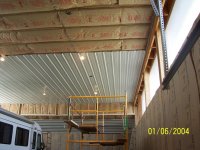
My Pole Barn was built in 97 but I just insulated it last winter. I used Tyvek house wrap cut and stapled in between the posts on the inside. Since you are just starting to build, you can have your builder put it on the outside of the framing BEFORE they put up the metal siding. This will block most of the drafts that Pole Barns with metal siding have, protect the insulation from dirt and moisture and allow the building to breathe from the inside out. Then 2x6 framing 24" on center between and flush with the inside of the posts and tie the studs into the exterior horizontal purlins with 2" drywall screws toe-nailed in to make a nice rigid wall. Then Kraft faced R19 fiberglass insulation between the studs. You can add the 1/1/2" foam board between the horizontal purlins first also if you want for more insulating value but it's expensive for what R value you get. I had used the purlins for my electrical wire runs so I just went with the R19 fiberglass between the studs and then 7/16" OSB on the interior walls.

What you do on the ceiling depends on your ventilation situation above it. If full soffit and ridge vents (which you should have in your location) then plastic sheeting for a vapor barrier stapled to the bottom of the trusses and then either a metal or drywall ceiling and blown in fiberglass above. Make sure you do not block off the truss bay openings out into the soffits with insulation. Use some baffles with fiberglass batts to plug the opening out to the soffits then blow in around it. Since I started my insulation project in the winter, I put up Kraft faced R30 batts between the trusses first so I could keep the heat in while I worked on framing out and insulating the walls. I'm now just priming and painting the inside (OSB) walls.

Here's a photo of my metal ceiling installation. Dis-regard the camera date, it was not reset.
 

Attachments

  • 100_2185.jpg
    100_2185.jpg
    145 KB · Views: 1,464
  • 100_2188.jpg
    100_2188.jpg
    149.8 KB · Views: 1,172

dwwright

Active member
Joined
Aug 6, 2010
Messages
25
Location
KCMO
I've been spending the past few weeks demoing my walls back down to the studs. I've got a 32' x 60' with 12" ceilings (well, no ceiling yet). The previous owner studded in up to 8', insulated and drywalled. The building was full of air leaks, so I've used about 10 cans of great stuff to seal it up, which helped greatly. Been building out the last 4' also.

The mice had a field day with the insulation, tunnels everywhere and completely destroyed it, so here is my advice. Take the time to seal up the gaps and install blocking to limit their access. I've installed blocking between the posts and the girts to keep them from getting from one section to the next. I've also stuffed steel wool in the channels of the metal siding and filled them with great stuff as they don't like to chew through the steel wool or the expanding foam. I haven't found a supplier for rat guards, but will install them when I find some.

I've done as others, insulated, hung vapor barrier, and osb'd the walls. The ceiling will be vapor barriered, have steel siding hung (5' between trusses), and blow in insulation to r30. I've got gable vents on each end for ventilation.

Hadn't seen anyone else mention the rodents, so though it might be beneficial.
 
To avoid these ads, REGISTER NOW!

samert111

Well-known member
Joined
Feb 28, 2010
Messages
185
Location
Rockford, Mi
Hadn't seen anyone else mention the rodents, so though it might be beneficial.

Yes, they can be a problem. Before I studded out the walls inside I used the foam filler strips that are the same shape as the steel siding at the top and bottom of the siding, not only to block this entry point but also close up these huge air leaks. At the buildings exterior corners I removed the trim pc and used some 4" wide aluminum flashing tape to close the gap where the siding came together at the corner. I was amazed how large of a gap that was left here. This also was an entry point for the bees. Stainless Steel wool at the bottom of the trim pc to close it off. Put new seals on the bottom of the overhead doors as there was a little gap there.

It's cold here now and that's when they try to come inside and I've had some snap traps spread around baited with PB for 2 months now and haven't caught one mouse yet. So either my preventive actions are effective or all the mice in my area have gone South for the winter.
 

D KRAGER

Well-known member
Joined
Oct 16, 2007
Messages
581
Location
Central IL
The cheapest route I've seen some people use that really thin foam insulation that goes behind vinyl siding. It's like 1/4" thick. This will keep the roof tin from condensating and dripping on your ceiling insulation.

Plastic will not do the job, it will condensate and drip. No advantage to that.

Then later on you can drop your ceiling and blow in cellulose.
 

D KRAGER

Well-known member
Joined
Oct 16, 2007
Messages
581
Location
Central IL
Secondly, if the first methos is not recommended for some reason, I was thinking about using foam board up against the 2X4 horizontal wall girts and then framing out the walls and installing the fiberglass rolls. Would this take care of any moisture? My problem with this method would be the cost of the foam board but if it would work better than my first method, I'll do it.


Thanks in advance!

This is how I did mine. Did it in stages as budget allowed. (Just had foam for a while until I got it all studded out.) Except I left the wall open to the attic and blew in cellulose. With the foam against the tin, I figure that will keep any condensation from touching the cellulose (or fiberglass). I've heard that moisture doesn't affect cellulose as much as fiberglass as long as it's allowed to dry. Cellulose will wick the moisture out.
 

KyleQ

Well-known member
Joined
Jul 6, 2011
Messages
147
Location
Twin Cities, MN
Would it be stupid to have 1" of foam sprayed to get an air tight seal and then going over with the fiberglass batts before rocking the walls? 1" of foam will do wonders for a vapor and air barrier - the fibergass batts will finish of the job - or that is my thought...
 
OP
M

maxpower_454

Well-known member
Joined
Aug 5, 2011
Messages
58
Would it be stupid to have 1" of foam sprayed to get an air tight seal and then going over with the fiberglass batts before rocking the walls? 1" of foam will do wonders for a vapor and air barrier - the fibergass batts will finish of the job - or that is my thought...

Not stupid but expensive!!

I will have gable and eve soffits with a full ridge vent. I think the upper part will be well ventilated because of this. Also, I will be putting plastic down under the concrete.

The building is scheduled for next week. Drilling and setting the posts on Wednesday and then 1st construction day is Friday so that works out perfectly! I'll get some buddies to help install the Tyvek House wrap over the weekend and then they can sheet the building when they return on Monday. Hopefully it all works out as planned.

After that I will just go with 4X6 studs and insulate with fiberglass (blown or rolls) as others have. If the house wrap doesn't workout, I'll probably just put it up between the poles along with some foam and then proceed as planned.

I'll keep updating as things progress or maybe even start my own build thread.

For those considering Pioneer, the only reason I used them is because I aggressively negotiated with them comparing other companies in the area. I have a little bit of a bad taste in my mouth that they would charge so much just to INSTALL the housewrap but if everything goes smoothly I'll be happy overall. They have a good reputation in the area.
 

haugy

Well-known member
Joined
Dec 1, 2009
Messages
783
Location
Nashville, TN
Just remember, you are paying the building company. Talk to them about what you're planning, and that you will need that weekend to do it. So they don't go "well we finished early over here, so we'll start yours on Thursday and be done on Friday" or some nonesense like that.

I'm sure I'll get criticized, but you pay them. If you have a reasonable request that doesn't require any effort on their part, they should do it. No questions asked. Now if what you were doing would slow them down or cause a change in how they worked, yeah it's going to be a discussion.

With 3 people you can knock out that plastic wrap in half a day. I stapled close to 3000 staples in the ceiling of my shop to hold up 1200 sq/ft of 8-mil plastic 14' in the air all by myself in 6 hours. You can knock this out quick.
 

Jbullfrog

ALLIANCE MEMBER
Joined
Jan 9, 2007
Messages
2,347
Location
Avoca, Iowa
Would it be stupid to have 1" of foam sprayed to get an air tight seal and then going over with the fiberglass batts before rocking the walls? 1" of foam will do wonders for a vapor and air barrier - the fibergass batts will finish of the job - or that is my thought...

That is what I did. I am finishing half of a 40x90 flat storage. It was built in the early 80ies. We sprayed 1" of foam on the walls to the roof. I added 6" fiberglass and sheeted the inside with 7/16" OSB. The ceiling has 6ml plastic with taped seams above the steel screwed under the rafters. I am going to blow in 12" above the ceiling.
 

mebedave

Well-known member
Joined
Jan 17, 2010
Messages
260
Location
Atlantic county area, New Jersey USA
The cheapest route I've seen some people use that really thin foam insulation that goes behind vinyl siding. It's like 1/4" thick. This will keep the roof tin from condensating and dripping on your ceiling insulation.

Plastic will not do the job, it will condensate and drip. No advantage to that.

Then later on you can drop your ceiling and blow in cellulose.

how do you attach this thin foam to the tin
 

jdw8320

Active member
Joined
Jan 3, 2010
Messages
38
Location
Sandusky, Mi
We building a new farm shop their stapling netting over the post then putting the perlins on then blowing the cavity between the posts full of celloluse.
 
Last edited:

tater_51

New member
Joined
Jan 16, 2012
Messages
2
I'm having a 36 x 56 x 14 built this spring. I've debated all the insulation options. Currently I've decided to heat a section of the barn, probably a 24 x 24 section towards the back. This size shop would provide me with a warm work place and only half the expense of heating/insulating the whole building. I will have 2' vented soffit/1' vented eave and full ridge vent. From the outside, in this order, steel, housewrap, blown in cellulose, vapor barrier, OSB on the walls. Ceiling will be steel liner, vapor barrier, blown in fiberglass. Heat is the return loop on a outdoor wood stove/boiler. I live in northern Michigan. I still may do the whole darn thing but seems a reasonably sized workshop might just be enough.
 

petefarmer

New member
Joined
Jul 2, 2013
Messages
1
I'm having a 36 x 56 x 14 built this spring. I've debated all the insulation options. Currently I've decided to heat a section of the barn, probably a 24 x 24 section towards the back. This size shop would provide me with a warm work place and only half the expense of heating/insulating the whole building. I will have 2' vented soffit/1' vented eave and full ridge vent. From the outside, in this order, steel, housewrap, blown in cellulose, vapor barrier, OSB on the walls. Ceiling will be steel liner, vapor barrier, blown in fiberglass. Heat is the return loop on a outdoor wood stove/boiler. I live in northern Michigan. I still may do the whole darn thing but seems a reasonably sized workshop might just be enough.

I am moving to Northern Michigan this Oct. 2013 from the more mild Pacific NW, and will be moving my year round woodshop job with me into a rather large 70x40x14 pole barn. I am thinking of doing what you did and perhaps frame in 1/3 of the space within the barn to keep the outdoor wood stove/boiler cost to a minimum. I was just curious if you have any sage advice gleaned from your experience to help me cope with the hot/cold extremes. The pole barn is currently insulated with 24" wide R19 faced batts resting horizontally on the metal walls between 6" framing, concrete floor, composite roof with 2' spaced trusses, x2 12' high uninsulated garage doors, and only 2 windows/doors. Would passive solar work in these latitudes? Did the wood burning heater work for you? Was your insulation adequate? Staying dry?

Thanks for your reply in advance!

Pete ([email protected])
 

Bowser

New member
Joined
Mar 25, 2014
Messages
4
Location
PA
@ samert111. I put the same light fixtures in my garage. Did you plan ahead for the fixtures to miss the 1" ribs? How did you cut out the round holes? I was planning on buying a good hole saw.
 

Repsolracer22

Well-known member
Joined
Jan 4, 2012
Messages
238
Location
central MD
my foam guy said that it's better to spray foam the walls, and the ROOF back .. not ceiling. He said you are suppose to seal up the ridge vent, soffets, etc etc everything. I understand the idea behind a nice sealed envelope ... but how does it breathe and get fresh air circulating? (im speaking of closed cel foam)
 

04fivefour

Well-known member
Joined
Apr 26, 2013
Messages
221
Location
Perry Township, OH
@repsolracer22 There has been a shift in theory from having soffits and good ventilation, to making an air tight building that doesn't need ventilation because the moisture can't get in.
 

Repsolracer22

Well-known member
Joined
Jan 4, 2012
Messages
238
Location
central MD
@repsolracer22 There has been a shift in theory from having soffits and good ventilation, to making an air tight building that doesn't need ventilation because the moisture can't get in.

correct. that's what i was saying that my foam guy suggested. it makes sense i guess.

but how do you get fresh air then? are there certain types of heating/cooling that are required for pole barns with the closed cel foam? such as HVAC that brings in fresh air? I just finished a 40x60 and need it insulated. cant decide if this 100% sealed building is the way to go or not
 

jersey blue fin

New member
Joined
Jan 1, 2015
Messages
1
Has anyone used the plastic wrapped insulation batts directly against the steel siding? This after sealing all openings with cans of spray foam.
 

CA_Tallguy

Well-known member
Joined
Sep 4, 2014
Messages
120
@repsolracer22 There has been a shift in theory from having soffits and good ventilation, to making an air tight building that doesn't need ventilation because the moisture can't get in.

Whoa! I don't think that is where the thinking shifted at all! Google "build tight and ventilate right" and also look at ERV (energy recovery ventilator) and HRV (heat recovery ventilator) systems. Also, "building tight" is a LOT more complicated than just sealing up every crack and other opening you can find. You have to get the right minimum amount of insulation to prevent condensation on surfaces (or within your wall/roof assembly somewhere), for example, and you have to get it in all the right places.

correct. that's what i was saying that my foam guy suggested. it makes sense i guess.

but how do you get fresh air then? are there certain types of heating/cooling that are required for pole barns with the closed cel foam? such as HVAC that brings in fresh air? I just finished a 40x60 and need it insulated. cant decide if this 100% sealed building is the way to go or not

Your questioning is right on. The tighter a building is, the MORE you need to figure out a ventilation plan. ESPECIALLY for a workshop where you could have all kinds of fumes and gasses and other things you don't want to trap inside and breathe. (I've been welding on some galvanized metal recently, for example... not good to breathe the fumes from that stuff!) Further, you have to have a way to rid the air of moisture that arises from people breathing, propane heaters, wet stuff/vehicles brought inside, water usage, etc etc.... I don't think you'd want to be locked in an airtight building without considering some sort of ventilation plan any more than you'd like to be locked in a coffin underground without fresh air!

I'm not against spray foam by any means, but it does make sense to think through the whole system and how you will maintain indoor air quality for your needs and building usage. Also, it's probably a good idea to find someone who knows a thing or two about how to do it right. If they screw it up, it could end up causing you a bigger problem than your building is worth. It ain't easy to remove that stuff! Check out this article....

http://www.cbc.ca/news/spray-foam-insulation-can-make-some-homes-unlivable-1.2224287
 
Last edited:
To avoid these ads, REGISTER NOW!
Top Bottom