To avoid these ads, REGISTER NOW!

Moisture behind vapor barrier (new construction)

Mike_B

Member
Joined
Nov 25, 2014
Messages
20
Location
Nova Scotia, Canada
Hi guys,

Last night I went out to work on finishing my vapor barrier in the garage.

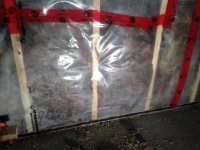
Aaand what I discovered was that moisture had returned between my vapor barrier and insulation. (See attached pic)

What I'm wondering though... is what would have caused this?

Could it have something to do with me originally installing the insulation and vapor barrier (with seams taped) but failing to seal up the bottom of the vapor barrier with acoustical sealant? I noticed the moisture about a week ago and simply tried to remove it from the inside of the vapor barrier by wiping the plastic down, then I sealed it up.

So my new plan is to remove any insulation that has any sign of moisture, replace it with new dry insulation and immediately seal the vapor barrier back up.

There were no signs of leaks... and these damp sections are only on one side of my garage (westward side, gets sunlight from 2pm-4:30 pm this time of year). We have had some temperature swings in my area lately too from -5 C to about 12 C over 24 hrs a couple of times...

Thoughts?
 

Attachments

  • IMG_1254.jpg
    IMG_1254.jpg
    136.5 KB · Views: 137
To avoid these ads, REGISTER NOW!

pstnbly

Well-known member
Joined
Jul 20, 2010
Messages
766
Location
So. Vermont
How new is the concrete and framing? Is there a moisture barrier under the slab? Are you using unvented gas LP/NG for temp heat? New construction materials contain a lot of moisture, especially if it rained before the shell was weathered in. Open that vapor barrier up and get some ventilation going before you have a mold problem. This is the very reason I moved away from fiberglass, especially in a high humidity and high heating degree day climate.
 
OP
M

Mike_B

Member
Joined
Nov 25, 2014
Messages
20
Location
Nova Scotia, Canada
How new is the concrete and framing?

Concrete was done last October (2013), framing in November 2013.

Is there a moisture barrier under the slab?

Yes, as well as 2" extruded polystyrene.

Are you using unvented gas LP/NG for temp heat?

Currently, the garage is not heated.

What's on the other side of the insulation? Tin? Hopefully something that isn't air tight, right?

No tin, just standard osb sheathing and Typar.
 

DEnd

Well-known member
Joined
Oct 25, 2008
Messages
218
It looks to me like it is condensation. Likely what is happening is that the vapor barrier is cold and moisture in the warmer interior of the insulation is being driven in by the warming of the wall due to the afternoon sun. There is a simple way to test this, and that is to heat up the garage. If you are not going to keep the garage heated 24/7 you may want to consider closed cell spray foam to stop the air movement through the wall, this should eliminate any condensation concerns.
 

Radix2

Well-known member
Joined
May 28, 2014
Messages
1,853
Location
the thumb!, MI
An unheated garage will often be cooler than the outside - especially on a sunny side.

In my unheated garage, on warm summer mornings I get bad condensation and sweating when the garage door is opened and the warm humid air rolls in and the tools/surfaces are still cold from the night.

I would take the fact that you have been able to see how the building is going to respond to the climate with the visible vapor barrier as a good thing - and use this knowledge to get rid of it.

A vapor barrier on the warm side of a heated building where the thermal gradient prevents what you are seeing makes sense.

A vapor barrier where it will act as a condensing surface as yours is - is not.

I wouldn't expect the problem to go away, but at least you should monitor it under the same weather conditions to see if it improves before covering it up.
 

Highbeam

Well-known member
Joined
Feb 15, 2011
Messages
2,292
Location
Mt Rainier foothills, WA
Ignore it. It will go away on its own until the conditions repeat. To the moisture in the warm wall, your cold plastic is like an ice cold can of soda. There will always be some amount of water in the wall just as there is in the air, it might be dissolved into the air and it might condense out on occasion. You can pull the plastic and dry it out but it will just come back, forever.
 
To avoid these ads, REGISTER NOW!

SeniorCitizen

Well-known member
Joined
Nov 29, 2014
Messages
53
Location
about 150 mi west of tulsa
The best thing for that building is to remove the plastic. That inner surface has reached dew point temperature and drying is nearly impossible. The reason wooden structures 200 years old are still standing is because plastic hadn't been invented. The link below can be used to determine when condensation may occur and when your tools etc. may be subject to rusting.

http://dpcalc.org/
 

yeldogt

Well-known member
Joined
Jan 2, 2012
Messages
18,184
You have discovered the problem with plastic vapor barrier -- what you have is very common and is the cause of many wall failures.

Walls actually dry from both sides -- inside and outside. Plastic does not allow this to happen. As humidity changes and temps change -- moisture moves in and out.

When the inside wall becomes colder then the outside -- the possibility of condensation occurs. Lost of things can be allowing the moisture to flow.
 

stangkid14

Well-known member
Joined
Dec 23, 2007
Messages
152
Location
Allentown,PA
so what is the best way to avoid this? I see people using vapor barrier on here all the time? Is tyvek on the outside behind the tin a bad idea too? what about doing both? tyvek on outside and vapor barrier on inside?
 

DEnd

Well-known member
Joined
Oct 25, 2008
Messages
218
Tyvek is vapor open, even if condensation occurs once the building materials warm up it will allow the moisture to escape. The best way to avoid the issue is by using Building Science Corporation's "Perfect Wall" assembly. http://www.buildingscience.com/documents/insights/bsi-001-the-perfect-wall You have to be careful with how much insulation you add on each side of the wall as it can vary on the outside from a little bit to a lot and on the inside from a lot to none at all.

Another option is to incorporate the vapor barrier into the insulation by using the correct type and amount of spray foam.

The third option is to keep the space heated to above the dew point.
 
Last edited:

JCByrd24

Well-known member
Joined
Jul 21, 2005
Messages
493
Location
Bath, ME
Mike B, you should check with your codes enforcement on the requirement for the VB in a garage. In a heated building in Canada with showers and cooking going on it makes good sense. In a garage, it doesn't. The risk of high interior moisture is much lower and the likelihood of the outside being the warm humid environment instead of the inside is much higher, which is when an interior vapor barrier is known to be bad. I'd call you codes person out on a morning when this is happening and try to convince him that the vapor barrier isn't necessary because this isn't a house and obviously isn't working properly because the vapor is coming from the outside. Even if you heat this somewhat in the winter humidity in the air is much lower during winter and a garage has much less humidity than a house (unless it's a car wash).

If you can't delete it, your best bet is to air seal the exterior sheathing as best you can so vapor in the wall is limited to that driven in by diffusion and not carried by air leaks. Don't believe anyone that says air sealing will limit drying ability. I am also under the impression that a rain screen is required by Canadian code between the exterior sheathing and siding. If you don't have this installed yet it is making your situation worse as it will help reduce vapor drive into the wall on a warm sunny day once installed.
 
Last edited:

SeniorCitizen

Well-known member
Joined
Nov 29, 2014
Messages
53
Location
about 150 mi west of tulsa
Sure air sealing inhibits drying. Have you ever seen water under a rubber backed mat inside a walk in shop door but no where else on the concrete floor? Leave it there and it may still be wet at days end. Remove it and that area will be dry in less than an hour.
 
To avoid these ads, REGISTER NOW!
Top Bottom