To avoid these ads, REGISTER NOW!

My new (to me) compressor - Opinions?

skidooby

Active member
Joined
Oct 15, 2014
Messages
29
Been lurking a while now, reading lots. Just thought I would finally post something...

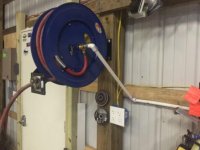
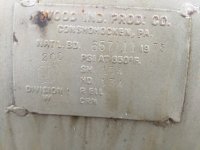
Ok, so over the holidays I saw this beast sitting by the road. Made in 1975, its got a 24.5 cfm worthington compressor, mounted on an 80 gallon tank. Only problem was the 3 phase motor.....but for $100, I figured I couldn't go wrong.

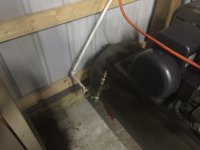
Fast forward a month and she has a brand new Baldor 5HP single phase motor (thanks ebay) and finally got around to hooking it up and plumbed the first run.

Hope I will be happy with it. From dead empty to 175 psi, 6 1/2 minutes on the nose. It will leak back down over the course of about 3 days but I can live with that I spose.
 

Attachments
  • IMG_0112.jpg
    IMG_0112.jpg
    50 KB · Views: 85
  • IMG_0113.jpg
    IMG_0113.jpg
    67.2 KB · Views: 83
  • IMG_0115.jpg
    IMG_0115.jpg
    55.8 KB · Views: 129
  • IMG_0204.JPG
    IMG_0204.JPG
    78.1 KB · Views: 123
  • IMG_0206.JPG
    IMG_0206.JPG
    54.7 KB · Views: 124
  • IMG_0208.JPG
    IMG_0208.JPG
    28.7 KB · Views: 97
  • IMG_0205.JPG
    IMG_0205.JPG
    48.5 KB · Views: 100
Last edited:
To avoid these ads, REGISTER NOW!

cattoon

Active member
Joined
Jan 12, 2006
Messages
34
Location
N.W. Alabama
It is indeed a nice compressor. The only thing that is bothersome is what appears to be pvc from comp to regulator/water trap and so on. I have personally seen pvc break/splinter when used for this. I realise that there are folks that have run and used pvc airlines in their shops or garages since the civil war, I do not trust it in this application. It is your equipment and you may do as you please. My opinion is that you would be better in the long term to replace it with a more suitable piping such as black iron or copper and utilize a flexible connection from compressor to plumbing to dampen vibration and cutdown on the compressor noise resonating in the plumbing.
 

redmondjp

Well-known member
Joined
Nov 25, 2014
Messages
2,318
Location
Redmond, WA
Excellent!

One caution - from the 24.5CFM rating, that sounds like 7.5HP range (most 5HP 2-stage are 17-18 CFM). You may want to measure your motor running current to ensure that you are not overloading the motor (it can't talk - you could be running 25% over full-load current and not even know it). Was the original 3-phase motor 5HP? If so, it may not be an issue.

And the leakdown may be from a not-completely-sealing output valve on your secondary cylinder, since it appears that you have no tank check valve. Adding a check valve at the tank entrance would be an easy way to rectify that, as well as adding a ball valve shutoff on the tank exhaust.

And as mentioned above, you need to lose that PVC from the compressor to the wall STAT! The high air temperature, as well as oil from the compressor, will weaken and damage PVC very quickly. Plus, you really should use a flexible high-temp. line between compressor and your stationary piping anyways to deal with the vibration that is present during operation (which also will contribute to PVC pipe failure).
 
Last edited:

C96

Well-known member
Joined
Nov 30, 2013
Messages
1,251
The compressor is nice and good score, but your choice of piping is dangerous. Be prepared to catch hell for using the PVC.

This is definitely a No-No here on GJ.

Good luck with that!
 

C96

Well-known member
Joined
Nov 30, 2013
Messages
1,251
Oh, and welcome to the Garage!

Thanks for sharing, but loose the PVC!
 

sberry

Banned
Joined
Jun 18, 2005
Messages
35,747
Location
Brethren, Michigan
I agree that depending on pulley size 5 hp might be marginal. It might work with some duty cycle. Could take a current draw test and see if it was overloading the motor I spose and it might be able to be tuned down with a pulley change.
 
Last edited:
OP
S

skidooby

Active member
Joined
Oct 15, 2014
Messages
29
Thanks for the input guys. The original motor was a 5hp and I called the guys at worthington compressors.com and they were the ones that told me 24.5 cfm with a 5hp motor at 1725 rpm.

As for the PVC. Are you saying lose it entirely or just up to the regulator? The PVC is rated at 600psi and I know of multiple pvc installs that have worked for years flawlessly. I can understand the first section due to vibration but all of it?

There is a ball shutoff valve on the output of the tank but no check valve. May look into getting one of those. I guess this was a continuous duty unit in its previous life so perhaps they weren't too concerned with any type of leak down.

Thanks again!
 

cattoon

Active member
Joined
Jan 12, 2006
Messages
34
Location
N.W. Alabama
I would recommend completely removing the PVC. When it fails, it fails violently. It is not recommended for air/gas applications.http://www.jmeagle.com/plastic-pipe/faq.html I hope the link works. There is no mention of air application. You may not feel the need to remove it. I'm sure there are some well aged systems that have never failed, I simply will not work around it or have it in my shop, I have seen sudden,violent,unanticipated failure.
 
Last edited:

Major Ramifications

Well-known member
Joined
Feb 28, 2005
Messages
4,673
Location
River Ridge, Louisiana
I love the old Worthington. I even like the name, Worthington. It's just a manly name for a compressor company.

The PVC for air lines has been discussed to death on this site. I wouldn't consider using it, mainly because it does not condense water like copper or iron pipe does. For the amount of air lines in a home shop, copper is cheap and easy. No PVC pipe bombs for me.
 

redmondjp

Well-known member
Joined
Nov 25, 2014
Messages
2,318
Location
Redmond, WA
Thanks for the input guys. The original motor was a 5hp and I called the guys at worthington compressors.com and they were the ones that told me 24.5 cfm with a 5hp motor at 1725 rpm.

As for the PVC. Are you saying lose it entirely or just up to the regulator? The PVC is rated at 600psi and I know of multiple pvc installs that have worked for years flawlessly. I can understand the first section due to vibration but all of it?

There is a ball shutoff valve on the output of the tank but no check valve. May look into getting one of those. I guess this was a continuous duty unit in its previous life so perhaps they weren't too concerned with any type of leak down.

Thanks again!

That PVC pressure rating is for liquids and is at a low temp (something like 75 degrees F) - the pressure rating goes WAY down with increasing temperature - the hot air coming out of the compressor will soften the pipe and lower its pressure capability. Plus the oil from the compressor will attack the plastic over time as well.

Lose all of the PVC, every last fitting.

Just because you've seen other people do things and get away with it doesn't make it safe. A lot of people drive around on bald tires too. There is a lot of advice on this site - tens of thousands' of years worth of experience of all the members combined - take advantage of that.

If you search on 'compressor' or 'air piping' or 'air system' on this site, you will find all the information you could ever want on acceptable, safe methods of connecting your compressor to the stationary air piping that don't involve using PVC (and this from somebody who has already purchased all of the PVC pipe and fitting to do my shop, and then backed out after reading this and other sites).

Also, have you considered adding a tank drain (besides the usual petcock)? A ball valve is much easier to use, and there are auto tank drains as well.
 

FriendOfYours

Well-known member
Joined
Feb 26, 2012
Messages
303
There are multiple people on here who have had violent pvc explosions. When I moved into the shop we're in now, there was PVC routed all through the shop. The back wall still had shards of PVC embedded in the drywall.

The previous tenant was there to pick up a few things. He showed me the 6" long scar across his thigh where it had torn through his dickies and down his leg
 
OP
S

skidooby

Active member
Joined
Oct 15, 2014
Messages
29
I had no idea that PVC was that bad of an idea......I will be changing strategies. I appreciate all of the opinions, and really appreciate the civil way it is being gone about. I have been on many sites where the majority tears a person apart just because they did something that they didn't know was wrong. To me, that's the purpose of these sites......to educate and share.

Redmonjp.....I do have a tank drain, not a ball valve but the style you would see for a garden hose......came on the tank. Will most likely replace that with a ball valve though for quicker/easier draining.
 
To avoid these ads, REGISTER NOW!

redmondjp

Well-known member
Joined
Nov 25, 2014
Messages
2,318
Location
Redmond, WA
Redmonjp.....I do have a tank drain, not a ball valve but the style you would see for a garden hose......came on the tank. Will most likely replace that with a ball valve though for quicker/easier draining.
You HAVE to post a picture of that!!!
 

scw1991

Well-known member
Joined
Mar 28, 2010
Messages
506
nice score but you have some serious re-plumbing to do. I've seen the aftermath of a PVC pipe explosion and it's not pretty. You are putting yourself and anyone around you in harms way. Spend the money and do it the right way using copper or black pipe for your hard lines.

No way that 5HP motor coupled to that compressor will put out 24.5 SCFM, unless you are severely overloading the motor and running it into the service factor or beyond. You gotta increase the size the motor pulley to ensure the motor never sees any amperage rating above motor nameplate rating from cut-in to cut-out pressure.

Did you size the mag starter thermal overload heaters correctly at around 21 amps? A 5HP 220v motor requires a NEMA size 1.5 mag starter. A true 5HP compressor will put out around 17 SCFM. Most compressors of this size will spin at 700-900 RPM max when coupled to a 5HP motor.
 
Last edited:
OP
S

skidooby

Active member
Joined
Oct 15, 2014
Messages
29
nice score but you have some serious re-plumbing to do. I've seen the aftermath of a PVC pipe explosion and it's not pretty. You are putting yourself and anyone around you in harms way. Spend the money and do it the right way using copper or black pipe for your hard lines.

No way that 5HP motor coupled to that compressor will put out 24.5 SCFM, unless you are severely overloading the motor and running it into the service factor or beyond. You gotta increase the size the motor pulley to ensure the motor never sees any amperage rating above motor nameplate rating from cut-in to cut-out pressure.

Did you size the mag starter thermal overload heaters correctly at around 21 amps? A 5HP 220v motor requires a NEMA size 1.5 mag starter. A true 5HP compressor will put out around 17 SCFM. Most compressors of this size will spin at 700-900 RPM max when coupled to a 5HP motor.

To be perfectly honest, I did nothing other than buy the motor, transfer the pulley and put it on. The pulley is a good size though.....at least 12 inches in diameter.
All I am going off in respect to the 24.5 cfm (I'd still be happy with the 17) is what the tech at worthingtoncompressors.com told me. He said that pump uses a range of motors from 3-7.5hp. And with a 5hp motor, it puts out that amount of cfm. And the ebay listing that I bought the motor from said it is a compressor motor.....this is from the listing:

SPEC. NUMBER: 36M926T077G1
CATALOG NUMBER: L1430T
FL AMPS: 20.6
208V AMPS: 22.7
BEARING-DRIVE-END: 6206
BEARING-OPP-DRIVE-END: 6205
DESIGN CODE: L
DOE-CODE: --
FL EFFICIENCY: 84
ENCLOSURE: ODTF
FRAME: 184T
HERTZ: 60
INSULATION-CLASS: F
KVA-CODE: H
SPEED [rpm]: 1725
OUTPUT [hp]: 5
PHASE: 1
POWER-FACTOR: 94
RATING: 40C AMB-CONT
SERIAL-NUMBER: --
SERVICE FACTOR: 1.15
VOLTAGE: 230
 
OP
S

skidooby

Active member
Joined
Oct 15, 2014
Messages
29
The compressor also has a fairly large pulley on it as well......if memory serves, the same size as the motor.
 

scw1991

Well-known member
Joined
Mar 28, 2010
Messages
506
I've purchased this exact Baldor motor and it's the best you are going to find commercially available for 220v/1ph other than perhaps a Leeson.

To produce 24.5 SCFM, you'd need a 7.5HP motor. Rule of thumb for reciprocating compressors is 3.5-4.0 SCFM per horsepower. But, a 17 SCFM output should suffice just fine.

As stated, you have to make sure you are not overloading the motor. It's best to take a clip-on style amp meter to measure amperage on each L1 & L2 leg of the motor during the entire cycle of compressor from cut-in to cut-out pressure (amperage rating will be highest at cut-out pressure). The motor will have a shorter life span if you consistently overload it beyond nameplate amperage rating.
 

redmondjp

Well-known member
Joined
Nov 25, 2014
Messages
2,318
Location
Redmond, WA
I've purchased this exact Baldor motor and it's the best you are going to find commercially available for 220v/1ph other than perhaps a Leeson.

To produce 24.5 SCFM, you'd need a 7.5HP motor. Rule of thumb for reciprocating compressors is 3.5-4.0 SCFM per horsepower. But, a 17 SCFM output should suffice just fine.

As stated, you have to make sure you are not overloading the motor. It's best to take a clip-on style amp meter to measure amperage on each L1 & L2 leg of the motor during the entire cycle of compressor from cut-in to cut-out pressure (amperage rating will be highest at cut-out pressure). The motor will have a shorter life span if you consistently overload it beyond nameplate amperage rating.

Exactly.

What the factory person told you is the maximum flow of that pump, running at its' maximum RPM using a 7.5HP motor. I'd still check your running current just to be sure you don't toast your motor.
 
OP
S

skidooby

Active member
Joined
Oct 15, 2014
Messages
29
Will do on the AMP test......question though, is there a way to test cfm? Or would that take a bunch of $$ and not really worth it?
 

redmondjp

Well-known member
Joined
Nov 25, 2014
Messages
2,318
Location
Redmond, WA
Will do on the AMP test......question though, is there a way to test cfm? Or would that take a bunch of $$ and not really worth it?
There is no reason to do an airflow test, but you can approximate it by doing a timed pump-up test (requires some math - search online for examples).

You have a high-quality compressor that will do everything you need it to do unless you have two or three air sanders running at the same time, or one massive sandblasting cabinet.
 

scw1991

Well-known member
Joined
Mar 28, 2010
Messages
506
not quite sure that water faucet valve would be rated to 175 psi or not....unlikely. Fortunately, you can pick up small 1/4"-1/2" brass ball valves cheap at any hardware store.

Also, I noticed in your pic of the PVC running up to your air regulator/filter, is this unit also rated at 175 psi minimum? Most I've seen that look like yours are only rated for 125-150 psi max. You should ensure it is rated for whatever the tank pressure is to be on the safe side.
 
OP
S

skidooby

Active member
Joined
Oct 15, 2014
Messages
29
not quite sure that water faucet valve would be rated to 175 psi or not....unlikely. Fortunately, you can pick up small 1/4"-1/2" brass ball valves cheap at any hardware store.

Also, I noticed in your pic of the PVC running up to your air regulator/filter, is this unit also rated at 175 psi minimum? Most I've seen that look like yours are only rated for 125-150 psi max. You should ensure it is rated for whatever the tank pressure is to be on the safe side.

It has a max output of 145psi but says nothing about max input. It does have 1/2" fittings though and from what I've seen the pressures are raised with the larger ports.

The flow test was just more of a curiosity thing though.
 

scw1991

Well-known member
Joined
Mar 28, 2010
Messages
506
most air filter/regulators rated at 175 psi or above have all metal bowl assemblies with a small plastic sight glass window. If your bowl assemblies are all plastic, chances are it is not rated at a minimum 175 psi.

The pressure regulator/filter inlet/outlet NPT fitting size has nothing to do with the maximum pressure rating.
 
To avoid these ads, REGISTER NOW!
Top Bottom