To avoid these ads, REGISTER NOW!

Insulation and HVAC questions

kogerat

Member
Joined
Feb 8, 2015
Messages
13
Location
Spokane WA
I bought a home last year with a 24'x36'x9' stick frame detached garage. It was built in 1989. The walls have been insulated and drywalled. It is roofed with asphalt shingles and the underside is just bare sheeting with no insulation. I want to insulate the underside of the roof deck and install a HVAC unit.
After doing some research here, it looks like my best options are to use spray foam insulation on the roof deck and go with a split mini HVAC unit. I'm a bit out of my element here and would appreciate any help or guidance.
Thanks, Jim
 
To avoid these ads, REGISTER NOW!

MagKarl

Well-known member
Joined
Oct 15, 2012
Messages
684
Location
Olympia, WA
Welcome. Before you get too far, make sure your shop roof or ceiling will have proper ventilation. If you post some pics you will get more suggestions.
 

DC73

Well-known member
Joined
Dec 27, 2014
Messages
1,627
Location
Lubbock TX
Go to BuildingScience.com, click on the "Information" tab and you'll find plenty of information on how to insulate this area properly.

Another good source is GreenBuildingAdvisor.com. You can ask questions in their Q&A section.

Between the two sites, you'll find enough information to make a good decision. Note that your local climate is an important factor.

Spray foam can be a good choice.

DC
 

St-rider

Well-known member
Joined
May 30, 2005
Messages
283
Location
Mentor, Ohio
Spray foam directly on the underside of the roof deck may be a bad idea as the deck needs airflow to keep cool during hot weather.
 

DC73

Well-known member
Joined
Dec 27, 2014
Messages
1,627
Location
Lubbock TX
Spray foam directly on the underside of the roof deck may be a bad idea as the deck needs airflow to keep cool during hot weather.

They've begun to change their thoughts somewhat on this and roof decks are now routinely sprayed with foam. Depending on the climate, you may have to use closed cell foam and there are ways to calculate the foam thickness to avoid condensation on the underside of the roof deck. In my climate, we can get away with open cell foam. To save costs, some are using a technique called "flash and batt" which consists of a layer of closed cell foam just thick enough to avoid condensation issues and then the remaining rafter cavity is filled with standard insulation (fiberglass, mineral wool, etc.). Some people recommend a ventilation channel between the roof deck and the beginning of the insulation but that's done more often when spray foam is not the insulation of choice.

DC
 
OP
K

kogerat

Member
Joined
Feb 8, 2015
Messages
13
Location
Spokane WA
Some people recommend a ventilation channel between the roof deck and the beginning of the insulation but that's done more often when spray foam is not the insulation of choice.
This is the reason I'm looking into spray foam. My garage is an existing structure and there is no easy access to the soffits, no vents in the soffits, and no vent in the roof ridge to create a ventilation channel. I'm still working on getting pictures to help visualize my situation. Been a busy week so far. To bad I have to work to support my hobbies!

Jim
 
Last edited:

DC73

Well-known member
Joined
Dec 27, 2014
Messages
1,627
Location
Lubbock TX
This is the reason I'm looking into spray foam. My garage is an existing structure and there is no easy access to the soffits, no vents in the soffits, and no vent in the roof ridge to create a ventilation channel. I'm still working on getting pictures to help visualize my situation. Been a busy week so far. To bad I have to work to support my hobbies!

Jim


Sounds like spray foam would be a perfect fit for you. You'll probably need to use closed cell foam but your local spray foam contractors would know for sure. There are charts and resources on the two websites I mentioned that can tell you the minimum levels of closed cell foam to avoid condensation issues.

DC
 
OP
K

kogerat

Member
Joined
Feb 8, 2015
Messages
13
Location
Spokane WA
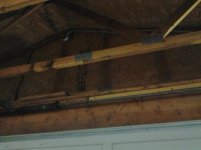
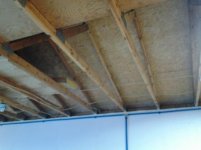
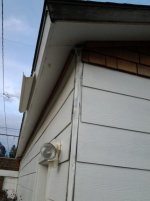
Here are some pictures of the soffits and roof deck.
There are charts and resources on the two websites I mentioned that can tell you the minimum levels of closed cell foam to avoid condensation issues.

DC
I've been working my way through both web sites. There is a wealth of information there. Thanks for the links.

Jim
 

Attachments

  • garage 02_11_15 (14).jpg
    garage 02_11_15 (14).jpg
    29.9 KB · Views: 45
  • garage 02_11_15 (9).jpg
    garage 02_11_15 (9).jpg
    26.9 KB · Views: 42
  • garage 02_11_15 (7).jpg
    garage 02_11_15 (7).jpg
    23.8 KB · Views: 41
  • garage 02_11_15 (5).jpg
    garage 02_11_15 (5).jpg
    29.1 KB · Views: 41
  • garage 02_11_15 (4).jpg
    garage 02_11_15 (4).jpg
    30.9 KB · Views: 40
  • garage 02_11_15 (10).jpg
    garage 02_11_15 (10).jpg
    31 KB · Views: 38

MagKarl

Well-known member
Joined
Oct 15, 2012
Messages
684
Location
Olympia, WA
Looks like standard framing to me, should be no reason at all you could not cut in soffit and ridge vents that would allow you to use inexpensive, standard building materials to finish it off. Sheet the ceiling and blow in insulation. Do it yourself and save big.
 
OP
K

kogerat

Member
Joined
Feb 8, 2015
Messages
13
Location
Spokane WA
Looks like standard framing to me, should be no reason at all you could not cut in soffit and ridge vents that would allow you to use inexpensive, standard building materials to finish it off. Sheet the ceiling and blow in insulation. Do it yourself and save big.

There are 2x4s between the rafters blocking off the soffits. Do the 2x4s serve some structural purpose, or can I just remove them? They look like they would block air flow from the soffit vent.
 

Attachments

  • garage 02_11_15 (10).jpg
    garage 02_11_15 (10).jpg
    31 KB · Views: 19
  • garage 02_11_15 (11).jpg
    garage 02_11_15 (11).jpg
    24.8 KB · Views: 17

DC73

Well-known member
Joined
Dec 27, 2014
Messages
1,627
Location
Lubbock TX
There are 2x4s between the rafters blocking off the soffits. Do the 2x4s serve some structural purpose, or can I just remove them? They look like they would block air flow from the soffit vent.

Obviously if you're going with spray foam, you'll just leave them be. But if you are considering a vented attic like MagKarl suggested, you'll have to find out if they serve some kind of structural purpose (maybe as nailing blocks for roof deck??) and whether or not they can be easily removed.

You could just drill holes in the middle of the blocks. I would think you could get enough holes in each block to provide adequate attic ventilation. There are ways to calculate how much area you need for soffit and ridge vents. Just make sure the holes drilled provide the needed area and do the same for the soffit vents you install to the outside.

Double check your trusses and make sure they can support the weight of the sheetrock. Apparently, not all trusses are designed for a sheet rock ceiling load.

DC
 

MagKarl

Well-known member
Joined
Oct 15, 2012
Messages
684
Location
Olympia, WA
The blocks normally serve no purpose other than to keep birds out. Typically they have holes covered with screen and come in a bundle with the trusses.
 
To avoid these ads, REGISTER NOW!
OP
K

kogerat

Member
Joined
Feb 8, 2015
Messages
13
Location
Spokane WA
The blocks normally serve no purpose other than to keep birds out. Typically they have holes covered with screen and come in a bundle with the trusses.
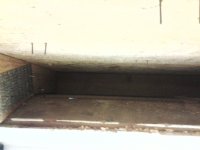
Thanks for your reply. I removed a block and it looks as if it does give some support to the rafters as well as keep birds out. I could bore holes in the blocks and cover the holes with screen, put screen vents in the soffits, and install a full length ridge vent to ventilate the roof deck. This would be more labor intensive than spray foam, but my labor is cheap. The picture on left is before I removed the block, picture on right is after block is removed.
 

Attachments

  • before.jpg
    before.jpg
    25.9 KB · Views: 16
  • after.jpg
    after.jpg
    124.6 KB · Views: 16
Last edited:
OP
K

kogerat

Member
Joined
Feb 8, 2015
Messages
13
Location
Spokane WA
Last edited:
OP
K

kogerat

Member
Joined
Feb 8, 2015
Messages
13
Location
Spokane WA
Platonic Solid & earthworks,
I was wondering about that. Even if I had to put a thermostatically controlled fan in one of the gable vents. Its not like I'm living in there.
Jim
 

earthworks

Well-known member
Joined
Sep 22, 2014
Messages
73
Location
Northwestern Ontario, Canada
Platonic Solid & earthworks,
I was wondering about that. Even if I had to put a thermostatically controlled fan in one of the gable vents. Its not like I'm living in there.
Jim

I think even the fan is overkill. There is a specific formal to calculate airflow, and vents are sized accordingly. 300 sqft of attic space to 1sqft of ventilation. Ridge vent preferable, but a gable vent would work if at the peak.
 

DC73

Well-known member
Joined
Dec 27, 2014
Messages
1,627
Location
Lubbock TX
If you do Gable vent (at peak like earthworks said), don't do ridge vent.

Just curious, why do you say that? If gable vents are sufficient, you don't necessarily need any additional vents but I don't see why a combination of ridge vents and gable vents is a no-no. I know of two houses built without soffits that use gable vents down low as intakes and ridge vents up high for exhaust.

DC
 
OP
K

kogerat

Member
Joined
Feb 8, 2015
Messages
13
Location
Spokane WA
Thanks guys for the replies. If I were to go with gable vents, it seems to me that with a vent in either gable, a path for air flow would be created through the attic. Hence the idea of the fan, although it may be unnecessary.
I could also see gable vents mounted low in the gables with a ridge vent creating a convection flow as hot air rises. What I'm not clear on is does the ridge vent run the full length of the ridge, or there individual vents mounted along the length of the ridge at regular intervals.
Also, I thought that the idea of vent channels running from the soffits to the ridge was to create a sweeping action on the underside of the roof deck. Is this sweeping action unnecessary in a structure that is not continuously occupied?
I don't see this sweeping action occurring with gable vents, or a combination of gable and ridge vents. I do however, see a turning over of air with these venting strategies. Is this enough to vent a structure that is not going to be continuously occupied?
At the end of the day, I don't want waste money and time on venting and insulation solutions that are way overkill. But, I will invest the money and time necessary to do the job right to avoid problems down the road. Again, thanks guys for your input.
Jim
 
OP
K

kogerat

Member
Joined
Feb 8, 2015
Messages
13
Location
Spokane WA
Just curious, why do you say that? If gable vents are sufficient, you don't necessarily need any additional vents but I don't see why a combination of ridge vents and gable vents is a no-no. I know of two houses built without soffits that use gable vents down low as intakes and ridge vents up high for exhaust.

DC
I got the impression Platoinc Solid is saying vents at the top of the gable and ridge vents would be redundant due to their proximity to one another.
 

Platonic Solid

Well-known member
Joined
Nov 29, 2014
Messages
3,587
Location
CT-USA
I got the impression Platoinc Solid is saying vents at the top of the gable and ridge vents would be redundant due to their proximity to one another.
Correct, thus reducing air flow in the center of the attic. I think it's a common mistake that people let their roofers talk them into.

I had to research this when my roofer offered to put ridge vents on my gable vented attic.
The air will enter the gable and exit the nearby ridge vent leaving the air in the center of the attic stagnant.
 
Last edited:

DC73

Well-known member
Joined
Dec 27, 2014
Messages
1,627
Location
Lubbock TX
I had to research this when my roofer offered to put ridge vents on my gable vented attic.
The air will enter the gable and exit the nearby ridge vent leaving the air in the center of the attic stagnant.

Makes sense. Around here we don't have to ventilate for humidity reasons, just to exhaust heat so you see a lot of different methods, all of which seem to work.

What I'm not clear on is does the ridge vent run the full length of the ridge, or there individual vents mounted along the length of the ridge at regular intervals.

If you are going with soffit vents, I like a continuous ridge vent. If you are going with low mounted gable vents, given Platonic Solid's advice, I'd install some centrally located ridge vents so the air has to move from the low mounted gable vents to the center of the space and then out.

DC
 
To avoid these ads, REGISTER NOW!
Top Bottom