To avoid these ads, REGISTER NOW!

roof fall protection

tcpoob

Well-known member
Joined
Oct 26, 2010
Messages
246
Location
Boston
guys, i need some help. i am sick of the amount of snow on my roof. i've a 2300 sq ft colonial, 2 story. i can climb out the 2nd flr BR window on to of a flat roof over the screened porch. Once there i plan to set up a ladder with a standoff-stabilizer to access the gable roof of the main house. the pitch is about 30 degree. there is vent pipe (steel) at the mid front, and chimney on one end of the house and the other part has some braces that support several solar panels for hot water.

could you recommend a simple safety / fall protection that i can attach to myself just in case? i know i have to figure out where i would anchor it to on the other end, maybe the chimney or the solar panel support. i picture it'll be a body harness that i wear, attached to a adjustable lanyard as i roam the roof ... hopefully the other end tied down to the chimney or something ... am i crazy? there is serious ice dam water problem in one of the bedrooms and i am just so sick of it.

anything from zoro.com or homedepot would do. links to products , tips / suggestions are welcome. thank you very much.
 
To avoid these ads, REGISTER NOW!

DonPowers

Well-known member
Joined
Dec 7, 2014
Messages
4,398
Location
On The Hair At The End Of The Dog's Tail
Roofing fall protection kits are available from several vendors. I have a MSA kit, which was around $160, that included the harness, 20 - 25 ft rope lanyard with follower and anchor which would be nailed on the peak of the roof. The whole kit came in a plastic bucket.

The tie off point is critical. In the industrial world, the tie off requires a 5,000 lb rating to safely arrest a fall and commercially available anchors meet this rating.

Something else to consider when using a long lanyard, especially when it is attached at one end of the structure, is the length of arc when you move horizontally away from the anchor. If you do slip, you could swing down and possibly off the edge. Again, in the industrial world, we use what's called a rat line to minimize / eliminate this effect. The line would go along the peak from one end of the roof to the other and your lanyard would be attached to and follow the line, so that your lanyard would be mostly perpendicular to the rat line at all times.

Good Luck with your ice dam and be safe out there.
 
Last edited:

Zeke

Well-known member
Joined
Aug 13, 2009
Messages
17,176
Location
Long Beach CA, the sewer by the sea.
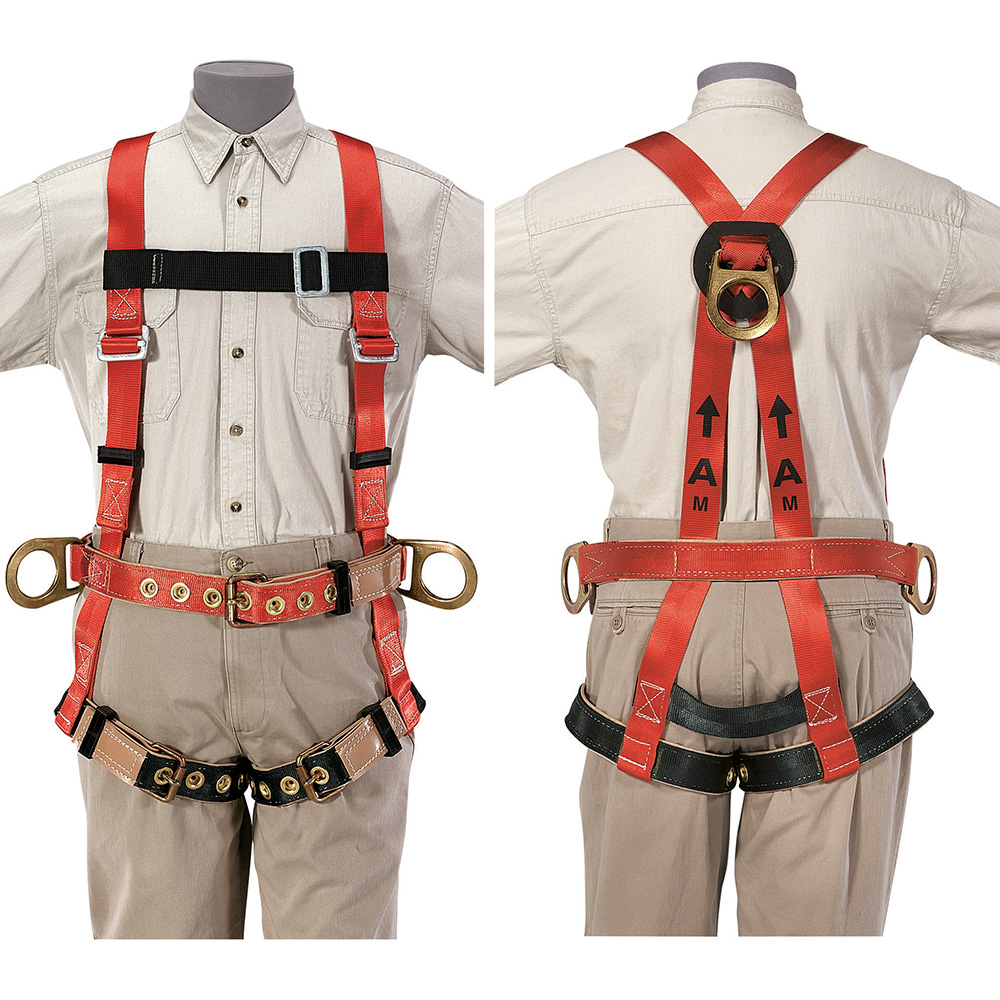
What Don said. You may not have to get fancy, but having your rope going straight up from where you are is the way to go. And, it's not just a fall protection system. You can use climber's knots and pull up some tension so you can work with both hands. You'll need a climber's harness with the rings to do that. There are 2 types of harnesses: a basic climber's harness and a fall protection harness. This is fall protection:

ABC-fall-arrest.gif


This is a type of climbing harness which won't do you much good if you're upside down:

photos.demandstudios.com%2Fgetty%2Farticle%2F81%2F102%2F92820595_XS.jpg


You need both features if you want to use the harness for support.

87080.jpg
More than one rope is needed. You can get a center ring too.

85503.jpg


In fact, you can get whatever you want, hip rings, chest rings, back rings. Just decide which direction you want to face to work.
 
OP
T

tcpoob

Well-known member
Joined
Oct 26, 2010
Messages
246
Location
Boston
thanks guys. if all/most roof anchor require nailing onto the roof, wouldn't that potentially cause leak at the nail punctures? is the roof anchor removed after every use, or it's ok to leave there for future uses ( residential, my own house ) ... ?
 

RivennHewn

Well-known member
Joined
Jun 4, 2011
Messages
10,385
Location
PNW
Some anchors are for temporary use, and some are for permanent installation.

The ones that are to be left on the roof are designed to be weather proof.
 

alwaysFlOoReD

Well-known member
Joined
Sep 24, 2013
Messages
2,408
Location
Airdrie, Alberta, Canada
You CANNOT just nail it into the roof, you must connect into a truss. I would tie off to a vehicle using the trailer hitch and a shackle after removing the battery. Of course you will need to move the vehicle when it comes time to do the opposite side. There is a difference between fall arrest and fall restraint.
 

RivennHewn

Well-known member
Joined
Jun 4, 2011
Messages
10,385
Location
PNW
You CANNOT just nail it into the roof, you must connect into a truss. I would tie off to a vehicle using the trailer hitch and a shackle after removing the battery. Of course you will need to move the vehicle when it comes time to do the opposite side. There is a difference between fall arrest and fall restraint.

I believe Labor & Industries would frown on tying off to a car.
 

alwaysFlOoReD

Well-known member
Joined
Sep 24, 2013
Messages
2,408
Location
Airdrie, Alberta, Canada
I took a fall protection course. The owner of the safety company with the same course is the one that described using a vehicle. Personally I would be comfortable with a rope around the chimney and cork boots, but I wouldn't reccomend that to someone else.
 

CNGsaves

Well-known member
Joined
Sep 26, 2012
Messages
13,233
Location
KS and OK
^ ^ ^ +1 . . . . if you use chimney, have it just be "connection point" and have the ultimate anchor point be down on ground from a tree or vehicle.

Connecting a ladder to your secure line will give you some footing up there.

Good luck, but be careful.
 

Zeke

Well-known member
Joined
Aug 13, 2009
Messages
17,176
Location
Long Beach CA, the sewer by the sea.
A man falling can exert 5000# of force. Ropes are designed to stretch some, not a lot. If you were tied off to a slack steel cable, your injuries at the restraint point might exceed those if you hit the ground. If the rope is a noodle, well when do you stop falling? After you hit the ground? This ain't no bungee.

So the length of your rope is part of the equation. Tying off to a truck way over on the other side needs some consideration.
 

Jlbc212

Well-known member
Joined
Dec 7, 2013
Messages
1,530
Location
Northeast MA
Do you have water leaking into the house? A warming trend is in the forecast for this coming week. You've gone this long with the snow up there. It could disappear this coming week. Be patient.
 
OP
T

tcpoob

Well-known member
Joined
Oct 26, 2010
Messages
246
Location
Boston
that's a lot of good and interesting ideas. isn't the chimney strong enough to restraint a fall ? i understand the benefit of a shock absorbing lanyard/rope.

i don't have the option to tied off a truck/vehicle. it's the garage under plan and the car has no access to the front or rear of the house.

yes water is getting into a 2nd floor bedroom ceiling and light fixture. The weather may be warming up finally but with that comes melting and ice dam is backing the water up so the leak is worse today.

thanks for the good ideas. i'd a raised ranch with a relatively low pitch roof so i'd walked it to shovel snow off etc without any protection other than being extra careful, but you can never be too careful. Now with the 2 story colonial, i am hesitant to go up there without any protection. i installed a stainless steel mesh gutter guard in Dec, on a ladder, which i'd to re-position every few feet, and it was heavy, a 28' aluminum Werner. Speaking on which, i wonder if the gutter guard had made the ice dam worse.
 
Last edited:
To avoid these ads, REGISTER NOW!

jakemac

Well-known member
Joined
May 21, 2013
Messages
9,035
Location
New England
I have a similar house to the one you have, north of Boston. I REFUSE TO GO UP THERE IN THE SNOW. I bought more buckets to catch the water in the house. I'll deal with the repairs in the spring. Just keep an eye out for saturated plaster that might fall on you and try to keep outlets and lighting fixtures dry, or disconnect them (replacing the breaker on those circuits with a GFCI breaker would do it too). Depending on how wet the inside of the walls are, you may need to open the wall to dry it out when this is over. You don't want mould to take over.

I shoveled off the lower flat roof areas. And then used a long roof rake to get what snow I could reach off the gutters. I'll let the warmer weather next week take care of the rest.

I wouldn't worry about the roof on the main house collapsing. It should be able to handle the snow that we got. The collapses we've been seeing on the news are from flat roofs and low rake roofs over large open spaces. Your house should have plenty of support under your trusses. Even the older building codes took snow load into consideration. Just clear off any flat spaces over porches.

Just remember, your homeowner policy won't cover injuries if you fall off the roof, and don't pay anyone to do it for you if they can't show you a copy of their own insurance policy that covers working on roofs.
 
Last edited:

metal1313

Well-known member
Joined
Apr 28, 2009
Messages
3,416
Location
clinton NJ
i live in an older home with yankee gutters, ie 3ft wide shallow, nearly flat gutters, the roof pitch is approximately 7/12 or so. the house is a T shape, the front of the T is asphalt but the majority of the house is slate.

my safety system is several proper roof tie ins, my rock climbing ropes harness, self belay device. climbing rope is not average rope, it has much more stretch and give. im not on the roof often, the tie ins were installed when i had to trim some trees over hanging the house. Also slate takes a special skill to walk on

i also have a ladder with two brackets off of it that i can hook on the roof. the base of which has spring loaded wheels so i climb to the peak and sit on it and can easily move the ladder.
 

DonPowers

Well-known member
Joined
Dec 7, 2014
Messages
4,398
Location
On The Hair At The End Of The Dog's Tail
i live in an older home with yankee gutters, ie 3ft wide shallow, nearly flat gutters, the roof pitch is approximately 7/12 or so. the house is a T shape, the front of the T is asphalt but the majority of the house is slate.

my safety system is several proper roof tie ins, my rock climbing ropes harness, self belay device. climbing rope is not average rope, it has much more stretch and give. im not on the roof often, the tie ins were installed when i had to trim some trees over hanging the house. Also slate takes a special skill to walk on

i also have a ladder with two brackets off of it that i can hook on the roof. the base of which has spring loaded wheels so i climb to the peak and sit on it and can easily move the ladder.

Looks like you have your bases covered.

I installed a roof hatch, near the ridge in the center of the building, with a tie off point. My back pitch is 10-12 and the dormer is 5-12 with metal roof on both sides, so it can get very slippery especially when wet. Its also 30 ft to the ground from the peak. So far, the hatch has only been used during construction and I haven't had the need to get up there yet. If I ever have to go out there in the future, it will sure be better than climbing a ladder. Just putting this out for others to consider whether or not to install a hatch. The best time to do it is when you are building but they can be retrofitted.

Here is a photo with the hatch open.

View media item 45824
 
Last edited:

gte718p

Well-known member
Joined
Mar 12, 2009
Messages
3,977
This is a type of climbing harness which won't do you much good if you're upside down:

photos.demandstudios.com%2Fgetty%2Farticle%2F81%2F102%2F92820595_XS.jpg


Really, that comes as a significant surprise considering how much time I spend upside down in my harness. I enjoy repelling head down. Lots of fun and I have a nasty habit of going head first especially of overhangs. Have not fallen out of my harness yet. Of course it is important to have a proper fitting harness and be properly strapped in.
 

Jlbc212

Well-known member
Joined
Dec 7, 2013
Messages
1,530
Location
Northeast MA
that's a lot of good and interesting ideas. isn't the chimney strong enough to restraint a fall ? i understand the benefit of a shock absorbing lanyard/rope.

i don't have the option to tied off a truck/vehicle. it's the garage under plan and the car has no access to the front or rear of the house.

yes water is getting into a 2nd floor bedroom ceiling and light fixture. The weather may be warming up finally but with that comes melting and ice dam is backing the water up so the leak is worse today.

thanks for the good ideas. i'd a raised ranch with a relatively low pitch roof so i'd walked it to shovel snow off etc without any protection other than being extra careful, but you can never be too careful. Now with the 2 story colonial, i am hesitant to go up there without any protection. i installed a stainless steel mesh gutter guard in Dec, on a ladder, which i'd to re-position every few feet, and it was heavy, a 28' aluminum Werner. Speaking on which, i wonder if the gutter guard had made the ice dam worse.

I wouldn't trust the chimney as a tie-off unless you can give it a thorough inspection first. The gutter guard may have made the situation worse. Even if you could safely get onto the roof, it will probably be very difficult at this point in time to break up the ice dam at the edge of the roof, particularly if the temps are near or below freezing. It will also be difficult to get the snow off as it has probably thawed and refrozen making it very difficult to move. Get out the heavy Werner and try to move some of snow with a snow rake while you stand on the ladder. This will help you determine if getting up onto the roof is worth the risk, expense and effort.
 

gungatim

Well-known member
Joined
Jan 8, 2013
Messages
8,101
Location
west mich
You CANNOT just nail it into the roof, you must connect into a truss. I would tie off to a vehicle using the trailer hitch and a shackle after removing the battery. Of course you will need to move the vehicle when it comes time to do the opposite side. There is a difference between fall arrest and fall restraint.

This is what I did when I had to put in a exhaust fan in a attic bathroom of a steep cape cod roof. went and bought 300ft of 500 lb test rope and tied to my pickup parked in front of the house. didn't remove the battery though, what was the reasoning behind that something electrical related? or so nobody drove away with it?

I wouldn't be hanging from any rope in this situation but it's enough to steady yourself in case you slip...
 

theoldwizard1

Well-known member
Joined
Feb 22, 2011
Messages
43,246
Location
SE MI
but you'll need a rope and harness to do it right.

Read and understand the instructions.

Your best/quickest tie off point is OVER the ridge and down to a large tree or vehicle !

Too much slack is bad. You won't die from hitting the ground, but you can get pretty messed up dropping 5-10' off of a roof and coming to an abrupt stop at the end of the rope.
 

theoldwizard1

Well-known member
Joined
Feb 22, 2011
Messages
43,246
Location
SE MI
Really, that comes as a significant surprise considering how much time I spend upside down in my harness. I enjoy repelling head down. Lots of fun and I have a nasty habit of going head first especially of overhangs. Have not fallen out of my harness yet. Of course it is important to have a proper fitting harness and be properly strapped in.

Most people get very disoriented, quickly, being upside down !

One of the "Ax Men" got "ahead of himself" showing off for the camera and managed to "out climb" his rope around the trunk ! Yep, flip himself over about 20' up. the only thing saving him was the friction of the rope on the bark on the opposite side of the tree !! Very difficult to get him flipped back over.
 

Mandres

Well-known member
Joined
Jun 22, 2006
Messages
1,158
I'm a fan of the arborist-style climbing systems. You use a friction hitch (prussik knot) to advance up and down a static line so there is no slack as long as you tend the hitch. For an anchor point I've used my Jeep with the battery unhooked. I can see how the lines might get in your way working on a roof though.

split6.bmp
 
Last edited:
OP
T

tcpoob

Well-known member
Joined
Oct 26, 2010
Messages
246
Location
Boston
i see my roofer and home inspector just go up and walk my roof without any fall protection. Do they wear special boots with super traction? i know they do it for a living so i am not copying. Please also recommend some good shoes / boots for this purpose. it's the normal 3 tab ( non dimensional ) asphalt shingle roofing.

oh i've an attic hatch w pull down folding ladder. i'm paranoid about leak / water / heat if i'd a roof hatch but i see it could be useful for maintenance. never seen that however.
 

theoldwizard1

Well-known member
Joined
Feb 22, 2011
Messages
43,246
Location
SE MI
I'm a fan of the arborist-style climbing systems. You use a friction hitch (prussik knot) to advance up and down a static line so there is no slack as long as you tend the hitch.
Arborists know, "It is not the fall that will kill you, it is the sudden stop at the end !"

A slack harness may prevent death, but the broken back and messed up internal organs from the sudden stop 6' off the ground may make you wish you were !
 
To avoid these ads, REGISTER NOW!
Top Bottom