To avoid these ads, REGISTER NOW!

Cost of copper

taylormade

Member
Joined
Oct 10, 2007
Messages
14
Location
Staunton, Illinois
Just when I had the money and the time to put in my compressor lines and had decided to use black pipe due to cost and my novice standing soldering copper pipe, I went into the big orange box and found out 1 inch copper pipe in now 18 bucks and change for a ten foot length vs. 24 bucks and change for black iron. The copper fittings are more, but I figure the cost to be even or slightly lower with copper.

So, never having soldered much, am I asking for trouble if I go the copper route? Several people have commented that copper can be more easily damaged than the iron - anyone have any problems in this area? I think I will be dead before the iron pipe rusts through, so I don't see that as an issue.

Planning on buying the materials this weekend, what do you think? And don't worry, PVC never entered into the equation.
RT
 
To avoid these ads, REGISTER NOW!

pipehack

Well-known member
Joined
Feb 23, 2009
Messages
923
Location
chicago
dude if it wasn't such a cruise I'd get the fittings and sweat it for you. I'm laid off right now so I wouldn't be able to get em' for free right now.
 

isr2kba

Well-known member
Joined
Apr 6, 2009
Messages
324
Location
MA
Several people have commented that copper can be more easily damaged than the iron - anyone have any problems in this area?

Maybe so, but it's also a hell of a lot easier to repair.

Choice of material should depend on the environment and complexity of installation, not necessarily cost. For example if there are a lot of bends and twists, copper is a lot easier. Copper also looks a lot better. If folks are going to be hanging things off the lines and using them as anchor points for come-alongs, then you better go with iron.
 

flesburg

Well-known member
Joined
Aug 15, 2006
Messages
105
Location
Pontiac, IL
Get good flux and great solder. Not walmart stuff. Ask at a plumbing supply house. Then get brushes to clean the inside of the fittings and scouring pads made for stripping paint (mine re 3" x 5" x 1/2" and are dark red). Get both sides of each joint VERY CLEAN!!!!! Flux and heat until the joint is hot enough to melt solder. Do several joints at once. Use cold water in a bucket to cool it quick, and cold wet rags as a heat sink to avoid remelting solder at a nearby joint. Get a piece of fire blocking material. Mine is about 8x10". Use behind what you are soldering to keep from setting things on fire. Wear a leather work or welders glove on your left hand so you can "hang on" to smaller assemblies. Get a bunch of fittings and cut some short pieces and practice. I always do the smaller assemblies at an old card table while setting on a chair. Maybe its just old age. Once you get the hang of it, you will be successfully soldering joints overhead while standing on the top rung of an 8' ladder. Its just like ***, it gets better with practice.
 

nate379

Banned
Joined
Feb 2, 2009
Messages
7,279
Location
Palmer, AK
It's not hard. My Dad taught me in less than 5 mins last week actually. (Have to install a water softner and sink in the garage)
 

hetkind

Banned
Joined
Sep 28, 2008
Messages
995
Location
Johnson City, Tennessee
I prefer black iron for air distribution piping...yes it is a tough job to cut and thread pipe, but I find it is a much more durable installation. Now, the formable, high pressure aluminium tubing is VERY handy for oddball runs and as a flex connector.

Howard
 

GAW

Member
Joined
Apr 2, 2009
Messages
8
It ain't like you're running high pressure steam lines at a nuclear power plant-- 150- 175 psi max. Either copper or iron will work fine. Sweating joints is simple--- you can teach a kid to do it in 5 minutes. Schedule L is more than enough. If you want super heavy spend the bucks you don't need to and go with Sch M. If you like threading pipe, that'll obviously do fine. Either way will last a couple of lifetimes. I see people going nuts over air plumbing thinking they are building for an industrial site and then seen a length of unprotected 10-2 Romex feeding the compressor.--- Point is, don't sweat the stuff that doesn't make a tinkers damn either way.
 
OP
T

taylormade

Member
Joined
Oct 10, 2007
Messages
14
Location
Staunton, Illinois
I thought L was heavier than M. The 18 bucks was for schedule L. I'd practice on some fittings if they weren't so expensive!

How likely am I to get a leaking connection? I assume it's fairly easy to repair if you do mess up a joint. On the T connections, should I heat the whole thing up and solder all three joints at once? Seems like too small an area to get a good heat sink on doing it one at a time. If you do melt out a finished joint, what happens - do you have to take everything apart and redo it. If it's anything like an electrical joint, once you melt it it loses its strength even though it rehardens as it cools. I guess these are pretty basic questions, but that's why I go on this forum.
RT
 

pipehack

Well-known member
Joined
Feb 23, 2009
Messages
923
Location
chicago
DO NOT USE WATER TO COOL THE PIPE!!!!!!!!!!!!!!!!!!!!!!!!!!!!!!!!!!! you can actually break the solder joint doing that. I learned the hard way AND I'm a licensed union plumber. That is VERY WRONG. The rest of the advice is good.
 

rickairmedic

Well-known member
Joined
May 31, 2005
Messages
4,165
Location
louisville ,Ky
Soldering Copper is easy as pie nothing to it . Buy a 10' stick or 1/2" and a bag of 1/2" 90's and make a yard ornament out of it a couple T's thrown in for creativity . Clean the joints well for every joint I prefer Krocus cloth/plumbers tape which can be had at Home depot . Get a tub of oatey flux and about a 1/2 dozen or so acid/flux brushes and practice away with your 1/2" yard ornament . Leave one end open so you can fill it with water to check your joints :D. Once you are comfy with soldering on the yard ornament you are ready to do the air lines it really isnt rocket science . I prefer Mapp gas over propane for soldering as it heats the joint quicker and gets the job done faster . Once you see the Flux bubbling the joint should be about hot enough to add solder to . Heat the fitting so that the solder pulls into the joint . Once you have one side of a coupler done move the heat to the other side and solder it . I dont use alot of T's in HVAC work but usually on a T start on one side then move to the center then the other side . Basic rule of thumb on a good joint is usually figured at if its a 1/2" pipe and joint a little over 1/2" of solder should make the joint 3/4" pipe 3/4' solder and so on .I have taught alot of young guys to solder by showing them the basics and then sitting them down at a workbench with a tubing cutter and a small pile of 1/2" fittings and a 10' stick of 1/2" and telling them to make SWMBO something nice to stand up out in her garden :D. Youtube will most likely have a few decent videos on soldering .

Rick
 

Torque1st

MEMBER EMERITUS
Joined
Sep 14, 2008
Messages
5,668
Location
KC Metro, Kansas
Save some more bucks, for most home shops 3/4" distribution lines and 1/2" for drops is big enough. Go to a plumbing supply store and get some Easy-Flo 50% silver solder. Do not use the basic plumbing solder.
 
To avoid these ads, REGISTER NOW!

kool55

Well-known member
Joined
Aug 25, 2007
Messages
382
Location
South Central VA.
Since I only want to do this once and am into restoring cars, I'm going with a one inch system. Probably overkill, but I'm going with it.
RT

You are correct in that 1'' is overkill for a home shop. I ran 3/4 bip in my work shop that has 5 heavy equip. mechanics . No problems. At my home shop I just finished installing a 3/4 copper loop system around[42x60] with drops to 4 hose reels. This was quicker and easier than bip. I have done both.
 

Torque1st

MEMBER EMERITUS
Joined
Sep 14, 2008
Messages
5,668
Location
KC Metro, Kansas
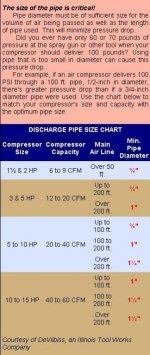
Check out this chart. Remember they are talking REAL HP here not the foo-foo HP they advertise on most compressors. You can generally find the approximate real HP your compressor has by looking up the full load amps the motor draws.

Code:
Single Phase Alternating Current Motors Full Load Current in Amperes
from the NEC: 
-----------------------------
HP_____  115V_____  230V 
-----------------------------
1_____ 	 16_____    8 
1.5_____ 20_____    10 
2_____   24_____    12 
3_____   34_____    17 
5_____   56_____    28 
7.5_____ 80_____    40 
10_____  100_____   50
 

Attachments

  • AirLineSizeChartR.jpg
    AirLineSizeChartR.jpg
    54.4 KB · Views: 95
Last edited:

SteveU

Well-known member
Joined
Nov 20, 2006
Messages
1,243
Location
Michigan
Since I only want to do this once and am into restoring cars, I'm going with a one inch system. Probably overkill, but I'm going with it.
RT

Good call, it will cost more up front but like you said it will only have to be done once.:thumbup: Was changing the passenger side half shaft on my toyota & after taking off all 4 lug nuts & the axle nut the impact seemed to be running slow. Looked at the compressor & the ball valve was turned off, did all this off the air stored in 45' of 1" pipe. The larger size will allow the air to move thru the pipe slower which will help cool it & take the water out of it better for a given length + will provide a little more storage.
 

sberry

Banned
Joined
Jun 18, 2005
Messages
35,747
Location
Brethren, Michigan
I agree with Torque here, anything above 3/4 is a waste in a small shop, 1/2 will even do. Most tools are connected with 3/8 line, thats where the real loss is. I have a couple 100 ft runs from 3/4, never an issue and I have large tools. I didn't even bother to loop it. The needs in small shops are usually wayyyyy over estimated.
 
OP
T

taylormade

Member
Joined
Oct 10, 2007
Messages
14
Location
Staunton, Illinois
Although I'll run most of my tools off a 3/8 line, I'll be running my sandblaster with a 1/2 hose. I know from experience I'll need the air to blast the frame of my 50 Dodge convertible. I'll stick with the 1 inch system. Thanks everyone for the help.
RT
 
OP
T

taylormade

Member
Joined
Oct 10, 2007
Messages
14
Location
Staunton, Illinois
26 SCFM @ 100 PSI with a 7.5 Baldor motor (I know about the bogus HP ratings, but this draws enough amps to be close). It's a two stage with an 80 gallon tank. It's done everything I asked of it and more with a hose straight off the tank, but the humidity in this area requires a piping system and so does my big shed.
RT
 

Torque1st

MEMBER EMERITUS
Joined
Sep 14, 2008
Messages
5,668
Location
KC Metro, Kansas
One thing to remember when figuring pipe size is a rule of thumb that every place the air takes a turn to get to where it is being used is equivalent to 10' of straight pipe run. So a main line run to the drop that is only 50 lineal feet may add 10' for the 90° out of the compressor and up the wall, then another 10' for the 90 at the main run, then another 10' for the 90 at a corner. Add another 10' for the turn into the drop, and omit the drop line size reduction for this exercise, and the other bends to the tool since we are sizing the main line. The equivalent run total would be 90' to the drop at the end of the run. Some people will omit that last 90 into the drop but I add it in.
 

krehmkej

Well-known member
Joined
Mar 20, 2009
Messages
197
Location
Oregon
I did mine with iron years ago, and wish to this day I'd done it in copper. No rust. probably cools quicker, too.
 

ovilla

Well-known member
Joined
Dec 18, 2005
Messages
2,342
Location
Plainfield, IL
When sweating large diam (1") copper I always use MAP gas and only do the end of one fitting at a time. I do the one side, wipe it with a damp rag, let it cool and repeat on the other end of the same fitting. I did my water softner like that and never had a leak. By the way, I was taught to remember (M)artin (L)uther (K)ing to remember that the smallest size is M, then it goes up to L, and then K. Thinking of MiLK will also help you remember this too. Best of luck!
 

pipehack

Well-known member
Joined
Feb 23, 2009
Messages
923
Location
chicago
Martin Luther King ?? That's a good one. I never heard of that but it's good. I'll have to tell apprentices to use that. Wait till the joint solidifies before you use a damp rag on anything. You can actually see it harden. Do all the joints on the fitting before cooling. Don't do one side of a 90 and shut the torch off , then do the other side shut the torch off. That's a good way to possibly have a leak. As far as MAPP V.S. propane. If you have a bottle torch then yes MAPP. If you have a turbo torch set up with a 20 lbs propane tank and bigger tips then propane is fine. I've used propane on 6" copper without a problem.
 
OP
T

taylormade

Member
Joined
Oct 10, 2007
Messages
14
Location
Staunton, Illinois
Bought the copper today. It was actually about fifty bucks cheaper than black iron. I'm putting it up this weekend. I'll post photos when I'm done.
RT
 
To avoid these ads, REGISTER NOW!
Top Bottom