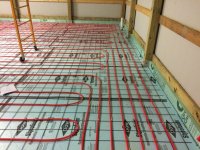
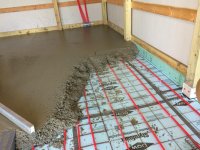
Took me a month preparing and installing stuff but it turned out great..Slab is about 6.5-7" thick, with 1,250' of 1/2" pex throughout


You are using an out of date browser. It may not display this or other websites correctly.
You should upgrade or use an alternative browser.
You should upgrade or use an alternative browser.
Finally got my Radiant heated Floor Done!
- Thread starter tmcelheny
- Start date






BigGMC
Well-known member
Nice work!
Never seen one of those conveyor type extensions before - that's the cats ***! Trucks only seem to have the chutes by me.
Never seen one of those conveyor type extensions before - that's the cats ***! Trucks only seem to have the chutes by me.
mx842
Well-known member
That's a really neat and well laid out floor. I love it when a well thought out plan comes together. I know you will love it. I love mine even with all the troubles I have had with my crappy old boiler I have been trying to use. What are you going to use the heat the water?
That's a first for me to on the concrete conveyors, that's a neat idea probably cheaper than pumping.
That's a first for me to on the concrete conveyors, that's a neat idea probably cheaper than pumping.
rieferman
Well-known member
Thatta boy, looks awesome.
Also curious about what heat source you'll use. A couple of my customers from previous life in post-frame sales used a water heater (like you'd use in your home) and have been happy for years. But, I'll admit, I don't know the pros/cons of the various options.
Also curious about what heat source you'll use. A couple of my customers from previous life in post-frame sales used a water heater (like you'd use in your home) and have been happy for years. But, I'll admit, I don't know the pros/cons of the various options.
I may go with one of those "flash heaters" for about 1100 bucks that mount on the wall and run on propane. But I am pretty sure I will be installing an outdoor furnace in the next few years... I have thought about trying a residential hot water heater but I've heard they won't recover fast enough. Still might be worth a shot for the price. Just to keep the chill off this winter. Thanks fr the compliments And yes the conveyer truck is the only way to go if u can get it. In my opinion
dlhindiana
Member
Nice! You planning your layout for the future outdoor furnace or will you just redo if needed when you install the outdoor furnace? Is that just duct tape you used to tape the insulation together?
bigman68
Well-known member
Looks, great. Just wondering though, it looks like you put the Tuf-Tite trench drain directly on top of the foam?
VHF
Well-known member
Are you talking electric or propane? A domestic electric water heater is typically 4,800 watts, which translates to 16,320 BTU/hr. That might be just enough to keep a well insulated garage warm, but running continuously it will cost you $345/month at $0.10/kWh.I have thought about trying a residential hot water heater but I've heard they won't recover fast enough.
A propane water heater is typically 40,000 BTU/hr or larger, so it should have the capacity to heat up a cold garage. Whether it is any cheaper to operate than electric depends on your electric cost vs. propane price. I use $1.72/gallon as the "break-even" point when compared with $0.10/kWh electric.
The wall-mounted "flash heater" you mention (either propane or electric) would be a better choice than a domestic water heater as it is designed for that job and you aren't trying to heat 40 gallons of water in addition to your floor.
A renewable bio-fuel heated garage would be the best way to go in my book, and even if you have to buy wood the cost per BTU is much less than other fuels. Try to get a wood gassifier--more expensive up front, but much cleaner burning and uses less wood.But I am pretty sure I will be installing an outdoor furnace in the next few years...
If it is generally sunny in your area in winter you might also consider solar. For a garage, you could hook up an array of thermal solar pannels directly to your floor loops. No need for a storage tank, your floor provides the thermal mass. You will get some temperature swings (and overnight cooling) that might be unacceptible in a house but are OK in the garage. Easy to combine with an electric or propane "flash heater" for backup.
TractorJeff
Well-known member
Hanson Concrete trucks running around Olean, NY have conveyors on them. They found them beneficial on Bridge pours.
Are you talking electric or propane? A domestic electric water heater is typically 4,800 watts, which translates to 16,320 BTU/hr. That might be just enough to keep a well insulated garage warm, but running continuously it will cost you $345/month at $0.10/kWh.
A propane water heater is typically 40,000 BTU/hr or larger, so it should have the capacity to heat up a cold garage. Whether it is any cheaper to operate than electric depends on your electric cost vs. propane price. I use $1.72/gallon as the "break-even" point when compared with $0.10/kWh electric.
The wall-mounted "flash heater" you mention (either propane or electric) would be a better choice than a domestic water heater as it is designed for that job and you aren't trying to heat 40 gallons of water in addition to your floor.
A renewable bio-fuel heated garage would be the best way to go in my book, and even if you have to buy wood the cost per BTU is much less than other fuels. Try to get a wood gassifier--more expensive up front, but much cleaner burning and uses less wood.
If it is generally sunny in your area in winter you might also consider solar. For a garage, you could hook up an array of thermal solar pannels directly to your floor loops. No need for a storage tank, your floor provides the thermal mass. You will get some temperature swings (and overnight cooling) that might be unacceptible in a house but are OK in the garage. Easy to combine with an electric or propane "flash heater" for backup.
Thanks for the info! Im not sure wether electric or propane yet but i know i aint payin 345 a month!! Wow..lol As for the question about the drains.. They are 5" wide by 3' sections. ?3 in each bay) They were laid atop the stone bedding and they have rebar slots to hold them in place during the pour.. A little more info... I used 2" thick by 14" wide strips of insulation around the edge and embedded it 8-9" into the earth around it... The floor has 6" of 2b then a 6 mil vapor barrier then 1" foam insulation atop that. Then the welded wire mesh (zip tied) then the pex ( zip tied). The buioding is 40 deep and 30 wide. It took 5 loops none exceeding 270 l.f. And thats spaced 12" on center... Yes the seams are just industrial strength duct tape. It worked awesome..any other questions,, happy to answer
Last edited:
You can tell a homeowner laid it out. The lines are perfectly straight! Plumbers just slap the pex down and call it good enough.
Well done, OP. I took the time to get my layout like yours.
Thanks!
Nice! You planning your layout for the future outdoor furnace or will you just redo if needed when you install the outdoor furnace? Is that just duct tape you used to tape the insulation together?
I just have to decide how much money i want to spend between now and the time i buy my outdoor furnace (coal/wood burner)
VHF
Well-known member
You might check into what time-of-use (TOU) electric rates are offered in your area. With your thick slab you might be able to run an electric flash boiler just at night while on off-peak rates, which is some areas are $0.05/kWh or less. That should store enough heat to coast through the next day.
In any case, your PEX layout and slab look great! Just put in as much insulation as you can in the walls and roof and pay careful to attention to sealing up air leaks to minimize heat loss no matter what fuel you are using.
In any case, your PEX layout and slab look great! Just put in as much insulation as you can in the walls and roof and pay careful to attention to sealing up air leaks to minimize heat loss no matter what fuel you are using.
I just have to decide how much money i want to spend between now and the time i buy my outdoor furnace (coal/wood burner)
TMC, hey can you give me some details on your wall insulation there? Is that styrofoam under steel sheath?
pstnbly
Well-known member
Nice job, too bad the steel was not up in the slab more though.
TMC, hey can you give me some details on your wall insulation there? Is that styrofoam under steel sheath?
When I had the building put up I had 1/2" Rboard insulation installed between the metal and the girts.It has like a fiberglass coating on both sides. It adds a ton of sound proofing (metal bangs around when it heats and cools) and some R-value incase I decide to run a little heat before its time to stud in the walls.. My dad has been heating the same size pole barn with only the 1/2" rboard on the walls and blown in on the ceiling for the past 5 years with no problem.
http://www.atlasroofing.com/continuous-wall-insulation/rboard
Nice job, too bad the steel was not up in the slab more though.
Being the wire mesh was set atop foam, the foam tended to slouch down while the wire stayed firm and straight. It was only very minor hooking as we were worried about the tubing getting too high. Its probly in it an inch or better in most areas... It had great slate sub bedding, plenty of drainage with 2b bedding , 4000psi concrete 6-7"thick with fiberglass reinforcement in it.. I think it should be fine.
Last edited:
When I had the building put up I had 1/2" Rboard insulation installed between the metal and the girts.It has like a fiberglass coating on both sides. It adds a ton of sound proofing (metal bangs around when it heats and cools) and some R-value incase I decide to run a little heat before its time to stud in the walls.. My dad has been heating the same size pole barn with only the 1/2" rboard on the walls and blown in on the ceiling for the past 5 years with no problem.
http://www.atlasroofing.com/continuous-wall-insulation/rboard
I appreciate the link. Thanks for the info.
Alan Waters
Member
tricountytrail
Well-known member
Thanks for the info! Im not sure wether electric or propane yet but i know i aint payin 345 a month!! Wow..lol As for the question about the drains.. They are 5" wide by 3' sections. ?3 in each bay) They were laid atop the stone bedding and they have rebar slots to hold them in place during the pour.. A little more info... I used 2" thick by 14" wide strips of insulation around the edge and embedded it 8-9" into the earth around it... The floor has 6" of 2b then a 6 mil vapor barrier then 1" foam insulation atop that. Then the welded wire mesh (zip tied) then the pex ( zip tied). The buioding is 40 deep and 30 wide. It took 5 loops none exceeding 270 l.f. And thats spaced 12" on center... Yes the seams are just industrial strength duct tape. It worked awesome..any other questions,, happy to answer
Just wondering about how you set the elevation for the grading?
Did you dig out deeper.
I will have 1-2" stone vapor barrier then 4-6" concrete.
I am wondering where to set the top of the bottom 2x6 for floor elevation.
how are those floor drains working out? and more insulation pics?
Burl
Well-known member
If you're in the western part of PA, come and look at my system. Cheap and woks good!


If you're in the western part of PA, come and look at my system. Cheap and woks good!
You have anymore details of your system?
If you're in the western part of PA, come and look at my system. Cheap and woks good!
What are those things at the top of the tee above the water heater ?
theoldwizard1
Well-known member
What are those things at the top of the tee above the water heater ?
Water hammer preventer (?)
Looks like air bleeders.What are those things at the top of the tee above the water heater ?
Sent from my SM-G900V using Tapatalk
Looks like air bleeders.
Yup, that makes sense, thanks.
tricountytrail
Well-known member
Just wondering about how you set the elevation for the grading?
Did you dig out deeper.
I will have 1-2" stone vapor barrier then 4-6" concrete.
I am wondering where to set the top of the bottom 2x6 for floor elevation.
how are those floor drains working out? and more insulation pics?
Did you dig out deeper.
I will have 1-2" stone vapor barrier then 4-6" concrete.
I am wondering where to set the top of the bottom 2x6 for floor elevation.
how are those floor drains working out? and more insulation pics?
Burl
Well-known member
You have anymore details of your system?
Yes, bleeders. 30 gal gas hot water tank, using pink anti-freeze (for hydronic systems), anti-drainback valve, small red taco pump, valve sets from Ebay, oxygen barrier PEX (also from Ebay), expansion tank, 1/2 " copper pipe. Turn it on, let it heat up, it will basically bleed itself, start enjoying your heated garage!
Bottlecapdigger
Well-known member
Looks good. Nice simple basic design. I have a few questions, is the expansion tank on the return side or the discharge side? And same as the pump which side is it on? Thanks. BCD
homebuilt burner
Well-known member
Tricounty----to answer your question you need to determine top of floor height first then work down from there. You set the top of concrete floor then add all the dimensions and go down that far. For example if you want 6" of concrete and 2" of foam with 3" of 3/4" gravel 6+2+3=11 so you would have to dig down 11" form the top of concrete. Always start with the top of the floor as your bench mark. I would suggest after determining the top of floor you put a stake in the ground 10 or 15 feet away from the building and set the top of the stake at floor height then it won't get moved and you will have a good reference. Good luck.