To avoid these ads, REGISTER NOW!

Hardy board 500 vs Sheet rock

rinny_tin_tin

Well-known member
Joined
Dec 20, 2008
Messages
636
Location
Northern Virginia
This thread seemed to be the closest for this question -- has anyone used 1/2 inch hardy board instead of sheet rock for interior walls? I know the hardy product is heavier and costs more - but has anyone done this - and what are the advantages/disadvantages?
:headscrat
 
To avoid these ads, REGISTER NOW!

ddawg16

Well-known member
Joined
Jul 11, 2008
Messages
21,005
Location
S. California
I've used it to line the the shower walls.....

Harder to cut....outlet holes will be hell.....
Very heavy as compared to drywall

Except for it's added strength and water proof qualities, I can't really think of an advantage of it over drywall.

If you are wanting more strength and are not concerned about looks....go OSB. Almost as cheap as drywall.
 
OP
R

rinny_tin_tin

Well-known member
Joined
Dec 20, 2008
Messages
636
Location
Northern Virginia
I've used it to line the the shower walls.....

Harder to cut....outlet holes will be hell.....
Very heavy as compared to drywall

Except for it's added strength and water proof qualities, I can't really think of an advantage of it over drywall.

If you are wanting more strength and are not concerned about looks....go OSB. Almost as cheap as drywall.

I like 3/4-inch T/G OSB for the decking for the upper loft - however, I have this fire thing and the Hardi Board seems to becken me. Yea - its a ***** cutting the Hboard - but I'm trying out these shears by DeWalt - and they seem to work fine while preventing the dust. Since my garage is unheated, and I keep the doors open - I like the mold/wet performance of the Hboard over the sheetrock - however, I have yet to find anyone who has done this - aside from a definite wet app.
 

bmwpower

Super Moderator
Staff member
Joined
Apr 24, 2005
Messages
12,578
Location
NJ
Go with 5/8" sheet rock then...seriously. It's fire code rated stuff. I used that in my garage.

How would you plan on sealing the joints when using Hardiboard?
 
OP
R

rinny_tin_tin

Well-known member
Joined
Dec 20, 2008
Messages
636
Location
Northern Virginia
Go with 5/8" sheet rock then...seriously. It's fire code rated stuff. I used that in my garage.

How would you plan on sealing the joints when using Hardiboard?

I was planning on using the same slather used for sheetrock. The 5/8" is fine wrt fire, but I'm also concerned about the humid environment, etc
 

bmwpower

Super Moderator
Staff member
Joined
Apr 24, 2005
Messages
12,578
Location
NJ
I was planning on using the same slather used for sheetrock. The 5/8" is fine wrt fire, but I'm also concerned about the humid environment, etc

It will be hard to hide those joint lines. Are you going to be spraying the walls with water or something? I don't think you realize how much of a PITA hardiboard is to work with.
 
OP
R

rinny_tin_tin

Well-known member
Joined
Dec 20, 2008
Messages
636
Location
Northern Virginia
It will be hard to hide those joint lines. Are you going to be spraying the walls with water or something? I don't think you realize how much of a PITA hardiboard is to work with.

I know the nuisance dust the hardi board causes when cutting - however, aside from the added weight, I don;t think it will be that bad...I would think that I could feather the joints with joint compound as I do with reglar sheet rock..no? No - I won't be spraying the walls with water - however, the large unheated space will tend to get humid, and I had bad luck with water and sheet rock in a smaller garden shed....Perhaps I should look into green board or somethign else

Thanks
 

mmhouse

Well-known member
Joined
Aug 31, 2008
Messages
754
Location
Desert Southwest
Due to the fear of mold, there are many good water resistant or water-proof drywall options available today. I'd suggest you look around some more. Many of these would be much easier to work with and accomplish your goals better than Hardiboard.
 
Last edited:

uniongoon

Well-known member
Joined
Nov 18, 2008
Messages
106
Location
caesarea ontario
The nuisance dust from Hardy is cancerous, ( carcinogenic ) too so wear a mask. So many guys on site cutting this all day with no protection. I hope they invest in a life ins policy for their loved ones.
 

GDA

Well-known member
Joined
Nov 19, 2006
Messages
935
Location
Dallas, Texas
I used a thinner Hardiboard to finish out the lower half of my 2 car garage just a couple months ago. Yes its heavy, harder to work with and cutting is a bear (used a circular or jigsaw). I went with it because I wanted the additional water and humidity protection and also minimal fears of bumping parts or anything into a wall a punching a hole in the drywall. No worries as this stuff is sturdy! I can't imagine using 1/2 Hardiboard.

I finished out the upper half with pegboard. I am pleased with the results and functionality.
 
Last edited:
OP
R

rinny_tin_tin

Well-known member
Joined
Dec 20, 2008
Messages
636
Location
Northern Virginia
I used a thinner Hardiboard to finish out the lower half of my 2 car garage just a couple months ago. Yes its heavy, harder to work with and cutting is a bear (used a circular or jigsaw). I went with it because I wanted the additional water and humidity protection and also minimal fears of bumping parts or anything into a wall a punching a hole in the drywall. No worries as this stuff is sturdy! I can't imagine using 1/2 Hardiboard.

I finished out the upper half with pegboard. I am pleased with the results and functionality.

Good work - how did you finish the joints? I was thinking about using regular joint compound. How does it take paint?
 
OP
R

rinny_tin_tin

Well-known member
Joined
Dec 20, 2008
Messages
636
Location
Northern Virginia
The nuisance dust from Hardy is cancerous, ( carcinogenic ) too so wear a mask. So many guys on site cutting this all day with no protection. I hope they invest in a life ins policy for their loved ones.

Gotcha on this one -and I agree. Fact is - the dust from ordinary sheet rock is just as carcinogenic - however, much less dust is produced with sheet rock during the course of cutting than it is with Hardi-stuff -- using conventional cutting means. However, the DeWalt shears seems to almost eliminate the dust entirely.
 
To avoid these ads, REGISTER NOW!
OP
R

rinny_tin_tin

Well-known member
Joined
Dec 20, 2008
Messages
636
Location
Northern Virginia
I used a thinner Hardiboard to finish out the lower half of my 2 car garage just a couple months ago. Yes its heavy, harder to work with and cutting is a bear (used a circular or jigsaw). I went with it because I wanted the additional water and humidity protection and also minimal fears of bumping parts or anything into a wall a punching a hole in the drywall. No worries as this stuff is sturdy! I can't imagine using 1/2 Hardiboard.

I finished out the upper half with pegboard. I am pleased with the results and functionality.

You wouldn;t have any pics on this - would you?

Thanks
 

snorky18

Well-known member
Joined
Oct 1, 2007
Messages
1,170
Location
Southeast Tennessee
I just finished a full shower with Hardy board on the walls. Unless you need the water resistance or the puncture resistance, it's simply not worth the trouble to haul/cut/place.

Cost is about double, wears out your tools faster than drywall, wears out your body to install it, harder to cut than drywall, harder to put screws in than drywall, produces way more dust when you cut it, and good luck hanging anything on the wall without pre drilling a hole.

If you are that concerned about humidity/moisture, I would look into the fiberglass based paper free drywall. We've used it in most of our bathrooms etc and like it well.

If you ignore the advice of all these fine people and use it anyway, the easiest way I know to cut it is with an 4.5" angle grinder and the thinnest masonry disc. Wear a facemask and dustmask, and do it outside. I've heard good things about the shears and less dust, I just haven't ever had a need big enough to buy them. The dedicated Hardyboard shears are $$$, and you're probably going to go through some blades.
 

bmwpower

Super Moderator
Staff member
Joined
Apr 24, 2005
Messages
12,578
Location
NJ
I used a thinner Hardiboard to finish out the lower half of my 2 car garage just a couple months ago. Yes its heavy, harder to work with and cutting is a bear (used a circular or jigsaw). I went with it because I wanted the additional water and humidity protection and also minimal fears of bumping parts or anything into a wall a punching a hole in the drywall. No worries as this stuff is sturdy! I can't imagine using 1/2 Hardiboard.

I finished out the upper half with pegboard. I am pleased with the results and functionality.

By "thinner", what do you mean? How did you handle the joint between hardi and rock?

And hardi is not a smooth material. How did the walls come out?
 

snorky18

Well-known member
Joined
Oct 1, 2007
Messages
1,170
Location
Southeast Tennessee
By "thinner", what do you mean? How did you handle the joint between hardi and rock?

And hardi is not a smooth material. How did the walls come out?

Hardi comes in 2 thickness, 1/4" and 1/2".

IIRC the 1/4 is just as strong and more dense than the 1/2, the purpose of the 1/2 is to put on walls to **** up next to 1/2 sheetrock

For the joint between the two, you treat it just as a drywall joint, tape then mud.

It's worth noting though that the 1/2" is not truly 1/2", it's more like 0.4", so it is a PITA to join to 1/2" drywall in interior applications where you expect it to look seamless. I Learned that one the hard way.

I'm not sure how the walls would look painted, all of our Hardy that wasn't under tile was covered in drywall mud to cover the aforementioned bump in the wall from the difference in the thickness of the two materials.
 
OP
R

rinny_tin_tin

Well-known member
Joined
Dec 20, 2008
Messages
636
Location
Northern Virginia
Hardi comes in 2 thickness, 1/4" and 1/2".

IIRC the 1/4 is just as strong and more dense than the 1/2, the purpose of the 1/2 is to put on walls to **** up next to 1/2 sheetrock

For the joint between the two, you treat it just as a drywall joint, tape then mud.

It's worth noting though that the 1/2" is not truly 1/2", it's more like 0.4", so it is a PITA to join to 1/2" drywall in interior applications where you expect it to look seamless. I Learned that one the hard way.

I'm not sure how the walls would look painted, all of our Hardy that wasn't under tile was covered in drywall mud to cover the aforementioned bump in the wall from the difference in the thickness of the two materials.

Yes -- it is indeed 0.4-inch. The shears were not that expensive - less than $250 and they say the blades should last about 5 houses - considering that figure is based on HBoard siding. I have used HiBoard many times for floors/tiles and I prefer HBoard over Duro-rock - which makes a PITA feel good :) However, given that is it suited for outdoor use - and despite the somewhat extra weight and somewhat extra cost (I can get it for only about 15% more than 5/8-inch sheetrock for the quantity I need) I feel compelled to break ground and try this out.
 

GDA

Well-known member
Joined
Nov 19, 2006
Messages
935
Location
Dallas, Texas
Good work - how did you finish the joints? I was thinking about using regular joint compound. How does it take paint?

I have been slowly working on finishing out the interior of my garage so the lower walls, border area between lower hardi and upper pegboard has not been finished. I have been spending my money and time the last couple months on other items like finishing insulating the ceiling and buying and installing a window AC/heat unit. I am going to drywall the ceiling next and then will detail out the walls and paint. Right now its just plain white pegboard and 1/4 Hardi thats installed with the green hardi screws.

You wouldn;t have any pics on this - would you?

Thanks

I will go out and take a couple pics but its only halfway done so imagine asking for pics of drywall that hasn't been mudded and taped yet.


By "thinner", what do you mean? How did you handle the joint between hardi and rock?

And hardi is not a smooth material. How did the walls come out?

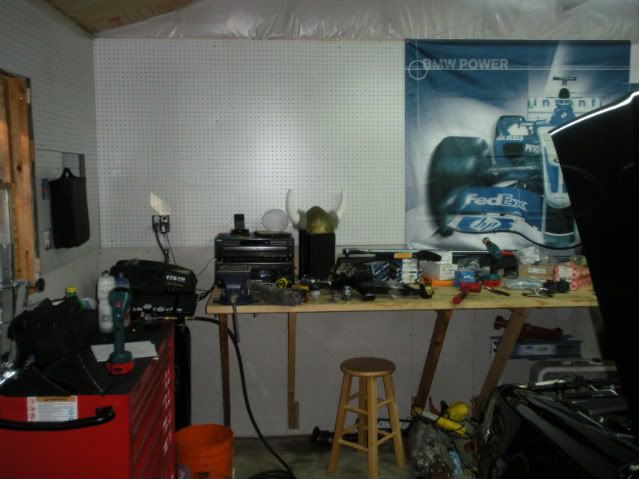
See my reply above... I'm only halfway done and still have to mud and tape the joints and then will paint. At the end of the day I am shooting for finishing out with a rough/industrial look. Here's a couple pics I just walked out and took -

SirToolsE46019.jpg


SirToolsE46020.jpg


Edit - I forgot to note that I also plan to epoxy the floor and really wanted the ease and functionality of being able to wash and powerwash out the garage without too much concern of blasting the drywall to pieces. I have yet to decide if I am going to do some type of tile at the joint of the floor to the hardi on the walls.
 
Last edited:
OP
R

rinny_tin_tin

Well-known member
Joined
Dec 20, 2008
Messages
636
Location
Northern Virginia
I have been slowly working on finishing out the interior of my garage so the lower walls, border area between lower hardi and upper pegboard has not been finished. I have been spending my money and time the last couple months on other items like finishing insulating the ceiling and buying and installing a window AC/heat unit. I am going to drywall the ceiling next and then will detail out the walls and paint. Right now its just plain white pegboard and 1/4 Hardi thats installed with the green hardi screws.


I will go out and take a couple pics but its only halfway done so imagine asking for pics of drywall that hasn't been mudded and taped yet.


See my reply above... I'm only halfway done and still have to mud and tape the joints and then will paint. At the end of the day I am shooting for finishing out with a rough/industrial look. Here's a couple pics I just walked out and took -

SirToolsE46019.jpg


SirToolsE46020.jpg


Edit - I forgot to note that I also plan to epoxy the floor and really wanted the ease and functionality of being able to wash and powerwash out the garage without too much concern of blasting the drywall to pieces. I have yet to decide if I am going to do some type of tile at the joint of the floor to the hardi on the walls.

Looks fine - and comparable to sheetrock. I don't see why regular tape and mud would not work with the HardiB. Thanks for taking the pics -- it looks like I'm going to also use the HardiB for my garage walls!
 

Doug_Fir

Member
Joined
May 11, 2009
Messages
9
HardiBacker (Hardiboard) is an underlayment for tile and not designed as a finish product. The joints need to be finished with mortar... Per the James Hardie website, instructions for HardiBacker, "Latex or acrylic modified thinset (complying with ANSI A118.4)" and fiberglass tape. Sheetrock compound and paper tape are not moisture resistant, so you're not gaining much if you have a weak link in the chain.

I would add that sheetrock is much more inert than Hardiboard. Sheetrock is made with gypsum and Hardiboard has crystalline silica, just like fiber cement. Silica can cause silicosis, and thus Hardi has a lot of warnings against using grinders, etc. without a respirator. I used fiber cement on the exterior of my house, and it's nasty (I used Durarock as a vertical tile backer and Hardiboard for floor tile).

It looks like your primary goal is to keep moisture out of the walls for mold, and to a have additional fire rating, correct? Here are some better alternatives (IMO):

  • Fire: I agree with bmwpower, go with 5/8" type X sheetrock, this is the international standard in UL fire resistive assemblies, and readily available.
  • Moisture in the wall assembly: Use a 6 mil vapor barrier behind the sheetrock to keep moisture out of the wall (migrating from the interior outward), which causes mold/rot. 32" laps, Tremco acoustic sealant the penetrations, joints, tops and bottoms. A less effective moisture barrier is to paint the sheetrock with a moisture resistant primer. Check out Sherwin Williams Preprite SF-1 Sealer or similar.
  • Moisture & fire: Use moisture resistant (it's not waterproof) sheetrock, that is, "green board", which is used in kitchens and restrooms. A more expensive option is Georgia Pacific's DensGlas Gold, http://www.gp.com/build/product.aspx?pid=4674 this stuff is the bomb, but not cheap.
  • Impact Resistance and water resistance: Hardiboard can be brittle if hit hard enough. 1/2" plywood with FRP glued on it, staggered joints. If you need the fire rating, you can still apply this over the sheetrock, but you'll need extra deep mud rings on your electrical boxes. I'm not a big fan of FRP, so check out IPC's products if you want to go for a first class look. It's more money than FRP (that you can buy at Home Depot), but it's top shelf. You can put FRP over sheetrock, but it may give you a false sense of impact security... you can break the sheetrock behind the FRP, leaving a soft spot, and a fun repair.
 

timgr

Well-known member
Joined
Dec 19, 2006
Messages
544
Location
Medford, MA USA
If you do a google search for "fire resistant sheathing" you will find several newer products that offer a fire rating, impact resistance and moisure/mold/mildew resistance.
 

Justanoldguy

Well-known member
Joined
Jun 1, 2008
Messages
3,673
Location
Atiamuri. Central North Island. New Zealand
I have been in the construction trade for 40+ years and have been using Hardis products for that long.
I can't believe you guys are having a hard time with it.
I use a very thin metal diamond blade in an angle grinder to cut it.
Dust is minimal.
Google hardi products and look for downloadable pdf versions of installation guides.
It's as easy as falling off a rock...
ps there is an aluminium jointer that looks very industrial and if sheets edges are glued into it then it is 100% waterproof. Cheers from Kiwi Clive in NZ.
 
Last edited:

tcianci

Well-known member
Joined
Feb 7, 2009
Messages
4,242
Location
Walpole, Ma
I am wondering what goes on in your garages that requires you guys to go so nuts about moisture and impact resistance? Are you concerned about moisture/ humidity or water? Keeping the board about 1/4 inch off any horizontal floor surface will take care of ocassional water situations, if it gets wet, it'll dry out. Moisture/humidity is a different issue... the type of moisture/ humidity you will encounter is typically generated in the interior of the building. A garage/shop environment is far less likely to generate the levels of moisture that you will encounter in a residential situation. It seems like you guys have nightmares about your wall finish crumbling the first time you get a hot humid day. It's not gonna happen. There is a vapor barrier on your typical insulation, it keeps the moisture that passes through the interior wall finish from saturating and thus lowering the R value of the insulation. If the typical wall finish didn't conduct moisture, there would be no need for a vapor barrier. The water vapor in this instance is generated inside the building and passes through the wall finish. The source of this moisture is showers, cooking, clothes washing, exhaling etc. Aside from the exhaling, you don't see too much of the other sources of moisture in a garage. Get a grip guys, its just a wall.
 
Last edited:
To avoid these ads, REGISTER NOW!
Top Bottom