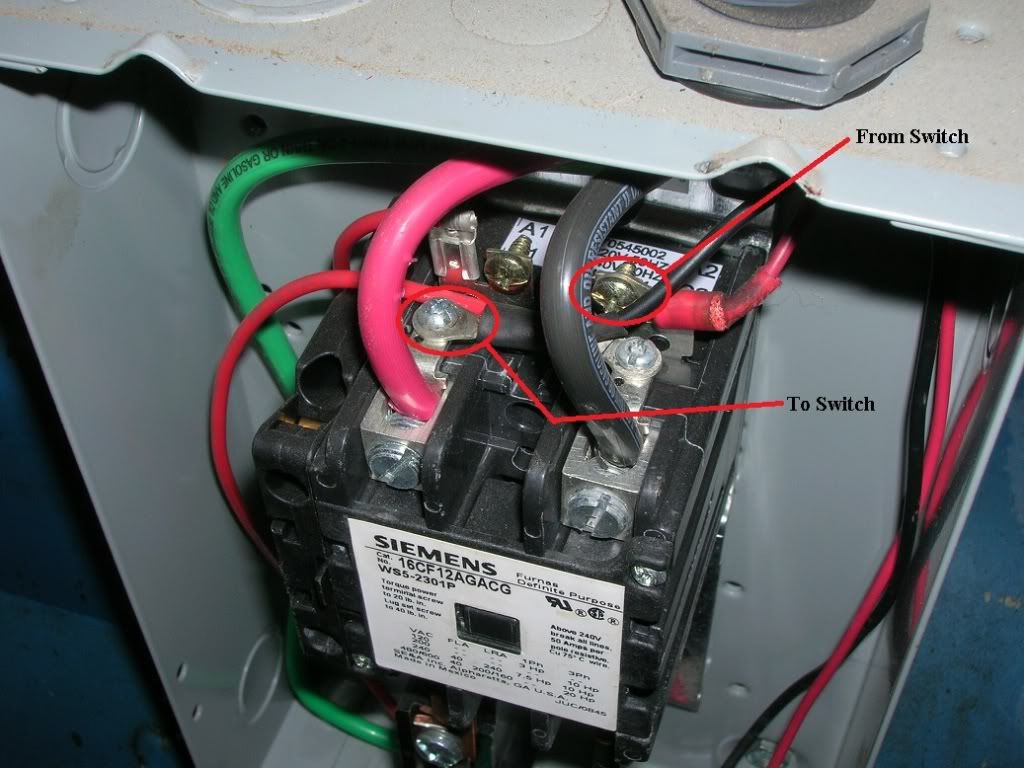
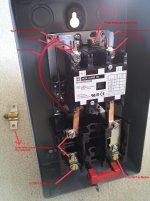
Magnetic Starter is sort of a dumbed down term for "motor starter" or "contactor" which is just a relay....albeit a heavy duty one.
Usually you find them in industrial 3 phase power settings where they can also be wired to create reverse rotation of the motor very simply.
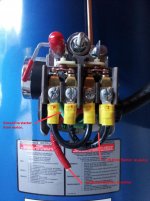
In a residential, single phase setting, it has heavier duty contacts than the pressure switch, so instead of using the pressure switch's contacts to stop and start the main motor voltage and current, you get an improved device with much longer life. The pressure switch still is used but its now a low-current "signal"
Overload heaters are exactly that, precisely calibrated electrical heaters, which generate heat in proportion to the current running thru them. The overload heater(s) are placed near a bimetallic strip which has a low-current signaling contact. If enough current is sent thru the heater, it heats the bimetal strip to the point where the contact goes open-circuit. This signal is wired in series with the pressure switch and ultimately keeps the motor starter from closing and attempting to start the motor.
Two reasons for using an overload heater apparatus, 1) in 3 phase electrical wiring, loss of 1 of the 3 phases means the motor is electrically locked and cannot start, however it will draw current on the remaining phase until the windings cook and scrap the motor. If a motor runs unattended as in say on a rooftop blower, it needs a sort of automatic minding device to prevent replacing motors all of the time. 2) second reason is an actual mechanical overload where the motor has all the phases present, but it sits with a locked rotor and cannot turn. The current draw has to be such that fuses don't blow or breakers don't trip but the motor is sitting there humming but not running. Eventually this will also cook the motor as in 1) above.
A couple of practical points. On a single phase setup, an overload heater is sort of a rare bird. Also, if you intend to be present every time the motor runs, you can go shut it off if you hear it humming and grunting. Its easier if the motor runs a machine you are actually standing right in front of, say a lathe or mill. An air compressor could be in a quiet cabinet.
To Size a magnetic starter there are two basic schools of thought, both involve the FLA = full load amperage of the motor in question. Usually its imprinted on the nameplate. Or you can get a rough calculation using your jedi math, Each HP = 745 watts, Watts are volts * amps, so you can resolve the amperage to something like 5hp x 745W / 240vac to get around 15 amps max draw.
The two schools are the NEMA school and the IEC school. To make a long story short, a NEMA -sized starter is hugely overdesigned for industry, literally you might replace it once in a generation in severe duty. IEC is a much smaller device that works perfectly, has a double digit industrial lifespan, but obviously its not built for hell or high water or world wars. Still, you'd likely melt the bearings out of your geared electric power meter before you can wear out a properly sized IEC starter hooked to a 5hp air compressor.
In my experience, used industrial devices work very well in a home shop, its really hard to wear them out. There are brand new "definite purpose contactors" which spring out of the residential HVAC arena that are fairly cheap and work well enough. I consider them lower grade than the industrial devices in terms of lifespan but will handle switching the rated current just fine.
Hope that helped and wasn't too confusing.