To avoid these ads, REGISTER NOW!

20a gfi

Ironcrow

Well-known member
Joined
Sep 30, 2005
Messages
1,169
Location
Arizona
Why doesn't a 20A GFI receptacle have a 20A plug with one blade turned sideways? I get that the 20A is feed through, so when I group, say, 3 more regular 15A receptacles downstream...all GFI protected...along the kitchen counter I can interrupt 20A total current from all 4 15A receptacles together. Reduces bogus trips? But, a couple of questions come to mind; Do I breaker it at 20A? Seems like I would. Run the whole circuit in 12 AWG? Except the last run from receptacle 3 to 4 in 14 AWG if I was feeling cheap? Since these are all 15A plugs, if somebody had a 20A blender (if such a thing exists) it would have a 20A plug on it and I couldn't plug it in anyway. But, if I had a regular blender that was supposed to pull 3A go defective and want to draw 19A, would I be pulling more than the rated current through a receptacle waiting for a 20A breaker to never break?

When I stick a string of 4 receptacles along the wall in my garage, I don't worry about any of this. 15A breaker, 14 AWG, daisy chain 4 receptacles together..done.
 
To avoid these ads, REGISTER NOW!

DC73

Well-known member
Joined
Dec 27, 2014
Messages
1,627
Location
Lubbock TX
Why doesn't a 20A GFI receptacle have a 20A plug with one blade turned sideways?

You can get them that way if needed.

I was told there is no electrical capacity difference between a 15A rated receptacle and a 20A rated receptacle. The only difference is that you cannot plug a 20A rated appliance into a 15A rated receptacle which presumably could be connected with 14 gauge wire.

If it was me (and it was me, I wired my new workshop this way), I'd go with a 20A breaker, 12 AWG, 20A GFCI, 15A standard receptacles downstream of GFCI, done.

DC
 
OP
I

Ironcrow

Well-known member
Joined
Sep 30, 2005
Messages
1,169
Location
Arizona
Yeah, that's the way I have this, with 15A receptacles downstream, but I'm just staring at it trying to figure out how/if it makes sense does it meet code and/or what was going through the mind of whoever wrote the code...
 

Charles (in GA)

Well-known member
Joined
Jan 11, 2006
Messages
12,489
Location
50 mi south of Atlanta
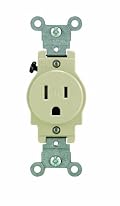
31YWvhSIVAL._SL500_.jpg


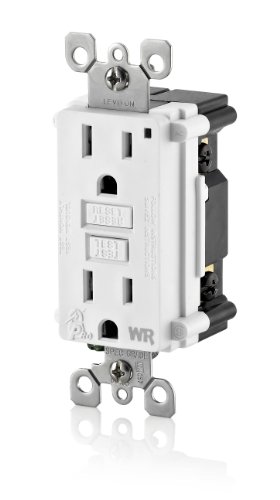
M9620WH-3.jpg


Both of these receptacles will have a 20 amp passthru, because it is quite legal to install 15 amp receptacles on a 20 amp circuit, and quite possible to put 20 amp of load downstream of the GFCI, so it has to be designed to support that load.

If you look thru the wide slot on a good quality 15 amp receptacle, GFCI or not, you will find the contacts just like those found on a 20 amp receptacle, the only difference in the receptacle is the face plate. Otherwise they are made with the same components inside.

The ONLY time it is not legal to install a 15 amp receptacle on a 20 amp circuit, is when ONE and only one of these is connected to the circuit and nothing else.

31KuR48cUIL._SX120_.jpg


In that situation, you would need one of these.........

PS_5351-W_IMAGE_ZM.jpg


Charles
 
Last edited:

Speedy Petey

Well-known member
Joined
Apr 22, 2012
Messages
1,430
Location
NY State
People get WAY too hung up on the whole 15 vs 20 amp device thing. It is also WAY over-thought.

The biggest thing to remember is that even a 15A duplex receptacle or GFI is TWO 15 amp receptacles on one yoke, and is still rated for 20A feed-thru. The 15A rating is for EACH of the two devices on the yoke.
 

wyliesdiesels

Well-known member
Joined
Aug 14, 2012
Messages
20,078
Location
Modesto, CA
People get WAY too hung up on the whole 15 vs 20 amp device thing. It is also WAY over-thought.

The biggest thing to remember is that even a 15A duplex receptacle or GFI is TWO 15 amp receptacles on one yoke, and is still rated for 20A feed-thru. The 15A rating is for EACH of the two devices on the yoke.

This and if the OP would have searched for this topic he wouldve seen that this topic has been covered and debated by us, especially Charles, numerous times...

:lol_hitti
 

Norcal

Well-known member
Joined
Mar 16, 2008
Messages
13,770
If something requires a 20A plug, that equipment would require a separate circuit, making 20A receptacles a waste of money for general purpose receptacles, when my shop was built used 20A receptacles, but that is because I had them, in the 20 + years since have not needed the 20A feature once. Spend the money on other more useful upgrades.
 

gtae07

Well-known member
Joined
Mar 6, 2015
Messages
2,987
Location
Fayetteville, GA
Good to know.

Honestly, I don't think I've ever seen a 20A male plug on anything. What uses them? I suspect most things that would are just made for 240V instead...
 

Mustang51js

Well-known member
Joined
Jan 24, 2014
Messages
1,734
Location
Haskell nj
Good to know.

Honestly, I don't think I've ever seen a 20A male plug on anything. What uses them? I suspect most things that would are just made for 240V instead...

Usually the only time I see them would be an air conditioner or air compressor and that's not even common
 

sberry

Banned
Joined
Jun 18, 2005
Messages
35,747
Location
Brethren, Michigan
They are often used in janitorial, this prevents the cleaning crew from plugging heavy floor equipment in to the general recepts, forces them to use dedicated circuits.
 
OP
I

Ironcrow

Well-known member
Joined
Sep 30, 2005
Messages
1,169
Location
Arizona
So, what makes it a 20A circuit? The selection of the GFCI? Or running to it with 12 AWG? I've got to run 12 AWG to it, right?

I've got a new problem now. I was staring at my code quick reference guide and see that I'm supposed to run a dedicated 20A circuit for the bathroom GFCI and it can't have any lights on it. Presumably, if I drop my hair drier in the sink and trip the GFCI they don't want me groping around in the dark?

And the same thing in the kitchen, but they want TWO 20A appliance circuits.
 

justsam

Well-known member
Joined
Aug 20, 2010
Messages
1,268
Location
Penngrove, California
The 20 Amp circuit breaker and the 12 gauge wire make it a 20Amp circuit. The selection of a 15 or 20Amp GFCI receptacle has nothing to do with it.

Remember GFCI is a fault current protection device, NOT an overcurrent protection device, that is the job of the circuit breaker. As long as the GFCI sees equal current on line and neutral it will not trip if you attempt to draw 30 Amps through it, however the 20Amp circuit breaker will trip.
 

bigredmf

Well-known member
Joined
Jan 2, 2012
Messages
414
Location
Between Boston and Detroit
I know a number of portable hydraulic pumps come with a true 20a rated male plug.

The first thing someone usually does is cut it off and install a 15a plug.

I have one in the shop where someone twisted the horizontal connector to a vertical position so they could use in a 15a outlet. Thought it was kind of a ingenious way to deal with it but will not be using it that way.
red


Sent from my iPad using Tapatalk
 
OP
I

Ironcrow

Well-known member
Joined
Sep 30, 2005
Messages
1,169
Location
Arizona
The 20 Amp circuit breaker and the 12 gauge wire make it a 20Amp circuit. The selection of a 15 or 20Amp GFCI receptacle has nothing to do with it.
Yeah, thanks for the sanity check. That's what I'm doing, 12 AWG throughout and a 20A breaker feeding the whole thing. Just seems odd the feed the whole circuit as 20A (with a GFCI rated at 20A but with a 15A receptacle) and 15A receptacles downstream. I guess its all kosher for code and all that. Maybe I should put 20A receptacles in the kitchen in case I need to run any hydraulic pumps :beer:
 

mobiledynamics

Well-known member
Joined
Mar 14, 2010
Messages
5,052
Location
Gotham City
The ONLY time it is not legal to install a 15 amp receptacle on a 20 amp circuit, is when ONE and only one of these is connected to the circuit and nothing else.

31KuR48cUIL._SX120_.jpg


In that situation, you would need one of these.........

PS_5351-W_IMAGE_ZM.jpg


Charles

Learn something new everyday. When I've renoved 2 prior kitchens, I've always bought the singles to install on the dedicated fridge and DW circuits, even though there were all 12AWG/20amp breakered.
 
To avoid these ads, REGISTER NOW!

sberry

Banned
Joined
Jun 18, 2005
Messages
35,747
Location
Brethren, Michigan
Cant overload the circuit with a single appliance. 20 are used in some industrial, some airless paint sprayers and as I mention cleaning equipment. I have seen 14 cord 20A end. These kinds of machines are best on a dedicated for a couple reasons but imagine the janitor plugging a 15 A machine in nightly to a general in a science lab etc. Disciplines the operator to use the correct circuit.
As long as there was no load or other sensitive equipment on a circuit it wouldn't matter.
 

alfredeneuman

Well-known member
Joined
Mar 3, 2011
Messages
4,595
Location
Fullerton, CA
Presumably, if I drop my hair drier in the sink and trip the GFCI they don't want me groping around in the dark?

Hair Dryers won't trip a GFI when dropped into sink full of water.
There isn't enough current to trip it.

Since the '90s they've been required to have an immersion detector (essentially a GFI with a lower trip value) on the cord.
It's usually a wall wart like gizmo that plugs into the receptacle, and has pushbuttons on it.
 
OP
I

Ironcrow

Well-known member
Joined
Sep 30, 2005
Messages
1,169
Location
Arizona
You learn something every day. I thought the wall wort was a regular GFCI in case my house was really ancient and didn't have one in the bathroom. But its necessary even in a GFCI equipped bathroom...
 

wyliesdiesels

Well-known member
Joined
Aug 14, 2012
Messages
20,078
Location
Modesto, CA
Hair Dryers won't trip a GFI when dropped into sink full of water.
There isn't enough current to trip it.

Since the '90s they've been required to have an immersion detector (essentially a GFI with a lower trip value) on the cord.
It's usually a wall wart like gizmo that plugs into the receptacle, and has pushbuttons on it.

huh? GFCIs trip when theres more than a 5ma difference between hot and neutral.
 

Dick in Wisconsin

Well-known member
Joined
Mar 3, 2012
Messages
3,048
Location
Shawano, Wisconsin
Both of these receptacles will have a 20 amp passthru, because it is quite legal to install 15 amp receptacles on a 20 amp circuit, and quite possible to put 20 amp of load downstream of the GFCI, so it has to be designed to support that load.

If you look thru the wide slot on a good quality 15 amp receptacle, GFCI or not, you will find the contacts just like those found on a 20 amp receptacle, the only difference in the receptacle is the face plate. Otherwise they are made with the same components inside.

The ONLY time it is not legal to install a 15 amp receptacle on a 20 amp circuit, is when ONE and only one of these is connected to the circuit and nothing else. Charles

Why does it seem to me that every outlet in a newer commercial building or medical facility has 20amp outlets with a T-slot? What is the reasoning behind it?

I had never heard about the 20amp pass through capability of a 15 amp outlet before. Very interesting. I presume this is listed on the package or the outlet itself somewhere.
 

alfredeneuman

Well-known member
Joined
Mar 3, 2011
Messages
4,595
Location
Fullerton, CA
huh? GFCIs trip when theres more than a 5ma difference between hot and neutral.

Pure water is non conductive. In fact they use deionized water to wash the insulators on high voltage lines.

It's only the minerals that make it conductive. Apparently, there's not enough to trip the GFI under all water conditions.
 

Norcal

Well-known member
Joined
Mar 16, 2008
Messages
13,770
Why does it seem to me that every outlet in a newer commercial building or medical facility has 20amp outlets with a T-slot? What is the reasoning behind it?

I had never heard about the 20amp pass through capability of a 15 amp outlet before. Very interesting. I presume this is listed on the package or the outlet itself somewhere.

Only on GFCI receptacles, otherwise it's in the NEC.
 
OP
I

Ironcrow

Well-known member
Joined
Sep 30, 2005
Messages
1,169
Location
Arizona
I guess there's this whole epic discussion that took place in an alternative universe or something...
 

wyliesdiesels

Well-known member
Joined
Aug 14, 2012
Messages
20,078
Location
Modesto, CA
Pure water is non conductive. In fact they use deionized water to wash the insulators on high voltage lines.

It's only the minerals that make it conductive. Apparently, there's not enough to trip the GFI under all water conditions.

Yes i know that. Liquid cooled computers and car radiators use distilled water. Well radiators are suppose to but u know the water people use at the gas station isnt distilled. And who has deionized or mineral free water at their tap?Unless u have a whole house RO or water softener, most taps will have minerals in the water...

I guess there's this whole epic discussion that took place in an alternative universe or something...

The subject has been discussed many times in previous threads. Just the reason why the search tool is a handy friend!
 
Last edited:

alfredeneuman

Well-known member
Joined
Mar 3, 2011
Messages
4,595
Location
Fullerton, CA
Well neither the GFI on the hair dryer nor the GFI receptacle tripped during this dunking by Mike Holt. There's no ground reference in the water, so the GFI sees the hair dryer as a load. I suppose we were both wrong.


When the water is shorted to the ground pin in the receptacle, both of them tripped
 
Last edited:

wyliesdiesels

Well-known member
Joined
Aug 14, 2012
Messages
20,078
Location
Modesto, CA
Well neither the GFI on the hair dryer nor the GFI receptacle tripped during this dunking by Mike Holt. There's no ground reference in the water, so the GFI sees the hair dryer as a load. I suppose we were both wrong.


When the water is shorted to the ground pin in the receptacle, both of them tripped

Wow great video find.

Yeah i got thinking about this thread last night after i signed off and realized that theres no connection to ground. So the GFCI isnt going to trip.

Now i wonder if it wouldve tripped if he left the faucet running...:headscrat
 

alfredeneuman

Well-known member
Joined
Mar 3, 2011
Messages
4,595
Location
Fullerton, CA
I wondered at the other end :D
If the drain was all metallic, with a brass tailpiece, trap, and cast iron drain with leaded fittings, like they used to be, then ....:headscrat
 
To avoid these ads, REGISTER NOW!
Top Bottom