To avoid these ads, REGISTER NOW!

New garage feed question

ExxWhy

Well-known member
Joined
Dec 8, 2014
Messages
97
Location
NE Ohio
I'm in the process of building a new garage on my property. AHJ is me, no inspections required aside from mine and now yours.

Local POCO is going to move my meter location from the side of my house out to the pole by the road. New meter socket will have a 200 amp breaker feeding the house and an additional 100 amp auxiliary breaker which I plan to use to feed the new garage. They will jump out the old meter socket on the house and install a blank cover and use all the existing underground wires for the house feed. New building is 303 feet from the meter pole and I am going to run 4/0 aluminum to account for voltage drop. (I'll need some adapters to fit the 4/0 wire into the 100 amp breaker.) UFER ground embedded in the footer of the new building.

Technically, the new meter panel will become the main and everything hooked up to it down line will be sub panels. As I understand that, it means code requires 4 wire feeds to the house and the new building. It seems that if you take the new breakers (disconnects) out of the equation, it's a service entrance that only requires a 3 wire feed.

As a practical matter, (safety) is there a reason a 3 wire feed won't work or is a bad idea? POCO guy tells me 3 wire is how it's been done for the last 100 years anyway.
 
To avoid these ads, REGISTER NOW!

pattenp

Well-known member
Joined
Jun 4, 2008
Messages
10,175
Location
Virginia - USA
I believe because the service is supplying loads to two disconnects, the disconnects need to be grouped together at the same location. So you are going to have some length of 4 wire feeder to run to both buildings from the disconnect location.
 

buddyboy

Well-known member
Joined
Oct 8, 2007
Messages
616
i'd go knob and tube, that stuff worked great for 50 or 60 years, not sure why they ever changed it.

lol, just kidding... my smart *** just likes to make comments like that when I hear someone say 'but we've always done it like this'
 

checkthisout

Well-known member
Joined
Sep 5, 2008
Messages
5,232
I'm in the process of building a new garage on my property. AHJ is me, no inspections required aside from mine and now yours.

Local POCO is going to move my meter location from the side of my house out to the pole by the road. New meter socket will have a 200 amp breaker feeding the house and an additional 100 amp auxiliary breaker which I plan to use to feed the new garage. They will jump out the old meter socket on the house and install a blank cover and use all the existing underground wires for the house feed. New building is 303 feet from the meter pole and I am going to run 4/0 aluminum to account for voltage drop. (I'll need some adapters to fit the 4/0 wire into the 100 amp breaker.) UFER ground embedded in the footer of the new building.

Technically, the new meter panel will become the main and everything hooked up to it down line will be sub panels. As I understand that, it means code requires 4 wire feeds to the house and the new building. It seems that if you take the new breakers (disconnects) out of the equation, it's a service entrance that only requires a 3 wire feed.

As a practical matter, (safety) is there a reason a 3 wire feed won't work or is a bad idea? POCO guy tells me 3 wire is how it's been done for the last 100 years anyway.

Will there be grounding rods at the meter?
 
OP
E

ExxWhy

Well-known member
Joined
Dec 8, 2014
Messages
97
Location
NE Ohio
i'd go knob and tube, that stuff worked great for 50 or 60 years, not sure why they ever changed it.

lol, just kidding... my smart *** just likes to make comments like that when I hear someone say 'but we've always done it like this'

:) I hear ya. I probably shouldn't have mentioned that because it's really not my main point/question. As I understand it, without the breaker 3 wires is code as a service entrance. Add the breaker, and now it should have 4 wires? Why?
Will there be grounding rods at the meter?

Yes, the pole is grounded, I think a bare #6 wrapped around the end of the pole underground.
 

checkthisout

Well-known member
Joined
Sep 5, 2008
Messages
5,232
:) I hear ya. I probably shouldn't have mentioned that because it's really not my main point/question. As I understand it, without the breaker 3 wires is code as a service entrance. Add the breaker, and now it should have 4 wires? Why?


Yes, the pole is grounded, I think a bare #6 wrapped around the end of the pole underground.

Ok. Is the neutral bonded to the meter or disconnect enclosures out there? In other words, bonded to the ground?
 
OP
E

ExxWhy

Well-known member
Joined
Dec 8, 2014
Messages
97
Location
NE Ohio
The POCO has not installed the new meter yet, so not sure what they will have there.
 

wyliesdiesels

Well-known member
Joined
Aug 14, 2012
Messages
20,031
Location
Modesto, CA
The reason 4-wire is required is because the neutral will be bonded at the pole with the main service panel since u will have disconnects there. The neutral can only be bonded to electrodes and EGCs in one location- at the main service panel. After that it has to be 4-wire. U dont want a bond in multiple locations. And the reason for the bond? So OCPDs can function properly!

In your house panel, u need to make sure the neutral bar is insulated and that any EGCs/grounds are moved off the neutral bar. U might have to buy a ground bar kit.

What brand of panel do u have?

Can u post pics?
 
Last edited:
OP
E

ExxWhy

Well-known member
Joined
Dec 8, 2014
Messages
97
Location
NE Ohio
The house panel is an ITE EQ load center, 150 amp. Late 60's vintage, it's full. I was hoping to not touch that at all, thus the reason for the new meter socket.

It appears to me the neutral is bonded/grounded at the transformer on the pole as it is right now. Pretty typical I think?? Off the transformer the 2 hots and the neutral go underground direct buried about 75 feet to the meter socket on the house. Just the 3 wires. Meter socket is back to back with the main house panel. Main panel neutral is bonded to the ground rod below the panel. As I understand things (weak understanding admittedly!), this is an acceptable installation even under current code.
 

wyliesdiesels

Well-known member
Joined
Aug 14, 2012
Messages
20,031
Location
Modesto, CA
Yes current panel and the its wired is fine.

The changes u propose means u have to change the wiring and the way the panel is hooked up..As u said your house main service panel becomes a subpanel. This means an isolated neutral...theres no other way to go about it. 3-wire feeds to detached structures was no longer allowed with 2008 code cycle...
 
OP
E

ExxWhy

Well-known member
Joined
Dec 8, 2014
Messages
97
Location
NE Ohio
This is where I get confused. The only difference between the present configuration and the proposed new configuration is the addition of the 200 amp breaker (disconnect) at the pole. The neutral is bonded to the ground at the pole/transformer. Not understanding the purpose of the 4th wire.

Then I get further confused because there is an exception for detached structures without a parallel conducting path. In those cases, the neutral is bonded at the sub panel and 3 wires is OK.

Both the house and the new garage are all unconnected structures. Nothing connects them aside from the electric service. House phone is via fiber optic on a different route and the old phone line has been physically removed. Water is all plastic.
 

dw1

Well-known member
Joined
Jan 26, 2015
Messages
1,335
Location
Ky
I'm in the process of building a new garage on my property. AHJ is me, no inspections required aside from mine and now yours.

Technically, the new meter panel will become the main and everything hooked up to it down line will be sub panels. As I understand that, it means code requires 4 wire feeds to the house and the new building.

You have it correct in your quote above about the new meter panel will become the main disconnecting means (This is where your service Neutral is bonded) anything that comes out of this meter/disconnect is considered a sub panel and it needs to be 4 wires and since it feeds seperate structures, they need a disconnecting means and to seperate the neutrals and grounds in all sub panels.

"Or as Wylies said" re-read reply # 8
 
Last edited:
To avoid these ads, REGISTER NOW!

wyliesdiesels

Well-known member
Joined
Aug 14, 2012
Messages
20,031
Location
Modesto, CA
The neutral is not grounded at the pole/transformer. The body of the transformer and the metal parts such as the enclosure are grounded.

The neutral is not grounded until it's at the service entrance.

The 4th wire used to just provide a ground. Your sub-panel would not have had ground rods. The grounding would have been provided through the 4th wire and the ground/neutral would have been isolated. Now the wire simply serves to balance the grounding potential between the two panels.

The neutral cannot be bonded to the ground in more than place. The breaker at the meter is now the service entrance and thus cannot be regrounded after that point.

I assume your question then is why can you not simply pass the neutral through the service entrance without bonding it ground?

NOT TRUE! The center tap/bushing on transformers ARE tied to a ground rod at the pole! And sometimes the neutral on the primary side depending on the voltage and system.

And youre confusing ground rods and EGCs in your 3rd paragraph. Theyre 2 different animals. One doesnt take the place of the other. Theyre both need at detached structures. So the OP will need to put in rods at the new service panel, house AND the garage!!

Read this to clear your confusion:

http://www.electriciantalk.com/articles/the-confusion-of-the-term-grounding/

Heres an article about grounding and bonding of transformers that are installed on the load side of the service. Its done the same way on the line/PoCo side, with only the wire gauges being different because PoCos dont follow NEC...

http://m.ecmweb.com/bonding-amp-grounding/basics-bonding-and-grounding-transformers
 
Last edited:

checkthisout

Well-known member
Joined
Sep 5, 2008
Messages
5,232
NOT TRUE! The center tap/bushing on transformers ARE tied to a ground rod at the pole! And sometimes the neutral on the primary side depending on the voltage and system.

And youre confusing ground rods and EGCs in your 3rd paragraph. Theyre 2 different animals. One doesnt take the place of the other. Theyre both need at detached structures. So the OP will need to put in rods at the new service panel, house AND the garage!!

Read this to clear your confusion:

http://www.electriciantalk.com/articles/the-confusion-of-the-term-grounding/

Heres an article about grounding and bonding of transformers that are installed on the load side of the service. Its done the same way on the line/PoCo side, with only the wire gauges being different because PoCos dont follow NEC...

http://m.ecmweb.com/bonding-amp-grounding/basics-bonding-and-grounding-transformers

Ok, deleted. I looked up at a pole out back and didn't see a ground? It might just be missing.

Ok, I will read your linky.
 

wyliesdiesels

Well-known member
Joined
Aug 14, 2012
Messages
20,031
Location
Modesto, CA
Ok, deleted. I looked up at a pole out back and didn't see a ground? It might just be missing.

Ok, I will read your linky.

The placement of the ground rod bonding wire can be in different places. Depends on the lineman who wired it. Ive seen them on the x2 bushing, crimped onto the neutral at the pole bracket, etc. sometimes, u will have a transformer that is rated for line to neutral voltage on the primary side and only one HV bushing is connected to the overhead primary. The second bushing will have a jumper connected to the SES on the pole as well as the X2 neutral bushing on the secondary side. This is for Wye primary systems...Every hookup and transformer will be slightly different in how its bonded(or grounded) to an electrode at the base of the pole!

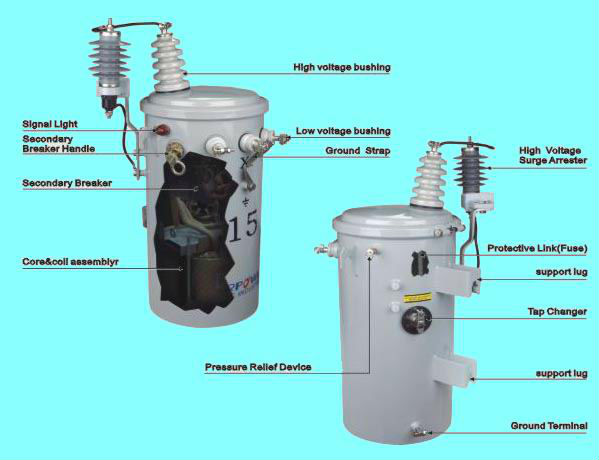
Heres a pic of a 3-phase Wye transformer. Note X0(neutral/coil star point)has a bonding strap!

parts+of+three+phase+distribution+transformer.bmp


Heres a single phase single bushing transformer with a ground ******** X2(neutral/center tap on secondary coil)...

Single_phase_pole_mounted_transformer_CSP_type.jpg
 
Last edited:

checkthisout

Well-known member
Joined
Sep 5, 2008
Messages
5,232
NOT TRUE! The center tap/bushing on transformers ARE tied to a ground rod at the pole! And sometimes the neutral on the primary side depending on the voltage and system.

Ok, got it. For transformers up on the pole, I was under the impression that the ground and neutral were isolated and that the enclosure itself and insulator metal parts and such were connected to ground (at the base of the pole) I.E. a conductor run down and buried with the pole.

And youre confusing ground rods and EGCs in your 3rd paragraph. Theyre 2 different animals. One doesnt take the place of the other. Theyre both need at detached structures. So the OP will need to put in rods at the new service panel, house AND the garage!!]

In this case I wasn't confused. Were they always required at detached structures? If not, why not? That was the point I was hitting on.

My service disconnect for my mobile is in my garage. There is no grounding (ground rods) required at the mobile. It just has a 4 wire connection from the mobile back to the feeder.
 

checkthisout

Well-known member
Joined
Sep 5, 2008
Messages
5,232
The placement of the ground rod bonding wire can be in different places. Depends on the lineman who wired it. Ive seen them on the x2 bushing, crimped onto the neutral at the pole bracket, etc. sometimes, u will have a transformer that is rated for line to neutral voltage on the primary side and only one HV bushing is connected to the overhead primary. The second bushing will have a jumper connected to the SES on the pole as well as the X2 neutral bushing on the secondary side. This is for Wye primary systems...Every hookup and transformer will be slightly different in how its bonded(or grounded) to an electrode at the base of the pole!

Heres a pic of a 3-phase Wye transformer. Note X0(neutral/coil star point)has a bonding strap!

parts+of+three+phase+distribution+transformer.bmp


Heres a single phase single bushing transformer with a ground ******** X2(neutral/center tap on secondary coil)...

Single_phase_pole_mounted_transformer_CSP_type.jpg

Wow! Thank's Wylies, you went above and beyond here in showing this to me. I really appreciate that.

I also appreciate the fact that you have enough intellectual curiosity to learn the ins and outs of principles of operation in your trade rather than just learning enough to make money.
 

wyliesdiesels

Well-known member
Joined
Aug 14, 2012
Messages
20,031
Location
Modesto, CA
Ok, got it. For transformers up on the pole, I was under the impression that the ground and neutral were isolated and that the enclosure itself and insulator metal parts and such were connected to ground (at the base of the pole) I.E. a conductor run down and buried with the pole.

In this case I wasn't confused. Were they always required at detached structures? If not, why not? That was the point I was hitting on.

My service disconnect for my mobile is in my garage. There is no grounding (ground rods) required at the mobile. It just has a 4 wire connection from the mobile back to the feeder.

Were rods always required at detached structures? Yes. EGCs/4-wire feeders on the other hand have only been required since 2008 code cycle. Before that, the neutral at a detached structure, thats fed from a main service panel on another building, was bonded to the enclosure and all metal parts of the building. Existing services are of course grandfathered in but should be inspected to make sure everything is intact.

The code was changed because there was cases where the neutral developed a bad connection and neutral return current found alternate pathways(metal in the building via pipes, rods, etc) to return to its source(transformer on pole). Because the neutral was bonded to all the metal, this meant that all bonded metal parts became energized! NOT GOOD!

There is one exception to this. Detached structures which had parrallel metalic pathways(plumbing, etc.) were NOT allowed to have a bonded neutral and a 4-wire feeder WAS required!

And Im not gonna even go into mobile home hookups. Dont get me started. Theyre a completely different animal with their own requirements(cant have the main service panel mounted on the home)...

Wow! Thank's Wylies, you went above and beyond here in showing this to me. I really appreciate that.

I also appreciate the fact that you have enough intellectual curiosity to learn the ins and outs of principles of operation in your trade rather than just learning enough to make money.

I love learning the principle of things. Sadly, Ive ran into many LICENSED electricians who had a poor understanding of grounding, bonding, difference between EGCs and grounding electrodes, etc. I even worked with one guy who new nothing about 4-wire feeders and thought 3-wire feeders were still allowed! :( I had to flop open my 2011 code book and show him the applicable code. He had a puzzled look on his face. He got his jouneyman card before the 2008 code cycle.

Im actually an electrician(not a lineman) but i know enough about how utlities hookup services. Its not much different from hooking up a transformer on the load side of a service! I also do a LOT of grounding and bonding at work(work at a Radio shop; we do towers and communications sites as well as dispatch centers with lots of radio equipment) so i have to stay up to date on it.
 
Last edited:

wyliesdiesels

Well-known member
Joined
Aug 14, 2012
Messages
20,031
Location
Modesto, CA
Ok. Is the neutral bonded to the meter or disconnect enclosures out there? In other words, bonded to the ground?

This is where youre probably confused. Saying ground isnt specific because theres electrodes AND EGCs/grounds. People often confused the 2!

Theres actually TWO things that the neutral should be bonded to- the electrodes AND any grounds/EGCs including the panel enclosure, any EGCs/grounds from branch circuits and feeders, etc.
 

wyliesdiesels

Well-known member
Joined
Aug 14, 2012
Messages
20,031
Location
Modesto, CA
The house panel is an ITE EQ load center, 150 amp. Late 60's vintage, it's full. I was hoping to not touch that at all, thus the reason for the new meter socket.

It appears to me the neutral is bonded/grounded at the transformer on the pole as it is right now. Pretty typical I think?? Off the transformer the 2 hots and the neutral go underground direct buried about 75 feet to the meter socket on the house. Just the 3 wires. Meter socket is back to back with the main house panel. Main panel neutral is bonded to the ground rod below the panel. [/b]As I understand things (weak understanding admittedly!), this is an acceptable installation even under current code.
[/b]

Sorry to not answer your comment. I got carried away with grounding.

What type of ITE panel do u have? Some ITE panels are bad. Can u post a picture or 2? Unfortunately, u WILL HAVE to touch your panel and change some things in it. Theres no way around it!

Yes your installation is good code wise then and now. However, since youre changing things around, it no longer meets code once u change where the main service is.

This is where I get confused. The only difference between the present configuration and the proposed new configuration is the addition of the 200 amp breaker (disconnect) at the pole. The neutral is bonded to the ground at the pole/transformer. Not understanding the purpose of the 4th wire.

Then I get further confused because there is an exception for detached structures without a parallel conducting path. In those cases, the neutral is bonded at the sub panel and 3 wires is OK.

Both the house and the new garage are all unconnected structures. Nothing connects them aside from the electric service. House phone is via fiber optic on a different route and the old phone line has been physically removed. Water is all plastic.

That applies to existing installations.

Hopefully, i have explained things enough in my last few replies. If not, ask more questions...
 

stg454

Well-known member
Joined
Jan 15, 2015
Messages
281
Location
Rhode Island
Not to hijack your thread but I have a question about the electric feed to a garage. We are looking at a house with a detached garage. The current electric feed to the garage comes from a sub panel on the second floor in the house and runs overhead to the garage through weather heads at the house and garage. The feed runs over a flat portion of the roof of the house. It's approximately 6-7' above the flat roof. Is this acceptable?
 
OP
E

ExxWhy

Well-known member
Joined
Dec 8, 2014
Messages
97
Location
NE Ohio
Ok, deleted. I looked up at a pole out back and didn't see a ground? It might just be missing.

Ok, I will read your linky.

Wyllie beat me to it, but here is a pic of my pole/transformer. The wire on the right is the neutral with the other end of what you see connected to the white wire of the service entrance conductors. And that is a ground wire connected to the neutral wire.

gjpole.jpg
 
Last edited:
OP
E

ExxWhy

Well-known member
Joined
Dec 8, 2014
Messages
97
Location
NE Ohio
[/b]

Sorry to not answer your comment. I got carried away with grounding.

What type of ITE panel do u have? Some ITE panels are bad. Can u post a picture or 2? Unfortunately, u WILL HAVE to touch your panel and change some things in it. Theres no way around it!

Yes your installation is good code wise then and now. However, since youre changing things around, it no longer meets code once u change where the main service is.

That applies to existing installations.

Hopefully, i have explained things enough in my last few replies. If not, ask more questions...

You've provided good information, most appreciated. I too like to understand why things work the way they do, but I'm still not grasping a key point. Mainly, I still don't see the difference between having a direct connection without a disconnect and having a disconnect (breaker) aside from a code definition. With either method the neutral is bonded to a grounding conductor at the pole. With a direct connection, it is appropriate to reground at the house panel and bond the neutral and ground. Add a disconnect and code says do it differently. I'm not understanding what the advantage is and why it would be better.

Obviously, there is a substantial cost involved to run a new 4 wire entrance cable from the pole to the house as well as a lot of labor. Additionally, it would cost an additional $2 per foot extra for the wire to the new building. If I have to spend that money and effort, I'd like to at least feel like I made an improvement.
 
To avoid these ads, REGISTER NOW!
Top Bottom