To avoid these ads, REGISTER NOW!

Gerlacr

Member
Joined
Feb 4, 2013
Messages
11
Location
Tustin, CA
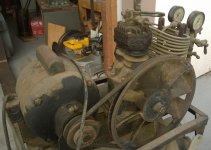
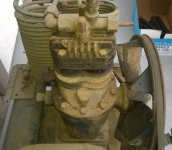
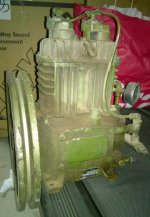
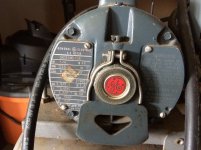
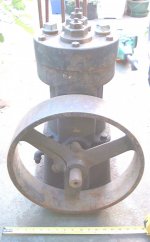
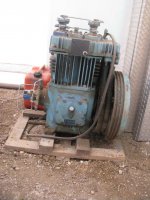
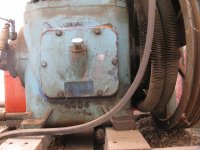
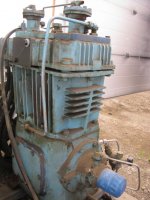
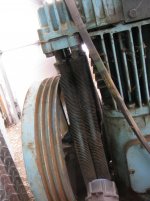
OK, now it is my turn. I went through all the posts and looked at all the great pictures of your old compressors hoping I'd see one like mine but no such luck. Here is what I just picked up. The motor runs and the pump spins freely but pumps very little air. I am going to pull the head off and check the valves but I was hoping to get some clue as to the brand. I can see no clues on any side of the pump casting. The accessories are all DeVilbiss.

RonG
North Tustin, Ca
 

Attachments

  • WP_20150322_008a.jpg
    WP_20150322_008a.jpg
    142.1 KB · Views: 94
  • WP_20150322_009a.jpg
    WP_20150322_009a.jpg
    138.5 KB · Views: 76
  • WP_20150322_010a.jpg
    WP_20150322_010a.jpg
    146.8 KB · Views: 79
  • WP_20150322_011a.jpg
    WP_20150322_011a.jpg
    147.2 KB · Views: 69
  • WP_20150322_012a.jpg
    WP_20150322_012a.jpg
    144 KB · Views: 69
To avoid these ads, REGISTER NOW!

Gerlacr

Member
Joined
Feb 4, 2013
Messages
11
Location
Tustin, CA
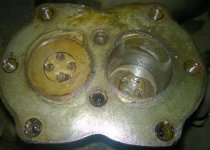
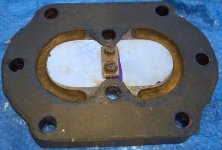
I still have no clue about the make of this compressor but I did pull the head to get an idea why it was not producing any pressure. What I found was an obvious problem. One of the flap valves had been poked right through thus providing absolutely no valve action. This seems to be a common configuration based on the pictures I have seen. The next picture shows the pistons with valves built into their crowns. I have not seen pictures of these before. Is this a common technique? So I suppose it breathes into the crankcase and then up through the valve in the pistons. Question: what gauge steel shim stock should I use to make a new flap valve? Did this valve get poked through by sheer pressure because the material was too thin or was this the results of some previous oaf that was poking around inside?

RonG
 

Attachments

  • WP_20150323_005a.jpg
    WP_20150323_005a.jpg
    140.4 KB · Views: 92
  • WP_20150323_004a.jpg
    WP_20150323_004a.jpg
    141.6 KB · Views: 84

redmondjp

Well-known member
Joined
Nov 25, 2014
Messages
2,318
Location
Redmond, WA
Ron,

That appears to be a vintage refrigerant compressor, in which the oil-laden freon passed through the compressor crankcase. So that is a problem for using it for other purposes. Plus, it has such a low CFM rating that it's not going to be very useful other than for a conversation piece or airing up some tires.

There have been a few other threads about refrigeration compressors on here.

As for thickness of the material, you may be able to use some steel shim stock, say .007" thick (get out a set of feeler gauges and see what seems close) or so.

So how big is this hole? And are you sure that it isn't supposed to be there? On a refrigeration compressor, there is no unloader valve - after the compressor cycles off, the high-side pressure is allowed to bleed back to the low side until the pressure equalizes. Otherwise, the compressor could never start against the high-side pressure. That's what makes me think that the hole could be serving as an unloading feature which allows the pressures to equalize faster after the unit turns off.
 

Gerlacr

Member
Joined
Feb 4, 2013
Messages
11
Location
Tustin, CA
I was afraid I might have a re-purposed refrigeration pump. It still could be good for general shop air. It will be a hell of a lot quieter than my oil-less compressor.

The hole in the flapper is about the size of a pencil eraser and is not a clean hole. You can see where the metal was just pushed down through the opening like with a punch.

Thanks for the feedback.
 

Gerlacr

Member
Joined
Feb 4, 2013
Messages
11
Location
Tustin, CA
Redmondjp

It looks like you were spot on with your assessment. I did get the pump to work but the cycle time to get any useful pressure is really long. I made a new flapper to replace the one with the hole and that was the problem. Once going it took more than a half hour to get up the 95lbs.

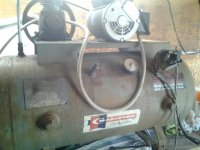
After poking around in my garage for a compressor pump that I bought in an antique store years ago I found a Binks compressor that turns out to be an OEM pump made by Quincy and is the same as the same as their model 210. Photot attached. So it looks like I will be scrapping this old refrigeration pump. Thanks for the help.

RonG
 

Attachments

  • WP_20150325_002a.jpg
    WP_20150325_002a.jpg
    142 KB · Views: 48
  • WP_20150325_005a.jpg
    WP_20150325_005a.jpg
    92 KB · Views: 49
  • WP_20150324_001a.jpg
    WP_20150324_001a.jpg
    144.4 KB · Views: 63

redmondjp

Well-known member
Joined
Nov 25, 2014
Messages
2,318
Location
Redmond, WA
Redmondjp

It looks like you were spot on with your assessment. I did get the pump to work but the cycle time to get any useful pressure is really long. I made a new flapper to replace the one with the hole and that was the problem. Once going it took more than a half hour to get up the 95lbs.

After poking around in my garage for a compressor pump that I bought in an antique store years ago I found a Binks compressor that turns out to be an OEM pump made by Quincy and is the same as the same as their model 210. Photot attached. So it looks like I will be scrapping this old refrigeration pump. Thanks for the help.

RonG

No problem!

But fer criminy sakes, why didn't you tell us about the Binks/Quincy before - THAT is the one you want to get running, and parts should still be available.

Download this brochure which has the performance specs on that pump on p.5:

http://igor.chudov.com/manuals/Quincy-QR25-Compressor-Brochure.pdf

And that air filter/regulator is awesome as well - I have the same one that I salvaged out of a scrapyard almost 25 years ago and refurbished (I used old but clean cotton rags inside to replace the original unidentified filter media).
 

Gerlacr

Member
Joined
Feb 4, 2013
Messages
11
Location
Tustin, CA
OK, I deserved that. I didn't even know what I had and was shocked when I started reading up about the Binks/Quincy compressors. I am compressor illiterate. I have been using a noisy Porter Cable oil-less compressor for years and never thought much about upgrading until I picked up the old rig and starting playing around with it. I would like to retain the cooling coil, regulator and tank; swap out the pump and also look for a stronger motor. The current motor is a 110V 3/4 HP with sleeve bearings. I should probably look for a newer 1-1/2HP 220V motor.

You have the same DeVilbiss regulator filter manifold? I presumed the long canister with the drain valve at the bottom was a dryer of some sort. It had a long metal canister inside. I can post a picture. I presumed it was toast by now.

Do you have an additional dryer/filter in line? I need air for general home machine shop use: occasional spray painting, occasional plasma cutting, frequent air blasts for cleaning out tapped holes etc.
 

redmondjp

Well-known member
Joined
Nov 25, 2014
Messages
2,318
Location
Redmond, WA
OK, I deserved that. I didn't even know what I had and was shocked when I started reading up about the Binks/Quincy compressors. I am compressor illiterate. I have been using a noisy Porter Cable oil-less compressor for years and never thought much about upgrading until I picked up the old rig and starting playing around with it. I would like to retain the cooling coil, regulator and tank; swap out the pump and also look for a stronger motor. The current motor is a 110V 3/4 HP with sleeve bearings. I should probably look for a newer 1-1/2HP 220V motor.

You have the same DeVilbiss regulator filter manifold? I presumed the long canister with the drain valve at the bottom was a dryer of some sort. It had a long metal canister inside. I can post a picture. I presumed it was toast by now.

Do you have an additional dryer/filter in line? I need air for general home machine shop use: occasional spray painting, occasional plasma cutting, frequent air blasts for cleaning out tapped holes etc.

Yes, I have that identical filter/regulator, mounted right at the compressor tank outlet which is not the best place for it (other than maybe keeping oil out of my lines). One side of the unit is unregulated air out, and the other side, regulated (on mine regulated is on the right side as you look at the regulator handle IIRC). I don't have any other filters in the system right now. When I paint, I use a disposable screw-on filter right at the gun (as many people do, they are available at auto body supply stores).

Yes, the cannister at the bottom is a filter/dryer, of the impingement type I believe - where the air has to rapidly and repeatedly change directions through the media, causing the heavier water and oil droplets to slam into the media and then coalesce into the reservoir at the bottom. You can carefully disassemble the cannister as it is screwed on top and bottom, much like a grease gun tube. Same for the regulator section, you can disassemble it and clean everything if needed. Gauges may not still work (but new, Chinese-made ones probably not any better, ha ha, sad but true).

The best thing to do is to have some section of stationary air line and then put the filter/dryer at the end of it as it will catch more moisture that way since the air has a longer distance from the compressor to cool off during travel. But, honestly, I have a rubber air line from my compressor at one corner of the garage to a hose reel at the diagonal corner and it's been that way since 1998 or so (it was 'temporary', as is life)! I bought a ton of PVC stuff to do the air system, but then discovered through this and other forums how dangerous that was, so I never installed it. Then I had kids, end of story . . .

Oh, I keep my lines oil-free with the filter right at the compressor, and periodically add a few drops of oil to my air tools. Much better as I like oil-free air for blowing off parts. So it's all good wherever you decide to install it.

Keep us posted on your 210 rebuild or it may be better to start your own 'Frankencompressor build thread'.
 
Last edited:

slasko

New member
Joined
Apr 3, 2015
Messages
4
Location
denver colorado--mile-high
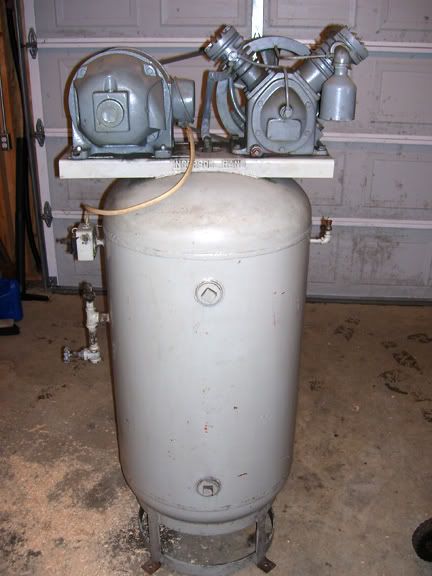
Finally got some pics of the "new" monster. I'm hoping Tantara is right about the pump being the same to this day, as the one in ironroad's picture looks a lot like mine.

Can anyone suggest a vintage for this unit? I'm guessing 50's to 60's, but I can't find any concrete information and know you guys will have a better idea.

Front:
comp4.jpg


Back:
comp5.jpg


Closeup of pump and motor. You can see where an identification plate used to be on the pump.
comp3.jpg


comp2.jpg


I removed the gauge for transport purposes, but it goes up to 300. I'm guessing this is a dual stage compressor but don't know for sure. I think (and hope) it's single phase power but don't know how to tell for sure.
I don't know how much oil it takes or what kind.
Obviously, any information you guys can share would be greatly appreciated.

I would like to change the oil and clean up the pressure switch if not replace it and still have to wire it up obviously... just hope I can get some concrete information first.

And I'm GUESSING it's 80 gallons... looks almost dainty in the photos but this ***** is big. Thought about getting out the measuring tape and dusting off the cobwebs in my brain to do the math to figure out the volume of this pig.
that pump is a 232, if u go to ir site, you can download PDF) a service manual
 

slasko

New member
Joined
Apr 3, 2015
Messages
4
Location
denver colorado--mile-high
i just recently researched the 232, a person in pueblo Colorado (craigslist) has one for 250.00 2 hp 220v motor 30gal tank. cfms are about 4.5-6.0
if you want to spray auto paint or others you need at least 15.
i'm currently rebuilding an ir 253 model, puts out 17-24 cfms, depending on pump speed
 

ajwingnut

New member
Joined
Apr 2, 2015
Messages
1
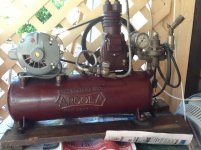
Newbie here. I also have a compressor that I can not find anywhere. I believe that it may be from a 1930's heating system that someone converted. The name on it is "ARCO Systems Inc. New York N.Y. Also the name "ARCOLA" is on it. The tank is cast iron. I know the electric motor has been changed. The gauges on it are US Gauge Co. N.Y. It has a patent date on it of August 1933. Any help identifying would be appreciated.
 

Attachments

  • image.jpg
    image.jpg
    88 KB · Views: 115

thehorse13

Well-known member
Joined
Mar 15, 2015
Messages
3,478
Location
Jefferson County, WV
Here is my vintage compressor. I got this one for free from a guy who said it didn't work. I added the motor and presto, it compresses air like a charm. The one problem that it does have is that the regulator is broken. It never turns off so you have to watch the gauge and then shut it down when you get the pressure desired.

Does anyone know how to fix/replace the regulator? I know nothing about compressors.

Thanks and Happy Easter.
 

Attachments

  • IMG_2594.jpg
    IMG_2594.jpg
    140.4 KB · Views: 91
  • IMG_2595.jpg
    IMG_2595.jpg
    148 KB · Views: 52
  • IMG_2596.jpg
    IMG_2596.jpg
    142 KB · Views: 53

ViseSquad

Active member
Joined
Apr 29, 2014
Messages
27
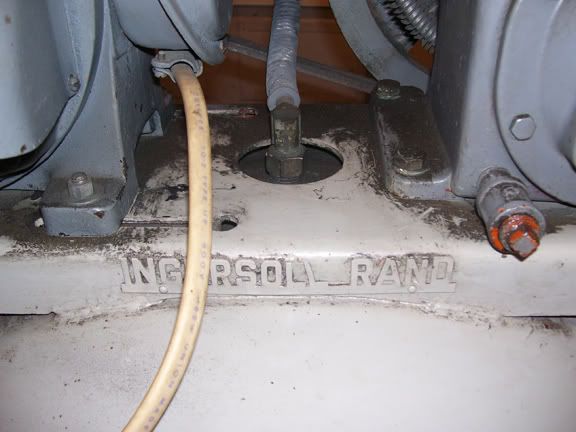
Here's an oldy I used to own: Ingersoll-Rand from the flat belt days. Bore was 6" I see!
 

Attachments

  • IRCompressorBack.jpg
    IRCompressorBack.jpg
    145.2 KB · Views: 39
  • IRcompressorfront.jpg
    IRcompressorfront.jpg
    135.1 KB · Views: 39
  • IRCompressorplate.jpg
    IRCompressorplate.jpg
    129.4 KB · Views: 38
  • IRCompressorside.jpg
    IRCompressorside.jpg
    135.9 KB · Views: 37

csmitty

Well-known member
Joined
Dec 17, 2010
Messages
1,542
So, after going through all the posts I saw one or two that looked similar but didn't see anything posted about them. I'm considering this compressor and was wondering if anyone might be able to shed some light on the specs. I did a google image search and found a ACC1006 that looked pretty similar.
 

Attachments

  • GD1.jpg
    GD1.jpg
    29 KB · Views: 103

Jay.ok

Member
Joined
Apr 11, 2015
Messages
5
Thanks for letting me join the group,my interest is in old air compressors,I have one and have not had much luck getting information on this item,any help would be welcome.
 

Zrexxer

Well-known member
Joined
Jan 23, 2007
Messages
5,058
Location
Pflugerville, TX
Thanks for letting me join the group,my interest is in old air compressors,I have one and have not had much luck getting information on this item,any help would be welcome.
Hi Jay and welcome to the forum. Nobody can help you if we don't know what you have. Detailed pictures and descriptions will go a long way toward finding someone who knows about your compressor.
 

Jay.ok

Member
Joined
Apr 11, 2015
Messages
5
I have a 1976 Champion compressor need some advice ,it runs but will not build up air,I removed the back cover and water pumped out,the same thing happened when I took out what seemed to be the oil filler plug,more water,The plate with the makers info has Shell 100 on it which made me think it should have had oil,not water pouring out.Any help or advice would be welcome.Thanks.
 

Jay.ok

Member
Joined
Apr 11, 2015
Messages
5
These are pictures of my 1976 Champion air compressor.
 

Attachments

  • 20150406_165338.jpg
    20150406_165338.jpg
    131.4 KB · Views: 70
  • 20150406_165354.jpg
    20150406_165354.jpg
    134.4 KB · Views: 50

Zrexxer

Well-known member
Joined
Jan 23, 2007
Messages
5,058
Location
Pflugerville, TX
I have a 1976 Champion compressor need some advice ,it runs but will not build up air,I removed the back cover and water pumped out,the same thing happened when I took out what seemed to be the oil filler plug,more water,The plate with the makers info has Shell 100 on it which made me think it should have had oil,not water pouring out.Any help or advice would be welcome.Thanks.
What back cover are you talking about? Have you drained the tank? Is it full of water too? There should not be any water in the crankcase of the pump, and if there is I'm afraid that the crank and the bearings may be ruined.
 
To avoid these ads, REGISTER NOW!

Jay.ok

Member
Joined
Apr 11, 2015
Messages
5
Thank you for your reply. The plate that I mentioned is on the back of the cylinder held by 4 bolts. Inside the plate, there is a small tube. When I removed the drain plug, there was no water in the main tank. Sorry it took so long to reply to you, I was out on the road all week.
 

Attachments

  • 20150418_131308.jpg
    20150418_131308.jpg
    122.2 KB · Views: 52
  • 20150418_131234.jpg
    20150418_131234.jpg
    133.1 KB · Views: 47
  • 20150418_131202.jpg
    20150418_131202.jpg
    134.7 KB · Views: 62
  • 20150418_131150.jpg
    20150418_131150.jpg
    133.5 KB · Views: 59

maxpower_hd

Well-known member
Joined
Apr 17, 2015
Messages
2,230
Location
Massachusetts
This is a 1973, give or take a year. I have the original manual and parts list, but no date, no receipt, so I cannot remember for sure which year I got it. Craftsman 1hp, 12 gal tank, 100 psi. I added the handy box and double pole 30 amp motor rated switch (set up for 120V but can be converted to 240V so I used a double pole switch in case it ever gets changed over.) Its been holding 100 psi for months now. Use it only occasionally now that I have a stationary shop compressor. 6.4 cfm @ 40 psi, 5.4 cfm @ 90 psi, it came without the belt guard, an option at the time, before they found out that stupid people used air compressors. I never had any little fingers around it so I didn't worry.

Charles.

I have, or had, the exact same compressor. My brother has it now and it still works great. Very quiet. Just not enough volume.
 

Eaton inside

New member
Joined
Apr 24, 2015
Messages
3
Found this one on the local Craigslist site...in the process of cleaning it up as it had some water in one of the cylinders.

00V0V_cMdZhDyLkLp_600x450.jpg
 

Indiana Dave

Member
Joined
Oct 18, 2014
Messages
14
Posted this in it's own thread before discovering this one...
Don't know much about it, but I think it's probably one of the first electric compressors...
Check out the **** shape, and the riveted tank!
 

Attachments

  • IMAG0967.jpg
    IMAG0967.jpg
    147.5 KB · Views: 114
  • IMAG0972.jpg
    IMAG0972.jpg
    144.7 KB · Views: 99

eddiebob

New member
Joined
May 20, 2015
Messages
3
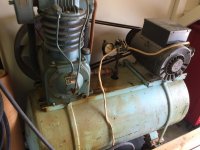
I've looked through all the posts and can't find anything like this. My brother in law gave it to me 10 years ago and I thought it was some of his junk yard junk. It quit working several years ago so I bought a new one. Several days ago I was loading it up to take it to the dump and looked at the engine tag. It is an Indian. What the heck? I'm thinking a 1940s gas station compressor. Thanks for any help. Ed B
 

Attachments

  • image.jpg
    image.jpg
    149.2 KB · Views: 91

zoggynog

Member
Joined
Jan 21, 2013
Messages
8
Complete novice here so I have to ask about these vintage 50's 60's compressors. Could they be used if restored for either of these two purposes?:

1. Used to run an airbrush setup for detailed stencil paint jobs?
2. Connected to a larger (60 gallon+) tank and used for painting large cabinets?

If so, could anyone elaborate on what would make for the ideal compressor in each situation? Again, novice. Thanks for the advice. Some real beauties posted here. Would love to have the look if one could provide functionality.
 

yaidunno

Well-known member
Joined
Feb 10, 2011
Messages
1,336
Location
WI
Complete novice here so I have to ask about these vintage 50's 60's compressors. Could they be used if restored for either of these two purposes?:

1. Used to run an airbrush setup for detailed stencil paint jobs?
2. Connected to a larger (60 gallon+) tank and used for painting large cabinets?

If so, could anyone elaborate on what would make for the ideal compressor in each situation? Again, novice. Thanks for the advice. Some real beauties posted here. Would love to have the look if one could provide functionality.

"50s-60s compressors" is a vague and open ended statement. Assuming you are referring to smaller compressors like the ones in the previous few posts, my answers are as follows:

For air brush use, absolutely. Hooking it up to a 60 gallon receiver and expecting it to keep up with the demands of a HVLP gun or air tools, probably not in your best interests. Again, this all depends specs of whatever compressor you have in mind.
 

Scott Larrieu

New member
Joined
Jun 20, 2015
Messages
1
I have the same model compressor. It is in very good shape. Shaft spins freely and all the screw and bolt heads are clean. Mine has two small tanks mounted on top of the motor. I'd like to sell it to a collector who can restore it. It is very cool looking unit. The little tanks look like small artillery shells. Can I post it somewhere here for sale? I can't figure out how to attach an image to this "quote". I created an album in my profile though. Thanks.
 

laser3kw

Well-known member
Joined
Nov 17, 2012
Messages
7,276
Location
northen IL
Richard d
I googled around and found the part number for the crank as 5504X or 5504X1.They are only sold as assemblies. There are places that will quote you one.
parts source link
Or the last reference is to :
QUINCY COMPRESSOR DIVISION OF COLTEC
INDUSTRIES INC
DBA QUINCY COMPRESSOR DIV QUINCY
COMPRESSOR
3501 WISMANN LANE
QUINCY IL 62305-3116
UNITED STATES
Telephone: 217-222-7700
Parts-Manual-Quincy-325-Pump link

that's all I got :willy_nil
 

Grlstar11

New member
Joined
Jul 5, 2015
Messages
2
I just brought this home today, and thought I would share it here. I would rather have a vintage American compressor, than a new one. So after some research, I kept my eyes open for a Kellogg American. For a winter project, I'll clean it up, paint, re-gasket, and tune up. The data plates say it is made by Schramm. The pump is a 1959 Kellogg American 331 with centrifugal unloader. It currently has a 3 hp motor turning it 390 rpm. I'm considering a 5 hp motor to spin it at about 550 rpm. This thing is quiet and massive!


Hi can you tell me how much you paid for that compressor. I have one that is almost exact that I want to sell. Thank you
Laura
 

Attachments

  • image.jpg
    image.jpg
    137.7 KB · Views: 53

twooldfarmers

Member
Joined
Jul 9, 2015
Messages
12
Location
SK
who can tell what this is, someone tells me maybe Webster but the data tag is missing

or is it a Quincy or what

any thoughts
 

Attachments

  • IMG_7788.jpg
    IMG_7788.jpg
    143.7 KB · Views: 47
  • IMG_7789.JPG
    IMG_7789.JPG
    145.6 KB · Views: 39
  • IMG_7790.jpg
    IMG_7790.jpg
    140.3 KB · Views: 40
  • IMG_7791.jpg
    IMG_7791.jpg
    140.1 KB · Views: 40
  • IMG_7792.jpg
    IMG_7792.jpg
    140.6 KB · Views: 37
  • IMG_7793.jpg
    IMG_7793.jpg
    139.8 KB · Views: 40
  • IMG_7794.jpg
    IMG_7794.jpg
    140.3 KB · Views: 38

redmondjp

Well-known member
Joined
Nov 25, 2014
Messages
2,318
Location
Redmond, WA
who can tell what this is, someone tells me maybe Webster but the data tag is missing

or is it a Quincy or what

any thoughts

Definitely a Quincy 2-stage. It's one of the following three pump models (that all share the same castings and external dimentions): 340, 350, or 370.

Since the data plate is missing, you'll have to go from the bore and stroke in order to tell the difference (all data in inches below; 'L.P.' is low-pressure larger-diameter primary piston, while 'H.P.' is the higher-pressure, smaller-diameter secondary piston).

Model Bore L.P. Bore H.P. Stroke
340 5.25 3.00 3.50
350 6.00 3.25 3.50
370 6.00 3.25 4.00
 
Last edited:

twooldfarmers

Member
Joined
Jul 9, 2015
Messages
12
Location
SK
Definitely a Quincy 2-stage. It's one of the following three pump models (that all share the same castings and external dimentions): 340, 350, or 370.

Since the data plate is missing, you'll have to go from the bore and stroke in order to tell the difference (all data in inches below; 'L.P.' is low-pressure larger-diameter primary piston, while 'H.P.' is the higher-pressure, smaller-diameter secondary piston).

Model Bore L.P. Bore H.P. Stroke
340 5.25 3.00 3.50
350 6.00 3.25 3.50
370 6.00 3.25 4.00

So is there a method to determine the bore/stroke without disassembly ?

removal of the inspection plate perhaps?

so there is absolutely no question then that this is a Quincy and not something that another manufacturer made that was very close such as this Webster brand that was suggested ? I only ask as I searched for several hours on Webster and about all I found out for sure is that they are as dead as the dinosours and there are zero parts available at this juncture

you seemed very certain of this so I probably should not have asked really but given what I found out about Webster I have to ask again .....

so is there a range on what this pump would be worth in good condition then?

was there a big $$ spread between the 340/350/370's ?

from what I have been able to glean from surfing today is that the 340 was considered a 7 1/2 horse model, the 50 a 10 horse and maybe a 15 on the 370 model ? yes ?

thanks
 

redmondjp

Well-known member
Joined
Nov 25, 2014
Messages
2,318
Location
Redmond, WA
So is there a method to determine the bore/stroke without disassembly ?

removal of the inspection plate perhaps?

so there is absolutely no question then that this is a Quincy and not something that another manufacturer made that was very close such as this Webster brand that was suggested ? I only ask as I searched for several hours on Webster and about all I found out for sure is that they are as dead as the dinosours and there are zero parts available at this juncture

you seemed very certain of this so I probably should not have asked really but given what I found out about Webster I have to ask again .....

so is there a range on what this pump would be worth in good condition then?

was there a big $$ spread between the 340/350/370's ?

from what I have been able to glean from surfing today is that the 340 was considered a 7 1/2 horse model, the 50 a 10 horse and maybe a 15 on the 370 model ? yes ?

thanks

There is no question that you have a Quincy pump there. I've never heard of Webster but they may have used a Quincy pump. You can tell from the shape of the castings, the cooling fin designs, the head unloaders, and the oil pump and filter, and the paint color, that it is a Quincy.

And from the looks of the pallet that it is bolted onto, that could be a new or remanufactured pump, as that is how they were shipped from the factory (or somebody swapped pumps and bolted the old one onto the pallet).

Here is a place to download the brochure which has the relevant technical specifications in it regarding horsepower, pump speed, and CFM:

http://igor.chudov.com/manuals/Quincy-QR25-Compressor-Brochure.pdf

I have no idea on pricing, but this is the top-of-the-line industrial-duty pump with full pressure lubrication and head unloaders. It's worth whatever you can get somebody to pay in your area. At 480 pounds just for the pump, shipping it will be expensive.

You should be able to determine the bore and stroke from removing the side plate. Unfortunately, without the nameplate on the side, you don't know the Revision Of Change or ROC, and this can be important when ordering parts. That plate would have the pump model and ROC, such as "340 ROC 13" on it.
 
Last edited:

twooldfarmers

Member
Joined
Jul 9, 2015
Messages
12
Location
SK
Thank you for that rock solid clarification

I am going to pursue this pump then as well as look for a large enough single phase motor to spin it

thx again
 
To avoid these ads, REGISTER NOW!
Top Bottom