To avoid these ads, REGISTER NOW!

Plumbing Question - Copper Pipes Degrading

In The Doghouse

Well-known member
Joined
Dec 20, 2012
Messages
877
Location
South of Due West, West of NinetySix in SC
I don't see a plumbing section so I hope it is okay to post here. If not maybe the moderators will move it for me.

About 5 years ago I again replaced my water heater located under the house. The exit pipe area of the heater had rusted out again. An acquaintance told me that I should use stainless steel pipes exiting the unit because dissimilar metals ultimately cause the rusting at the union with the tank.

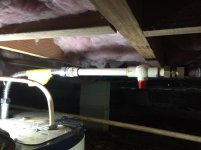
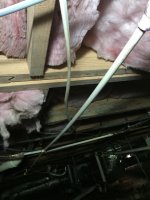
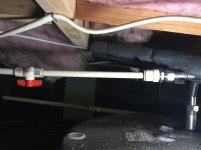
Now I find that the copper lines leading away from the tank are degrading to the point of leaks. I used screw clamps and old bicycle tube rubber to effectively block earlier pin hole leaks but now need to replace the entire section. While checking it out this morning I see it is worse than I had realized and I must replace about 8 ft of 3/4" pipe plus the T's and short sections beyond the T's.

Now to the question: Is the dissimilar material between the stainless steel exit pipe and the copper tubing the cause of this? Could I rebuild this with a short piece of plastic connection to insulate the metals from each other? What is the best way to fix this permanently? :headscrat

Photos are provided to show my dilemma.

What says the great minds of Garage Journal?
 

Attachments

  • IMG_0890.jpg
    IMG_0890.jpg
    130.5 KB · Views: 245
  • IMG_0893.jpg
    IMG_0893.jpg
    134.8 KB · Views: 276
To avoid these ads, REGISTER NOW!

Warrenator

Well-known member
Joined
May 31, 2008
Messages
781
Location
Newberg, OR
They make a thing called a dielectric union, which has plastic in it to act as an insulator. In my area code does not allow pvc pipe on hot water lines, but pex or something like that would accomplish the same thing. I'd just get the dielectric unions.
 

sixty4

Well-known member
Joined
Dec 1, 2007
Messages
1,424
Location
CT
One problem I see is it's type M copper (usually used on heating lines a thinner wall thickness). Yes a dielectric union coming off the top of a HW heater is a good thing. However have to ask if you are on a well?
 

94EG8

Well-known member
Joined
Apr 5, 2015
Messages
248
I would say your problem is more likely the water itself. Does the sink and tub turn green?
 

sixty4

Well-known member
Joined
Dec 1, 2007
Messages
1,424
Location
CT
If your PH is good and no electrolysis from ground straps or heater annode rod is still ok, it only leaves the pipe to blame. I noticed the red stripe on one of your pipes indicating type M. My old boss was the king at using it for water piping new homes back in the day (he saved a few pennies). Either way looks like the damage has been done.
 

M10

Well-known member
Joined
Nov 8, 2010
Messages
134
Location
Minnesota
Is the dissimilar material between the stainless steel exit pipe and the copper tubing the cause of this?
Yes. There may be other factors, but copper and stainless steel will have a galvanic reaction.
Could I rebuild this with a short piece of plastic connection to insulate the metals from each other?
Yes.
What is the best way to fix this permanently?
Pex.
 

joel63

Well-known member
Joined
Oct 9, 2012
Messages
1,909
Location
Central FL
If your PH is good and no electrolysis from ground straps or heater annode rod is still ok, it only leaves the pipe to blame. I noticed the red stripe on one of your pipes indicating type M. My old boss was the king at using it for water piping new homes back in the day (he saved a few pennies). Either way looks like the damage has been done.

I don't know if it makes much difference, but I never use type M copper (drain, waste, vent) for anything. I don't see that the savings in price versus quality is going to make a significant difference.

I use type L for most piping jobs, and type K if I feel the need to go overboard.

And always use acid free flux.

It looks as if acid based flux was used on some the joints.
 

Lassen Forge

Well-known member
Joined
Apr 26, 2014
Messages
15,278
Location
The romantic hills of central Umbria, Italy,
Direct connecting copper to ferrous metal pipe (Iron, Galvy, Stainless) will cause the coper to eat away due to Galvanic action. If you HAVE to interconnect them, you need a dielectric break - for hot water, it's brass; for cold, either brass or Plastic lined or plastic.

Our old house in Oakland, someone years before had put a piece of black iron pipe in the hot water supply, using a galvanized pipe union to attach it to the downline copper lines, and a black-iron connector to the galvy source from the water heater. I don't know how it lasted as long as it did, but I do remember it took weeks to get the basement dried out.
 

djjsr

Well-known member
Joined
Sep 4, 2006
Messages
4,796
Location
In the cornfields
Dielectric union. This type is for connecting a threaded pipe to a soldered copper pipe.

396410814.jpg


Note - If you decide to use plastic, do not use PVC for hot water. Use CPVC or PEX.
 

djjsr

Well-known member
Joined
Sep 4, 2006
Messages
4,796
Location
In the cornfields
That is not a dielectric union.

CPVC will work. Although I've heard that it is not recommended to use CPVC right at the water heater connection. Maybe use a short piece of copper or stainless then connect to the CPVC.
 
Last edited:

djjsr

Well-known member
Joined
Sep 4, 2006
Messages
4,796
Location
In the cornfields
After you get everything glued together, let it sit for a while before you pressurize it. Maybe a couple of hours but check the instructions on the can.
 

cbracer

Well-known member
Joined
Feb 27, 2012
Messages
639
Location
Costa Mesa, CA
FYI, besides the dielectric union, and the Type M copper pipes, you must also pay attention to cleanup of the solder! BSTM813 solder is the current lead free, water soluble flux that you should be using. However, making the flux water soluble has caused a corrosion issue on the outside of the pipes. You must clean off all flux residue on the outside of copper. I use soapy hot water and a scotch bright pad. Works great and give shiny pipes. The corrosion will eat away causing pin hole leaks if not cleaned off. Older non water soluble flux didn't have this problem, but the flux leaked into the water supply for years.
 

CNGsaves

Well-known member
Joined
Sep 26, 2012
Messages
13,233
Location
KS and OK
Wouldn't hurt to get yourself a torch and pipe cutter so you can practice sweating joints !! ;)

+1 agree that replacing that bad section is best solution. Looks like bad copper.

Was that problem only happening on hot water pipes ?? Let's see PICs of pipes coming out of top of hot water heater . . . what kind of pipe ??

Where are your copper water pipes grounded to electrical system ??

ANOTHER MAINTENANCE ITEM: Replace any saddle valve if you have one for water to ice maker in frig. Those are notorious for leaking and causing problems. Put in actual T and fitting that has 1/4 turn shutoff valve. Good luck.
 

Kiwi Canuck

Well-known member
Joined
Dec 13, 2014
Messages
156
Location
Langley BC
I see you have purchased your supplies already, next time you need to fix a plumbing issue like this try Sharkbite connectors, a little spendy but fantastic product.

You can cut out a bad piece of pipe and add in a new piece of what ever pipe you have on hand, you can join copper to PEX/PVC/CPVC and back to copper with ease, also really good if you're in a confined space.

I have no issue sweating copper but sometimes if you are doing a repair and the line won't fully drain it can be a PITA trying to sweat a joint when water keeps flowing back into the joint, the sharkbite takes minutes to do and the beautiful thing is they even come apart if needed, the tool only costs a $1 or so.

I've been using them for about 5 years and never had an issue, I just make sure the pipe is cut square and the burrs are removed otherwise you can damage the fitting.
I also use a sharpy marker pen to mark the insert depth on the pipe so I know it's inserted fully.
http://www.sharkbite.com/how-to/how-to-repair-burst-pipe-frozen-pipe-repair-with-sharkbite/

Home Depot carries this product here in Canada.

Good luck with your repair.

David
 
Last edited:

ALinCarolina

Well-known member
Joined
Dec 29, 2014
Messages
758
Location
NC Piedmont
One way to hold back the water draining is to stuff some bread up into the pipe. It will usually last just long enough to get the joint soldered before it dissolves.
I had a problem while on well water that was so soft and acidic that it was dissolving the copper pipes. Especially at the nineties. Like 94 said i had green stains in toilets etc. it took maybe 10 to 12 years to cause a leak. It also dissolved a brass gate valve. Had to install a water hardening filter until i was able to switch to city water.
 

ForceFed70

Well-known member
Joined
Apr 27, 2010
Messages
3,441
Location
BC, Canada
1st off - reactions between dissimilar metals are mostly localized. You will not see 8' of pipe corroded like this just because you have a reaction at one point.

I agree with others - looks like bad pipe perhaps combined with a moisture problem. Is it a cold water line? If so you could be experiencing a condensation problem that might be exasperating the issue. IF that's a cold line, I would consider insulating the replacement to help avoid condensation.

Personally - I'd use a short section of poly in between the heater and the copper pipe rather than trying to use some special fitting. Simple, easy, and makes future heater replacements easier.
 

JRC3

Well-known member
Joined
Jun 30, 2014
Messages
12,481
Location
Southwestern OH
I agree, Sharkbites are the way to go for repairs. They are pricey but well worth it. Just don't cheap out and buy the Watts brand or other knockoffs (especially the plastic ones), only use the Sharkbite brand.
 
To avoid these ads, REGISTER NOW!

Kiwi Canuck

Well-known member
Joined
Dec 13, 2014
Messages
156
Location
Langley BC
One way to hold back the water draining is to stuff some bread up into the pipe. It will usually last just long enough to get the joint soldered before it dissolves.

Thanks, I didn't know this tip until after my issues, I had 2 older rental properties so always needed to be fixing something plumbing related until I re-piped the both properties.

Once I discovered the Sharkbite fittings I never needed the bread trick but a good one to put in the memory bank.

David
 

Champ128

Active member
Joined
May 3, 2015
Messages
33
The bread trick does work pretty good. When soldering the bread ends up turning to toast. You should remove the aerators and allow the water to run for a few minutes. If you do not you are likely to get black crumbs in your water and likely clog the aerators.
 

JRC3

Well-known member
Joined
Jun 30, 2014
Messages
12,481
Location
Southwestern OH
I've gone to the carryout to buy a whole loaf of bread to do this at a customer's house before. I learned to use my pancake compressor or a shop vac hose on blow too to blow back the water too. All before discovering Sharkbite and pex. I also used compression couplers and ALWAYS replaced water supply shutoffs for sinks and toilets with compression/non sweat versions. Those can be easily removed and reinstalled need be. Again, that's what I did before discovering Sharkbite.
 

LS6 Tommy

Well-known member
Joined
Dec 27, 2013
Messages
26,162
Location
Northern NJ
1st off - reactions between dissimilar metals are mostly localized. You will not see 8' of pipe corroded like this just because you have a reaction at one point.

I agree with others - looks like bad pipe perhaps combined with a moisture problem. Is it a cold water line? If so you could be experiencing a condensation problem that might be exasperating the issue. IF that's a cold line, I would consider insulating the replacement to help avoid condensation.

^^^This.^^^ M is not the best choice for that application.

Tommy
 
Last edited:

cbracer

Well-known member
Joined
Feb 27, 2012
Messages
639
Location
Costa Mesa, CA
Besides the bread trick, I normally hook up a wet/dry vac and vacuum out the water. Or pressurize it away. Opening up and proper draining of water system helps.
 
OP
I

In The Doghouse

Well-known member
Joined
Dec 20, 2012
Messages
877
Location
South of Due West, West of NinetySix in SC
Update: I did finish it up yesterday afternoon. The glue instructions said to let it cure for 12 hours before applying pressure. It didn't take me long to take the cold shower yesterday evening. :yikes:

This is coming from our water heater, all the cold water lines look fine. This leads me to believe it may have stemmed from the dissimilar metals and/or some acid flux that may have deteriorated the tubing over the years. The line coming into the heater was also corroded, to the point the brass shutoff valve would not close completely.

My local Lowe's does not offer the Gator Grip connectors, but some similar. We have no Home Depot nearby. I chose the type with the feral that you wrench tight around the copper tubing. They have no rubber seal that might degrade in later years, just the mechanical tightening. Also you may notice that I reduced the main line from 3/4" to 1/2" diameter. We have very good water pressure and this change will reduce the length of time it takes the hot water to arrive at the spigot, saving water and a little electricity too. This morning when I showered I did not notice a difference in the pressure. I am happy with that decision.

One of you mentioned I should learn to sweat pipes. I do own a MAPP gas setup and I do sweat pipes as needed. I just didn't want to do this again in a crawlspace that I could only sit upright when I put my head into the insulation between floor joists. Also, when I broke the pipes apart a good bit of water drained in the red clay further lessening the working conditions.

During my past experience of stopping the water flow by stuffing a ball of bread into the pipes I learned the best bread is white bread without all the fancy oats or anything. Sunbeam bread is kind of gummy and seems to work the best. Also, as mentioned, you had better remove any screens at the spigot before you flush out the bread or you will clog them up.

Thanks to you guys I used the CPVC pipe and fittings. Hopefully the remaining copper tubing leading to the faucets will remain good and will not require replacing in later years.
 

Attachments

  • IMG_0899.jpg
    IMG_0899.jpg
    128.1 KB · Views: 78
  • New plumbing.jpg
    New plumbing.jpg
    133.1 KB · Views: 75
  • IMG_0900.jpg
    IMG_0900.jpg
    133.4 KB · Views: 72
Last edited:

bczygan

Well-known member
Joined
Nov 4, 2009
Messages
22,002
Location
DETROIT! Arsenal of Scrappers
1st off - reactions between dissimilar metals are mostly localized. You will not see 8' of pipe corroded like this just because you have a reaction at one point.

I agree with others - looks like bad pipe perhaps combined with a moisture problem. Is it a cold water line? If so you could be experiencing a condensation problem that might be exasperating the issue. IF that's a cold line, I would consider insulating the replacement to help avoid condensation.

Personally - I'd use a short section of poly in between the heater and the copper pipe rather than trying to use some special fitting. Simple, easy, and makes future heater replacements easier.

exacerbating?:bounce:
 
OP
I

In The Doghouse

Well-known member
Joined
Dec 20, 2012
Messages
877
Location
South of Due West, West of NinetySix in SC
Good looking repair work! Did you just show us an electric water heater in a bare dirt crawlspace?
That is what you are seeing. Wish it was not true, but it is. I do not believe it is unusual in this area. When I changed it out last I dug it out and put a bag of quickcrete in the bottom and then 3 bricks for it to sit on. When the weather cools down I will go down there to scoop the loose dirt away from it. I hope with the stainless steel lead off connectors this tank lasts a long time.

Put a couple of hangers on that CPVC.
I plan to do that in the near future. I have some of the wire things that you tap into the joists to support the plumbing.

exacerbating?:bounce:

Exacerbated! :headscrat That pretty well describes me yesterday when I was crawling around on the damp red clay. :wtf:
 

BillK

Well-known member
Joined
Aug 24, 2006
Messages
9,347
Location
Beautiful Southern Maryland
Dog,
I have not read all of the replies but you just might want to call your water company and have them take a look. In our area about ten years ago they started having a lot of similar issues and it turned out the cause was a change in the chemicals they used to treat the water. Might not be the cause in your case but it cant hurt to call them and get their opinion. I doubt that they will charge you anything.

Just a thought,
 

Mopar14

Member
Joined
Aug 13, 2015
Messages
11
Location
Barriere, B.C. Canada
I would agree with ForceFed70. Use an 18 inch piece of copper coming off the tank on both hot and cold. Then adapt to pex from there. You shouldn't have any more issues.
 

pop pop

Well-known member
Joined
Apr 1, 2010
Messages
2,859
Location
Virginia
You need to remove the sacrificial anode in the water heater and see if any of it is left. My guess is not, and the copper is serving as the sacrificial anode.
 

TK LP

Well-known member
Joined
Sep 1, 2010
Messages
105
Location
Middletown, Md.
I would say your problem is more likely the water itself. Does the sink and tub turn green?

No well, we are on city water. And very good soft city water. Minimal staining in sinks and toilets. We had this house built in 1986 and these problems just began in the past few years.

I agree, I believe the problem is the water itself. Is your municipal system a well system? Perforation in the piping is corrosion, heavier grades of piping will prolong system life, but I would have a sample checked first.

I installed a softener and charcoal filter on my municipal fed system to get rid of the eavy chlorine and hardness.
 

Rickss96

Well-known member
Joined
Sep 23, 2010
Messages
455
Location
SoCal
Will the circuit breaker not suffice?
A GFCI breaker will be a lot safer for you. If your water heater is on, say, a 15 amp breaker and you touch it and create a path to ground that conducts only 5-10 amps, the standard breaker will not trip but you will be very unhappy. A GFCI breaker will detect that and trip. And consider that you likely will be down there checking out a leaky water heater with damp clay all around. Its a cheap way to prevent future problems.
 

wbrett102701

New member
Joined
Feb 16, 2015
Messages
3
Anytime you go from steel-copper you need a dialetric ****** or union, to prevent electrics, just a heads up or you will be having leaks within the next year, especially on m copper


Brett.
 
To avoid these ads, REGISTER NOW!
Top Bottom