To avoid these ads, REGISTER NOW!

rust removal/rust treatment/metal restoration and conservation

Ekie

Active member
Joined
May 27, 2015
Messages
29
Location
Kansas City
Steel will rust Matthew 6:19, however it can be delayed. The purpose of this thread is to discuss methods to remove or stop rust.

My back ground is in firearm assembly and finishing with 20 years experience. Specifically taking knocked down surplus post war military rifles (parts kits) and assembling on semi-auto receivers. Then either refinishing the entire rifle as new, or finishing the receiver to match the used and worn kit. This is the basis of my experience.

My education is in the fine arts and not chemistry. Any input from those with direct experience and or a formal chemistry education is very much encouraged to post feedback/correction/clarifications.

Here are a some examples of prior work:

left%20close.jpg

IMBEL FAL receiver and surplus parts kit parkerized and painted with Brownell's Baking Lacquer.

M14big000005.jpg

TRW M14 parts on a Polytech receiver and parkerized.

104-0471_IMG.jpg

SARCO surplus Italian 7.62 NATO M1 kit on a Beretta receiver - parkerized.

IMG_2826.jpg


IMG_3142.jpg


Recently purchased a 1995 Jeep Cherokee and found myself dealing with rust of this magnitude.

Methods of rust removal:

Phosphoric Acid:

Commonly used for the purpose of removing rust and to add a tart taste to carbonated beverages. Variously sold as the active ingredient in such products as Rustmort, Prep and Etch, Ospho, Navel Jelly, Metal Prep, and found in Coke a Cola, etc. Expect to pay about $30 a gallon for a 80% strength solution or about $16 a gallon for a 35% solution.

Phosphoric acid will remove rust and conversion finishes on steel, i.e. black oxide, bluing, and phosphates (AKA parkerizing). Will also remove paint, but it's not a very good paint remover. Have not seen it remove electroplating, i.e. zinc plating. Will take chrome off plastic.

Excessive exposure of steel to phosphoric acid will lead to heavy etching and will ruin the part/tool.

Because phosphoric acid can also leave a iron phosphate finish on steel I use it as the final rust treatment prior to finishing prep.

Heat greatly speeds up the process. Beware phosphoric acid can foam up while actively working especially when heated.

Phosphoric acid in a natural state is a white powder as such it is quite normal to have a white coating on your parts after treatment. The final finish can be applied over this white coating as it is quite durable. If you wish to remove this white chalky coating I have only found two methods that work. This can be important if you have some sort of industrial accident such as spilling the acid on your garage floor. Abrasion will obviously work. Better yet is a Chelation product such as Evapo-Rust. Will "melt" it right off.

Hydrochloric Acid:

This is the nuclear option and it is caustic nasty stuff. Since it is the same as stomach acid you can make fake vomit with it, kids love that type off stuff. Hydrochloric acid is why your dog can eat putrid stuff and not get sick. Available at the hardware store and Wal-Mart in a diluted form labeled muriatic acid for about $7 a gallon. Muriatic acid is commonly used to clean pools.

Hydrochloric acid in a approximately 10 percent solution is commonly used in metal prep in industry and has been connected to incidents of hydrogen embrittlement. Nice article on the subject:

http://www.bestbolt.com/white_papers/white_paper_05.pdf

In short it states that at least as far as fasteners go hydrogen embrittlement involves Grade 8 bolts that have been prepped with hydrochloric acid and electroplated.

Due to hydrochloric acid's caustic nature it is a paradox, will remove rust and will rust things. I now keep my supply outside after learning a lesson on the caustic nature of it's vapors emitted from a capped bottle. Because of this I only use it in extreme cases, that is on heavily rusted pitted furry scaled up nasty stuff. Used only as a early step and finishing up with other methods.

Is also a decent paint remover. Will also remove conversion finishes and zinc plating. However I have not been able to remove hard chrome with it. Will eat non ferrous metals for lunch. If you drop something in it and it starts to boil remove it immediately because your part/tool is dissolving before you eyes.

The real trick on using it is to stop the flash rust that develops as the parts dries after rinsing.

Electrolysis:

Considering this is the garage journal then this is about the cheapest method in that you should have the necessary equipment on hand. This involves hooking a car batter charger up to a sacrificial anode on the positive side and your rusty part on the negative with everything suspended in a electrolyte solution.

I find the process to be a bit to slow in that it's action is line of site (part/tool is flipped around and moved periodically) as opposed to acids that work in all areas of contact which is easy to achieve as long as total immersion is possible.

My setup uses a graphite rod as a sacrificial anode so that I don't end up with a bucket of gross red colored muddy slop.

Not sure how it does with paint removal or zinc plated parts, have not tried it. Did successfully remove rust from a parkerized shotgun barrel without damaging the finish. Not aware of any other method that can do that.

When you remove the part/tool after treatment you will find it coated with a black substance. Typically user tutorials call for removing this residue with abrasion which is not going to work on a heavily pitted part. Descriptions of this black coating have been describe as being various things but I am convinced that this black residue is magnetite. Phosphoric acid will dissolve this black residue in no time.

Don't think I will be using this process much anymore in that it is not as aggressive as hydrochloric acid and does not get all the rust off as well as phosphoric acid. And if I am going to remove the magnetite with a post treatment phosphoric acid bath anyhow then what is the point?

Chelation:

Sold as Evapo-Rust at your hardware store for $25 a gallon. Molasses can also be used (currently have no plans of going that route). Due to the high cost of Evapo-Rust I was slow to try this method.

Recently purchased some Rust911 and the math on it works out to about $4 a gallon. This could prove to be a economical choice depending on how long the solution will remain active.

On this forum there is a discussion on a home brew chelation solution utilizing ethylenediaminetetraacetate or EDTA:

http://www.garagejournal.com/forum/showthread.php?t=69793

Planning on posting progress on this method in this thread and once experience is gained I will update this section.

Abrasion:

Angle grinders set up with wire wheels, grinding wheels, sanding, tumblers, sand blasting, etc.

First mentioned downside, your part will get smaller.

Second downside regarding blasting is that the itty bitty media left laying around after use can lead to premature wear of parts later down the line. For example, sand in the engine bay of a vehicle later sucked up into the engine intake.

While I have a blast cabinet both in the garage and at work, and a "pot blaster" that can be used outdoors I rarely use them for rust removal in that in the majority of cases I find all other methods described here to be more effective in removing rust. However for large items where immersion is not possible like the frame on a vehicle my first step after a power wash is the wire wheel.

While I typically don't use abrasion for rust removal it is irreplaceable for prep work for getting a durable surface for you final finish to adhere to. For finish prep I use a vibrating tumbler for small parts and the blast cabinet for larger items. The end resulting frosted surface allows better bite for the finial finish to adhere to.

Vinegar:

Never tried it.

Citric Acid:

Another never tried it.
 
Last edited:
To avoid these ads, REGISTER NOW!
OP
E

Ekie

Active member
Joined
May 27, 2015
Messages
29
Location
Kansas City
Treatment rather than removal as in encapsulation or conversion

Encapsulation:

Method of action is to seal the area to prevent such things as salt, water, and oxygen from allowing oxidation to occur. Common products include Rust Bullet, POR-15, and Rust Encapsulator.

Only have experience with POR-15 and it is something like a 50 step plan (exaggeration). In short, to get this to work you really have to study and pay attention to the instructions that comes with you product. In my experience is this type of stuff is very brittle and will only adhere to porous surfaces as in rusted surfaces. Applied to a smooth surface like bare steel or paint it will peel off in sheets. As a result this product has very limited usefulness. One example of a situation that I used it with little alternative is a rusty oil pan on a van. Had to either unbolt and lift the engine to remove and replace the pan or treat in place. I chose to treat in place using this method. The pan was treated with POR-15 and the holes sealed with JB Weld, and has now survived two winters with no leaks.

It works, but know it's limitations.

Some tips on using POR-15. Use only on roughed up or rusted surfaces. Prime four hours after application, that is not wet and not dry but tacky. Will not survive UV rays. Once the can is open it is a bear to seal and save.

Conversions

Phosphoric Acid:

Not for use on converting heavy rust. Better used for rust removal. Is the best for converting rust once it is reduced to remaining only in the bottom of bits. In such situations it will turn the pit black, as in iron phosphate a fine prime for the finial finish.

Tannic Acid:

As opposed to the other acids described here tannic acid does not remove rust instead it converts rust to ferric tannate. like phosphoric acid it is also used in food products. Will be posting some before and after pictures using this method.

Covering: for lack of a better term

As Kenwc pointed out rust can be treated with petro based products to arrest rust with such purpose made products as Corrosionx. You can see the effectiveness of this method by crawling under a high millage vehicle that has a transmission, engine, or steering pump leak. The areas covered from the leak are well protected. One down side to this is in the case of a engine bay fire the whole thing can go up quick.

There are also under carriage treatments designed to prevent corrosion with brand names such as Texaco Rust Proof Compound, AMSOIL Heavy Duty Metal protector, Krown, and Ziebart.
 
Last edited:
OP
E

Ekie

Active member
Joined
May 27, 2015
Messages
29
Location
Kansas City
So lets get to work.......... :

Will start with the most basic (cheapest) method.

This appears to be and exceptionally adaptable all purpose bolt head rounding off tool in which the chrome finish has failed:

IMG_3815.jpg


The "tool" was submersed in a phosphoric acid solution. In this case Prep & Etch in a Harbor Freight ultrasonic cleaner. The heat was turned on reaching about 130 degrees and ran for about three minutes. The end result is the rust is removed and replaced with iron phosphate finish. Kept protected with oil or a paint this iron phosphated tool will be rust free and available for bolt head rounding at a moments notice:

IMG_3817.jpg


The same result can be achieved without heat and ultrasonic agitation with the phosphoric acid product of your choice but the process will take more than 180 seconds. Just follow the instructions that came with your product.

More examples of the same process:

IMG_3777.jpg


IMG_3785.jpg


IMG_3778.jpg


IMG_3786.jpg
 
OP
E

Ekie

Active member
Joined
May 27, 2015
Messages
29
Location
Kansas City
Worst case scenario tutorial

This was attacked with every method I had on hand at the time (prior to playing with Chelation).

01%20start.jpg

Trailer hitch brackets that are heavily rusted.

01%20start%20drain.jpg

For the purposes of this tutorial, and for practice I thought up the nasty rustiest thing available. This is the HVAC drain cover out of my basement. In addition to rust it has what appears to be iron bacteria.

The process described below to refurb this drain cover is not economical nor is it worth the time spent on it. In this case buying a new one at Home Depot makes more sense.

02%20hyrdo%20acid.jpg

Soaked overnight in a 10 percent hydrochloric acid solution. Results are the heavy scale rust is largely removed, and now we have a mottled unidentified black finish and flash rust. The flash rust develops after the water rinse and during the drying phase.

This flash rust issue during the post rinse drying phase is an issue with all rust removal methods involving solutions that contain water (but greatly magnified when hydrochloric acid is used). Have found that air and heat, like a heat gun or compressed air exasperates the issue.

Doubling down on the issue here, this post rinse drying phase flash rust is not due to the corrosive nature of acid (but it sure don't help). The same situation occurs at a lesser degree using methods that don't involve acid. In addition a post acid treatment that involves a alkaline rinse (baking soda, lye) in my experience has no effect in tempering post treatment flash rust.

While not tried in the examples shown here a alcohol post rinse has shown great promise. Parts go from acid to water rinse and then into alcohol. Once out of the alcohol rinse the parts dry quite quickly with little rust and with no assistance (air or heat). Denatured alcohol can be purchased quite economically at retailers since it free from BATF tax. However if you are doing a large item or a large batch buying a bunch of denatured alcohol for this purpose will great increase the cost of rust removal treatment.

Going to look at using E85 Ethanol to rinse off parts post rust treatment. There is a station North of me that sells it. If anyone has tried this please share.

03%20phospo.jpg

This is post treatment with phosphoric acid. Further removal of rust and less flash rust. Dark areas are iron phosphate.

04%20suspension.jpg

If you have something else other to do during such a project such as going to work or otherwise living your life what do you do with bare steel? The best method I have found is to "suspend" such projects is to douse with kerosene and keep wet. When ready to start working on the parts again place near a fan to dry them out. Petroleum products such as kerosene prevent rust formation and kerosene has a good balance between quick removal and not evaporating. If you don't have a parts cleaner to keep them stored in place in a plastic bag of some sort.

Kerosene is also attractive in that it can be purchased at the pump.

05%20electircb_1.jpg

Post electrolysis treatment.

06%20wire%20wheel%2001_1.jpg

Hit the trailer hitch brackets with a wire wheel. Probably should have been step one.

07%20blast%20phosphoric%2003_1.jpg


07%20blast%20phosphoric%2002.jpg


07%20blast%20phosphoric%2001.jpg

Post sand blasting and another phosphoric acid treatment. What rust that has not been removed has been converted to iron phosphate (deep pits). Now ready to apply a final finish.
 
OP
E

Ekie

Active member
Joined
May 27, 2015
Messages
29
Location
Kansas City
52 gallon stainless steel tank project:

Can't get these at Wal-Mart. Picked this up from a friend that moved his shop and no longer had use for it.

Any numbers of uses for this. First thought is to fill it with a Chelation product i.e. Rust911 and do some serious bigger stuff rust removal. Could get an in tank heater and use it for parkerizing, or set it up as a ultrasonic cleaner. Lots of ideas here, short version is that it will be put to work,

tank%2001.jpg

Straight off the truck.

tank%2002.jpg

Straight off the truck.

tank%2003.jpg

Straight off the truck. Note the rust on the cart, deep pitting.

tank%2004.jpg

Wheel rusted in place, will not turn.

tank%2005.jpg

Abrasion, everything I have, wire and flap wheel, and sanders.

tank%2006.jpg

Treated with phosphoric acid. I used Ospho on this one. Following the instructions Ospho either removed the remaining rust that abrasion could not reach or converted it to iron phosphate. In edition it etched the surface providing a foundation for the primer to bind to.

tank%2007.jpg

Detail showing the rusted pits that where iron oxide has been converted to iron phosphate.

tank%2008.jpg

Wheels now turn, note the flat spot from being pushed around with a rusted solid wheel.

tank%2009.jpg

Am thinking that the stainless needs a new brushed finish.

tank%2010.jpg

Looking clean and ready to go to work.
 

Shiftless

Well-known member
Joined
Mar 9, 2014
Messages
14,551
Location
East Bay SFO
Excellent post!
Thanks for sharing the results of your "research" into rust removal and your first class photography.
 

OkRider

Well-known member
Joined
Apr 26, 2014
Messages
593
Location
Oklahoma
Excellent post!
Thanks for sharing the results of your "research" into rust removal and your first class photography.

Outstanding!!!! All I could add would be fine Bronze Wool to gently remove light rust without removing the blueing. I used to be in the same business as you, but that's been years gone now.

For what it's worth, as a kid I lived in Overland Park and Independence. I remember your neck of the woods. ;)
 
OP
E

Ekie

Active member
Joined
May 27, 2015
Messages
29
Location
Kansas City
Outstanding!!!! All I could add would be fine Bronze Wool to gently remove light rust without removing the blueing. I used to be in the same business as you, but that's been years gone now.

For what it's worth, as a kid I lived in Overland Park and Independence. I remember your neck of the woods. ;)

Removing rust from a blued part without damaging the bluing is near mission impposable. Compared to iron oxide bluing is quite fragile. Am sure it could be removed as you describe but I would do electrolysis and be done with it.

As far as location, that is interesting in that I spent many a summer in OKC and ended up marrying an Okie
 
OP
E

Ekie

Active member
Joined
May 27, 2015
Messages
29
Location
Kansas City
I've used this product (red can) on firearms and it will remove "some" rust from bluing and protects from furthers rust.

http://www.corrosionx.com

I will have to add a blurb going in that direction. In addition to your example there are also vehicle treatments like Texaco Rust Proof Compound, AMSOIL Heavy Duty Metal protector, Krown, and Ziebart. Heak, engine oil, transmission fluid and gear oil all can provide rust prevention to the underside of a vehicle, with the down side of being a fire hazard.
 

XxToolAholicxX

Well-known member
Joined
May 28, 2014
Messages
1,449
Location
SF **** Bay Northern California
Excellent information thanks for sharing.. As an old tools collector Evapo-Rust is my best friend....

-----------------------------------------------------

I am ToolAholic, Sometimes I regret it, Especially when the Toolman won't give me no credit
 
OP
E

Ekie

Active member
Joined
May 27, 2015
Messages
29
Location
Kansas City
IMG_3820.jpg


Some old pneumatic stuff that came from the now defunct TWA KCI overhaul base. Not that it matters, but kinda cool. Been painted over and some mild corrosion.

IMG_3934.jpg


Paint stripped with Oven cleaner. Decided to try the Rust911 product with this, did'nt want to try acid and definitely abrasion would not be appropriate. Came out pretty nice.
 
OP
E

Ekie

Active member
Joined
May 27, 2015
Messages
29
Location
Kansas City
Ekie,

Have you heard about the slow cooker and antifreeze metal cleaning method? It seems to be popular with the RC airplane community for cleaning out the little gas engine blocks.

No, sounds interesting. Will check that out.
 
OP
E

Ekie

Active member
Joined
May 27, 2015
Messages
29
Location
Kansas City

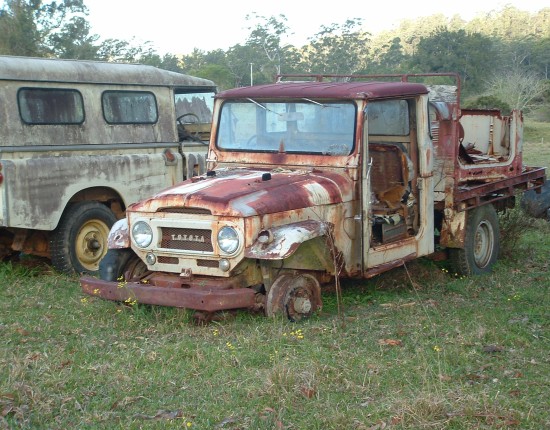
Future rat rod Yota. At some point I am going to get a set up with a pump and a kiddie swimming pool. You place the pool under something like that, fill with your rust remover and using the pump set up a fountain to have a continual flow over the rusted steel.

Have any pictures of the Range Rover, curious as to what the corrosion looks like 50 years later. Considering the aluminum F150's are being built here now.
 

EDGAR

Well-known member
Joined
Aug 21, 2010
Messages
437
I know you are testing things here but had you sand blasted the test trailer hitch parts from the beginning, you would had saved a lot of time and resources.

Nothing beats sandblasting for rust removal in readily accessible surfaces. Leaves a better, more evenly colored surface finish ready to paint, after some dusting, of course. Would only use acids and such when there is no other choice, like no direct access to the surface.

It is like having a rifle to hunt deer and instead throw stones at them. More work, more time spent, and most likely, lesser results.

Anyway, you forgot two other methods: hand held sandpaper and a pointy, serrated knife to scrape the rust off of heavily rusted metal.

Vinegar works OK, but do not leave the parts immersed too much time or these will rust much more.
 
To avoid these ads, REGISTER NOW!

CwazyWabbit

Well-known member
Joined
Jan 9, 2015
Messages
1,189
Location
Surrey, UK
Horses for courses, whilst shot blasting is great for some things I'd not want too use it if I was restoring something with machined surfaces. The electrolysis would win hands down there.
 

EDGAR

Well-known member
Joined
Aug 21, 2010
Messages
437
"Horses for courses, whilst shot blasting is great for some things I'd not want too use it if I was restoring something with machined surfaces. The electrolysis would win hands down there"

But this is a choice of a specific surface finish desired and not necessarily the rust removing ability of one method over the other. Some people do not like the kind-of-flat surface finish left by sandblasting if the metal is going to be left bare and that is understandable. But for painting steel, where the surface finish is hidden by the paint, sandblasting should better and faster.
 
OP
E

Ekie

Active member
Joined
May 27, 2015
Messages
29
Location
Kansas City
Excellent post!
Thanks for sharing the results of your "research" into rust removal and your first class photography.


Tag for a great thread. Thanks! :)

Excellent information thanks for sharing.. As an old tools collector Evapo-Rust is my best friend....

WOW, thank you very much for sharing, an excellent insight.:bowdown:

Nice thread! Thanks for sharing the knowledge.

I have spent quite a bit of time posting such threads as this and I appreciate a thank you here and there.
 
OP
E

Ekie

Active member
Joined
May 27, 2015
Messages
29
Location
Kansas City
Horses for courses, whilst shot blasting is great for some things I'd not want too use it if I was restoring something with machined surfaces. The electrolysis would win hands down there.

No doubt, electrolysis is the least destructive rust removal method.
 
OP
E

Ekie

Active member
Joined
May 27, 2015
Messages
29
Location
Kansas City
EDGAR, much appreciate you input, I trust you will continue to contribute.

I know you are testing things here.

Am testing Chelating, however I am well beyond testing acid rust removal vs sandblasting rust.

had you sand blasted the test trailer hitch parts from the beginning, you would had saved a lot of time and resources.

Depends on what you mean by time and resources. If you have an immediate deadline than sandblasting is more effective, as in quicker. If you lack the time to dedicate standing at the sandblast cabinet than acid is more efficient, as in less labor hours, the acid does the work while you do something else.

In short acid will remove rust with much less labor but will take more time. Or what is more important the completion date or labor time?

Nothing beats sandblasting for rust removal in readily accessible surfaces

Not following you here. For example you are not going to remove the iron bacteria and rust off that nasty drain cover in a sandblast cabinet. Or maybe you could, but could it be done without reducing the part to dust?

Leaves a better, more evenly colored surface finish ready to paint, after some dusting, of course.

Agreed.

Would only use acids and such when there is no other choice, like no direct access to the surface. .

My last choose is an encapsulant like POR-15.

It is like having a rifle to hunt deer and instead throw stones at them. More work, more time spent, and most likely, lesser results.

My experience is the opposite. As in acid is the rifle and sandblasting is a stone. Acid will reach areas that a blast media can never reach.

Anyway, you forgot two other methods: hand held sandpaper and a pointy, serrated knife to scrape the rust off of heavily rusted metal.

Falls under abrasion which was covered in my original post.

Vinegar works OK, but do not leave the parts immersed too much time or these will rust much more.

Going to skip trying that method.
 

WVBrady

Well-known member
Joined
May 5, 2005
Messages
1,679
Location
WV
Ekie: I appreciate the effort you went to in presenting this.

I wonder if there is some way to use electrolysis to separate two pieces of metal in the latch at the top of my pop-up tent. I hadn't used it for several years and they seemed to be fused together. They don't have any rust. I have used different penetrating oils with no luck. I don't know if they are stainless or not; I know stainless will gall and stick together. I can't apply much heat because of the tent fabric.

Any ideas?
 

mg283680

Banned
Joined
Jul 23, 2015
Messages
103
I've used a few methods and molasses is slow, cheap, easy and can be used on parts that fit in a garbage can such as a few wheels. It leaves a black residue and is prone to flash rust. I've sprayed diluted phosphoric acid (paint or cement section at the home store). Careful phosphoric acid eats cement/concrete.
Be careful not to use strong acid on parts that have lapped joints. The acid gets in the joint and comes back to ruin paint.
 
OP
E

Ekie

Active member
Joined
May 27, 2015
Messages
29
Location
Kansas City
First attempt using chelation (Rust911). Did post an example earlier (the pneumatic stuff), but the below was done prior.

rust911%2001.jpg


Bits that spent time in a wet tool roll and rusted. Cleaned with kerosene and a day or so in the vibrating tumbler.

rust911%2002.jpg


Straight out of the Rust911 solution.

rust911%2003.jpg


These dried out nicely with no flash rust. They are coated with a grayish film. Evapo-Rust says this is carbon. Not sure what it is but it acts and smells just like the finish resulting from a fresh batch of Parkerizing solution. It wipes right off with a rag. I removed it in the tumbler.
rust911%2004.jpg


These developed flash rust while drying, just like an acid treatment. I recycled these, as in start from beginning.

rust911%2005.jpg


Final product, rust free with a zinc phosphate finish.

First impression, is that the process and results are much like using phosphoric acid accept you have an additional step dealing with the film residue and the end result lacks the iron phosphate finish and etching that phosphoric acid can provide. The plus is that the initial cost is lower, which begs the question of how long will the solution remain active?
 
OP
E

Ekie

Active member
Joined
May 27, 2015
Messages
29
Location
Kansas City
IMG_3958.jpg


The bottom of the pan rusted through and developed a leak. Was repaired two years ago. Treated with POR-15 and the hole sealed with JB Weld (the light spot). There are other rust spots that threatened to rust through (red areas) so time to treat the rest of it.

Again, would be best to remove and properly refurb or replace, but in this case not economically possible.

oil%20pan%202_1.jpg


All rusted areas now treated with POR-15. This should get us by for five years or so, which is about how long I suspect we will require this van to get us about.
 
OP
E

Ekie

Active member
Joined
May 27, 2015
Messages
29
Location
Kansas City
Ekie: I appreciate the effort you went to in presenting this.

I wonder if there is some way to use electrolysis to separate two pieces of metal in the latch at the top of my pop-up tent. I hadn't used it for several years and they seemed to be fused together. They don't have any rust. I have used different penetrating oils with no luck. I don't know if they are stainless or not; I know stainless will gall and stick together. I can't apply much heat because of the tent fabric.

Any ideas?

As long as we are talking about ferrous metals I would try hydrochloric acid first.

Thanks for the info, Ekie.

I am enamored by the "idea" of rust converters for some projects. But, in reality, serious Google search says they do not live up to their hype, no matter how good the marketing hype is.

However, here is a link to some most recent ongoing research on rust converters just FYI:

http://ncptt.nps.gov/blog/comparative-study-of-commercially-available-rust-converters/

Thanks for the link, good stuff. Mirrors my experience in that outside of tannic acid there is not much good to be found in conversions. I do have a tannic acid project to share here, but I need to take the after pics.
 
OP
E

Ekie

Active member
Joined
May 27, 2015
Messages
29
Location
Kansas City
Ekie The tools with the rubber grips did you immerse them completely? If so on the pair with the torn grip did you have any trouble cleaning all the solution out from under the grip?

Did not attempt to clean the solution out from under the grip. These are cheap tools and were treated as such.
 

EDGAR

Well-known member
Joined
Aug 21, 2010
Messages
437
I have used Evaporust and it remains active until it turns to a dark color like Coke or coffee. The problem is that this can happen quite rapidly, depending on how much rust is to be removed. For heavy rust removal one might get to use the Evaporust once or twice. For light duty rust removal, it can be reused a bit longer. And it is a good idea not to pour it back into the original container as it might contaminate and /or affect the effectiveness of the fresh Evaporust.

Because of the price and possible short usable life, Evaporust might be better suitable to remove rust on higher priced items and not mere bolts and nuts and the like, unless these are "vintage " hardware not easily procured or not available anymore.

Between the phosphoric acid and the Evaporust, I prefer the Evaporust as the acid treated part will rust again if left untreated with some oil or paint. The Evaporust can remain without rust for a longer time untreated. I have removed rust with acid on steel parts one day and then, if I wait until the next day to paint it, it has rusted again enough to warrant the use of the acid all over again. So, more waste of time and more acid spent. And it is not only flash rust because when I put the part away, no flash rust is readily seen. But I guess the humidity of the area plays an important part on this, so this might not be the case for everyone. With Evaporust, I can leave the painting for next day, or more, and it is still rust free.

I have used phosphoric acid on parts I know I am going to paint right away after removing the rust. Otherwise, I don't.
 
OP
E

Ekie

Active member
Joined
May 27, 2015
Messages
29
Location
Kansas City
Because of the price and possible short usable life, Evaporust might be better suitable to remove rust on higher priced items and not mere bolts and nuts and the like, unless these are "vintage " hardware not easily procured or not available anymore.

The process works, but agreed that the economics is questionable. I really need to look further into reactivating the solution.
 
Last edited:
OP
E

Ekie

Active member
Joined
May 27, 2015
Messages
29
Location
Kansas City
IMG_3888.jpg


Drain valve that goes with the stainless steel tank. Since this is a non ferrous metal with precision fitted parts we are limited in the process that can be used.

IMG_3963.jpg


Soaked over night in Rust911. I am happy with it.
 
OP
E

Ekie

Active member
Joined
May 27, 2015
Messages
29
Location
Kansas City
hitch.jpg

kiddie%20pool.jpg


Working on a hitch, was hoping it would fit in that tank I just restored, no luck so am using a kiddie pool. Not sure how long to let it soak before flipping over. Am using Rust911. That is about 12 gallons of solution. That's about $48 in solution. If this process depletes the solution, then this is not going to be cost effective.
 
OP
E

Ekie

Active member
Joined
May 27, 2015
Messages
29
Location
Kansas City
Here is a vise I am working on:

vise.jpg


Having a issue with removing the "grease". Considering the age of the vise the "grease" may not be petroleum based.
 

Burgerkong

Well-known member
Joined
Apr 17, 2010
Messages
2,501
Location
Markham, Ontario, Canada
Any ideas for refubing fasteners? If you don't want to glass-bead them, but still want to get all the **** out of the threads, be it old threadlocker, rust etc? I've resigned myself to soaking them in solvent for a couple days then going to town with a brass brush and a scraper.
 
To avoid these ads, REGISTER NOW!
Top Bottom