To avoid these ads, REGISTER NOW!

Show us Your Vintage Bench Grinders!!!!

pdubss

Well-known member
Joined
Mar 16, 2013
Messages
72
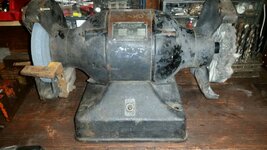
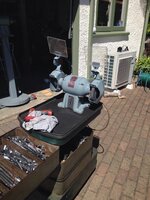
Picked this up yesterday. Looking forward to painting it. Most likely will put a wire wheel on one side and a polishing pad on the other. Didn't come with shields and is missing side cover. I can't really find much info. Couldn't pass up for $10
61ecc4c8c1e661452431b81271e405fa.jpg

1f589d7be7a919c08e55d7b41edd4d49.jpg

Sent from my SM-G900P using Tapatalk
 
To avoid these ads, REGISTER NOW!

zkling

Well-known member
Joined
Jan 23, 2007
Messages
16,939
ZK,

Thanks!

I gotta think they're going to be close in value. I've been to their website and looked at the parts list, but no specs on the caps MFD range.

I enlarged the picture you posted, but I can't make out the specs on the cap.

Sorry for the trouble, but could you re-open it and jot down the specs?

Thanks, I'm getting close to getting this 1 running. :thumbup:

Yea, I'll pull it tonight, I should have thought of that before closing it up. I'll have to look up the formula but years ago a baldor guy gave me a formula for determining the necessary capacitance based on motor specs. Pretty sure you will just need a slightly higher capcatance rating (mf) due to the slightly higher amp draw from the 3/4 vs 1/2hp motor. :headscrat
 

exmaxima1

Well-known member
Joined
Jun 25, 2011
Messages
6,343
Location
Midwest
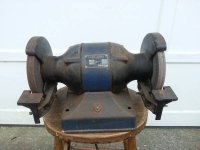
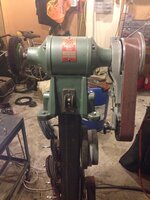
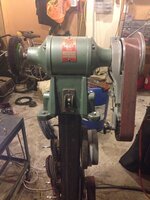
A new find in this Speedway grinder. It has lots of vibration and movement in bushings/bearings. Any ideas to replace or refurbish the bearings? Open to ideas for this rebuild? It is sitting on a homemade stainless steel base.

If you have a lathe you might be able to re-sleeve your existing bearings. They have a unique spherical shape (self-aligning) and would be impossible to locate NOS. But first make sure the shafts are still good---you can spend a lot of time on a grinder that won't fetch much more than $40 when it's all finished.
 

torqueman2002

Well-known member
Joined
Jun 3, 2009
Messages
6,144
Location
SE Michigan
Picked this up yesterday. Looking forward to painting it. Most likely will put a wire wheel on one side and a polishing pad on the other. Didn't come with shields and is missing side cover. I can't really find much info. Couldn't pass up for $10
That is the great-grandaddy of the Blocks.

It looks heavy, CI probably.

I'd bet bearings are still available, and a used RH tool rest and cover might be also. Check on OWWM and VM.
http://owwm.org/
http://vintagemachinery.org/

Check my first link in my signature line for eye shield kits, if you want to install non-OEM.

I'm looking forward to seeing what you do with it.
:thumbup:
 

torqueman2002

Well-known member
Joined
Jun 3, 2009
Messages
6,144
Location
SE Michigan
Yea, I'll pull it tonight, I should have thought of that before closing it up. I'll have to look up the formula but years ago a baldor guy gave me a formula for determining the necessary capacitance based on motor specs. Pretty sure you will just need a slightly higher capcatance rating (mf) due to the slightly higher amp draw from the 3/4 vs 1/2hp motor. :headscrat
Super!

Thanks a bunch.

I'm even looking at a no-tag look-a-like, in hopes it will help. :lol_hitti
 

creativecars

Well-known member
Joined
Nov 15, 2010
Messages
4,300
Location
Indiana- where horse and buggies still roam
If you have a lathe you might be able to re-sleeve your existing bearings. They have a unique spherical shape (self-aligning) and would be impossible to locate NOS. But first make sure the shafts are still good---you can spend a lot of time on a grinder that won't fetch much more than $40 when it's all finished.

The shaft seems good, but with so much movement it is hard to tell. Im not sure why the bushing is worn on the outside, it spins nice and smooth inside the bushing, not much wear there.
I wont try to sell it. I'm gonna use it.:thumbup:
 

exmaxima1

Well-known member
Joined
Jun 25, 2011
Messages
6,343
Location
Midwest
The shaft seems good, but with so much movement it is hard to tell. Im not sure why the bushing is worn on the outside, it spins nice and smooth inside the bushing, not much wear there.
I wont try to sell it. I'm gonna use it.:thumbup:

I restored a similar Thor a few months ago and found that a few wads of aluminum foil would align and clamp the bearings in their housing. The contact areas are fairly small, so it's not surprising that the bearings slipped and wore on the outside.
 

454ragtop

Well-known member
Joined
Mar 24, 2008
Messages
5,011
Location
Carver, MA
The shaft seems good, but with so much movement it is hard to tell. Im not sure why the bushing is worn on the outside, it spins nice and smooth inside the bushing, not much wear there.
I wont try to sell it. I'm gonna use it.:thumbup:

In the pics you posted, it looks like the grinding wheel has holes in it? Never saw a wheel like that before, and I'd be very leery of it. A lot of grinder vibration is caused by out of round or out of balance wheels. Might try dressing or replacing the wheel first and see if it makes a difference.
HTH, Jim
 

zkling

Well-known member
Joined
Jan 23, 2007
Messages
16,939
Super!

Thanks a bunch.

I'm even looking at a no-tag look-a-like, in hopes it will help. :lol_hitti

Hard to read, even in person but... as written on the cap, from top to bottom.

103414-11
Aerovox 7814
P104F263
370VAC 60HZ
6UF AH
 

creativecars

Well-known member
Joined
Nov 15, 2010
Messages
4,300
Location
Indiana- where horse and buggies still roam
In the pics you posted, it looks like the grinding wheel has holes in it? Never saw a wheel like that before, and I'd be very leery of it. A lot of grinder vibration is caused by out of round or out of balance wheels. Might try dressing or replacing the wheel first and see if it makes a difference.
HTH, Jim

Yes there are holes, or at least shallow dents. I assumed they were for balance. I pulled the wheel off and it runs much smoother, but there is still a lot of play. I am thinking to cover the outer bushing part with aluminum foil like someone else did, but then add some jb weld, put it together and rotate by hand to let the jb weld move around and self center. I will go back with new Norton wheels.
 

torqueman2002

Well-known member
Joined
Jun 3, 2009
Messages
6,144
Location
SE Michigan
Hard to read, even in person but... as written on the cap, from top to bottom.

103414-11
Aerovox 7814
P104F263
370VAC 60HZ
6UF AH
zk - thanks for all the help. I'm guessing it is a 6μF (microfarad) rated for 370VAC 60HZ.

Getting closer.

My 1 HP Milwaukee uses a 310MFD 110VAC.
 

exmaxima1

Well-known member
Joined
Jun 25, 2011
Messages
6,343
Location
Midwest
zk - thanks for all the help. I'm guessing it is a 6μF (microfarad) rated for 370VAC 60HZ.

Getting closer.

My 1 HP Milwaukee uses a 310MFD 110VAC.

Your Milwaukee is a capacitor start motor, and uses a large cap to get the motor running and then switches out of the circuit. The Baldor is a capacitor RUN motor, using a much smaller cap that stays in the circuit all the time.
 

1982fxr

Well-known member
Joined
Jan 7, 2012
Messages
10,012
Location
Phoenix
A new find in this Speedway grinder. It has lots of vibration and movement in bushings/bearings. Any ideas to replace or refurbish the bearings? Open to ideas for this rebuild? It is sitting on a homemade stainless steel base.

that is awesome! never seen one of those
 

torqueman2002

Well-known member
Joined
Jun 3, 2009
Messages
6,144
Location
SE Michigan
Your Milwaukee is a capacitor start motor, and uses a large cap to get the motor running and then switches out of the circuit. The Baldor is a capacitor RUN motor, using a much smaller cap that stays in the circuit all the time.
I found a parts diagram for the 1-HP Milwaukee Cat. No. (Model No.) 5080 on eReplacement Parts.

It appears to be ~1968 vintage.

In addition to the capacitor (310MFD 110VAC), it has a rotating switch and a stationary switch, which are housed in the RH end-shield.

I also reached Baldor who informed me the 3/4-HP Cat. No. (Model No.) 862RE uses a 16 mfd 370 VOLT oil cap (run cap).

Grainger sent me a Motor Run Capacitor, 17.5 mfd rating, 370-440VAC.

I'll get a chance to try it out tomorrow.

My elementary (mechanical) understanding of a caps role in a circuit, is that of a 'shock absorber', store and release energy.

So, help me understand the functional differences between a start and run capacitor. :dunno:
 
Last edited:

exmaxima1

Well-known member
Joined
Jun 25, 2011
Messages
6,343
Location
Midwest
My elementary (mechanical) understanding of a caps role in a circuit, is that of a 'shock absorber'.

So, help me understand the functional differences between a start and run capacitor. :dunno:

There are numerous sources available that better describe this, but I'll take a shot at it:

Capacitors are somewhat of a "shock absorber" when used in DC applications, but in AC applications they are more tasked as high-pass filters. And one of the attributes of a high-pass filter is a phase shift. A phase shift is useful to provide rotational force in a single phase motor circuit. And it provides a means to force the direction in which the shaft will spin. Changing the polarity of the phase shift will change the direction.

In a capacitor start motor, a large capacitor is used in series with a start winding to provide a strong starting torque. The capacitor is sized to limit the initial in-rush current to something on the order of 150-200% of full load running current. Once the motor gets up to speed, a switch of some sort removes the start winding (and cap) from the circuit. Common switches are mechanical centrifugal types, as well as current sensing relays.

A cap run motor is similar in that it has a secondary coil with a capacitor in series. But the cap is much smaller and its purpose is primarily to maintain a phase shift between the main and secondary coils. The secondary coil (and cap) remain energized all the time the motor is running. This type of motor has much less starting torque, but has good running torque and efficiency.
 

torqueman2002

Well-known member
Joined
Jun 3, 2009
Messages
6,144
Location
SE Michigan
There are numerous sources available that better describe this, but I'll take a shot at it:

Capacitors are somewhat of a "shock absorber" when used in DC applications, but in AC applications they are more tasked as high-pass filters. And one of the attributes of a high-pass filter is a phase shift. A phase shift is useful to provide rotational force in a single phase motor circuit. And it provides a means to force the direction in which the shaft will spin. Changing the polarity of the phase shift will change the direction.

In a capacitor start motor, a large capacitor is used in series with a start winding to provide a strong starting torque. The capacitor is sized to limit the initial in-rush current to something on the order of 150-200% of full load running current. Once the motor gets up to speed, a switch of some sort removes the start winding (and cap) from the circuit. Common switches are mechanical centrifugal types, as well as current sensing relays.

A cap run motor is similar in that it has a secondary coil with a capacitor in series. But the cap is much smaller and its purpose is primarily to maintain a phase shift between the main and secondary coils. The secondary coil (and cap) remain energized all the time the motor is running. This type of motor has much less starting torque, but has good running torque and efficiency.
Maxima - Thank you. I was hoping for just this sort of description.

So, a phase-shift is used to 'push' the rotor/shaft in the desired direction of rotation.

Now I'm curious how that is done. Back to Google. :D

Oh, I found this description of Start & Run caps, but I still had questions, that you answered. :thumbup:
http://www.capacitorformotor.com/starting_capacitor.html

I read that run caps have exact values (and lower) vs. a start cap's range.

So, given that I could not find the 16-MFD 370VAC run-cap specified by Baldor, I would like confirmation the 17.5-MFD 370VAC (+/-5%) run-cap will work OK.

Thanks. :)
 
Last edited:

exmaxima1

Well-known member
Joined
Jun 25, 2011
Messages
6,343
Location
Midwest
Maxima - Thank you. I was hoping for just this sort of description.

So, a phase-shift is used to 'push' the rotor/shaft in the desired direction of rotation.

Now I'm curious how that is done. Back to Google. :D

Oh, I found this description of Start & Run caps, but I still had questions, that you answered. :thumbup:
http://www.capacitorformotor.com/starting_capacitor.html

I read that run caps have exact values (and lower) vs. a start cap's range.

So, given that I could not find the 16-MFD 370VAC run-cap specified by Baldor, I would like confirmation the 17.5-MFD 370VAC (+/-5%) run-cap will work OK.

Thanks. :)

Start caps are only in the circuit for a brief moment, and their tolerance can be very broad yet still operate ok. Run caps, however, are engineered for a specific current in the secondary coil and need closer tolerance. I think if I could not find the exact value I would choose a smaller run cap to avoid overheating the coil. Just my 2 cents....
 

McBrownie

Well-known member
Joined
Mar 27, 2014
Messages
1,827
Location
Cleveland, OH
Many newer type capacitors say "Non-PCB" on them just for that reason.

Ex,
That is good info, but for those on this forum dealing with vintage grinders, if it does not say "Non-PCB", then handle with care, correct? Also, any idea of the proper handling/disposal procedure for old capacitors?
 
To avoid these ads, REGISTER NOW!

exmaxima1

Well-known member
Joined
Jun 25, 2011
Messages
6,343
Location
Midwest
Ex,
That is good info, but for those on this forum dealing with vintage grinders, if it does not say "Non-PCB", then handle with care, correct? Also, any idea of the proper handling/disposal procedure for old capacitors?

AFAIK, you take them to your local "toxic" waste pickup where they take batteries, old CRT type televisions, unused paint, etc. They should have a barrel for PCB capacitors and lamp ballasts
 

Toolguybak

Active member
Joined
Jul 9, 2012
Messages
27
Location
Michigan
Nice find--you don't see many Wen dry grinders.
I'm guessing 1960s.

just picked up this WEN grinder and restored it. This is an ALL ALUMINUM grinder. Everything is aluminum, everything. 6" cutting wheel on one side, 6" grinding wheel on the other. Put bearings in it (timkens). Noisy though because it is aluminum.

I cannot find anything about this model online. Any help? Anyway I think it is cool.
 

torqueman2002

Well-known member
Joined
Jun 3, 2009
Messages
6,144
Location
SE Michigan
Thanks.
I'm an OWWM admin, enthusiast and user.
Welcome to the Journal's Vintage grinder thread and thank you for your help.

I am a OWWM/VM poster, mainly about CM Block grinders, but I do have a thread on the 3/4-HP red Baldor I posted here.

It's good to see the cross-pollination between the sites.

Mike
:)
 

torqueman2002

Well-known member
Joined
Jun 3, 2009
Messages
6,144
Location
SE Michigan
Baldor says the grinder uses an oil filled cap (run cap) 16-MFD 370VAC, for the 3/4-HP m-862RE (Big Red)
http://www.garagejournal.com/forum/showpost.php?p=5163840&postcount=884

I found a 17.5-MFD 370VAC run cap.

I understand that replacement run caps need to be a very close in value to the OEM.

I tried the 17.5 cap.

When switched ON, the grinder 'bumps' a small amount, but does not run.

Could it be the 17.5MFD cap is not close enough?

Well, the field coils Ohmed out OK, so I cracked open the case.

I believe this is the problem.

Rust.
Fi%20P1100881.jpg


Fi%20P1100886.jpg


Fi%20P1100889.jpg


Fi%20P1100890.jpg


The 'blob' on the rotor had me puzzled at first. I thought it might be an insect nest. But, after poking at it, it's not budging and there's another 'blob' on the other side.
Fi%20P1100893.jpg


I believe it is for balancing the rotor assembly.

The rust was removed from the rotor and it is waiting in the freezer, until the bearings are ready.

Right now the bearings are soaking to clean out the old grease, to allow inspection, but I'll probably replace them.

If they are still serviceable, what type of grease should be used? I'm thinking automotive bearing grease should be well within the grinder's operating range.

I can't believe this grinder has rust. I rescued/restored a 1-HP CM Block grinder that also had sat in water.

Well, at least this grinder was not much $$ and it is quite the HD built grinder.

I'm going to start a new thread for the complete restore. I'll post a link here, when I get it set up. http://www.garagejournal.com/forum/showthread.php?p=5199757&posted=1#post5199757

Thanks for looking.
;)
 
Last edited:

Outlawmws

Well-known member
Joined
Aug 9, 2011
Messages
39,313
Location
The Badlands
On the Cap value, there is usually a (Large) tolerance on the Mfd value, so you should have been fine with a 17.5 vs. a 18...
 

torqueman2002

Well-known member
Joined
Jun 3, 2009
Messages
6,144
Location
SE Michigan

exmaxima1

Well-known member
Joined
Jun 25, 2011
Messages
6,343
Location
Midwest
The 'blob' on the rotor had me puzzled at first. I thought it might be an insect nest. But, after poking at it, it's not budging and there's another 'blob' on the other side.
Fi%20P1100893.jpg


I believe it is for balancing the rotor assembly.

Yes, it's for balancing. My Baldor belt grinder has those blobs on the big wheels as well. They don't look pretty, but seem to work great.
 

Rileysan

Well-known member
Joined
Sep 11, 2015
Messages
4,298
Location
Milwaukie, Oregon
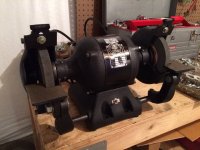
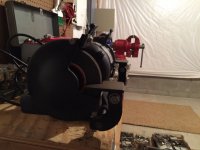
I was browsing CL for "grinders" when I came across this: A Blue Point 1/4 horse bench grinder model BG-250G. Paid $35

Brian
 

Attachments

  • Oct 2015 179.jpg
    Oct 2015 179.jpg
    140.5 KB · Views: 49
  • Oct 2015 180.jpg
    Oct 2015 180.jpg
    141.9 KB · Views: 44
To avoid these ads, REGISTER NOW!
Top Bottom