ZK,
Thanks!
I gotta think they're going to be close in value. I've been to their website and looked at the parts list, but no specs on the caps MFD range.
I enlarged the picture you posted, but I can't make out the specs on the cap.
Sorry for the trouble, but could you re-open it and jot down the specs?
Thanks, I'm getting close to getting this 1 running.![]()

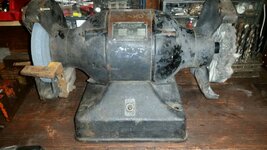
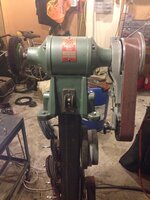
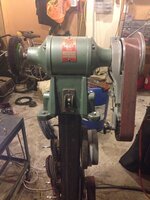
A new find in this Speedway grinder. It has lots of vibration and movement in bushings/bearings. Any ideas to replace or refurbish the bearings? Open to ideas for this rebuild? It is sitting on a homemade stainless steel base.
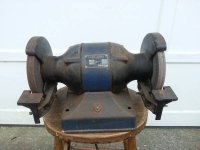
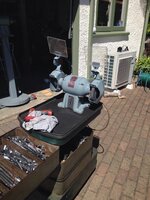
That is the great-grandaddy of the Blocks.Picked this up yesterday. Looking forward to painting it. Most likely will put a wire wheel on one side and a polishing pad on the other. Didn't come with shields and is missing side cover. I can't really find much info. Couldn't pass up for $10
Super!Yea, I'll pull it tonight, I should have thought of that before closing it up. I'll have to look up the formula but years ago a baldor guy gave me a formula for determining the necessary capacitance based on motor specs. Pretty sure you will just need a slightly higher capcatance rating (mf) due to the slightly higher amp draw from the 3/4 vs 1/2hp motor.![]()

If you have a lathe you might be able to re-sleeve your existing bearings. They have a unique spherical shape (self-aligning) and would be impossible to locate NOS. But first make sure the shafts are still good---you can spend a lot of time on a grinder that won't fetch much more than $40 when it's all finished.
The shaft seems good, but with so much movement it is hard to tell. Im not sure why the bushing is worn on the outside, it spins nice and smooth inside the bushing, not much wear there.
I wont try to sell it. I'm gonna use it.![]()
The shaft seems good, but with so much movement it is hard to tell. Im not sure why the bushing is worn on the outside, it spins nice and smooth inside the bushing, not much wear there.
I wont try to sell it. I'm gonna use it.![]()
Super!
Thanks a bunch.
I'm even looking at a no-tag look-a-like, in hopes it will help.![]()
In the pics you posted, it looks like the grinding wheel has holes in it? Never saw a wheel like that before, and I'd be very leery of it. A lot of grinder vibration is caused by out of round or out of balance wheels. Might try dressing or replacing the wheel first and see if it makes a difference.
HTH, Jim
zk - thanks for all the help. I'm guessing it is a 6μF (microfarad) rated for 370VAC 60HZ.Hard to read, even in person but... as written on the cap, from top to bottom.
103414-11
Aerovox 7814
P104F263
370VAC 60HZ
6UF AH
zk - thanks for all the help. I'm guessing it is a 6μF (microfarad) rated for 370VAC 60HZ.
Getting closer.
My 1 HP Milwaukee uses a 310MFD 110VAC.
A new find in this Speedway grinder. It has lots of vibration and movement in bushings/bearings. Any ideas to replace or refurbish the bearings? Open to ideas for this rebuild? It is sitting on a homemade stainless steel base.
I found a parts diagram for the 1-HP Milwaukee Cat. No. (Model No.) 5080 on eReplacement Parts.Your Milwaukee is a capacitor start motor, and uses a large cap to get the motor running and then switches out of the circuit. The Baldor is a capacitor RUN motor, using a much smaller cap that stays in the circuit all the time.

My elementary (mechanical) understanding of a caps role in a circuit, is that of a 'shock absorber'.
So, help me understand the functional differences between a start and run capacitor.![]()
Maxima - Thank you. I was hoping for just this sort of description.There are numerous sources available that better describe this, but I'll take a shot at it:
Capacitors are somewhat of a "shock absorber" when used in DC applications, but in AC applications they are more tasked as high-pass filters. And one of the attributes of a high-pass filter is a phase shift. A phase shift is useful to provide rotational force in a single phase motor circuit. And it provides a means to force the direction in which the shaft will spin. Changing the polarity of the phase shift will change the direction.
In a capacitor start motor, a large capacitor is used in series with a start winding to provide a strong starting torque. The capacitor is sized to limit the initial in-rush current to something on the order of 150-200% of full load running current. Once the motor gets up to speed, a switch of some sort removes the start winding (and cap) from the circuit. Common switches are mechanical centrifugal types, as well as current sensing relays.
A cap run motor is similar in that it has a secondary coil with a capacitor in series. But the cap is much smaller and its purpose is primarily to maintain a phase shift between the main and secondary coils. The secondary coil (and cap) remain energized all the time the motor is running. This type of motor has much less starting torque, but has good running torque and efficiency.
I also reached Baldor who informed me the 3/4-HP Cat. No. (Model No.) 862RE uses a 16 mfd 370 VOLT oil cap (run cap).
Maxima - Thank you. I was hoping for just this sort of description.
So, a phase-shift is used to 'push' the rotor/shaft in the desired direction of rotation.
Now I'm curious how that is done. Back to Google.
Oh, I found this description of Start & Run caps, but I still had questions, that you answered.
http://www.capacitorformotor.com/starting_capacitor.html
I read that run caps have exact values (and lower) vs. a start cap's range.
So, given that I could not find the 16-MFD 370VAC run-cap specified by Baldor, I would like confirmation the 17.5-MFD 370VAC (+/-5%) run-cap will work OK.
Thanks.![]()
Back in the old days, didn't the oil in capacitors and transformers contain PCB's? If so, is the same true today, or has that been "cleaned up"?
Many newer type capacitors say "Non-PCB" on them just for that reason.
ToolGuy,
You are solving all of the mysteries on this thread. Thanks for pitching in with great answers. Did you work in the industry? Or, are you an enthusiast? Or both?
Ex,
That is good info, but for those on this forum dealing with vintage grinders, if it does not say "Non-PCB", then handle with care, correct? Also, any idea of the proper handling/disposal procedure for old capacitors?
just picked up this WEN grinder and restored it. This is an ALL ALUMINUM grinder. Everything is aluminum, everything. 6" cutting wheel on one side, 6" grinding wheel on the other. Put bearings in it (timkens). Noisy though because it is aluminum.
I cannot find anything about this model online. Any help? Anyway I think it is cool.
Welcome to the Journal's Vintage grinder thread and thank you for your help.Thanks.
I'm an OWWM admin, enthusiast and user.
Outlaw, thanks.On the Cap value, there is usually a (Large) tolerance on the Mfd value, so you should have been fine with a 17.5 vs. a 18...
It's MIA.What's the tolerance on the old cap? It should be listed.
The 'blob' on the rotor had me puzzled at first. I thought it might be an insect nest. But, after poking at it, it's not budging and there's another 'blob' on the other side.
![]()
I believe it is for balancing the rotor assembly.
Brian, you'll find out that you ****. Good find brother.
Sent from my iPhone using Tapatalk
Brian, you'll find out that you ****. Good find brother.
I would agree. Looks like a Wisotta grinder. Nice find.