To avoid these ads, REGISTER NOW!

Minin split DIY tips

thammel

Well-known member
Joined
Oct 3, 2005
Messages
2,260
Location
Maryland
Well I did it - bought 2 Mitsubishi mini splits from ecomfort. And I have a couple of questions for the experienced ones here:

1) I have 2x6 construction and would like to run the linesets in the walls. Any thoughts on this? I know it would be more of a challenge making tubing bends.
2) Any recommendations on tubing benders? What kind do you prefer? The coil spring type ones?
3) Mitsubishi talks of wall sleeves and caps...are these really needed?
4) Can I use Pvc for the drain line? Mitsubishi mentions soft pvc hose (19/32" ID ) or hard pvc vp16. What is vp16?

Now tips from me - if you want to elevate your outside unit on the pad, don't buy the Mitsubishi system - it costs $71. You can buy 4 6" high feet from supply house for less than $8.

ANother tip - Mitsubishi recommends installing 3 pole switches to turn off the inside units. Ecomfort sells Mitsubishi switches for about $75 each. Get the same Leviton thing off Amazon for about $25.

Thanks,
Tom
 
To avoid these ads, REGISTER NOW!

98ssuck

Well-known member
Joined
Oct 21, 2012
Messages
350
Location
British columbia
1) Running a continuous length of pipe inside the walls is going to be hard. You need to sliver solider or braze while purging nitrogen any connections. Make sure the insulation rips get repaired while installing it. Take your time. Annealing the pipe after it gets work hardened during the install may make it is easier to install. Again anytime you heat the pipe you need to purge it.
2) I like ratchet tubing benders. I use a cps one. A compact swaging tool is also useful as it reduces the number of joints you will have to heat. The smaller diameter pipe usually has a tighter radius bending die. To make the two pipe bend had the same radius I run the gas(bigger pipe first) then bend the smaller one by hand along the same radius.
3) Use them whenever practicable when going through the outside wall.
4) You can use PVC. Follow the installation manual. The soft PVC hose is the hose coming off the unit.
 
Last edited:

walrus

Well-known member
Joined
Nov 12, 2008
Messages
11,696
Location
Maine
Well I did it - bought 2 Mitsubishi mini splits from ecomfort. And I have a couple of questions for the experienced ones here:

1) I have 2x6 construction and would like to run the linesets in the walls. Any thoughts on this? I know it would be more of a challenge making tubing bends.
2) Any recommendations on tubing benders? What kind do you prefer? The coil spring type ones?
3) Mitsubishi talks of wall sleeves and caps...are these really needed?
4) Can I use Pvc for the drain line? Mitsubishi mentions soft pvc hose (19/32" ID ) or hard pvc vp16. What is vp16?

Now tips from me - if you want to elevate your outside unit on the pad, don't buy the Mitsubishi system - it costs $71. You can buy 4 6" high feet from supply house for less than $8.

ANother tip - Mitsubishi recommends installing 3 pole switches to turn off the inside units. Ecomfort sells Mitsubishi switches for about $75 each. Get the same Leviton thing off Amazon for about $25.

Thanks,
Tom
The 3 pole switches are a NEC requirement, in Maine they aren't making us put them in. Its ridiculous to me that the manufacturers aren't installing them in the units themselves
 

Radix2

Well-known member
Joined
May 28, 2014
Messages
1,853
Location
the thumb!, MI
The 3 pole switches are a NEC requirement, in Maine they aren't making us put them in. Its ridiculous to me that the manufacturers aren't installing them in the units themselves

What is the specific requirement in the NEC? I saw some optional switching of the power to the inside unit when I installed my mini, but can't see the logic to it. Does this NEC req. apply to other hard wired appliances or Equipment? Is this an extension of the furnace disconnect switch?

There is a breaker and an outside disconnect already - one more means than the electric wall heater has....
 

walrus

Well-known member
Joined
Nov 12, 2008
Messages
11,696
Location
Maine
What is the specific requirement in the NEC? I saw some optional switching of the power to the inside unit when I installed my mini, but can't see the logic to it. Does this NEC req. apply to other hard wired appliances or Equipment? Is this an extension of the furnace disconnect switch?

There is a breaker and an outside disconnect already - one more means than the electric wall heater has....
Disconnect near indoor unit, switching all 3 wires that go between indoor and outdoor unit. Wording is probably within sight of indoor unit. It's for service
 

Jackfre

Well-known member
Joined
Dec 26, 2010
Messages
4,430
Location
N CA
The manus aren't installing the internal disconnects because they make an international product. It is the US NEC that requires the disconnect. The inspector on my home n MA busted me on the lack of an internal disconnect. I flatly refused to install it and won't put them on any of my units. I can kill the power at the panel and the primary disconnect at the condensing unit.

6" risers are ok...depending upon how much snow you get.

I ran my lineset in my last unit in the 2x6 wall and it was a *****. If the wall is totally open then I guess you are ok, but getting the line set and drain line up and out of those tight bends is tough and that was with a 1/4 & 3/8 linseed. The critical component is the drain line. It has to run unobstructed at a gradual continuous grade and you have the line set and power line all trying to get into to small a space. If you create any type of riser in the drain you are screwed. Yes, it can be done, but patience is called for. I had to walk away from mine a few times before I was able to get everything right
 

Jackfre

Well-known member
Joined
Dec 26, 2010
Messages
4,430
Location
N CA
Another thing on the 6" risers off a pad. As you travel around the area, look and see how many peoples condensing units are actually level. Most time a Diversitech pad gets dropped the unit placed on it and after settling and a few frost cycles the unit is catywhopus in the first degree. You want your condensing unit level, level, level. $75 for a wall bracket is smart money.
 

Radix2

Well-known member
Joined
May 28, 2014
Messages
1,853
Location
the thumb!, MI
I thought about putting the lines in the wall - the issue to me was no access to the flare connections after the walls were finished - so the unit would have to be installed while painting and drywall work was going on.
 

Git

Well-known member
Joined
May 18, 2008
Messages
6,895
Location
S Cal
Didn't need the switches in S Cal either - Remember with the Mr Slims, ALL power to the interior units is supplied from the main unit outside so I only needed a disconnect there.

When I bought my lineset I bought the "Kamco EZ-Roll" because it was supposed to be softer copper and easier to bend. I carefully made all bends by hand but probably the spring type bender would have worked fine

You didn't mention what type of install you have - are you just going in and straight up or what. If the wall was open I could see doing it inside the studs, but a nice lineset cover really cleans up an outside installation - at least get the piece that cleans up the hole through the wall
http://www.ecomfort.com/Mitsubishi-NW-100/p30623.html

Drain lines - On one unit I used about 30' of regular pvc tubing (sprinkler pipe) that glues to the drain tube that comes out of the indoor unit. On my other unit I used the soft tubing similar to this. I was really surprised about the amount of condensate that comes out - so make sure your drain lines are up to speed
http://www.ecomfort.com/Bramec-DRAINTUBING-15/p50999.html
 
Last edited:
To avoid these ads, REGISTER NOW!

Gerald O

Well-known member
Joined
Mar 5, 2013
Messages
1,884
Location
NC
In my mini-split install I ran the lines inside the 2x6 wall. Ran PVC line for drain. Outdoor unit is on a small poured pad with brick risers. 3-pole switch for inside disconnect. This was a ceiling cassette unit, but many of the details will be common for any style. I have tubing benders but there were no bends so tight that I needed to use one. You will probably need to do new flares, so a quality flaring tool is needed.

All the details in this thread: http://www.garagejournal.com/forum/showthread.php?t=262539
 

rlitman

Well-known member
Joined
Oct 18, 2010
Messages
24,759
Location
Long Island
Another thing on the 6" risers off a pad. As you travel around the area, look and see how many peoples condensing units are actually level. Most time a Diversitech pad gets dropped the unit placed on it and after settling and a few frost cycles the unit is catywhopus in the first degree. You want your condensing unit level, level, level. $75 for a wall bracket is smart money.

I put my condensing unit on 18" square concrete pavers. Yeah, it's a little off-level from frost heaving, but I do not have the heat pump option, so I do not get condensation on the condenser outside, so having it level is not important.

I will say that the biggest mistake (in retrospect) I made, was to purchase the unit without heat to save a few bucks. I'm not making that mistake again!

About the comment on making flares:
Linesets often still come with pre-made flares, and use flare nuts that are thinner walled than the heavy shouldered flare nuts that come on the mini-split. It is important for R410a's higher pressure to use the thicker walled flares, so if your lineset comes with flare nuts that seem less beefy than the ones that came on the mini-split, best practice is to cut them off and re-flare.
 

theoldwizard1

Well-known member
Joined
Feb 22, 2011
Messages
43,583
Location
SE MI
1) I have 2x6 construction and would like to run the linesets in the walls. Any thoughts on this? I know it would be more of a challenge making tubing bends.
2x6 construction is a good place to start.

Any chance you can make a diagram or picture from where you are starting and where you are going ?


1) Running a continuous length of pipe inside the walls is going to be hard. You need to sliver solider or braze while purging nitrogen any connections. Make sure the insulation rips get repaired while installing it. Take your time. Annealing the pipe after it gets work hardened during the install may make it is easier to install. Again anytime you heat the pipe you need to purge it.

Most "kits" for DIYer come with pre-charged tubing. As stated, any cuts are going to require a "pro" to braze, purge and charge the system. Going around corners is difficult. Tight corners will likely require "piecing" the piping.


2) I like ratchet tubing benders. I use a cps one. A compact swaging tool is also useful as it reduces the number of joints you will have to heat. The smaller diameter pipe usually has a tighter radius bending die. To make the two pipe bend had the same radius I run the gas(bigger pipe first) then bend the smaller one by hand along the same radius.
Don't the lines come pre-insulated and do benders work on that ?

OP won't need a swagging tool if he is not brazing. Got a recommendation on a swagging tool ?
 
OP
T

thammel

Well-known member
Joined
Oct 3, 2005
Messages
2,260
Location
Maryland
More info from me.

The 2x6 walls are insulated but not drywalled yet...so I have great access now. I can remove the insulation to run the linesets.

I did buy Kamco from ecomfort and if need be I do have a good flaring toolset. I made up brake lines for my old Bronco II so I have some experience with that.

On the risers and pads.....I HATE it when pads go unlevel. So I've poured 5 pads in the past 11 years here...1 for the generator, 2 for the house heat pumps and 2 for these new mini splits. I'm a fanatic with these pads. I dig an 8" min hole 3 feet down, use a construction tube and pour a footer in that along with rebar tied to the pad. These pads never go out of level. I just hope I never have to remove any of them!!!!

The layout will be simple. The 18k btu unit will be in the middle of the garage rear wall with the compressor directly outside it. The 9 k btu unit will be in the 2nd floor attic space at the end opposite the stairs again with the compressor directly outside it. My only reason for thinking of running pipes in the walls is aesthestics. I know it would be easier and less risky (to future puncture) and easier to repair if I ran them outside with covers. Since these are in the back of the garage, looks aren't all that important.

Thanks for all the comments!
Tom
 

Jackfre

Well-known member
Joined
Dec 26, 2010
Messages
4,430
Location
N CA
Regardless of the "type" of soft copper you get, it work hardens very quickly. You end up going, "what the hell happened to this stuff?" The difficulty is the bend out of the wall into the mounting bracket.
Never use the factory supplied flares. Make your own.
I have Fujitsu's and they have minimum line set lengths. 9" up to 18kbtu. Not sure on the Mitsu's, but confirm the spec on the line set minimums.
 

Git

Well-known member
Joined
May 18, 2008
Messages
6,895
Location
S Cal
HVAC tech avoid flares like the plague especially if they are buried in a wall. Swage and braze is the way to go.


Flares are good enough for brake lines but not for ac lines?

I am certainly not an expert - but with these new mini-splits, very rarely do you see someone brazing the lines...

had a flaring tool but spend $100 to buy a new Yellow Jacket 60278.


Also get some Nylog
http://www.amazon.com/gp/product/B008HOSQQQ/?tag=atomicindus08-20

None of the Mr Slims come with 'pre-charged' lines. (The unit is pre-charged). The lines are insulated - which is one of the reasons why I just carefully bent them by hand
 
Last edited:

Slednut

Well-known member
Joined
Dec 20, 2012
Messages
2,561
Location
Washington state
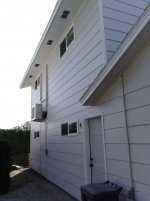
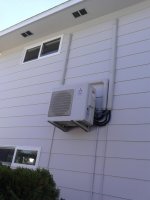
I was going to install the line sets and drain in the wall but decided to use line set covers. The small PVC pipes running down the wall are the drains. It was easy.
 

Attachments

  • P82A0341.jpg
    P82A0341.jpg
    134.7 KB · Views: 53
  • P82A0320.jpg
    P82A0320.jpg
    129.9 KB · Views: 63

theoldwizard1

Well-known member
Joined
Feb 22, 2011
Messages
43,583
Location
SE MI
Flares are good enough for brake lines but not for ac lines?

I am certainly not an expert ...

Yep. Different kind f flare entirely ! Brake line are double flare (aometimes called double bubble). AC line are not. IIRC, it is also a different angle.

The copper tubing for refrigerant is a different type than what you buy at a big box store (ACR vs Type L pr Type M).

... had a flaring tool but spend $100 to buy a new Yellow Jacket 60278.


Also get some Nylog
http://www.amazon.com/gp/product/B00..._od_pd_dx_bx_1
Well, you are starting out with good tools !

Try to keep the number of joints to a minimum.
 
Last edited:
To avoid these ads, REGISTER NOW!
Top Bottom