To avoid these ads, REGISTER NOW!

Service Upgrade Questions

His200HerScout

Well-known member
Joined
Mar 17, 2009
Messages
217
Location
mid-michigan
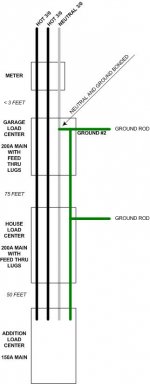
This is my thought for wiring my new detached garage, which was just built and has no electrical service yet.

Currently, my house has 150A service from an overhead line, feeding a 150A panel in my basement.

I want to remove that service, and instead have 200A buried service run to my detached garage, which will have a 200A panel with feed thru lugs.

I want to run three 3/0 copper wires plus a #4 ground 75 feet from the feed thru lugs in the detached garage to the 150A panel in my basement inside a 3" conduit. This would make my basement panel a subpanel, so I would unbond the neutral and ground at that panel.

Down the road, I want to replace the 150A panel in my basement with a 200A panel with feed thru lugs just like the one in the detached garage. The reason is that I will be building an addition above my attached garage (I have both an attached and detached garage). Then take the 150A panel in my basement and put it up in the addition. The addition's 150A panel will power both the addition and the garage below.

Eventually, it'll look like this:
pole -> meter -> garage panel -> house panel -> addition panel

The detached garage and house will both have ground rods. The ground wire at the detached garage will be bonded to the neutral. The ground wire in the basement and addition will NOT be bonded because they will be subpanels. Correct?

My big question is: Is it OK to gang main panels in this manner? I think so, because each set of feed thru lugs is protected by the panel's main breaker. However, I'm not sure if feed thru lugs are supposed to feed subpanels 75 feet away.

Did I get that ground wire size right?

I made a diagram. Not quite electrical engineering quality, but I think it describes my plans.

Thanks!
 

Attachments

  • electrical layout.jpg
    electrical layout.jpg
    28.3 KB · Views: 49
To avoid these ads, REGISTER NOW!

LoneGunman

Well-known member
Joined
Mar 27, 2007
Messages
2,081
Location
The Gunshine state
Maybe I'm not understanding something but what's protecting the 3/0? Example: Addition load center draws 100 amp while the house panel draws 200 amps, unless you have a main breaker installed before the first panel I don't see how you are protecting the wire. Are you planning on using a feed through breakers in the panels?
 

Charles (in GA)

Well-known member
Joined
Jan 11, 2006
Messages
12,489
Location
50 mi south of Atlanta
Running 200amp service to the garage and then pulling off of it for a 150 amp house panel then other panels later is probably too much.

I would run 400 amp service (or 320) and then split the service with two disconnects, one to the garage and one on to the house. Simply "feeding thru" leaves lots of unprotected cables running everywhere.

You will probably encounter problems with the house, splitting the ground and neutral in a panel where that was not originally done. Usually in a panel like this, the ground and neutral are run to the nearest bar, and you won't have enough wire to take one of them and run it over to the other side of the panelboard. You will probably end up with lots of splices (wirenuts) or running new romex back to the first junction in the circuit, to get enough wire to separate the ground and neutral to their respective bars.

You need to check with your power company to insure that they will charge you the same residential rate you are now paying, if the meter is moved to the garage. Some want to charge commercial rates on any building that is not a house.

Charles
 

Aceman

Well-known member
Joined
Jan 28, 2007
Messages
2,513
Location
Eastern Oregon
The detached garage and house will both have ground rods. The ground wire at the detached garage will be bonded to the neutral. The ground wire in the basement and addition will NOT be bonded because they will be subpanels. Correct?

That's right.

My big question is: Is it OK to gang main panels in this manner? I think so, because each set of feed thru lugs is protected by the panel's main breaker. However, I'm not sure if feed thru lugs are supposed to feed subpanels 75 feet away.

Yes, it's fine as long as your house has a disconnecting means and since you're using a main breaker panel, you're all set.

Did I get that ground wire size right?

#6 Cu would be fine.

Maybe I'm not understanding something but what's protecting the 3/0? Example: Addition load center draws 100 amp while the house panel draws 200 amps, unless you have a main breaker installed before the first panel I don't see how you are protecting the wire. Are you planning on using a feed through breakers in the panels?

He will have a 200 amp main in his garage service panel. As long as he runs 200 amp wire between all the panels it'll be fine.

Running 200amp service to the garage and then pulling off of it for a 150 amp house panel then other panels later is probably too much.

Going with what Charles is saying, a load calc is the way to go, it wouldn't make sense to do all this work of moving services around just to find out the new garage and addition overloaded your new service. You may be better off just adding an additional service to the garage.

I would run 400 amp service (or 320) and then split the service with two disconnects, one to the garage and one on to the house. Simply "feeding thru" leaves lots of unprotected cables running everywhere.

There is a main breaker in the garage panel, nothing is "unprotected."

You will probably encounter problems with the house, splitting the ground and neutral in a panel where that was not originally done. Usually in a panel like this, the ground and neutral are run to the nearest bar, and you won't have enough wire to take one of them and run it over to the other side of the panelboard. You will probably end up with lots of splices (wirenuts) or running new romex back to the first junction in the circuit, to get enough wire to separate the ground and neutral to their respective bars.

Separating neutrals and grounds is a pain but it's done every day. Try and find a place closest to the the most ground wires and mount your ground bar there. Wirenut and extend all the rest.
 
To avoid these ads, REGISTER NOW!
OP
H

His200HerScout

Well-known member
Joined
Mar 17, 2009
Messages
217
Location
mid-michigan
I won't have trouble separating neutrals and grounds in the basement panel. Whoever wired my house left a ton of slack on the wires in the panel. Although the neutral bar is near the top of the panel, every neutral and ground wire for every circuit is run down almost to the bottom of the panel and then bent like a hairpin and run back up to the neutral bar. That gives me maybe 24" of slack on every circuit to work with.

I don't expect to draw a full 200 amps. I haven't done a load calc in a while, so I forget the figures, but when I did it, 200 amps was plenty. I will look into the 400A service with two 200A disconnects option and talk about it with the POCO guy and my inspector. I like that idea, but I don't know if I can upgrade to 400A living out in the sticks.

I talked with the POCO guy yesterday, and he said that this would be considered residential at the residential rate.

As always, thank you for your help!
 

thammel

Well-known member
Joined
Oct 3, 2005
Messages
2,245
Location
Maryland
In my last house I had 200 amp service when I moved in. I was building a garage and also installing an electric driveway snow melt system. I had an extra 200 amps delivered to the house with a second main panel. I then fed bothe the new garage and snow melt system from this new panel.

The point is that BGE was easily able to tell me that the feed wire to my existing 200 amp main was plenty large enought to handle the extra 200 amp main panel. I watched as it was done. I'm pretty sure they did go to the transformer and pull a wire to disconnect. I really can't recall if they needed to change out the electric meter, but of source once they had their job done, the electrician could pull the meter to connect up to the new panel.

Tom
 

GearBeer

Well-known member
Joined
Jun 12, 2009
Messages
252
You should be fine. I did something similar with my garages. The workshop (attached) is the main panel and the detatched garage and house are subpanels fed from that 200A service. My rates are similar to what they were before and the meter is now located on my garage.
 

Charles (in GA)

Well-known member
Joined
Jan 11, 2006
Messages
12,489
Location
50 mi south of Atlanta
I would run 400 amp service (or 320) and then split the service with two disconnects, one to the garage and one on to the house. Simply "feeding thru" leaves lots of unprotected cables running everywhere.


There is a main breaker in the garage panel, nothing is "unprotected."

Well, sorta. He will have a 200 amp main in the garage protecting cable/wire feeding a 150 amp panel in the house. He will need to size the feed from the garage to the house accordingly.

Charles
 
To avoid these ads, REGISTER NOW!
Top Bottom