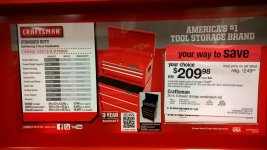
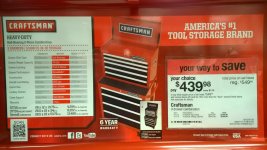
I'm not sure. I can go to Sears tomorrow and take a better picture. But it does say Assembled in USA. And here is how the FTC defines that. So if anyone here thinks that Sears is misleading people with the assembled in USA claim then report them to the FTC.
Assembled in USA Claims Link
A product that includes foreign components may be called "Assembled in USA" without qualification when its principal assembly takes place in the U.S. and the assembly is substantial. For the "assembly" claim to be valid, the product’s last "substantial transformation" also should have occurred in the U.S. That’s why a "screwdriver" assembly in the U.S. of foreign components into a final product at the end of the manufacturing process doesn’t usually qualify for the "Assembled in USA" claim.
What if I suspect noncompliance with the FTC’s Made in USA standard or other country-of-origin mislabeling?
Information about possible illegal activity helps law enforcement officials target companies whose practices warrant scrutiny. If you suspect noncompliance, contact the Division of Enforcement, Bureau of Consumer Protection, Federal Trade Commission, Washington, DC 20580; (202) 326-2996 or send an e-mail to
[email protected] (link sends e-mail). If you know about import or export fraud, call Customs’ toll-free Commercial Fraud Hotline, 1-800-ITS-FAKE. Examples of fraudulent practices involving imports include removing a required foreign origin label before the product is delivered to the ultimate purchaser (with or without the improper substitution of a Made in USA label) and failing to label a product with a required country of origin.
You also can contact your state Attorney General and your local Better Business Bureau to report a company. Or you can refer your complaint to the National Advertising Division (NAD) of the Council of Better Business Bureaus by calling (212) 754-1320. NAD handles complaints about the truth and accuracy of national advertising. You can reach the Council of Better Business Bureaus on the web at adweb.com/adassoc17.html.
Finally, the Lanham Act gives any person (such as a competitor) who is damaged by a false designation of origin the right to sue the party making the false claim. Consult a lawyer to see if this private right of action is an appropriate course of action for you.