To avoid these ads, REGISTER NOW!

metal siding and condensation between the insulation

Bigfork G

Well-known member
Joined
Nov 27, 2013
Messages
46
I have a concern about my shop having condensation/ice between the metal siding and the fiberglass batt insulation. I checked in multiple places throughout the shop and it moisture where ever i checked. Even above the garage door.

Couple of thing first. Im not finished putting up the insulation on all of the interior, I did have the skid steer in there that had a lot of snow that melted off, and the shop is heated.

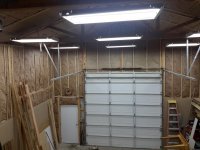
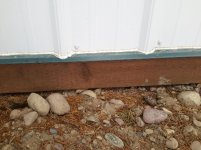
I did seal all the joints inside and out with calk, foam and tape. See the pictures. The first picture is of the top of the wall, foam in the ridge and calk where the siding and wood meet. The bottom of the wall is similar except it calked on the outside as well, last picture.

Could this be from the snow that melted off and moved throughout the shop? Or could it be from the outside between the concrete and the pressure treated board, last picture?
 

Attachments

  • 20160112_115755.jpg
    20160112_115755.jpg
    135.3 KB · Views: 136
  • 20160112_115733.jpg
    20160112_115733.jpg
    132.3 KB · Views: 136
  • 20160112_115816.jpg
    20160112_115816.jpg
    135.6 KB · Views: 130
  • 20160112_115924.jpg
    20160112_115924.jpg
    140.8 KB · Views: 126
Last edited:
To avoid these ads, REGISTER NOW!

pattenp

Well-known member
Joined
Jun 4, 2008
Messages
10,175
Location
Virginia - USA
What's your location. The problem is heated moist air is leaking through every gap in the kraft paper vapor barrier and is hitting the cold metal and condensing. You need to completely seal the vapor barrier and the barrier should cover the stud/framing faces.
 
OP
B

Bigfork G

Well-known member
Joined
Nov 27, 2013
Messages
46
It will stop if I finish the interior wall sheeting then? I have planned on finishing the upper open wall just time, help and $$$.
 
Last edited:

danfromsyr

Well-known member
Joined
Jan 1, 2009
Messages
11,752
Location
Cicero, NY
for 1, that big open gap by the garage door for the wiring? will let alot of interior air & vapors into the space of your girts to metal exterior walls.
 

shadyluke

Well-known member
Joined
Oct 3, 2014
Messages
267
Location
SE Pa
It will stop if I finish the interior wall sheeting then? I have planned on finishing the upper open wall just time, help and $$$.

What Pattenp is saying in instead of tucking the edges of the kraft paper/vapor barrier between the studs it should remain on top of the stud edge creating a continuous barrier.
 
To avoid these ads, REGISTER NOW!

kansei

Well-known member
Joined
Mar 8, 2011
Messages
141
Location
Greenville, Michigan
I would think adding a true vapor barrier- plastic film/sheeting designed for this purpose before you sheetrock would also really help eliminate the issue altogether.
 
OP
B

Bigfork G

Well-known member
Joined
Nov 27, 2013
Messages
46
What Pattenp is saying in instead of tucking the edges of the kraft paper/vapor barrier between the studs it should remain on top of the stud edge creating a continuous barrier.

The one time I followed instructions! I knew i should have laid them over the studs.
 

jack stand

Well-known member
Joined
Feb 29, 2012
Messages
3,346
Location
Lakes Region Maine
The one time I followed instructions! I knew i should have laid them over the studs.

Wall insulation "science" has gotten very confusing & sophisticated. I'd do a little reasearch on the "dew point" in an insulated wall before you bother to flip out the little kraft paper staple edge on the f/g. I don't think that qualifies as a moisture barrier without drywall and specific painting. Yes the paint has become a portion of the m/b. :scared:
I've abandoned relying on f/g insulation for the heavy duty part of insulating and use it on the inside of several inches of ridgid foam cut & fit into each stud bay.
 
OP
B

Bigfork G

Well-known member
Joined
Nov 27, 2013
Messages
46
Im thinking if I finish the interior sheeting and paint that should stop the moisture?
 

Jlbc212

Well-known member
Joined
Dec 7, 2013
Messages
1,530
Location
Northeast MA
Moisture in the air is attracted to the coldest surface where if it is below the dew point temperature, the moisture will condense back to liquid or solid (frost or ice). This is how air conditioning systems work to remove humidity and heat from the air. Ideally, in a cold climate a vapor barrier is installed toward the heated side of the structure to prevent the transfer of moisture through the wall/ceiling. Any moisture that can pass through will condense into liquid when it reaches the dew point temp. This could be in the insulation itself or the interior side of the exterior sheathing. If the exterior sheathing is permeable, that is if it will allow moisture to pass through, the moisture will continue on through drawn to the cold outside and beyond the structure. Obviously, steel siding is not permeable, and sadly, most present day exterior panels (such as osb and plywood) also are not very permeable. You need a real tight vapor barrier.
 
Last edited:

wagspe208

Well-known member
Joined
Apr 29, 2011
Messages
94
About the only way to prevent condensation on the inside of the panels is to spray closed cell foam on the tin directly. They will still sweat on the area between the perlin and the tin, but it won't be an issue in my lifetime.
Wags
 
To avoid these ads, REGISTER NOW!
Top Bottom