To avoid these ads, REGISTER NOW!

Patch panel questions

WhoWhatNow

Well-known member
Joined
Feb 22, 2011
Messages
1,884
Location
Collegeville, PA
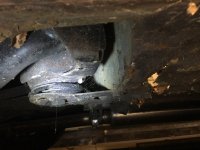
This is my first attempt at welding in a patch panel and I have a few questions. The car is a 1974 Mercedes Benz 450 SL. Panel is the passenger side rear floor. I have a nice replacement panel from a company that specializes in Mercedes parts. The panel is 18 gauge. My question is exactly what do I cut out and how do I weld in the new panel? It appears that the original panel is attached from the bottom of the car, i.e. the lip of the rear bulkhead panel is on top of the floor panel. What I am confused about is how the floor panel is welded to the rear bulkhead panel. I do not see any weld on the joint. It almost looks like it is bonded. So what I cut and what type of joint; **** or lap joint?

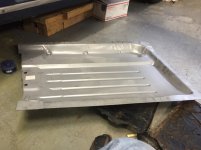
The first pick is of the floor looking down from the top of the car. The second pick is under the car looking back from the rear tire. You can see part of the rear suspension and the joint between the rear bulkhead and the rusted floor panel. The third pic is my attempt at drawing the joint between the two panels. The fourth pic is the replacement panel.

ImageUploadedByTapatalk1453742930.468373.jpg

ImageUploadedByTapatalk1453742947.274956.jpg

ImageUploadedByTapatalk1453742959.797585.jpg

ImageUploadedByTapatalk1453742970.969938.jpg
 
To avoid these ads, REGISTER NOW!

jimbbski

Well-known member
Joined
Feb 5, 2009
Messages
67
Location
Chicago Area
Your diagram describes how it was put together as far as I can see. I think if you looked hard you will find spot welds at the bulkhead to floor joint. It may be hard due to the rust on the surface of the metal.

IF I were doing the repair and the lip at the bottom of the bulkhead is to rusty to save I would make up a piece of metal and bend it into a "L" with one side welded to the bulkhead and the other to form the "lip" the OEM bulkhead had. This will give you the lip the stock floor pan needs to sit on.
 

gungatim

Well-known member
Joined
Jan 8, 2013
Messages
8,101
Location
west mich
I prefer lapping, punching a hole, and plug welding when possible. poor-man's spot weld...easiest to do, and since your SL already has rust, originality is not important at this point. you should also be looking for more rust. they are not supposed to rust, so if an SL has rust it was not taken care of and will have a lot more hidden...
 
OP
W

WhoWhatNow

Well-known member
Joined
Feb 22, 2011
Messages
1,884
Location
Collegeville, PA
Jimbbski - I was afraid that would be the answer. I am worried about fabricating a new lip since it appears that the suspension is bolted to that panel. I guess I need to start removing the undercoating to see exactly what I have to work with. Any suggestions for the best method for removing undercoating?

Gungatim - Agreed, I'm not really worried about originality. It isn't the most desirable year for this model nor is it good enough shape to be made perfect again. I have an old Whitney punch that I picked up at a auction. Think that will work in 18 gauge?

Thanks for the reply's.
 

Professur

Well-known member
Joined
Apr 7, 2010
Messages
3,911
Location
Mo-Ray-Al, K-bec, Ka-Na-Da
I attack the old floor with an icepick. Anywhere it dents or punches through is 'thin'. I cut out the thin stuff. Then I cut the pieces I need from the patch pan to fill those holes and **** weld them in place. Just because a replacement pan is a certain shape doesn't mean you need to use all of it.

If you choose to lap weld, make sure your joint is super clean and prep it with a shot of weld through primer. Then make sure you seal it well with joint compound. **** welds IMO are superior in this, as without any overlap, there's nowhere for rust or water to hide and get an early start.
 

gungatim

Well-known member
Joined
Jan 8, 2013
Messages
8,101
Location
west mich
great advice above, forgot to mention the seam sealer, and good advice on the cleco's. I use a HF punch copy of the whitney (not sure they still sell it) and also their cleco copys. I work on british cars a bit so you get used to doing that type of repair...my SL is from Texas, so no rust yet!
 

hemifalcon

Well-known member
Joined
Jan 4, 2013
Messages
708
Location
Union Grove, Wisconsin
from what it sounds like.. you're not a restoration shop and aren't doing this on the regular.. No need to get fancy--but don't waste time and money doing an incorrect repair. Plug welds will be easiest, but you have to cut out all the cancerous metal. No need for cleco's, sheetmetal screws will work fine if you're not doing this for a living.
 

rsanter

Well-known member
Joined
Dec 22, 2007
Messages
18,487
Location
visalia ca
Keep in mind that you also have the option to epoxy the panel in place if you are not confident in your welding.
Many of the new cars have their panels epoxied in place. The metal needs to be super clean like sandblast clean

Bob
 
OP
W

WhoWhatNow

Well-known member
Joined
Feb 22, 2011
Messages
1,884
Location
Collegeville, PA
Thanks for the suggestions guys. My plan right now is to clean the area up a bit to get a better idea of what I am dealing with. I will probably plug weld if the tab on the rear panel is in good shape. I also ordered some weld through primer to paint the panel prior to installation. It will probably take me a few weeks to get back to this project. Shop time is very limited for me. I'll post my progress as it happens.

Thanks again for the suggestions.
 

NYBODYMAN

Well-known member
Joined
Sep 10, 2013
Messages
4,822
Location
NY
IMO if you have the entire patch panel and access to change out the entire piece, do so. It will help with the structural integrity of the floor rather than piecing it in.
 

Capt Chrysler

Well-known member
Joined
Mar 6, 2011
Messages
1,160
Location
Middle of nowhere.
Keep in mind that you also have the option to epoxy the panel in place if you are not confident in your welding.
Many of the new cars have their panels epoxied in place. The metal needs to be super clean like sandblast clean

Bob

Last I knew you were not supposed to panel bond floor pans or firewalls.

Please correct me if I'm wrong.

Capt. Chrysler
 
To avoid these ads, REGISTER NOW!

countryroad82

Well-known member
Joined
Mar 18, 2011
Messages
3,447
Location
Kentucky
Last I knew you were not supposed to panel bond floor pans or firewalls.

Please correct me if I'm wrong.

Capt. Chrysler

It's supposed to be a cure-all for welding. Yes it does hold up, but I'm always curious about the future. I'm just as guilty though anymore, when I do rocker panels and bedsides, I glue them over welding. It saves a **** ton of time, therefore I can move the next on in that much faster.
 

countryroad82

Well-known member
Joined
Mar 18, 2011
Messages
3,447
Location
Kentucky
Not trying to start a $h!t storm.

"This product is not intended to bond structural components of a vehicle such pillars, rockers, or frame members. If doubt exists as to whether a particular component is structural, then that component should be welded."

http://3mcollision.com/3m-panel-bonding-adhesive-08116.html

Capt. Chrysler

No storm taken. But also read what they recommend the uses for. It makes absolutely no sense. I went to a training seminar last year with my jobber and that is what 'sold' me on using it. Plus many new cars are 'glued' together now. It's insane!
 

mg283680

Banned
Joined
Jul 23, 2015
Messages
103
To the OP, while you may have found (but unlikely) a vendor to sell 18G parts, its unlikely the original parts are that thick. People need to get a measuring device and learn how to use it.

It's supposed to be a cure-all for welding. Yes it does hold up, but I'm always curious about the future. I'm just as guilty though anymore, when I do rocker panels and bedsides, I glue them over welding. It saves a **** ton of time, therefore I can move the next on in that much faster.

The car owner is (hopefully) interested in quality. The shop owner is (as said often) interested in quantity. Other posts have echoed the same. Quality and quantity are in direct conflict.

Find a shop interested in making _metal_ straight, or see rust in a year.
 
Last edited:

Blake150

Well-known member
Joined
Jan 20, 2013
Messages
93
Location
Indiana
Quality isn't always what has been traditionally welded.think about it when you weld metal you work harden it, plus your burning off all the corrosion protection. A floor pan is not a structural peice.plus panel bonds is corrosion resistant. I would rivet bond the floor then use a quality bare metal seam sealer Followed by some wax sprayed inside any cavities opened up. Just my opinion
 

rustynutts

Well-known member
Joined
Nov 13, 2009
Messages
54
Looking at the pictures, my opinion is that floor is definitely a structural piece and I would weld the panel in.
 
OP
W

WhoWhatNow

Well-known member
Joined
Feb 22, 2011
Messages
1,884
Location
Collegeville, PA
I had a few minutes to wire wheel off the undercoating and I can see what I assume are the spot welds on the original joint. I am going to weld this panel in for a two reasons: this car is the main reason I bought a welder 4+ years ago and I want to get some experience welding in patches for the times that there is no alternative. I don't think this will be my last project.

So a one more question: If I drill out the welds will the panel simply fall out? How do I get the floor out without damaging the surrounding panels that I am going to weld the new panel to?

Countryroad82 - interesting discussion about the bonded panels. I believe the Lotus Elise is one of the cars that was had an almost entirely bonded chassis.

Thanks to everyone for the feedback. I will keep updated this thread as I make progress.
 

DpSyChO

Well-known member
Joined
Sep 16, 2006
Messages
402
Location
Blue Ridge Mountains of Southern Virginia
Since we got sidetracked to the topic of automotive panel adhesives..........
I went through the local community college auto body program in the early 2000's.
A rep for one of the adhesives came and wanted to do a "demo" so the instructor let him.
He ask who the best welders were in the class.....not to sound like I have an ego half the class and instructor looked over at me. I said that Joe,( guy in the class), welded as well as I did. The rep gave each Joe and I six pcs of metal strips, around 1-1/2" wide x 6 or 8" long and ask me to weld two together how ever I liked.
I quickly drilled three holes in one , overlapped and spot welded one of them, over lapped one of them1/2 and welded both sides. I think I may have just overlapped and welded one side of the second one. I think Joe did around the same with his six strips.
At the same time the rep was putting some of his adhesive on two of the strips by overlapping and bonding together.
He had some sort of tool that looked like a small shop press with a pull action enerpac cylinder that he would rig up the strips in and pull them apart.
All of my test strips and the other guys that welded them tore right at the weld.
The ones with the adhesive tore metal but did not pull the adhesive loose.
 

Capt Chrysler

Well-known member
Joined
Mar 6, 2011
Messages
1,160
Location
Middle of nowhere.
Since we got sidetracked to the topic of automotive panel adhesives..........
I went through the local community college auto body program in the early 2000's.
A rep for one of the adhesives came and wanted to do a "demo" so the instructor let him.
He ask who the best welders were in the class.....not to sound like I have an ego half the class and instructor looked over at me. I said that Joe,( guy in the class), welded as well as I did. The rep gave each Joe and I six pcs of metal strips, around 1-1/2" wide x 6 or 8" long and ask me to weld two together how ever I liked.
I quickly drilled three holes in one , overlapped and spot welded one of them, over lapped one of them1/2 and welded both sides. I think I may have just overlapped and welded one side of the second one. I think Joe did around the same with his six strips.
At the same time the rep was putting some of his adhesive on two of the strips by overlapping and bonding together.
He had some sort of tool that looked like a small shop press with a pull action enerpac cylinder that he would rig up the strips in and pull them apart.
All of my test strips and the other guys that welded them tore right at the weld.
The ones with the adhesive tore metal but did not pull the adhesive loose.


The same test was used by Fusor. Except we used the frame machine.


Just replace the floor pan, like it was installed by the factory and you will be fine.

In the pre-robot welding days. You might find more spot welds on one side of the car VS the other. Always wondered what side was correct!


Capt. Chrysler
 

toomanytoyzz

Well-known member
Joined
May 11, 2012
Messages
1,571
Location
Malvern, PA
Also, the rust inhibitors used in the glue are very good. Much better than weld-thru primer (which more than likely gets burnt off during welding) IMO.
 

Blake150

Well-known member
Joined
Jan 20, 2013
Messages
93
Location
Indiana
After you drill the welds you're going to need a seam buster basically a thicker scraper.You run it between the corresponding panels and tap with a hammer to separate the panel.make sure u don't drill through the mating panel or you're going tip have nothing to weld to_Oh and structural components are frame related ie frame rails pillar pieces reinforcements a floor is not structure and panel bonds has a better hold than welds when done properly
 
To avoid these ads, REGISTER NOW!
Top Bottom