To avoid these ads, REGISTER NOW!

Why small feet on lifts?

sberry

Banned
Joined
Jun 18, 2005
Messages
35,747
Location
Brethren, Michigan
Not at all. I am seeking to understand the design constraints and engineering decisions made. What specifications and standards apply? How were these met? What limitations then apply?

A two post lift is definitely complicated enough to require engineering. But, it is not so complicated that sufficient understanding of its design is inaccessible to a knowledgable owner.
No one is saying a guy cant get creative but there should be some caution when modifying an engineered design. Its ok to understand it but that don't mean it needs to be "fixed" when there is nothing wrong with it.
 
To avoid these ads, REGISTER NOW!

WNYflyer

Well-known member
Joined
Sep 13, 2009
Messages
2,122
Location
Lockport, NY
A lot of them were missing the lift arm locks, on some the arms were bent, i said they were 25 years old but after thinking about it they were 29 years old,
not that that makes much of a difference.
There are 14 lifts in our shop, they replaced them all with Rotaries.
they sold most of the old ones, there are 1 or 2 left, want one? LoL
heres my bays and the old Benwils

Those substantial cross members rigidly attached to the top of the columns make those lifts act vastly different structurally than those two post lifts with no or non structural cross members up top. Like you said they look very substantial and I definitely can see there being less deflections/movement with that design. I would figure that design assumed a non-fixed column base thus the requirement for looks it like outriggers ? at the base to help with the fore and aft forces.
 

dave*99

Well-known member
Joined
May 5, 2009
Messages
4,269
Location
Coastal NJ
1) I used the lift as a jib crane.
2) To unload a 2400 lb milling machine (which happens to be the same weight as the vehicle I most often work on).
3) It was not overloaded. The lift has a 9000 lb capacity frame so is rated for 2,250 lbs on each arm. Since it is ALI Certified it has been tested to 150% or 3,375 lbs. So, the arm/carriage was at about 70% maximum. The anchors were not stressed unusually as this column is attached solidly at the top (remember I "modified" this lift) as well as bolted to the floor. Without the top attachment, the tipping moment at the base would be around 10,000 ft-lb (4 foot arm x 2400 lb load). In my lift, this moment is also supported by the top mount to the wall. The tension in the top mount is about 800 lbs. This load is carried through two 3/4 inch bolts, being good for, whatever, 30,000 lbs so I didn't bother to calculate the safety factor there. Also, with a cross brace, this load is carried to the other column. Which is also bolted at the top.

I remember distinctly reading in the manual for my 2 post lift that it should never be loaded on 1 or 2 arms in this fashion. Taking the lift capacity and dividing by 4 to arrive at a load capacity per arm does not work. An evenly loaded lift transfers load vertically to the ground. Loading a single arm puts a tipping force on the lift it was not designed for.
 

srr

Well-known member
Joined
Jul 10, 2015
Messages
111
Location
San Diego
A lot of them were missing the lift arm locks, on some the arms were bent, i said they were 25 years old but after thinking about it they were 29 years old,
not that that makes much of a difference.
There are 14 lifts in our shop, they replaced them all with Rotaries.
they sold most of the old ones, there are 1 or 2 left, want one? LoL
heres my bays and the old Benwils

That is the lift I have now. Works great. It's actually called an "outrigger" Those bases are solid steel and heavy as hell! My concrete is 5" thick and drilling those anchors was a lot of fun. I've had mine for 10 years and only trouble I had was my fault as it's outside and the motor is NOT water tight. I had to have the motor redone to the tune of $500. Since I only paid $1000. for the lift I think I'm still ahead of the curve. That lift has made me a few bucks over the years and not having to work on the ground rocks when your kissing 60 years old! :thumbup:
 

75toolman

Well-known member
Joined
Jan 29, 2009
Messages
147
Sorry, nobody is going insane. My mistake.
I should have done a better job of answering your question. I think you are entirely correct. I would not buy, own, install, or use most of the hobby lifts on the market today. I am not impressed with any two post lift that does not have a cross bar at the top preventing the columns from leaning together. Note the video of the test where the columns bent toward each other by several inches at the ALI certifying load. It also does not pull the anchors out, which is all good, but I'll not stand under a noodle. Additionally, as you point out, a longitudinally extended base plate greatly reduces fore/aft tipping strain at the anchors. I think 4 inch thick concrete pad is not something I want to load by bending it. Concrete testing is done by compression. I am perfectly happy to spend the time and money to have a lift that can solidly and easily lift and support 3 times the weight of the heaviest vehicle I typically work on.

I understand the whole hobby lift thing trust me. I own a mohawk tp 16. Do you honestly think it's not safe since it doesn't have a cross bar?
 

Ironcrow

Well-known member
Joined
Sep 30, 2005
Messages
1,169
Location
Arizona
I understand the whole hobby lift thing trust me. I own a mohawk tp 16. Do you honestly think it's not safe since it doesn't have a cross bar?
Well, I said most. Mohawk is pretty solid stuff and they make free standing columns for really heavy duty lifts. I looked at their website to see what they had in the hobby market and saw some other free standing two posts holding up cement trucks.

What I don't trust are lighter weight lifts of uncertain parentage and concrete my contractor told me was 4000 psi. Which, to be fair, is most of what's out there in Bob's garage.
 
Last edited:

lakeroadster

Well-known member
Joined
Jan 19, 2015
Messages
5,166
Location
Central Colorado
Congress Passes "2 Post Lift Entitlement Program"

What I don't trust are lighter weight lifts of uncertain parentage and concrete my contractor told me was 4000 psi. Which, to be fair, is most of what's out there in Bob's garage.

Just how big would the pad on the lift need to be for "unknown strength concrete"?

That is impossible to answer, it's a moving target.

So the manufacturers base their design on a given concrete strength.

This isn't rocket science. If you don't know how strong your concrete is, or how thick it is, then take the steps to find out (core sampling). Don't expect the lift manufacturers to design their lifts to the lowest common denominator.
 

Ironcrow

Well-known member
Joined
Sep 30, 2005
Messages
1,169
Location
Arizona
I remember distinctly reading in the manual for my 2 post lift that it should never be loaded on 1 or 2 arms in this fashion. Taking the lift capacity and dividing by 4 to arrive at a load capacity per arm does not work. An evenly loaded lift transfers load vertically to the ground. Loading a single arm puts a tipping force on the lift it was not designed for.
Of course. I use the single arm math only to consider what will break that arm off, not tip the lift over. Your lift is not designed for this. Mine is. And that is the crux of the discussion in this thread.
 

lakeroadster

Well-known member
Joined
Jan 19, 2015
Messages
5,166
Location
Central Colorado
My lift has larger feet that are strengthen by a 6x6 angle iron running longitudinally to the rear of the column.

I am perfectly happy to spend the time and money to have a lift that can solidly and easily lift and support 3 times the weight of the heaviest vehicle I typically work on.

In my lift, this moment is also supported by the top mount to the wall. The tension in the top mount is about 800 lbs. This load is carried through two 3/4 inch bolts, being good for, whatever, 30,000 lbs so I didn't bother to calculate the safety factor there. Also, with a cross brace, this load is carried to the other column. Which is also bolted at the top.

I have a two post that comes with ample column baseplates, so no problem there. The tops of the columns are attached to reinforced concrete wall (12 inch thick, two curtains of #5 rebar, on 8 inch centers) on one side and a W16x50 beam on the other. While my structure is adequate for this, I suspect the OP's is not and I would not recommend the average garage owner attach a lift to the building walls/roof.

Your lift is not designed for this. Mine is. And that is the crux of the discussion in this thread.

Sounds like a beast... any chance you could post up some photo's of your lift? Photo's make it real for the rest of us.

Are you a boiler maker or a steam engine guy? Just curious, based on your avatar.
 
Last edited:

Ironcrow

Well-known member
Joined
Sep 30, 2005
Messages
1,169
Location
Arizona
Re: Congress Passes "2 Post Lift Entitlement Program"

Just how big would the pad on the lift need to be for "unknown strength concrete"?

That is impossible to answer, it's a moving target.

So the manufacturers base their design on a given concrete strength.

This isn't rocket science. If you don't know how strong your concrete is, or how thick it is, then take the steps to find out (core sampling). Don't expect the lift manufacturers to design their lifts to the lowest common denominator.
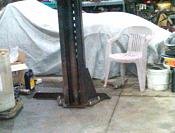
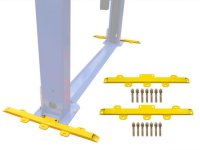
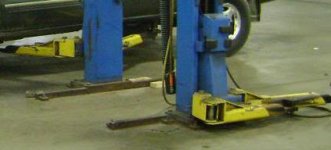
Perhaps we would be willing to think about these images. Two are older lifts with welded fore/aft base extensions that are manufactured as part of the column base. The other two are bolted extensions, one very much older (from this thread) and the other a new offering from Greg Smith. Of particular interest is a visit to the Greg Smith website to see their explanation of the Atlas baseplate extensions.

Why do these features exist? Even if the lift manufacturers do not find them necessary, users install them? And Greg Smith offers the option? Clearly sufficient strength can be achieved with well placed anchors in smaller bases with good concrete (as you point out). Perhaps very old anchors loosen up? Garage owners can not expect their mechanics to periodically check anchor torque? Extensions are more cost effective than placing a new pad if it is discovered to be weak? Becomes weak? Over the years anchor technology has improved? Garage owners are deluded and the extended bases serve no purpose whatsoever?
 

Attachments

  • 13391b.jpg
    13391b.jpg
    50 KB · Views: 86
  • Capture.JPG
    Capture.JPG
    6.3 KB · Views: 265
  • BP-EXTKIT-02.jpg
    BP-EXTKIT-02.jpg
    85.8 KB · Views: 84
  • DSC01083_zpse0725e0d.jpg
    DSC01083_zpse0725e0d.jpg
    13.6 KB · Views: 83

Ironcrow

Well-known member
Joined
Sep 30, 2005
Messages
1,169
Location
Arizona
Sounds like a beast... any chance you could post up some photo's of your lift? Photo's make it real for the rest of us.

Are you a boiler maker or a steam engine guy? Just curious, based on your avatar.
That's just the thing, my lift does NOT look like a "beast". Some well thought out braces can work wonders without throwing mass at it until it looks like the old Benwils pictured above. Look at the cross bar on those!

I am a bit squeamish about posting pictures of my inner sanctum on the internet. My lift is a Benwil GPOA-7 (which has the same columns as a GPOA-9) with the tops of the columns attached to the concrete and steel building as described.

The avatar is a picture from Durango-Silverton yard. I am an engineer with a CAD program that does FEA and experience in designing industrial fixturing (carts, racks, work benches, cranes), sometimes for assemblies that weigh as much as a small truck.
 

gungatim

Well-known member
Joined
Jan 8, 2013
Messages
8,101
Location
west mich
for the record, the base extension on my wheeltronic (bear branded) lift is not a user add-on. though I thought it was when I got the lift, the parts manual lists them as standard equipment...it is assymetric lift, 8000lb capacity and 1000lb on the cross bar for pulling engines...hard to believe it's only 8k capacity, compared to a lot of the home lifts I have seen, the column steel is nearly twice as thick, but I understand the hydraulics are probably the limiting factor...
 

sberry

Banned
Joined
Jun 18, 2005
Messages
35,747
Location
Brethren, Michigan
Ironcrow is an engineer then but I don't understand why or what's in it for him to actually advocate modifying lifts or leaving the impression it is a good idea or no big deal?@
 
To avoid these ads, REGISTER NOW!

lakeroadster

Well-known member
Joined
Jan 19, 2015
Messages
5,166
Location
Central Colorado
... Of particular interest is a visit to the Greg Smith website to see their explanation of the Atlas baseplate extensions.

From the Greg Smith's Website: "The Atlas® Base Plate Extension Kit is designed for those customers who are unsure of the integrity (thickness and PSI) of their concrete floor. These extensions increase the column base surface area that is anchored to the floor."

If you don't know what the "integrity" of the concrete is, how do you know the extension kit will be "good enough"? Will it help.. maybe, or it might just make it worse by having additional anchors that bust up bad concrete.

Our local testing facility charges $60.00 to do a compressive test on a concrete sample. Why not use the $200 that you would spend for the extensions and have the concrete tested? Then you'll actually know what needs to be done, instead of guessing?

I am a bit squeamish about posting pictures of my inner sanctum on the internet. My lift is a Benwil GPOA-7 (which has the same columns as a GPOA-9) with the tops of the columns attached to the concrete and steel building as described.

Awe.. jump in and be bold. Got Jimmy Hoffa's corpse in there?
baseplate extensions....
  1. Why do these features exist?
  2. Even if the lift manufacturers do not find them necessary, users install them? And Greg Smith offers the option?
  3. Perhaps very old anchors loosen up?
  4. Garage owners can not expect their mechanics to periodically check anchor torque?
  5. Extensions are more cost effective than placing a new pad if it is discovered to be weak? Becomes weak?
  6. Over the years anchor technology has improved?
  7. Garage owners are deluded and the extended bases serve no purpose whatsoever?

  1. Because some folks would rather apply a band aid than evaluate and then fix a problem
  2. See 1. If there is a demand for a product manufacturer's will build it, needed or not.
  3. Then replace them.
  4. Sure they can. I check mine frequently with a torque wrench. To do otherwise is reckless. It takes all of about 2 minutes.
  5. How do you know the concrete is "weak" without testing? If testing reveals the concrete doesn't meet the required specification, replace it.
  6. See 3
  7. They serve no purpose unless the lift design requires them. Installing them on unknown quality, unknown thickness concrete is a fools errand.
 
Last edited:

dave*99

Well-known member
Joined
May 5, 2009
Messages
4,269
Location
Coastal NJ
Of course. I use the single arm math only to consider what will break that arm off, not tip the lift over. Your lift is not designed for this. Mine is. And that is the crux of the discussion in this thread.

When you load a single arm, you also twist the carriage that holds the two arms. How have you modified your lift to carry these additional forces?
 

Ironcrow

Well-known member
Joined
Sep 30, 2005
Messages
1,169
Location
Arizona
When you load a single arm, you also twist the carriage that holds the two arms. How have you modified your lift to carry these additional forces?
I did an FEA on the carriage and found the SF to be about 8. I only needed to reinforce the weakest point, which was column tipping, to increase stiffness/strength/SF of the lift.
 

Ironcrow

Well-known member
Joined
Sep 30, 2005
Messages
1,169
Location
Arizona
Our local testing facility charges $60.00 to do a compressive test on a concrete sample. Why not use the $200 that you would spend for the extensions and have the concrete tested? Then you'll actually know what needs to be done, instead of guessing?
$60 for the test and $100 to core a chunk out and $100 to patch the hole...but no matter the cost is trivial for either the test or the extensions.

What if I bought a large shop with a couple of lifts in it. And I trust my mechanic to check to baseplate bolt torque on his periodic PM list. He's says he's done that and they are holding torque. Business is great and I want to expand. When adding a third lift, I DO core out the pad and check psi at a lab. Because I don't do fool's errands. It's 3500 psi and this meets the spec for the new lift. Being thorough and safety minded I look up the spec on the two lifts already installed. Well, gee its 4000 psi. What was the original owner thinking? Don't know. He died. Look up the architect, get a referral to the engineering firm. Huh, the engineering firm; they're out of business. Building inspector says the lifts have been up for 20 years why worry? My insurance guy and lawyer put their heads together and say I got to do something though. Do I close the business for 2-4 weeks, send two mechanics home, turn away my clients, hire a crew to strip the shop and put the stuff in a rented storage unit, rip out the pad and replace it for $10,000, and put the lifts back up? Or buy two sets of these extensions for $400? If Gregg Smith can't give me any data I could even hire a new engineer to work out a new spec for concrete strength with the extensions. If I have to pay him $500 I'm still way ahead.
 

lakeroadster

Well-known member
Joined
Jan 19, 2015
Messages
5,166
Location
Central Colorado
What if I bought a large shop with a couple of lifts in it. And I trust my mechanic to check to baseplate bolt torque on his periodic PM list. He's says he's done that and they are holding torque. Business is great and I want to expand. When adding a third lift, I DO core out the pad and check psi at a lab. Because I don't do fool's errands. It's 3500 psi and this meets the spec for the new lift. Being thorough and safety minded I look up the spec on the two lifts already installed. Well, gee its 4000 psi. What was the original owner thinking? Don't know. He died. Look up the architect, get a referral to the engineering firm. Huh, the engineering firm; they're out of business. Building inspector says the lifts have been up for 20 years why worry? My insurance guy and lawyer put their heads together and say I got to do something though. Do I close the business for 2-4 weeks, send two mechanics home, turn away my clients, hire a crew to strip the shop and put the stuff in a rented storage unit, rip out the pad and replace it for $10,000, and put the lifts back up? Or buy two sets of these extensions for $400? If Gregg Smith can't give me any data I could even hire a new engineer to work out a new spec for concrete strength with the extensions. If I have to pay him $500 I'm still way ahead.

If you are running a business, and you find something doesn't meet spec., you bring it up to spec.
-or-
Get a Professional Engineer to evaluate. He'll either:
  • Sign off and apply his seal to approve the existing installation, or
  • Specify the concrete under the lifts (not the entire slab) needs reworked.

Just buying something from somebody and then bolting it on leaves you liable if there is an issue in the future.
 
Last edited:

Ironcrow

Well-known member
Joined
Sep 30, 2005
Messages
1,169
Location
Arizona
If you are running a business, and you find something doesn't meet spec., you bring it up to spec.
-or-
Get a Professional Engineer to evaluate. He'll either:
  • Sign off and apply his seal to approve the existing installation, or
  • Specify the concrete under the lifts (not the entire slab) needs reworked.

Just buying something from somebody and then bolting it on leaves you liable if there is an issue in the future.
Yes, sign off and seal. I am actually working to gather information and improve understanding - I sent an e-mail to Greg Smith to ask if any relief was possible in the 3000 psi 4 inch thick pad requirement. Could one use these base extensions in, hypothetically, 2800 psi concrete safely? The answer back; yes. The manufacturers recommendation/approval may not satisfy an owner as much as a PE seal, but that does suggest what the baseplate extensions are for and what they might do for an installation.
 

lakeroadster

Well-known member
Joined
Jan 19, 2015
Messages
5,166
Location
Central Colorado
... I sent an e-mail to Greg Smith to ask if any relief was possible in the 3000 psi 4 inch thick pad requirement. Could one use these base extensions in, hypothetically, 2800 psi concrete safely? The answer back; yes.

Do you actually have some 2,800 psi concrete and a Greg Smith lift, if not, why are you yanking Greg Smith's chain?

They answered yes to a 7% reduction in concrete strength, hardly a revelation.
 

Ironcrow

Well-known member
Joined
Sep 30, 2005
Messages
1,169
Location
Arizona
I am asking questions because that is one way to learn something new. It interests me. Perhaps another individual among the 5400 page views in this thread is interested too.

If Greg Smith was happy with 2800 psi without the baseplate extensions I would think they would spec that instead of the 3000 psi they ask for.

I suppose I could have asked if I could set the lift up, with baseplate extensions, on my front lawn.
 

lakeroadster

Well-known member
Joined
Jan 19, 2015
Messages
5,166
Location
Central Colorado
I suppose I could have asked if I could set the lift up, with baseplate extensions, on my front lawn.

Or taking your logic (??) to the next step maybe ask them about using their lift with pontoons on a lake, so you could work on your boat. :eyecrazy:

The point I am making is it is a bad call, literally and figuratively, to be quizzing a company about their product if you don't have and/or aren't even contemplating buying any of their products.

It's not a vocational school or junior college... it's a business.
 

Ironcrow

Well-known member
Joined
Sep 30, 2005
Messages
1,169
Location
Arizona
I disagree. Obviously, or I wouldn't have done it. I am actually in the market for another lift. Probably a 4 post, not a baseplate two post; but still, if a company can't be bothered to spent 3 minutes for an e-mail, they'd get struck from the consideration list when I get ready for that 4 post. Such is marketing and sales. My "demand" on their time was no more than a dozen other sales queries, requests for pricing, brochures, answer a question about capacities, dimensions, warranty, deliver options, installation service or whatever that they entertain everyday.

A car dealer can treat me like poop when I come by to kick tires. If they lock the doors because I'm not going to Buy This Car Today...well, when I'm ready to write that check, it won't be at that store.

Now, I didn't continue the exchange, how about 2700 psi? How about 2600 psi? Can I send over the drawings of my garage addition and contact information for my structural engineer so you can sort out the details? Can I rip you off for several days of engineering...?
 
To avoid these ads, REGISTER NOW!
Top Bottom