When they poured the walls for my garage, they poured them about 1 foot above the slab. I am putting 2x6 walls and R21 insulation on the walls. How much insulation loss do I have with the concrete foundation walls. Is there a way to better insulate the concrete without adding width. Insulation paint?


You are using an out of date browser. It may not display this or other websites correctly.
You should upgrade or use an alternative browser.
You should upgrade or use an alternative browser.
High concrete walls
- Thread starter dnwong
- Start date
hoho98925
ALLIANCE MEMBER
With out furring it out and adding insulation, there is no real fix. The amount of heat loss isn't worth losing any sleep over, especially in a garage.
Pluribus
Well-known member
I'd consider that a bonus! Higher stem walls means your siding is less likely to be damaged by stuff growing up under it or water splashing back onto it. If you get water inside or wash your car inside, the bottom of your framed walls are up higher away from splashing water. You can likely use a taller garage door, and you have that much more room for storage or a vehicle on a lift. Not much of a downside anywhere, unless there's something I'm missing.
This might be a (minor) cause for concern in colder climates, but I don't think VA temps are going to be a big issue.
This might be a (minor) cause for concern in colder climates, but I don't think VA temps are going to be a big issue.
Cyberbear
Well-known member
Don't forget, if you are using a concrete slab garage floor, the stem walls should be of little concern heating wise. That entire slab in an enormous heat sink, unless you plan to put insulation on top of it.
gnpenning
Well-known member
Depending on how you plan to heat it will make a difference on your heat loss. Radiant heat will just go from hot to cold . I would either add insulation to the outside of your foundation or the inside depending on how you framing. Concrete is a great conductor of hot and cold. For me I see no reason to leave any part uninsulated. Like going out into a snow storm with snow pants, boots, gloves, hat but no coat. Cheaper to do now than wish you would have later. Thermo breaks between the slab and walls are a good thing. Even where the garage door comes down and man doors.
Questions like do you plan to heat only when your working, or all the time, cost of what your using to heat with, etc.
Questions like do you plan to heat only when your working, or all the time, cost of what your using to heat with, etc.
Last edited:
krandrew
Member
You can use 1 or 2" rigid insulation on the outside to help insulate the concrete. Use concrete faced insulation and a flashing with a drip edge to cover the top. You need this to protect the insulation from UV and makes it look good
larry4406
Well-known member
Post pictures of your stem wall.
Typically in the VA/MD area, poured concrete walls are 8". Then usually there is a 4" slab ledge on the interior of the stem wall which results in a net 4" concrete wall for framing. To then accommodate 2x6 framing, a small pony wall (studs turned sideways) is built from the surface of the slab to the underside of the overhanging sill plate. This pony wall provides an opportunity for Rmax type insulation of approximately 2" which should get you about R13. You can then run your drywall to the slab surface and trim it out with commercial rubber cove base molding.
The downside to this approach is your drywall is down to the slab on the interior. If you hose out to clean your garage, the drywall can get wet. For this reason, the pony wall material should be pressure treated and I recommend you use green board / mold resistant drywall for the bottom course.
If you have a full 8" stem wall, then I think you are forced to leave it as is without insulation.
Typically in the VA/MD area, poured concrete walls are 8". Then usually there is a 4" slab ledge on the interior of the stem wall which results in a net 4" concrete wall for framing. To then accommodate 2x6 framing, a small pony wall (studs turned sideways) is built from the surface of the slab to the underside of the overhanging sill plate. This pony wall provides an opportunity for Rmax type insulation of approximately 2" which should get you about R13. You can then run your drywall to the slab surface and trim it out with commercial rubber cove base molding.
The downside to this approach is your drywall is down to the slab on the interior. If you hose out to clean your garage, the drywall can get wet. For this reason, the pony wall material should be pressure treated and I recommend you use green board / mold resistant drywall for the bottom course.
If you have a full 8" stem wall, then I think you are forced to leave it as is without insulation.
woodzy
Well-known member
My new house, the poured concrete walls are 3' above the garage floor. This give me 13' ceilings. I agree, you will loose heat out of these walls but the choices are to insulate either inside or outside. In my case, both would detract from the design, so I will just **** up the heat loss in the winter. But when you open a 18' door, you really **** out any heat you have in there anyway. I did install a 45K heater but I will only use that for really cold days/night or parties.


What's the plan to cover the walls ? Do you plan on heating it and maintaining a temp duringthe winter ?
If so, I'd consider furring out the wall to match a furring strip on the concrete stem wall. Put some 3/4" foam insulation between the furring strips and cover it but don't go all the way down to the floor, give yourself 4-6".
If you're not going to heat it except when you are out there, I wouldn't worry about covering it. But, you could still do it and plan for the future.
As far as losing heat when the door is opened for 5-10 minutes, it doesn't matter much. The heat (or any temparature in the concrete) will make the interior space recover quickly once the door is closed again. If you heat and maintain a temp, the floor will act as a big heat sink and help retain the heat, that's why I would cover the stem wall. If you don't, the concrete exposed to the exterior cold, will draw the heat right out.
If so, I'd consider furring out the wall to match a furring strip on the concrete stem wall. Put some 3/4" foam insulation between the furring strips and cover it but don't go all the way down to the floor, give yourself 4-6".
If you're not going to heat it except when you are out there, I wouldn't worry about covering it. But, you could still do it and plan for the future.
As far as losing heat when the door is opened for 5-10 minutes, it doesn't matter much. The heat (or any temparature in the concrete) will make the interior space recover quickly once the door is closed again. If you heat and maintain a temp, the floor will act as a big heat sink and help retain the heat, that's why I would cover the stem wall. If you don't, the concrete exposed to the exterior cold, will draw the heat right out.
DonPowers
Well-known member
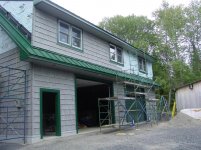
My concrete stub wall came up 6". I put 2" of blue board on the outside face with 1/2 inch pressure treated plywood over the blue board. Then I had some aluminum flashing made to step out over the blue board and plywood. Here are a couple photos. They don't show much detail but give you a general idea.
Good Luck
Don
Good Luck
Don
Attachments

jdwilson44
Well-known member
You can use 1 or 2" rigid insulation on the outside to help insulate the concrete. Use concrete faced insulation and a flashing with a drip edge to cover the top. You need this to protect the insulation from UV and makes it look good
That's a bad idea - unless you're in some place like upper Maine or North Dakota or some place like that - that is above the termite line.
Foam insulation on the outside of a foundation MUST be "properly" installed - or you will create a termite highway that will allow them easy access into the wood parts of your house.
I had a termite infestation in one section of my house - in NEW ENGLAND. They were able to get into the sill - by going thru a crumbling front steps setup that was allowing water into the wood. Once into the wood - they traveled thru the pink insulation board I had put between the floor rafters to stop heat loss. That pink foam board was RIDDLED with termite tunnels and it allowed them to travel to more sections of the sill.
I had to rip out about 12 feet of sill and replace it to get all of it.
The home building mags like Fine Homebuilding and Journal of Light Construction have had multiple articles in the past about how foam is loved by termites - and how to correctly install it outside with barriers and so forth to keep the termites away from the wood parts of the structure.
Unless you're willing to go all the way and do it right - just adding foam to the outside might be an invitation to have your whole building gutted by termites.
Don't do it would be my advice - especially in Virginia where I am sure the termites are even worse than they are up here.
jdwilson44
Well-known member
I'd consider that a bonus! Higher stem walls means your siding is less likely to be damaged by stuff growing up under it or water splashing back onto it. If you get water inside or wash your car inside, the bottom of your framed walls are up higher away from splashing water. You can likely use a taller garage door, and you have that much more room for storage or a vehicle on a lift. Not much of a downside anywhere, unless there's something I'm missing.
This might be a (minor) cause for concern in colder climates, but I don't think VA temps are going to be a big issue.
Good point.
Depending on how you want to use the garage - not having the walls right on the floor can be a plus.
The correct way to do it - is to insulate UNDER the floor slab, but if that is already poured you're sort of out of luck there. And since the floor slab touches the walls - you're going to lose heat one way or another.
People built structures for decades with exposed concrete walls or stem walls and never worried about insulating them. The obsessive worry about "insulation" is something that has come about in the last ten years or so. For a garage - if it was me - and I was worried about squeaking out every bit of energy savings - I would add a layer or two of foam insulation over the concrete stem wall on the INSIDE. Then I would put a layer of plywood or some type of wall covering that was resistant to dents and moisture ( the floor WILL get wet and if that wall touches it - you will **** the moisture up into it).
If you do that - you're going to end up with a "shelf" going around the circumference of the garage - and lose some floor space. So it's a tradeoff.
Hi Larry,Post pictures of your stem wall.
Typically in the VA/MD area, poured concrete walls are 8". Then usually there is a 4" slab ledge on the interior of the stem wall which results in a net 4" concrete wall for framing. To then accommodate 2x6 framing, a small pony wall (studs turned sideways) is built from the surface of the slab to the underside of the overhanging sill plate. This pony wall provides an opportunity for Rmax type insulation of approximately 2" which should get you about R13. You can then run your drywall to the slab surface and trim it out with commercial rubber cove base molding.
The downside to this approach is your drywall is down to the slab on the interior. If you hose out to clean your garage, the drywall can get wet. For this reason, the pony wall material should be pressure treated and I recommend you use green board / mold resistant drywall for the bottom course.
If you have a full 8" stem wall, then I think you are forced to leave it as is without insulation.
Thanks again for dropping by last week!
The stem wall height matches the existing house. However, I have decided to lower the slab so I can get more height for a lift. So, instead of 8", I have 17" above the slab at 8" thick. Little bit of an after thought. If I knew earlier, I would have gotten them to lower the stem wall.
For me it more of a temporary heat when I am in there. I realize there the insulation is not as effective when you are only heating when needed. But, since I am going to R21 in the walls, I feel bad that I can not account for the lost due to the concrete...What's the plan to cover the walls ? Do you plan on heating it and maintaining a temp duringthe winter ?
If so, I'd consider furring out the wall to match a furring strip on the concrete stem wall. Put some 3/4" foam insulation between the furring strips and cover it but don't go all the way down to the floor, give yourself 4-6".
If you're not going to heat it except when you are out there, I wouldn't worry about covering it. But, you could still do it and plan for the future.
As far as losing heat when the door is opened for 5-10 minutes, it doesn't matter much. The heat (or any temparature in the concrete) will make the interior space recover quickly once the door is closed again. If you heat and maintain a temp, the floor will act as a big heat sink and help retain the heat, that's why I would cover the stem wall. If you don't, the concrete exposed to the exterior cold, will draw the heat right out.

My walls will be about 18" high. However, I did not spec brick forms for the inside wall. Like your look with the brick.My new house, the poured concrete walls are 3' above the garage floor. This give me 13' ceilings. I agree, you will loose heat out of these walls but the choices are to insulate either inside or outside. In my case, both would detract from the design, so I will just **** up the heat loss in the winter. But when you open a 18' door, you really **** out any heat you have in there anyway. I did install a 45K heater but I will only use that for really cold days/night or parties.
I plan to put insulating foam boards on the wall that are expose above grade before pouring the slab.Good point.
Depending on how you want to use the garage - not having the walls right on the floor can be a plus.
The correct way to do it - is to insulate UNDER the floor slab, but if that is already poured you're sort of out of luck there. And since the floor slab touches the walls - you're going to lose heat one way or another.
People built structures for decades with exposed concrete walls or stem walls and never worried about insulating them. The obsessive worry about "insulation" is something that has come about in the last ten years or so. For a garage - if it was me - and I was worried about squeaking out every bit of energy savings - I would add a layer or two of foam insulation over the concrete stem wall on the INSIDE. Then I would put a layer of plywood or some type of wall covering that was resistant to dents and moisture ( the floor WILL get wet and if that wall touches it - you will **** the moisture up into it).
If you do that - you're going to end up with a "shelf" going around the circumference of the garage - and lose some floor space. So it's a tradeoff.