To avoid these ads, REGISTER NOW!

The VISES of Garage Journal

GETRIDAONE

Well-known member
Joined
May 21, 2013
Messages
1,549
Location
Auburn, GA
Another excellant post on castings Rileysan. Thanks for sharing with us your skills and experience.

How was these jaws casted in place on this Reed and others back in the day. Do you think they were brazed in after? This has always puzzled me. Also just for kicks what is the shrink rate on most castings. The powdered metals are over 20%. Kind of hard for the Asian folks to hit the screw hole dimensions and sizes with that much shrinkage. Thanks in advance Brian.

Kevin

I always thought it was some sort of forge welding to bond dissimilar metals with borax ?
I waiting on Rileysan's answer to that question also :dunno:
 
To avoid these ads, REGISTER NOW!

CRSINMICH

Well-known member
Joined
Aug 15, 2015
Messages
2,405
Location
Southeastern Michigan
Another excellant post on castings Rileysan. Thanks for sharing with us your skills and experience.

How was these jaws casted in place on this Reed and others back in the day. Do you think they were brazed in after? This has always puzzled me.

Kevin

Kevin: Here is an article from The May, 1919 issue of American Machinist titled, "How the Reed Vise is Made. It mentions the cast in place jaws at the bottom of page 924 and the top of page 925. I've posted this before so you may have already read it.
 

Attachments

  • American Machinist May, 1919 p.923 Reed vises.jpg
    American Machinist May, 1919 p.923 Reed vises.jpg
    141.2 KB · Views: 63
  • American Machinist May, 1919 p.924 Reed vises.jpg
    American Machinist May, 1919 p.924 Reed vises.jpg
    139.1 KB · Views: 69
  • American Machinist May, 1919 p.925 Reed vises.jpg
    American Machinist May, 1919 p.925 Reed vises.jpg
    143.1 KB · Views: 61
  • American Machinist May, 1919 p.926 Reed vises.jpg
    American Machinist May, 1919 p.926 Reed vises.jpg
    140.6 KB · Views: 50

Hemi49

Well-known member
Joined
Feb 13, 2015
Messages
282
Location
Rush (Rochester), NY
I always thought it was some sort of forge welding to bond dissimilar metals with borax ?
I waiting on Rileysan's answer to that question also :dunno:

CRS shared an article from American Machinist awhile back on how Reed made their vises.....Maybe he can locate it.....I can't find it.....
Hemi

EDIT.....CRS beat me to the send key��
 
Last edited:

JZiggy

Well-known member
Joined
Dec 1, 2014
Messages
990
Location
Atlanta
Exmaxima,

How do you like your Paramo? I really like them and actually think they are nicer (better finished) than Record vise's. Had a couple and love my tiny No.1.

GJ member MohawkDave (Thank you Dave) very kindly gave me a 6" Paramo vise I have never seen before and still can't find any info on. It's a No.72 with a keyed top slide like the 114X Athol I posted yesterday and it's a lighter duty version of a typical 6" Paramo vise. The vise was worn hard and put away wet but after some cleaning up, the vise still works great with zero backlash and jaws still line up. I'm impressed as this thing has seen a lot of use.

24646074964_214a8e5c00_b.jpg


24909051209_a28d33afef_b.jpg

Holy ****! That thing is amazing! Never seen a Paramo like that before.

I don't doubt that it is lighter than the standard 6" Paramo but it is certainly not lighter duty. That's cast steel rather than cast iron.

It's the same design as my Record 34P, which is also steel (verified by overdrilling a mounting hole -- long, continuous chips rather than cast iron swarf)

IMG_3622_zps8ujvjcan.jpg
 

drivesitfar

Well-known member
Joined
Oct 23, 2013
Messages
36,032
Location
Pacific Northwest
CRS: thanks for sharing. i don't think there is a REED VISE thread in Vintage and i'd help you as i find more information if you would like to start one. if all i can do is post pictures of my REED VISES it might be a great thread if the others here with their pages of catalogs and pictures. i still remember seeing and saving this old REED VISE picture.

ALL: i pulled out a few vises yesterday and noticed a big DAWN vise that looks amazingly close to a Paramo vice. anybody know the connection? i'll post up some better pictures as i can. one thing that amazes me is the size of the handle on this maybe 80 pound vise is only about 10 inches long so no wonder it's bent. the handle on my Prentiss #22 that also has six inch jaws might be 18 or 20 inches long and maybe 7/8 instead of a 1/2 inch, but it does weigh 165 pounds.

just an FYI there is a smallish Dawn offset 3.5 incher in Spokane, Wa. for just a little less than 3 benji's. too high and too far for me for that small, but we don't see them often around here so one of you that might be Jonesing for one i thought i'd share.
 

Attachments

  • attachment.jpg
    attachment.jpg
    133 KB · Views: 46
  • 5cf58024bb290c6fa293d8d73caf0470.jpg
    5cf58024bb290c6fa293d8d73caf0470.jpg
    103.1 KB · Views: 45
  • 4a7982ee279ca7c42b78e4fcedb45431.jpg
    4a7982ee279ca7c42b78e4fcedb45431.jpg
    90.6 KB · Views: 43
  • WP_20141209_011.jpg
    WP_20141209_011.jpg
    82.6 KB · Views: 37

Rileysan

Well-known member
Joined
Sep 11, 2015
Messages
4,298
Location
Milwaukie, Oregon
Another excellant post on castings Rileysan. Thanks for sharing with us your skills and experience.

How was these jaws casted in place on this Reed and others back in the day. Do you think they were brazed in after? This has always puzzled me. Also just for kicks what is the shrink rate on most castings. The powdered metals are over 20%. Kind of hard for the Asian folks to hit the screw hole dimensions and sizes with that much shrinkage. Thanks in advance Brian.

Kevin


I always thought it was some sort of forge welding to bond dissimilar metals with borax ?
I waiting on Rileysan's answer to that question also


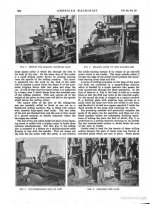
I really wish I knew!

In-house processes like that are are usually tightly held secrets and almost certainly lost once a company closes. We are not immune to this - we have to sign a non-disclosure agreement to protect company secrets as well!

As for your example, Kevin, I am going to forward the question and picture on to our chief metallurgist to see what he has to say.

Most vises on the market (both vintage and modern) are made with alloys that can be annealed before they are machined, so shrink rates will have no effect on the alignment of added parts (like jaw inserts).

Shrink rates vary depending on the alloy so I grabbed my AFS (American Foundry Society) manual to give some of the more common metal shrink rates. These numbers are used to determine how big of a riser is needed to feed metal into a casting as it cools. I might have to create an entirely new thread to cover all the nuances of metal casting :)

Volumetric Shrinkage Percentages from molten state to ambient:

Gray iron: 2%
Ductile iron: 2%
Ductile iron: (1" thick sections or smaller) 4% (this is news to me!)
White iron (chrome iron): 4.5%
Aluminum: 6.5%
Steel: 8-10%
Brass: 5%
Bronze (tin/copper): 6%
Bronze (Aluminum, Manganese): 10-12%

Brian
 
Last edited:

va.grouseman

Well-known member
Joined
Mar 26, 2011
Messages
4,965
Location
Southern-Central VA.
Originally posted by Rileysan.

That may very well be one of the worst (vintage) vise castings I have ever seen! It's full of voids that are likely the result of shrink, and the inside radius of the jaws look as if they were never cleaned or machined!
-----------------------------------------------------------------------------------------------------------------------------------------------------------------------------


Take a look at this complexion Rileysan.


Looks pretty bad, but a little JB Weld covers a multitude of sins.:lol:
 

Rileysan

Well-known member
Joined
Sep 11, 2015
Messages
4,298
Location
Milwaukie, Oregon
Originally posted by Rileysan.

That may very well be one of the worst (vintage) vise castings I have ever seen! It's full of voids that are likely the result of shrink, and the inside radius of the jaws look as if they were never cleaned or machined!
-----------------------------------------------------------------------------------------------------------------------------------------------------------------------------


Take a look at this complexion Rileysan.


Looks pretty bad, but a little JB Weld covers a multitude of sins.:lol:

Your vise is actually pretty nice - I don't see any voids caused by shrink. The surface defects are common, if not unavoidable. After "shake-out", castings are sent to a "cleaning room" where a grinder is used to clean off the rough edges, slag, and molding sand prior to annealing and machining. If necessary, castings are heat treated after machining.

All joking aside, using filler is exactly what most Chinese foundries do. Beware of painted, super-smooth vises!

Brian
 
Last edited:

macgee

Well-known member
Joined
Jan 11, 2014
Messages
2,834
Location
Sepulveda Pass, CA
Holy ****! That thing is amazing! Never seen a Paramo like that before.

I don't doubt that it is lighter than the standard 6" Paramo but it is certainly not lighter duty. That's cast steel rather than cast iron.

It's the same design as my Record 34P, which is also steel (verified by overdrilling a mounting hole -- long, continuous chips rather than cast iron swarf)

Thanks Ziggy for posting your nice vise, I never seen that model before.

You are correct about quality in the casting, they used spherical graphite (ductile) iron in this vise. I would love to find a Paramo No.0 with a swivel base.

I really wish I knew!

In-house processes like that are are usually tightly held secrets and almost certainly lost once a company closes. We are not immune to this - we have to sign a non-disclosure agreement to protect company secrets as well!

As for your example, Kevin, I am going to forward the question and picture on to our chief metallurgist to see what he has to say.

Brian

If I can add to the conversation, Athol also did an amazing job with attaching hardened jaws to their vice castings. The jaws are incredibly hard and tough. What's even more amazing is how well the jaws are lined up in both axis even after a hundred years of use. How they're able to attached the jaws in such a way to get the perfect alignment?

I'm with Kevin, It would be great to find out how they did it.

Here are three different Athol vise's:

25160501622_588914179b_c.jpg


24651965593_d025ed5767_c.jpg


25252508046_1e6b54b7e9_c.jpg
 
Last edited:

02superduty

Well-known member
Joined
Aug 3, 2014
Messages
136
Location
LI, NY
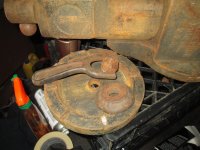
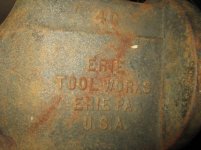
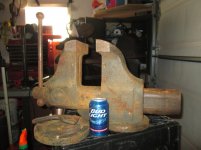
Picked this up today. It was on CL for 8 days (it was a poorly written ad). Finally had time to go look at it. WOW! Erie 4C 6" jaws, bolt through vise. Missing pipe jaws. Guy said it was going to scrap yard on Monday. Hopefully sunday I will have time to clean her up.
 

Attachments

  • IMG_2526.jpg
    IMG_2526.jpg
    143.1 KB · Views: 62
  • IMG_2525.jpg
    IMG_2525.jpg
    140.7 KB · Views: 73
  • IMG_2524.jpg
    IMG_2524.jpg
    145.6 KB · Views: 58
  • IMG_2523.jpg
    IMG_2523.jpg
    137.7 KB · Views: 73

Rileysan

Well-known member
Joined
Sep 11, 2015
Messages
4,298
Location
Milwaukie, Oregon
I got an unexpectedly fast response from our chief metallurgist. Here's what he had to say about the vises with jaws cast in place -


The picture in question shows a vintage bench vise with jaw inserts that appear to be cast into the larger casting. There are no fasteners of any kind and the two metals are disparate (the main casting is either gray or ductile iron and the jaw inserts are steel). If one placed a set of jaw inserts into a mold and pour around them, could you anneal and machine the jaws, then heat treat without affecting the bond between the two metals?

Brian


Brian,

There are even hammers for crushing material (big hammers hundreds of pounds). That are called bi-metal, they use a tough material in the shank and a harder material in the striking end. Some of these are only held together by the metallurgical bond. Two items have to work out for these parts. First is getting a bond in the first place. Oxides and the chilling effect of an insert can make this challenging. Next the trick is the heat treatment as you mention. Heating rates must be controlled to prevent delamination of the two materials but it is definitely possible. Large back up rolls for rolling mills are sometimes made from ductile iron cores and chrome iron working faces. Again the rate of heating is very critical. The final heat treatment issues is finding a heat treatment that leaves both material in the final desired condition. Luckily when gray iron is used it has limited response to any heat treatment so you just heat treat the steel and whatever the results in the gray iron is likely fine. Other alloy pairs can become more complicated.

Happy to discuss further if you like.
 

drivesitfar

Well-known member
Joined
Oct 23, 2013
Messages
36,032
Location
Pacific Northwest
Riley: thanks for the post. I'm still learning to speak METAL, but maybe before i die it will be better than my Spanish which was my second language in school. nicely done and thanks for the FACTS.

i'd love to see a few videos of this process.

02: nice save and how heavy is your early 1900's 4C? hard to believe some guys would scrap that. i do remember cleaning out a rental in my early 30's and a tenant left me 2 storage units worth of stuff and i left the Anvil in the garage when i sold the house because i couldn't lift it. sometimes heavy items don't agree with their owners and probably more than half the reason some of us find some great deals on these great old vises.

how much does your 4C weigh? more pictures when you spiff it up if you are going to would be great.
 

GETRIDAONE

Well-known member
Joined
May 21, 2013
Messages
1,549
Location
Auburn, GA
Rileysan, Thanks for your effort on the jaw question. :thumbup:
The hardened hammer head was a good example.
CRS, I remember seeing that article before and maybe that's where the jaw insert stuck in my mind.
 

Rileysan

Well-known member
Joined
Sep 11, 2015
Messages
4,298
Location
Milwaukie, Oregon
I just read through the brochures posted by Four.cycle and have concluded that Reed did NOT anneal their castings (soften the metal) prior to milling. Furthermore, I would conclude they did not heat treat the casting post-milling as they made it a point to place "tool steel" jaw inserts into the mold prior to casting. In short, if you're using tool steel, you don't wanna mess with it.

Here's the quote from the article:

"The preceeding methods will practically complete the parts of the plain vise for assembly, and these are now fitted together before the subsequent finishing operations of milling the jaws, the first of which is performed on a milling machine carrying on its spindle the two inserted-tooth cutters which finish the jaws to length.

Carbon steel is used for the inserts of these milling cutters because the jaws of these vises are formed of tool steel plates which are cast in place. These plates may act as chills on this portion of the casting and form hard spots. The result is rather destructive to milling cutters ..."

Brian
 

02superduty

Well-known member
Joined
Aug 3, 2014
Messages
136
Location
LI, NY
Thanks Drives 114lbs on my scale. Turns out this guy does cleanouts. He said he will call me from now on. Hopefully he does. I will try to clean it this weekend. I know you guys love your paint but I like em naked.
 

macgee

Well-known member
Joined
Jan 11, 2014
Messages
2,834
Location
Sepulveda Pass, CA
I just read through the brochures posted by Four.cycle and have concluded that Reed did NOT anneal their castings (soften the metal) prior to milling. Furthermore, I would conclude they did not heat treat the casting post-milling as they made it a point to place "tool steel" jaw inserts into the mold prior to casting. In short, if you're using tool steel, you don't wanna mess with it.

Here's the quote from the article:


Brian

Brian,

Thanks for your posting.

I do have a question, if they did use a (water or oil) hardened tool steel for the jaws. Wouldn't the bonding process (I'm assuming heat was used) to the cast vise effect the HRC of the tool steel (jaws) making the process defeat the purpose of using high HRC material?

Sorry if I'm asking a naïve question.
 

KMScott

Well-known member
Joined
Feb 14, 2012
Messages
4,642
Location
Daufuskie Island, South Carolina
Reed vise article also mentioned that they went to a cheaper carbon steel insert material so they could cut the faces parallel and maybe they case hardened the jaw faces for the final heat treating. They did not have carbide back then to cut hard toolsteel. Thanks Brian. Great stuff.
 

macgee

Well-known member
Joined
Jan 11, 2014
Messages
2,834
Location
Sepulveda Pass, CA
Reed vise article also mentioned that they went to a cheaper carbon steel insert material so they could cut the faces parallel and maybe they case hardened the jaw faces for the final heat treating. They did not have carbide back then to cut hard toolsteel. Thanks Brian. Great stuff.


That could make sense and would explain why the static & dynamic jaws line up so well and still be hardened.
 
Last edited:
To avoid these ads, REGISTER NOW!

drivesitfar

Well-known member
Joined
Oct 23, 2013
Messages
36,032
Location
Pacific Northwest
Slotard: the Parker jaws are the most expensive fix and it look pretty rough too. your call, but i'd pass and spend $200 on a nicer one.

02: in case you hadn't heard I love naked look when it's pertaining to vises and something else that is about 5'9". :beer:
 

macgee

Well-known member
Joined
Jan 11, 2014
Messages
2,834
Location
Sepulveda Pass, CA
http://sfbay.craigslist.org/nby/tls/5445752388.html what do people think of that? I know it's rough, but it doesn't seem outrageously priced. If it didn't have a corner of the end of the slide missing I'd almost certainly go buy it.

As tempting as that may seem, the back of the slide is broken off defeating all the needed effort to restoring that vise back into being presentable and useful. The dynamic jaw also has issues and the vise is missing two of the pipe jaws which are very pricey to replace if you want the correct ones. I highly recommend to pass.
 

slotard

Well-known member
Joined
Jun 21, 2012
Messages
137
Location
Alameda, CA
I'm curious as to how the slide there was broken. Seems like an odd place for a break to me. I also wonder how much it would impact function.

I could cut out a piece of steel of about the right thickness, clean everything up, braze it on, etc but of course at that point it wouldn't look quite right. As you say, other issues too.

I was thinking likely not worth it, just figured I'd ask.
 

CRSINMICH

Well-known member
Joined
Aug 15, 2015
Messages
2,405
Location
Southeastern Michigan
KMScott and Rileysan: If you guys pooled your talents and knowledge and then followed the directions in the American Machinist article, I'll bet you could build a Reed from scratch. What a thread that would be! Take lots of pictures. (Is there an emoji for "tongue-in-cheek"?)
 

slotard

Well-known member
Joined
Jun 21, 2012
Messages
137
Location
Alameda, CA
I've been watching CL for a while, I don't see many heavy duty vises around here other than people selling restored ones for significantly more than I'm looking to spend.
 

Outlawmws

Well-known member
Joined
Aug 9, 2011
Messages
39,266
Location
The Badlands
Slot :+1: on passing on that one. it's been posted before possibly more than once.
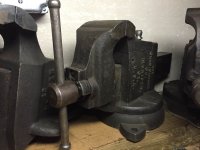
Broken slide, Brazed on jaws, missing Pipe jaws, If it was half or less, AND you were wiling to take on a challenge, maybe...

The slide damage was probably from being dropped. Not uncommon to see one broken that way and for a "user" it really doesn't impact use at all.

Too bad, it's hard to find that model of Parker. Many had the tall jaws broken.
 

drivesitfar

Well-known member
Joined
Oct 23, 2013
Messages
36,032
Location
Pacific Northwest
Outlaw: you might be correct that the Parker 288 and 288.5 are rare finding them not repaired or broken, but that might be the design that i've found dozens or maybe 50 of that all had broken off towers or slides. probably the reason I'm not a huge Parker fan even though i like yours and the others pristine ones.

so what i was saying to Slot was that a repaired Parker 288.5 might not have the value as maybe another vise that you can't even find broken like maybe an Emmert just to throw out a name where the repaired ones have some value.
 

slotard

Well-known member
Joined
Jun 21, 2012
Messages
137
Location
Alameda, CA
I'm not too concerned about value. Pipe jaws would be nice but not mandatory. Not really a big fan of how tall it is either but I'm sure it's nice sometimes.

Whatever I get will see some use but my fab work is hobby, not making money. It would be stored outside so not looking for something pristine. I have a 5" China vise that's adequate but I'd like something nicer.
 

macgee

Well-known member
Joined
Jan 11, 2014
Messages
2,834
Location
Sepulveda Pass, CA
I'm not too concerned about value. Pipe jaws would be nice but not mandatory. Not really a big fan of how tall it is either but I'm sure it's nice sometimes.

Whatever I get will see some use but my fab work is hobby, not making money. It would be stored outside so not looking for something pristine. I have a 5" China vise that's adequate but I'd like something nicer.

I think what people are trying to say is that because of the major issues with the vise that it may not be worth the investment in all the time needed to make it whole again and even then it may not work properly. To get jaws to fit properly on a Parker is from easy or typical.

Not sure if this is too far from you but there's a 5" Task Master in good shape for sale for $90. There are actually pretty good vise's, I wish I was closer. Ask Balane about them.

http://sfbay.craigslist.org/eby/tls/5465929895.html

00n0n_9nYec1Dj6Hw_600x450.jpg
 
Last edited:

slotard

Well-known member
Joined
Jun 21, 2012
Messages
137
Location
Alameda, CA
I saw that. I'm having trouble finding country of manufacture, I saw India somewhere but not sure if that's right. I'd rather go with US made (or Western Europe).
 

bareass172

Well-known member
Joined
Aug 5, 2012
Messages
817
Location
N'awlins
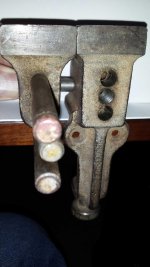
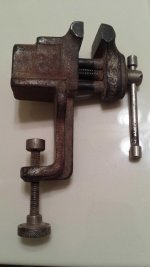
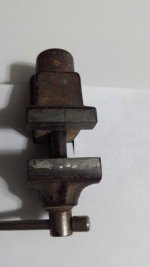
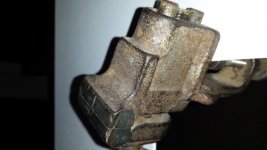
Can anyone ID this little clamp-on? Snagged it at an estate sale with a few other bits, nothing too special. In truth, I overpaid for this by a lot ($10) but I had a specific task in mind for it when I bought it so it was worth it to me.
Anyways, no identifying marks on it that I can find other than a single number "2" cast in the rib in the front. The camera flash really makes it show up well. No jaws per se, it's got some grooves on top from a saw/file.

Everything else in the place was all 30-40's era tools, the guy was 98 y/o, great stuff but all overpriced. You can see he was using it for woodwork so I need to give it a good cleaning. Pics make it look like multiple colors of paint, but the flash is just making colors come out that you don't see with the naked eye. Action on both sets of threads feels very smooth, even with all that sawdust and gunk, so I don't think it's junk!

As always, thanks in advance! :beer:
 

Attachments

  • vise7.jpg
    vise7.jpg
    146.3 KB · Views: 34
  • vise6.jpg
    vise6.jpg
    146.3 KB · Views: 39
  • vise5.jpg
    vise5.jpg
    139.4 KB · Views: 32
  • vise4.jpg
    vise4.jpg
    143.1 KB · Views: 35
  • vise3.jpg
    vise3.jpg
    136.9 KB · Views: 33
  • vise2.jpg
    vise2.jpg
    144.5 KB · Views: 33
  • vise1.jpg
    vise1.jpg
    143.5 KB · Views: 36

joe.striper

Well-known member
Joined
Sep 13, 2013
Messages
2,251
Location
agawam, ma
Got to love pickers. Went to buy this 3.5" Wilton bullet for $135 and then also picked up this 745 for $65. Sellers had all their vises setup for me. Saw this Yost (60) and this Athol and a few others but just picked up the two. Getting another Stephens tomorrow (100) and maybe a few more...

Sooo sad about this little Parker. Perfect but missing its jaw support. Soooooo sad. Original green paint.
 

Attachments

  • 20160226_164838-1.jpg
    20160226_164838-1.jpg
    145.7 KB · Views: 50
  • 20160226_164950-1.jpg
    20160226_164950-1.jpg
    150.6 KB · Views: 53
  • 20160226_164825-1.jpg
    20160226_164825-1.jpg
    151 KB · Views: 52
  • 20160226_164830-1.jpg
    20160226_164830-1.jpg
    149.1 KB · Views: 51
  • 20160226_170025.jpg
    20160226_170025.jpg
    153.4 KB · Views: 74
  • 20160226_165049-1.jpg
    20160226_165049-1.jpg
    149.2 KB · Views: 61

Fordriver6

Well-known member
Joined
Feb 6, 2016
Messages
200
Location
Afton, VA
Picked up two more vises tonight. First one is a Wilton C1. Regular and pipe jaws are present and in good shape. Only thing missing is the rear cap.
f3e585d4ee7d4177da806b921de657ec.jpg

3c099b080ff6250bb14e0479c22b6b58.jpg

79071b07392b6c2d775bcd524de56251.jpg

a1a344e1ba354d3dfcd6d45bac656b95.jpg


Next is a Parker 913 1/2. Still has the wrench for the swivel base. Jaws are in good shape on this one as well.
7f05eea7278caed157e01ea2ca91f7f6.jpg

3f994289f5b070957dc20e92517ef213.jpg

5d64d1d8a285c6e5d2864d49895d417a.jpg

0a7eafa21a08e43806c8b303ec43515c.jpg

1302edec576aa1d1f8ff4bccbae4fa46.jpg


Paid $300 total for both. Not a screaming deal but I don't think it's a terrible price. Especially considering that here in the mountains of Virginia these vises are few and far between. There are no really big manufacturing cities anywhere close and Richmond is over an hour and not a manufacturing city.

I'll do a restoration on the Parker and document it here and on the repair thread. Not sure what I'm gonna do with the C1 yet. Most likely plan is bolt it down and use it as is for a while.


Sent from my XT1080 using Tapatalk
 

joe.striper

Well-known member
Joined
Sep 13, 2013
Messages
2,251
Location
agawam, ma
Can anyone ID this little clamp-on? Snagged it at an estate sale with a few other bits, nothing too special. In truth, I overpaid for this by a lot ($10) but I had a specific task in mind for it when I bought it so it was worth it to me.
Anyways, no identifying marks on it that I can find other than a single number "2" cast in the rib in the front. The camera flash really makes it show up well. No jaws per se, it's got some grooves on top from a saw/file.

Everything else in the place was all 30-40's era tools, the guy was 98 y/o, great stuff but all overpriced. You can see he was using it for woodwork so I need to give it a good cleaning. Pics make it look like multiple colors of paint, but the flash is just making colors come out that you don't see with the naked eye. Action on both sets of threads feels very smooth, even with all that sawdust and gunk, so I don't think it's junk!

As always, thanks in advance! :beer:

Look at the nose. I believe this is a Millers Falls from up here in New England. Now, how about shipping me a gallon of some gumbo?
 

Rileysan

Well-known member
Joined
Sep 11, 2015
Messages
4,298
Location
Milwaukie, Oregon
Brian,

Thanks for your posting.

I do have a question, if they did use a (water or oil) hardened tool steel for the jaws. Wouldn't the bonding process (I'm assuming heat was used) to the cast vise effect the HRC of the tool steel (jaws) making the process defeat the purpose of using high HRC material?

Sorry if I'm asking a naïve question.

Not a naive question at all!

I would have assumed the same thing and therefore am surprised to read they used tool steel in the first place. Keep in mind that I am not a metallurgist and my expertise is limited to molds, molding materials, and the equipment used for the making of the molds. On a positive note, I am quite familiar with the process of chilling and directional freezing of castings, so I think I can make an educated guess as to why it doesn't affect the tool steel.

Iron has a relatively low melting point (compared to steel, anyways) and it's possible that the temperature never gets high enough to change the grain structure of the tool steel.

It's also possible that the tool steel is only affected a small distance away from the molten metal - leaving the finished jaw surface unhurt (this is my belief).

If neither of these scenarios worked, there are other things you can do to a mold that will flash freeze the molten metal including: using specialty sands like Chromite or Zircon, and adding brick-sized steel chills to the mold on both sides of the jaws. These solutions work great, but are expensive (and in the case of Zircon, you now have to deal with environmental issues because it is radioactive).

KMScott and Rileysan: If you guys pooled your talents and knowledge and then followed the directions in the American Machinist article, I'll bet you could build a Reed from scratch. What a thread that would be! Take lots of pictures. (Is there an emoji for "tongue-in-cheek"?)

Don't think this hasn't crossed my mind. I could easily get away with making my own mold and having it poured (we make big castings and deliberately melt 1-2k pounds more than is necessary), but our castings are made with metals that wouldn't work well for a vise (steel, manganese, and chrome-iron). Although Manganese would make a superior anvil ...:drool:

Brian
 
To avoid these ads, REGISTER NOW!
Top Bottom