To avoid these ads, REGISTER NOW!

Anyone know anything about these hay hoists?

6shooter

Well-known member
Joined
Nov 8, 2015
Messages
49
I've got this hanging in my barn, still haven't gotten around to getting 20 feet up on a ladder to remove it, so snapped a few pics the best I could. If it's not worth anything, I'll just hang it as a decoration when the barn is done. Anyone got any info on these? It's got probably 100 feet of 1" rope and 30' of rail still attached at the peak of the barn.


To avoid these ads, REGISTER NOW!

John in OH

Well-known member
Joined
Jun 2, 2007
Messages
2,444
Location
SE Ohio & Eastern Virginia
Very nice hay fork! I don't think I've ever seen a double-fork like this one.

Is it worth anything? Well, it's an obsolete harvesting tool, so it has no "useful" value, but as a historical artifact for preservation, it's quite nice. You could probably sell it as an antique to someone else that wants to display it in their barn, but you won't get much money for it as they are pretty common.

I'd suggest you do a simple restoration on it and hang it up in your own finished barn. It will look great!!
 
OP
6

6shooter

Well-known member
Joined
Nov 8, 2015
Messages
49
Thanks for the input, John. I wasn't sure if this was a double forked hoist, or just 2 that for some reason are hung on the same rope. I'll have to get around to removing it some day and restoring it. Maybe I'll find a name or patent number or something on it that will give me some more info.
 

John in OH

Well-known member
Joined
Jun 2, 2007
Messages
2,444
Location
SE Ohio & Eastern Virginia
Thanks for the input, John. I wasn't sure if this was a double forked hoist, or just 2 that for some reason are hung on the same rope. I'll have to get around to removing it some day and restoring it. Maybe I'll find a name or patent number or something on it that will give me some more info.

Well, I'm not positive that it's a double forked hoist either. It's possibly a pair of singles just hanging together. Kind of difficult to tell from the pics, but I can't tell why a pair would be hung from the single looped rope.
 

jakemac

Well-known member
Joined
May 21, 2013
Messages
9,035
Location
New England
Replace the rope before it rots and falls on someone, then turn it into a lamp for the barn.
 
To avoid these ads, REGISTER NOW!

B_Bimmer

Well-known member
Joined
May 7, 2015
Messages
1,871
Location
Eastern Iowa
Very nice hay fork! I don't think I've ever seen a double-fork like this one.

Is it worth anything? Well, it's an obsolete harvesting tool, so it has no "useful" value, but as a historical artifact for preservation, it's quite nice. You could probably sell it as an antique to someone else that wants to display it in their barn, but you won't get much money for it as they are pretty common.

I'd suggest you do a simple restoration on it and hang it up in your own finished barn. It will look great!!

Hey now, lets not jump right to obsolete. We still use ours of the curved fork variety to bring small round bales up into the mow... I love doing hay. One of the great memories I have of my grandpa on that side, now my dad is on the wagon, I still stack, just like I have since I was five. I like to think I'm a little more productive now though.
 

DieselSaves

Well-known member
Joined
Dec 9, 2012
Messages
848
Location
Big Sky Country
We have a few of those hanging around the place.

For what it's worth, before my time by a long shot, the empty hay wagons had a net spread over them. They went out into the field and were loaded with loose hay. Back at the barn, loaded with hay, under the roofs overhang, the corners of the net were gathered together around the hay making a basket. The rings on the nets corners were looped over the hooks of a trolley lowered from a rail running under the peak of the roof. The trolley had fixed hooks and hooks that would release.

After the net was hooked to the trolley, the whole works was lifted and run into the barn on the rail. Once over the stack, a rope was puller releasing half of the net and thus the hay onto the pile.

Your tools came into play when it was time to take a bit of hay out. The tongs were forced into the loose hay and handles were pulled up, bringing the ends of the tongs to right angles with the frame, facing each other, and thus catching some hay in the middle. Lift the aperatus up with the rope, swing to where you wanted it an release the ends of the tongs, loosing the hay.
 

John in OH

Well-known member
Joined
Jun 2, 2007
Messages
2,444
Location
SE Ohio & Eastern Virginia
Thanks for the input, John. I wasn't sure if this was a double forked hoist, or just 2 that for some reason are hung on the same rope. I'll have to get around to removing it some day and restoring it. Maybe I'll find a name or patent number or something on it that will give me some more info.

Found this pic on the internet ... note the double-fork!!

$$ _a Hay Loader 7.jpg
 

John in OH

Well-known member
Joined
Jun 2, 2007
Messages
2,444
Location
SE Ohio & Eastern Virginia
We have a few of those hanging around the place.

Yep, the fork is still hanging in one of my old barn also.

When I was a kid, my Dad and uncle would load the loose hay in the field onto a wagon using a hay loader. The hay loader was a sort of walking stick/rack device that was hitched behind the wagon. As the tractor ('41 Ford 9N in our case) pulled the wagon and loader down the windrow, the loader conveyed the loose hay from the windrow up onto the wagon. My uncle drove the tractor, my Dad stacked the hay on the wagon to maximize the load size, and I got in the way.

But sometimes, if the windrow was straight and the field level, I got to drive the tractor!! Hot damn!!

This isn’t a pic of ours, but it’s very similar to how it looked and was done!

$$ _a Hay Loader 2.jpg

Once the wagon was full, the loader was unhitched and the wagon pulled to the barn. We had two barns, one a bank barn where you backed the wagon into the barn, and the other smaller barn you loaded from the end. These were both old style barns with cavernous hay mows.

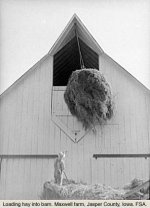
The hay fork was thrust down into the loose hay on the wagon and the fingers on the fork tangs were extended to “grip” the hay. The big rope on the hay fork was tied to the drawbar of a ’47 Allis-Chalmers B tractor which was then used to lift the bundle of hay via the fork. The fingers on the fork, though only a few inches long, would keep the hay bundle from slipping off the tangs. The fork and its bundle of hay then rolled along a monorail taking it back into the mow. When in the right location, a small pull rope was used to manually trip the fingers closed and the hay would slide off the fork. Then the hard work began!

Since the hoist fork ran on a single monorail through the center of the barn, it couldn’t drop the hay into the sides or corners of the mow. This had to be done by hand using a pitch fork.

These are stock pic off Google that show the concept of how the unloading was done. In our case, substitute tractors for the horses.

$$ _a Hay Loader 4.jpg $$ _a Hay Loader 5.jpg $$ _a Hay Loader 6.jpg

Putting up loose hay was hot, dusty, and extremely hard work. I think it was about 800 degrees F in those hay mows in the summer. It took several weeks each summer to fill those barns. I was about 10 years old and totally thrilled when Dad finally got a baler!! As a kid I hated putting up hay, but fond memories now.
 
To avoid these ads, REGISTER NOW!
Top Bottom