To avoid these ads, REGISTER NOW!

Brand new metal garage leaking at base rails

ukiltmybrutha

Well-known member
Joined
Apr 23, 2016
Messages
683
Brand new metal garage leaking at garage doors

OLD SUBJECT WAS BRAND NEW METAL GARAGE LEAKING AT BASE RAILS...I AM NOT SURE IT EVER LEAKED AT THE BASE RAILS AT THIS POINT...WAS PROBABLY AN ILLUSION.

I just had a company install a 2 car metal garage on top of a concrete slab that I had poured for that purpose.

I have been lurking for a while and know that this is a cheap setup, but I'd rather have than have not.

I waited for a rainstorm to see if I had any leaks and sure enough there is water intruding at the rear base rails for the entire rear wall of the garage and slightly up the rear sides.

I didn't know what base rails were before having this thing installed and on the contract it said not responsible for leaks around base rails.

I have done some reading and noticed that the slab shouldn't be much bigger than the garage.

Unfortunately the slab is 1 foot longer than the garage in the rear and this is the area where the water is coming from.

It's not like a torrent of puddles or anything, but I don't know how much worse it will be during a heavy rain.

The slab is not perfectly flat and is slightly slanted downwards to the rear so that the water should be flowing away from the garage. (Not intentionally but this should work in my favor).

Maybe some outdoor specific caulk might work or at least help?

What sort of caulk should I buy? I am sure that is not the end all solution, but really want to know what sort of caulk might work best in this application.

Also, would I caulk the inside or the outside. Googling this thing has yielded ambiguous results. Some say inside and others say outside.


Thanks


Last edited:
To avoid these ads, REGISTER NOW!

8mpg

Well-known member
Joined
Jul 9, 2012
Messages
350
Any quality outdoor caulking will work. Id recommend NP1
 

readhead

Well-known member
Joined
Dec 8, 2012
Messages
6,181
Location
Durango, Co.
It is going to be difficult to maintain a seal between the sheet and concrete and it will look like hell. It won't take long to remove the corner trim and screws in the bottom sheet. Caulk the joint at the tube to the concrete. Replace the screws carefully so they don't strip out. The sheet will protect the caulk from the sun and it will look like nothing happened.
 

lakeroadster

Well-known member
Joined
Jan 19, 2015
Messages
5,166
Location
Central Colorado
What's your location?

Simply put: As is, it is a bad design. Ideally there would be a stem wall or a pressure treated sill plate, for the building to set on.

For a flat slab, such as yours, some type of mastic or seal placed under the bottom rails, between the steel and the concrete would be better than nothing. But that will still leak some.

Slathering caulk on the outside will help, kind of, but you'll be battling it the rest of your life.

Long term: you could modify it by adding metal flashing as shown below. You don;t have to add the sill plate, but if you don't I see a rusted out bottom rail in your future.

Note that you'll have to lower the overhead door to compensate for the sill plate.

 
Last edited:

jhelrey

Well-known member
Joined
Sep 15, 2010
Messages
7,251
Location
MN
I'd put the caulking on the inside personally or unbolt the entire garage and carefully lift each side up an inch to run a bead of caulking and then set it back down on top of it.
 
OP
U

ukiltmybrutha

Well-known member
Joined
Apr 23, 2016
Messages
683
Thanks for being very helpful!

I guess that I have enough to go on here. I will probably start off with the least intrusive and work my way up if needed since I am new at this.

I'll post back in a while (it might take a while) to let you all know how it went.

One thing that was mentioned on another forum I frequented was to caulk on the outside just in case water did make it's way inside I'd at least give the water a chance to flow back out in an effort to minimize corrosion.

If the outside doesn't work, maybe I could caulk the inside....or maybe both inside and outside?
 

Toolfool

Well-known member
Joined
Aug 22, 2011
Messages
4,982
Location
Tallahassee, FL
The idea is to not let water inside in the first place. Best solution is to get custom-made flashing as posted by lakeroadster. If that's too much for you, pick up some butyl caulking and apply a generous bead along the outside edge , when it's dry , being sure to "finger" it into a coved profile to ensure full contact with siding and concrete (wear gloves and use a tongue depressor).
 

Radix2

Well-known member
Joined
May 28, 2014
Messages
1,853
Location
the thumb!, MI
I would pry the base rail up and insert some foam sill seal - not so much for the sealing effect, but to get the metal off of the concrete to reduce corrosion. Or any other non corrosive/non rotting plastic material.
 

matt_i

Well-known member
Joined
Mar 14, 2008
Messages
10,728
Location
SE Michigan
The pressure treated wood could very easily corrode the base rail. It would take awhile, but hot dipped galvanized fasteners are "better" for pressure treated (ss = best) wood apps. I see an electro-galvanized base rail there.

If you could get under the bottom row of trim, a roofing sealant would be really good. I agree with the counter-flashing, to protect the caulked interface. One could theoretically collect a pile of some roofing granules and embed in the wet sealant to help promote solar resistance, but the roofing caulks are going to be jet black and a stark contrast with the building.

While time-consuming, grinding the slab to a greater taper would also be a good step in the right direction = let water go to a lower place.
 

tinmanwpk

Well-known member
Joined
Oct 21, 2015
Messages
442
Location
Jacksonville
Dealing in metal fabrication for my company, I would have done exactly what lakeroadster showed. In addition, I would have used a white (or I have seen green color, too) foam topping between the sill plate and the metal framework.

Oh, and take a good look at the bottom of the flashing. It has a little kick to it and is called a drip edge. It only kicks out about a quarter inch, but the surface tension of the water will otherwise make it "stick" to the metal flashing and possible wick back upwards toward your metal building. Be sure to include that drip edge.

Good post, lakeroadster.
 
Last edited:

SALIV8

Well-known member
Joined
Dec 11, 2008
Messages
2,114
Location
chicago and s/w michigan
If you decide to caulk the base, I highly recommend a primer first. You will have to call around to find a place that carries it, but it will be well worth it.

The primer is brushed on and allowed to dry before the caulk. It essentially allows a perfect seal then. the caulk seal will not last as long if you skip this.
 

rburke65

Well-known member
Joined
Nov 10, 2007
Messages
12,349
Location
Canfield, Ohio
I would vote for the flashing also. Under the metal, out across the concrete pad and then down the side of the pad. Hopefully the outside grade is below the garage....hopefully the garage is HIGHER than the surrounding area.
 

Kilo70

Well-known member
Joined
Nov 12, 2007
Messages
158
Would it do any good to cut the extra concrete off and use flashing?
I don't know about any of this, purely curious.

Sent from my SM-T520 using Tapatalk
 

CJ7VFR

Well-known member
Joined
Jan 13, 2015
Messages
2,939
Location
Central New Jersey
If you went with flashing, is the metal siding of the garage easily removable? You would have to remove the lower section of the siding in order to put the flashing in place, and then re-install the siding. Also, you will have to do some fancy bending of the flashing since your concrete foundation sticks out a bit from the garage, and the flashing will need to go all the out and over the end of the concrete.

If that is not an option, then paint/caulk would be the easiest way to go. As others have said, you would be doing this every few years, but so what? You have to do the same thing with houses, where you put caulk around doors and windows where the siding meets up with the brickmold and trim.

Jim
 
OP
U

ukiltmybrutha

Well-known member
Joined
Apr 23, 2016
Messages
683
You all are awesome! The pad itself is on an incline actually. The back of the slab is lower than the front and so is the surrounding area. As a matter of fact the lowest point is the left rear (looking to the left from the inside). This might explain the presence of more moisture there.

If I am going to do anything that involves unbolting and lifting, how heavy are things going to be? I am not HE MAN and I'd have to go it alone. :(

As to the flashing, the diagram is excellent, but my understanding is slow at times. :)

I am having the same company put down one more similar single car garage as well.

What should I be asking them for this time around? They have offered to do the caulking for this garage when I have the other one put down....but they really made me twist their arm as in I'll cancel my new order if you don't resolve the previous issue. I think that they should be providing the caulk at minimum....but that is just me. Then again, I am sure that I'd be inclined to do a better job than these guys....but who wants to put their own time into that? I have a million other projects.

Is it pretty common in a contract for a company to refuse to cover leaking below base rails in the contract? As Joe consumer, I'd have to admit that I am a bit surprised. I'd figure that due diligence by the installer would have avoided this.

CJ7VFR....looks like we posted at around the same time.
 
Last edited:
To avoid these ads, REGISTER NOW!

CJ7VFR

Well-known member
Joined
Jan 13, 2015
Messages
2,939
Location
Central New Jersey
Is it pretty common in a contract for a company to refuse to cover leaking below base rails in the contract? As Joe consumer, I'd have to admit that I am a bit surprised. I'd figure that due diligence by the installer would have avoided this.

The garage company can't guarantee a leak free floor because they have no way to tell if the floor, which they did not put down, is completely level and flat where their bottom rail sits.

Any slight imperfections in the concrete will allow water to move under the bottom rail and into the garage.

Does the building company show any type of seal or similar item that they can install on the bottom rail, like a gasket, that is made to help with water? Or was that not an option?

Jim
 
OP
U

ukiltmybrutha

Well-known member
Joined
Apr 23, 2016
Messages
683
The garage company can't guarantee a leak free floor because they have no way to tell if the floor, which they did not put down, is completely level and flat where their bottom rail sits.

Any slight imperfections in the concrete will allow water to move under the bottom rail and into the garage.

Does the building company show any type of seal or similar item that they can install on the bottom rail, like a gasket, that is made to help with water? Or was that not an option?

Jim

I see, thanks. I wasn't given that option. It was never discussed with me. Both the dealer and building company have been very casual as in...go ahead and throw some caulk there and you will be fine (easy for them to say)...which I am not vehemently opposed to so long as it works....but I have been on this planet too long to not be a bit worried. :)

Most of their efforts were on upselling other elements of the garage....but not elements of the base rails.

I tend to agree with the caulking every few years remedy since it is the least intrusive and requires the least effort. You have valid points. Posters here have come up with a few nifty brands as well....some of which can be applied wet (although that is probably not the best idea). I like the idea of priming before I caulk....or at least using some brake clean.

I am slightly concerned about the area around the expansion joint on the slab as a poster previously mentioned.
 
Last edited:

KenC

Well-known member
Joined
Dec 20, 2009
Messages
2,590
Location
oklahoma
I have the same issue. My plan, when I get to it, is to remove the nuts on the anchor bolts and lift the base plate off the concrete about 1/4". Once up, I'll put a generous bead of Urethane caulk down and lower the building in place and replace the nuts.

I'm hoping a long heavy steel pry bar can handle the lift. If not, then I can fab an adapter for a jack to drive under the base and hook on the jack.
 
OP
U

ukiltmybrutha

Well-known member
Joined
Apr 23, 2016
Messages
683
I have the same issue. My plan, when I get to it, is to remove the nuts on the anchor bolts and lift the base plate off the concrete about 1/4". Once up, I'll put a generous bead of Urethane caulk down and lower the building in place and replace the nuts.

I'm hoping a long heavy steel pry bar can handle the lift. If not, then I can fab an adapter for a jack to drive under the base and hook on the jack.

Very neat idea. I wonder if more than one prybar would be needed depending on the width and or if the garage might sway on the jack if it is too wide. Also wondering if the prybar would get in the way of the bead...perhaps it would be better to put the prybar on the inside?

Do you plan on caulking the entire garage or just the effected areas?
 

txbonds

Well-known member
Joined
Jun 11, 2014
Messages
276
What's your location?

Simply put: As is, it is a bad design. Ideally there would be a stem wall or a pressure treated sill plate, for the building to set on.

For a flat slab, such as yours, some type of mastic or seal placed under the bottom rails, between the steel and the concrete would be better than nothing. But that will still leak some.

Slathering caulk on the outside will help, kind of, but you'll be battling it the rest of your life.

Long term: you could modify it by adding metal flashing as shown below. You don;t have to add the sill plate, but if you don't I see a rusted out bottom rail in your future.

Note that you'll have to lower the overhead door to compensate for the sill plate.


***** but this is exactly what I was thinking it needed. Sill plate to stop rust/corrosion and flashing to route water off slab. Good luck with it.
 

lakeroadster

Well-known member
Joined
Jan 19, 2015
Messages
5,166
Location
Central Colorado
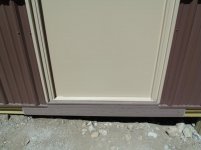
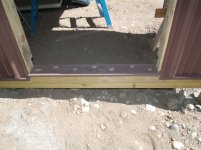
Consider a piece of composite decking board instead of pressure treated wood. It won't rot, it is more dense, and it looks better.

I used a piece this weekend as the sill plate for the man door of my barn.
 

Attachments

  • Outside Lower.jpg
    Outside Lower.jpg
    64.8 KB · Views: 129
  • Sill Plate.jpg
    Sill Plate.jpg
    112.9 KB · Views: 128

K'ledgeBldr

Well-known member
Joined
Aug 22, 2011
Messages
1,925
Location
Johns Creek, GA
I'm going to take the "Devil's Advocate" approach here...

I see two problems; or let's say there's "a" problem depending on which side of the fence you're on. One being if the building is sold in a particular size, why wasn't the slab constructed to that size? The other, if the slab was "pre-existing" why wasn't the building built to the size of the slab?

Ok; on to "better building techniques". On the next build lower the perimeter of the slab 1-1/2"X the width of the metal frame/channel. This will create ledge for the wall structure to sit on- and you'll never see water on the floor from the bottom of the wall.

For your current condition; yes I agree, caulk will be your best non-evasive cure for the problem. The question is which caulk...

Dow 790
http://www.siliconeconcepts.com/Category Data/Dow Corning/Weather Sealants/790.pdf

I did see a mention of NP1- yes, it's good stuff but it doesn't really compare to the Dow.
 

Moose97

Well-known member
Joined
Jul 11, 2013
Messages
2,802
Location
North Central Texas
What's your location?

Simply put: As is, it is a bad design. Ideally there would be a stem wall or a pressure treated sill plate, for the building to set on.

For a flat slab, such as yours, some type of mastic or seal placed under the bottom rails, between the steel and the concrete would be better than nothing. But that will still leak some.

Slathering caulk on the outside will help, kind of, but you'll be battling it the rest of your life.

Long term: you could modify it by adding metal flashing as shown below. You don;t have to add the sill plate, but if you don't I see a rusted out bottom rail in your future.

Note that you'll have to lower the overhead door to compensate for the sill plate.


This is your "best" fix. Caulk is the "quick" fix but you'll be back at it later.
 

readhead

Well-known member
Joined
Dec 8, 2012
Messages
6,181
Location
Durango, Co.
In the sketch above there is no reason to add the treated sill. Galvanized framing is placed on concrete every day. The sketch looks nice but there is actually 12" of horizontal concrete to cover. If the OP is ok with that then it is a good solution. Another thought would be to cut 9-10 inches of concrete off to make the flashing look like the sketch.
 
OP
U

ukiltmybrutha

Well-known member
Joined
Apr 23, 2016
Messages
683
I'm going to take the "Devil's Advocate" approach here...

I see two problems; or let's say there's "a" problem depending on which side of the fence you're on. One being if the building is sold in a particular size, why wasn't the slab constructed to that size? The other, if the slab was "pre-existing" why wasn't the building built to the size of the slab?

Ok; on to "better building techniques". On the next build lower the perimeter of the slab 1-1/2"X the width of the metal frame/channel. This will create ledge for the wall structure to sit on- and you'll never see water on the floor from the bottom of the wall.

For your current condition; yes I agree, caulk will be your best non-evasive cure for the problem. The question is which caulk...

Dow 790
http://www.siliconeconcepts.com/Category Data/Dow Corning/Weather Sealants/790.pdf

I did see a mention of NP1- yes, it's good stuff but it doesn't really compare to the Dow.

The dealer told me to pour the slab that size. Thanks for the Dow 790 link.
 

minytrker

Well-known member
Joined
Sep 19, 2012
Messages
1,390
Location
Brenham TX
I have a building like that (24x40) and built my slab the size they gave me and dont have any concrete exposed like that. Even though I dont have the water issues your having I plan on caulking around the inside of the floor with the dow 790.
 

CNGsaves

Well-known member
Joined
Sep 26, 2012
Messages
13,233
Location
KS and OK
IDEA: Jack up whole building and put in "plastic wood" sill plate . . .
. . . . . . . . like 1x4 Trex or whatever gets you out to edge of concrete slab.

Router the entire Trex "board" so that it has slope out to edge of concrete.

Install drip edge flashing as needed to improve water shedding out to edge. Better yet, bend custom flashing that directs water all the way to edge.

Caulk top & underneath Trex with the Dow caulk as building is re-secured.

/ . 02
 

pmiranda

Well-known member
Joined
Jul 15, 2008
Messages
1,504
Location
Austin, TX
I would pry the base rail up and insert some foam sill seal

This, assuming the sill seal is waterproof. I'd also caulk the outside with a UV stable compound that is meant to work with concrete and steel. Of course, if you have runoff onto the slab from the surrounding area it will find a way in.

Flashing would normally make the most sense but that's a large distance from the wall to the edge of the slab :(
 

T_R

Well-known member
Joined
Jul 2, 2015
Messages
902
Location
Maine
I would get or rent a concrete saw and cut the slab as close to the building as possible. Then I would lift the building and put sill seal under it or caulk under the bottom rail. Finally a step flashing under the siding and over the concrete will help.

With no gutters you will always get some backsplash up under the sills no matter how careful you are. I get it in my garage in heavy rain storms. It's just some dampness, not puddles or a river.
 
OP
U

ukiltmybrutha

Well-known member
Joined
Apr 23, 2016
Messages
683
So on the Dow 790...how many tubes do you all suggest? Should I just go around the back of the garage and a bit up the sides....or do the entire garage bottom?

The Dow 790 costs a bit from what I notice, so I want to make sure that I get it right.

Not ignoring the other solutions, but starting off here.

Thanks
 

bandaidmd

Well-known member
Joined
Feb 15, 2014
Messages
76
Location
Delmarva side of Md.
a couple people have suggested cutting off the slab which definitely would work but you may be ok just taking a concrete saw and cutting a drain slot right next to the base. A slot should break up the wicking action and with caulk may do the job.
 

cory58

Well-known member
Joined
Dec 23, 2015
Messages
234
Location
Charlotte, NC
The dealer told me to pour the slab that size.

That's a bummer. I ordered a building from Capitol Buildings here in NC. I wanted to pour the slab bigger than the building footprint. They STRONGLY discouraged it. The permit plans they sent specd the pad the exact size of the building. The told me that lapping the walls over the edge of the slab is the only way to keep it from leaking like yours eventually.

Cory
 

SALIV8

Well-known member
Joined
Dec 11, 2008
Messages
2,114
Location
chicago and s/w michigan
So on the Dow 790...how many tubes do you all suggest? Should I just go around the back of the garage and a bit up the sides....or do the entire garage bottom?

The Dow 790 costs a bit from what I notice, so I want to make sure that I get it right.

Not ignoring the other solutions, but starting off here.

Thanks

I would buy the sausage tubes (larger soft tubes) and buy the proper caulk gun for this. then you want to buy a few extra nozzles as you will be able to cut the nozzle to the size you want. And I would primer before the caulk. Good luck.
 

jgorm

Well-known member
Joined
Jan 5, 2015
Messages
463
Location
San Diego
You need flashing.

This^
You will never win this battle. My last shop was like this. If ANY water sits on the concrete, it will eat away at whatever sealant that you try to use. I did calking first, then henry's roof tar when that failed. Then I put more henrys over the part that failed, to try and build a slant to it. Then I cut grooves in the concrete with a diamond blade to try and get the water farther away. I finally solved it when I moved.:)

You need to add flashing to the edge of the concrete.
 
To avoid these ads, REGISTER NOW!
Top Bottom