To avoid these ads, REGISTER NOW!

Some more Oxy/Acetylene questions

gdocktor3

Well-known member
Joined
Apr 18, 2015
Messages
5,419
Location
Connecticut
I apologize, but I can't find the answers to a few questions. First let me explain, I am a weekend warrior, not a pro. I've never cut or welded with an oxy/acetylene torch, but have used acetylene quite a bit as I am a plumber by trade. Totally different I know, but I have the respect for the potential danger. Anyways, I have a B tank, 40 cu ft oxy tank, a Smith cutting torch, brand new hoses, and a few oxy gauges, all of which I obtained for free. I have been looking for a good gas regulator, but want to know what the difference is between Victor, Smith etc regulators? Why do the regulators differ and why are their different types? Wouldn't any "type" gauge/regulator work with any correclty sized tank and hose setup, or are they specific for the type torch you are using? Do I need a matching acetylene regulator for my oxy regulator? Because I won't have much use for this, I'm not about to spend $300 on one gauge, but I don't want to kill myself either. I was looking to pick up a cheap Miller, Hobart, or Purox off eBay. Also, should I find a deal on a full size or MC tank regulator, will an using an adapter to the B tank cause any problem? I appreciate any info. Thanks, Glenn
 
Last edited:
To avoid these ads, REGISTER NOW!

trackwelder

Well-known member
Joined
Jun 22, 2005
Messages
2,608
Location
n.y
You can use any acetylene brand gauge no need for a matching set. Can you post some pictures of what you have.
 

Zeke

Well-known member
Joined
Aug 13, 2009
Messages
17,176
Location
Long Beach CA, the sewer by the sea.
You may want to have any 'free' gauges checked out. At the very least, set up your outfit and run each gas separately while adjusting the gauge. You know to do this outside with a breeze. If there are any pulses, the gauge is done.

What can happen with an acetylene gauge is that someone may have let some of the tank contained acetone into the gauge diaphragm. I did this once and it certainly sent my gauge out to be rebuilt.

Don't buy a large capacity gauge if you're gonna use mostly small tips and not do much cutting. The big ones don't adjust in the low pressures as accurately. Maybe some do, my large capacity gauges don't. They are a good brand. So I keep 2 sets around.
 

Steve from Socal

Well-known member
Joined
Jan 27, 2009
Messages
3,513
Location
Hutchinson Ks.
Before you go too far, read up on withdraw rates of acetylene. A "B" tank is not good for a cutting torch. If you only plan on cutting with oxy/ fuel consider propane.

Steve
 

taumac

Well-known member
Joined
Aug 30, 2011
Messages
8,104
Location
Brooksville, Fl
I'll be honest with you is that my feeling with O/A is anything used you would want to have check out by a local welding shop. I've seen many sets on CL but not knowing how someone maintain there torchs scares me. I was testing out a set for friend he got for free and torch had some leaks in O rings in torch head and regs worked but not great. I was looking for set myself but after using a old used set I ended up buying a whole brand new set up from Tractor supply that came with torch, hoses, reg and small tanks on sale for $319.
Here's the link.
http://www.tractorsupply.com/tsc/product/gaspony-1-complete-portable-tote-outfit-with-cylinders
Even though it say gas pony my set everything was Victor. I figure the tanks alone if had to buy was 2/3 the price than throw in torches, reg and hoses was well worth it and piece of mind.
 

lukedwag

Well-known member
Joined
Aug 5, 2007
Messages
202
what's your intended use ?

I personally prefer propane but that's me and I grew up on it. Larger regulators are supposed to be more accurate and flow more. I prefer Harris but it honestly doesn't matter much. Harris torches are much nicer then Victor IMO.

Look up the regulator part numbers to check there rated pressures.
 

taumac

Well-known member
Joined
Aug 30, 2011
Messages
8,104
Location
Brooksville, Fl
Before you go too far, read up on withdraw rates of acetylene. A "B" tank is not good for a cutting torch. If you only plan on cutting with oxy/ fuel consider propane.

Steve


Very true and he also has to make sure his reg and hoses are able to run propane. He might have acetylene only hoses and regs.
 

kkroger

Well-known member
Joined
Apr 21, 2013
Messages
1,143
Gauges usually tend to hold up well, Mine I think I have a Victor Oxy and a Smith Acetylene, are pretty old... and the previous owners did not treat them very well. but they are old... The Diaphragms in the regulators can deteriorate with time. But most everything can be rebuilt or replaced with a trip to your LWS...
 

rharman

Well-known member
Joined
Apr 22, 2012
Messages
8,911
Location
SoCal
You may want to have any 'free' gauges checked out. At the very least, set up your outfit and run each gas separately while adjusting the gauge. You know to do this outside with a breeze. If there are any pulses, the gauge is done.

What can happen with an acetylene gauge is that someone may have let some of the tank contained acetone into the gauge diaphragm. I did this once and it certainly sent my gauge out to be rebuilt.

Don't buy a large capacity gauge if you're gonna use mostly small tips and not do much cutting. The big ones don't adjust in the low pressures as accurately. Maybe some do, my large capacity gauges don't. They are a good brand. So I keep 2 sets around.

Where did you get your gauges rebuilt. We're in the same general location and I have a set of 40 year old Victor that I'd like to get checked out.

Thanks.
 
OP
G

gdocktor3

Well-known member
Joined
Apr 18, 2015
Messages
5,419
Location
Connecticut
My uncle is a retired iron worker and gave me some of his extra stuff. The rest I picked up elsewhere. He also told me about propane, but because I have two b tanks and he had all the stuff for acetylene I figured just to stay with it. I'm not a welder/fabricator so I may never use it for cutting, or I may need it in a few weeks. Whatever and whenever the time comes, atleast I'll have something and I'll be able to get it done. I'm not going to spend big bucks on a propane setup when I really don't need it. It will mostly be used for heating stuck/frozen fasteners and stuff like that, but still have the option to cut if needed. I'm not going to be cutting 4" thick steel plates or anything like that. Nuts, bolts, fasteners, etc.

But my real question is why do people advertise regulators as working with victor or smith type setups? It would make sense if a victor Reg worked better with victor torch/tips or something, but this is not true, right?

Now, why isn't a "b" tank good to use for cutting? Because it's small and I will run out? An MC tank, B tank or full size will still put out the same pressure as long as the regulator is set correctly, no?

Has anyone used the firepower oxyfuel torch setups? I thought maybe if I found one cheap I could just buy one of those to ensure everything is up to par.
 
Last edited:

akalian

Well-known member
Joined
Apr 27, 2016
Messages
355
Location
St. George Utah
The size of the tanks has no bearing on the cutting ability of an O/A setup. It's the gas pressure and tip size that determines that. Any setup whether it be the small carry around setup of the largest ones deliver the same amount of gas at specified pressures. The only difference is how long the gas will last. Think 55 gal bucket, vs 5 gal bucket.

The regulators are interchangeable as well with the exception of the smallest portable setup. If the fittings on the regulator match the threads on the tanks you can mix and match to your hearts content and you can also mix and match torches as well. Harris torches will work with Victor regulators, no problem.

But I wouldn't recommend you do that. You need to be aware that if acetylene for any reason exceeds 15 psi, you are dead. There are countless videos on YouTube showing the explosions that happen if you are not careful.

Almost every welding supply place has a picture of a station wagon or car with the windows blown out due to somebody laying the acetylene tank on it's side. The regulators, the hoses, and the torches all have to be in good working condition. Any failure in any of the parts, will ruin your day.

Anytime you buy anything used, you have no history of how they rig was maintained. It's a **** shoot, and it might work out, then again you might end up dead. I've never bought a used set of O/A anything. Granted it's going to cost you maybe $500 to get a mid range setup but it will last a lifetime, with very little, if any maintenance.

I'm sure there are many people that have bought used O/A equipment and have had good luck and no problems. Me, I wouldn't chance it.

.
 
Last edited:

Buckgnarly

Well-known member
Joined
Oct 8, 2010
Messages
7,655
Location
VT
The size of the tanks has no bearing on the cutting ability of an O/A setup. It's the gas pressure and tip size that determines that. Any setup whether it be the small carry around setup of the largest ones deliver the same amount of gas at specified pressures. The only difference is how long the gas will last. Think 55 gal bucket, vs 5 gal bucket.

.

Bad advice, tank size has a lot to do with what you can use with it. Look up the 1/7 rule, a small tank will not safely support large cutting tips or rosebuds.

http://www.thefabricator.com/article/safety/fuel-your-safety-knowledge
 

Steve from Socal

Well-known member
Joined
Jan 27, 2009
Messages
3,513
Location
Hutchinson Ks.
Before anybody spouts off with more bad advice please read the link Buckgnarly posted above. I didn't have time last night to find a link when I posted.

A large rosebud is just as dependent on withdraw rate as a cutting torch

Steve
 

akalian

Well-known member
Joined
Apr 27, 2016
Messages
355
Location
St. George Utah
Bad advice, tank size has a lot to do with what you can use with it. Look up the 1/7 rule, a small tank will not safely support large cutting tips or rosebuds.

http://www.thefabricator.com/article/safety/fuel-your-safety-knowledge

Well lets get real here for a moment. The OP didn't say he was building an oil tanker and wanted to hook up a lance to a set of B tanks to a to cut some 12" plate. But yes you are correct in that if you get an O/A rig you need to gain some knowledge regarding flow rate, sizing etc.

Somehow I don't think he would probably never cut anything thicker than 1/2" plate, if that. My point was that it really wouldn't matter what rig he got from a small portable, a Performer to a Journeyman setup would probably suit his needs.

But what was important was that the equipment be in good working condition, and that's something you can never be sure about, buying used equipment, whether it be the tanks, the regulators, the torches or the hoses. Especially the tanks. Buying a used acetylene tank without know the last testing date is not wise. At least when you get a new rig from the welding supply house you will know that the tanks have been tested and rebuilt with new O-rings if necessary. With used tanks, you have no clue. A leaky oxygen tank just costs money to refill it. A leaky acetylene tank could cost much more.

The only way I would buy used tanks, is that I would take them right away to a welding supply and swap them out for filled ones. I would never consider using them.
 
Last edited:

MoonRise

Well-known member
Joined
Nov 5, 2010
Messages
4,031
Location
NJ
My uncle is a retired iron worker and gave me some of his extra stuff. The rest I picked up elsewhere. He also told me about propane, but because I have two b tanks and he had all the stuff for acetylene I figured just to stay with it. I'm not a welder/fabricator so I may never use it for cutting, or I may need it in a few weeks. Whatever and whenever the time comes, atleast I'll have something and I'll be able to get it done. I'm not going to spend big bucks on a propane setup when I really don't need it. It will mostly be used for heating stuck/frozen fasteners and stuff like that, but still have the option to cut if needed. I'm not going to be cutting 4" thick steel plates or anything like that. Nuts, bolts, fasteners, etc.

For heating or cutting, the current 'trend' is to use oxy-fuel, more specifically oxy-propane. Because of the expense and 'hassle' of acetylene mostly. Oxy-acetylene works just fine for cutting and heating, but oxy-propane works 90% or better as well, with less 'hassle' or expense (for the fuel anyway).

For oxy-fuel welding though, oxy-acetylene is still the way to go. The oxy-acetylene flame characteristics (and flame/burning chemistry) work pretty well for welding.

Also note that different tips need to be used with oxy-propane as opposed to oxy-acetylene (different fuel characteristics means different tips need to be used).

Most 'recent' torch handles can be used with the different fuels, just the tips need to be different.

Also note that if using a fuel gas other than acetylene, you need to use "T" hose. The 'standard "R" or "RM" hoses are safe to use with acetylene, but degrade if used with other fuels (like propane, or natural gas, or propylene, etc).


Right from Victor:

Hose

The gas hose transports low pressure gases (maximum 200 PSIG (1400 kPa)) from the regulators to the cutting or welding torch. Proper care and maintenance of the hose assists the operator in maintaining a safe, efficient shop or work area.

Hose Construction

Industrial gas hose used in the U.S. is generally color-coded for gas service identification. The oxygen hose is normally green and the fuel hose is red. The colors are subject to change in countries other than the U.S. The hose walls are constructed of continuous layers of rubber or neoprene material over a braided inner section. The hose is marked to indicate its grade. All
approved domestically fabricated type VD grade “RM” and “T” hoses are flame retardant and have an oil resistant cover. Grade “R” hose does not have an oil resistant cover. Grade “T” and “RM” hose will burn, but will not support a flame if the heat source is removed. Grade “T” hose is recommended for all fuel gases. Grade “R” and “RM” hose is for use with acetylene only.

WARNING

Grade “R” and “RM” hose are for use with acetylene only. These hoses have
rubber linings that are degraded by petroleum-based fuel gases. Grade “T” hose is recommended for all fuel gases. It should be used with petroleum-based fuel gases since it has a neoprene inner liner that is compatible with these gases.


But my real question is why do people advertise regulators as working with victor or smith type setups? It would make sense if a victor Reg worked better with victor torch/tips or something, but this is not true, right?

Any regulator can work with any tip. The job of the regulator is to "regulate" the high pressure from the source cylinder (oxygen or fuel, whether acetylene or propane) down to a lower 'usable' pressure for the tips and to keep that pressure (and thus flow rate) consistent in use as the source cylinder pressure changes.

Cylinder pressure for the oxygen can be 2000-2400 psi when the cylinder is full, and cutting or welding or heating usage pressure out of the regulator to the torch might be 5-100 psi for most 'common' tips (some 'big' industrial-type tips might have oxygen usage pressures up to maybe 200 psi, but that is 'BIG' tips for a place like a steel foundry).

Acetylene or propane cylinder pressure might be 400 psi or so, and the usage pressure out of the regulator to the torch might be 1-15 psi for acetylene (NEVER over 15 psi output pressure for acetylene. NEVER! ) and maybe sometimes a little bit higher fuel pressure with propane.

The pressure out of the regulators is what is being controlled, and that output pressure going through a fixed orifice (the tip in the torch, whether a welding tip or a heating tip or a multi-flame heating tip, aka 'rosebud' tip) determines the gas flow rate. The gas flow rate determines how much "heat" is being produced by the tip. Not the "flame temperature" (the flame temperature for oxy-acetylene is approximately 6000F ,for air-propane approximately 3500F, and oxy-propane approximately 4000F), that is determined from the chemistry of the oxygen and the specific fuel being used.

And the flow rate of the fuel gas leads into the next section ...

Now, why isn't a "b" tank good to use for cutting? Because it's small and I will run out? An MC tank, B tank or full size will still put out the same pressure as long as the regulator is set correctly, no?

Acetylene is stored in the cylinder by being dissolved in acetone, all within a very porous 'filler' inside the acetylene cylinder.

Otherwise, there is no practical safe way to store acetylene at pressures higher than 15 psig (tech note for the picky: acetylene is unstable and may spontaneously 'explode' at gas pressures higher than 29 psig).

https://en.wikipedia.org/wiki/Acetylene

Because the acetylene is dissolved in acetone inside the porous filler inside the acetylene cylinder, there is a practical limit as to how fast the acetylene can get out of the acetone and turn back into a gas.

In practical terms, that limit is the acetylene 1:7 withdrawal rate limit. Which means that you should not withdraw (flow rate) more than 1/7 of the volume capacity of an acetylene cylinder in cubic feet (of gas) per hour.

Right from a Victor reference source on cutting/ welding/ and heating with oxy-fuels:

At no time should the withdrawal rate of an individual acetylene cylinder exceed 1/7 of the cylinder contents per hour. If additional flow capacity is required, use an acetylene manifold system of sufficient size to supply the necessary volume.

A B acetylene tank is 40 cubic feet capacity. So 1/7 of 40 is approximately 6 (5.7 actually) CFH (cubic feet per hour) of acetylene gas flow rate. Which means you go to the torch tip catalog/reference and look up an acetylene flow rate of 6 CFH, and for a Victor acetylene cutting tip, that means that the biggest 'safe' size tip (not even maxed out!) you can use with that B cylinder is a Victor Size 0 (zero), which has a listed cutting thickness limit on steel of 3/8" to 1/2" thick.

A welding/brazing tip size limit based on a maximum allowable safe flow rate of 6 CFH means you can go up to about a Victor size 1 or 2 acetylene tip, good for welding steel up to 3/32" thick or 1/8" thick respectively.

There is no fuel rate withdrawal limit for fuel gases other than acetylene. You might 'frost' up or 'freeze' a regulator or cylinder of gas, dependent on ambient temperature and gas flow withdrawal rate. But there is no flow rate safety limit like there is with acetylene.

Read up some on oxy-fuel stuff here:

http://victortechnologies.com/IM_Uploads/DocLib_10074_65-1501.pdf

Has anyone used the firepower oxyfuel torch setups? I thought maybe if I found one cheap I could just buy one of those to ensure everything is up to par.

Haven't used Firepower stuff. But it is/was a Victor 'product' (recently under Thermadyne, more recently Victor is now owned by ESAB, as well as Stoody, Tweco, ThermalDynamics).

http://victortechnologies.com/thermadyne-us
 
Last edited:
OP
G

gdocktor3

Well-known member
Joined
Apr 18, 2015
Messages
5,419
Location
Connecticut
That's good info. Thank you all so much.

So, propane is better in the sense that the same size propane tank as my b acetylene can be used to cut thicker steel because there is no 1/7 rule and bigger tips can be used?
 
Last edited:

dr_clyde

Well-known member
Joined
Jan 7, 2009
Messages
6,466
Location
Holland, MI
That's good info. Thank you all so much.

So, propane is better in the sense that the same size propane tank as my b acetylene can be used to cut thicker steel because there is no 1/7 rule and bigger tips can be used?

Correct.

As for brand compatibility, any brand reg will work with any brand torch. Where it starts to matter is tips to handles. Each of the big names in torches has a specific thread that the handle uses to interface with their attachments and tips to heads and so on.

Basically, a smith cutting attachment won't work on a victor handle because the way they connect is different.

So, when an off brand says its "compatible with Victor" it just means their tips fit Victor hardware and not Smith or Harris or whatever.
 
OP
G

gdocktor3

Well-known member
Joined
Apr 18, 2015
Messages
5,419
Location
Connecticut
Well late last night I put a best offer in on eBay for a Firepower Oxyfuel 350 torch set by Victor. I really didn't think I'd win, but the seller accepted $140 for it brand new in box.. So we'll cancel on the propane for now. For $140 I'm happy. At least now I can comfortably use it knowing the regulators and everything else is up to par. This is an overview of the oxyfuel sets. For someone like me it will do just fine. http://victortechnologies.com/IM_Uploads/DocLib_9921_Firepower_Oxyfuel_Range_Brochure_(83-1409).pdf
 

lilredex

Well-known member
Joined
Apr 29, 2006
Messages
5,956
Location
Toronto
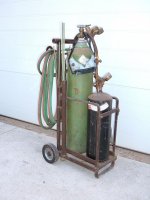
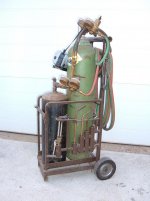
My setup is similar to what you have, a "B" tank and an 80 CF oxygen. You will note a rosebud tip hanging on the side, but the tanks will not really support it.

You can do a bit of cutting, like muffler clamps and shock studs, etc. And, you can also use the torch tip for heating things. This has suited my workshop needs adequately since 1981.

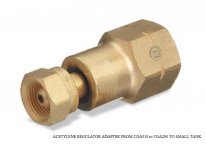
The adaptor pictured is needed to join up the regulator to a "B" tank.
 

Attachments

  • Ox-Ace Cart 02.jpg
    Ox-Ace Cart 02.jpg
    142 KB · Views: 43
  • Acetylene Tank Adaptor.jpg
    Acetylene Tank Adaptor.jpg
    52 KB · Views: 20
To avoid these ads, REGISTER NOW!

joel63

Well-known member
Joined
Oct 9, 2012
Messages
1,912
Location
Central FL
My setup is similar to what you have, a "B" tank and an 80 CF oxygen. You will note a rosebud tip hanging on the side, but the tanks will not really support it.

You can do a bit of cutting, like muffler clamps and shock studs, etc. And, you can also use the torch tip for heating things. This has suited my workshop needs adequately since 1981.

The adaptor pictured is needed to join up the regulator to a "B" tank.

Nice cart.:thumbup:
 

akalian

Well-known member
Joined
Apr 27, 2016
Messages
355
Location
St. George Utah
Well late last night I put a best offer in on eBay for a Firepower Oxyfuel 350 torch set by Victor. I really didn't think I'd win, but the seller accepted $140 for it brand new in box.. So we'll cancel on the propane for now. For $140 I'm happy. At least now I can comfortably use it knowing the regulators and everything else is up to par. This is an overview of the oxyfuel sets. For someone like me it will do just fine. http://victortechnologies.com/IM_Uploads/DocLib_9921_Firepower_Oxyfuel_Range_Brochure_(83-1409).pdf

Good for you on deciding to go with a new rig.

You won't regret it.
That's a very nice setup. Did you get the full kit, regulators and hoses?
Got a link to the auction?

Will those regulators bolt up to a type B tank, or are you going to opt for a larger one or use an adapter?

Edit: Never mind, lilredex's post shows the adapter for the type B tank.

Post some pics when you get it all setup.

.
 
Last edited:
OP
G

gdocktor3

Well-known member
Joined
Apr 18, 2015
Messages
5,419
Location
Connecticut
My setup is similar to what you have, a "B" tank and an 80 CF oxygen. You will note a rosebud tip hanging on the side, but the tanks will not really support it.

You can do a bit of cutting, like muffler clamps and shock studs, etc. And, you can also use the torch tip for heating things. This has suited my workshop needs adequately since 1981.

The adaptor pictured is needed to join up the regulator to a "B" tank.

Yes I am aware I need the adapter like that. If I'm not mistaken, the adapter I need is #317. CGA-520 on the B tank to CGA-510 regulator. Is that right? Do your tanks empty at the same time? I know you need more oxy than gas, but I didn't think that much. Also, where can I get a cart like that? Home made?

Good for you on deciding to go with a new rig.

You won't regret it.
That's a very nice setup. Did you get the full kit, regulators and hoses?
Got a link to the auction?
.

Here's the link http://www.ebay.com/itm/262408626678?_trksid=p2057872.m2749.l2649&ssPageName=STRK:MEBIDX:IT
 
Last edited:

taumac

Well-known member
Joined
Aug 30, 2011
Messages
8,104
Location
Brooksville, Fl
Well late last night I put a best offer in on eBay for a Firepower Oxyfuel 350 torch set by Victor. I really didn't think I'd win, but the seller accepted $140 for it brand new in box.. So we'll cancel on the propane for now. For $140 I'm happy. At least now I can comfortably use it knowing the regulators and everything else is up to par. This is an overview of the oxyfuel sets. For someone like me it will do just fine. http://victortechnologies.com/IM_Uploads/DocLib_9921_Firepower_Oxyfuel_Range_Brochure_(83-1409).pdf


Congrats on the new set up. You'll have years of good use out of those and peace of mind knowing everything is new.
 

akalian

Well-known member
Joined
Apr 27, 2016
Messages
355
Location
St. George Utah
Yes I am aware I need the adapter like that. If I'm not mistaken, the adapter I need is #317. CGA-520 on the B tank to CGA-510 regulator. Is that right? Do your tanks empty at the same time? I know you need more oxy than gas, but I didn't think that much. Also, where can I get a cart like that? Home made?


Here's the link http://www.ebay.com/itm/262408626678?_trksid=p2057872.m2749.l2649&ssPageName=STRK:MEBIDX:IT

That's the best buy of the year. Victor is a great brand, lots of support is available, and best of all, as many tips as you will ever need. Get 'em as you need them.

This rig will last a lifetime, and can be easily attached to a larger set of tanks if you get the urge to upgrade. No other changes will be needed.

Welcome to the 5,000 degree club.

.
 

lilredex

Well-known member
Joined
Apr 29, 2006
Messages
5,956
Location
Toronto
Yes I am aware I need the adapter like that. If I'm not mistaken, the adapter I need is #317. CGA-520 on the B tank to CGA-510 regulator. Is that right? Do your tanks empty at the same time? I know you need more oxy than gas, but I didn't think that much. Also, where can I get a cart like that? Home made?


[/url]

Yes and yes.

The tank sizing is about right for welding and brazing. Doing a bunch of cutting will knock that out of phase, but with two "B" tanks you'll do better.

The cart was one of my first projects.

My med. duty Victor set came with those tips, I did add a "000" size for sheet metal brazing and other smaller jobs.

That Volare job was completed when my choices were Lincoln 225 buzz box or brazing.....different today.
 

Attachments

  • Ox-Ace Cart 03.jpg
    Ox-Ace Cart 03.jpg
    146.1 KB · Views: 37
  • Ox-Ace Cart 005.jpg
    Ox-Ace Cart 005.jpg
    144.9 KB · Views: 39
  • '77 Vol #1.jpg
    '77 Vol #1.jpg
    136.1 KB · Views: 52

brownbagg

Well-known member
Joined
Mar 20, 2006
Messages
5,208
my tanks never empty at the same time, that why i have three sets of bottles (6 tanks) plus 25-75 and pure argon
 

trackwelder

Well-known member
Joined
Jun 22, 2005
Messages
2,608
Location
n.y
If the kit did not come with them I would add check valves at the torch handle and flashback arrestors at the gauges.
 

Craptain

Well-known member
Joined
Apr 18, 2013
Messages
4,032
Location
Tampa Bay FL
Great and useful post MoonRise. Whilst I knew most of the content the parts I didn't know might have saved my life. Specifically the T hose and 1:7 rate which I should have but didn't know.

Sent from my LG-D801 using Tapatalk
 

trackwelder

Well-known member
Joined
Jun 22, 2005
Messages
2,608
Location
n.y
OP
G

gdocktor3

Well-known member
Joined
Apr 18, 2015
Messages
5,419
Location
Connecticut
Thanks I love these links. I read on one site they changed it to 1/10 rule I thought? Can someone just explain this in simple math layman's terms? Or better yet, just give me an idea of how long I can safely use my B tank with different tips. I apologize for all this, but I really want to understand this stuff and you guys seem to explain things really well. I mean, if I have a 1/2 tank left and go by this rule, that means I can only use 1/14 or 1/20 of it, right? Which would mean only a few minutes... I just don't get it, but math was never my strong point after add, subtract, multiply...
 
Last edited:

MoonRise

Well-known member
Joined
Nov 5, 2010
Messages
4,031
Location
NJ
Go to the Harris or Victor or ESAB (which owns Victor now) or Smith (now owned by Miller) websites and read up on oxy-acetylene. Safety, usage, etc.

Or refer back to my previous post and the quote right from Victor :

In practical terms, that limit is the acetylene 1:7 withdrawal rate limit. Which means that you should not withdraw (flow rate) more than 1/7 of the volume capacity of an acetylene cylinder in cubic feet (of gas) per hour.

Right from a Victor reference source on cutting/ welding/ and heating with oxy-fuels:


At no time should the withdrawal rate of an individual acetylene cylinder exceed 1/7 of the cylinder contents per hour. If additional flow capacity is required, use an acetylene manifold system of sufficient size to supply the necessary volume.

A B acetylene tank is 40 cubic feet capacity. So 1/7 of 40 is approximately 6 (5.7 actually) CFH (cubic feet per hour) of acetylene gas flow rate. Which means you go to the torch tip catalog/reference and look up an acetylene flow rate of 6 CFH, and for a Victor acetylene cutting tip, that means that the biggest 'safe' size tip (not even maxed out!) you can use with that B cylinder is a Victor Size 0 (zero), which has a listed cutting thickness limit on steel of 3/8" to 1/2" thick.

A welding/brazing tip size limit based on a maximum allowable safe flow rate of 6 CFH means you can go up to about a Victor size 1 or 2 acetylene tip, good for welding steel up to 3/32" thick or 1/8" thick respectively.

There is no fuel rate withdrawal limit for fuel gases other than acetylene. You might 'frost' up or 'freeze' a regulator or cylinder of gas, dependent on ambient temperature and gas flow withdrawal rate. But there is no flow rate safety limit like there is with acetylene.

Read up some on oxy-fuel stuff here:

http://victortechnologies.com/IM_Upl...74_65-1501.pdf

It is not directly how long (time, in minutes or hours) you can use your acetylene tank (although that is related here), it is how fast you can withdraw the acetylene from the tank (gas flow rate in cubic feet per hour, or CFH).

Let me explain, no time. Let me sum up :D

Take the tip you are interested in using. Let's say a Victor #0 welding tip, rated as appropriate for welding 5/64" thick steel (1.9 mm thick, if you want to think in metric. Or 0.078", which is about 14 gauge sheet metal). Look in the Victor catalog or manual or reference and see what the flow rate for that size tip is. It is listed as using acetylene at a flow rate of 2-4 CFH (at an acetylene pressure of 3-5 psi).

You have a B size acetylene tank. That is 40 cubic feet of acetylene (volume capacity of the cylinder). But you can only safely withdraw acetylene gas from the cylinder (because the acetylene gas is dissolved in acetone, and the whole acetylene/acetone mix is 'soaked' into the porous 'filler' inside the acetylene tank) at a flow rate of 1/7 of the tank's volume per hour.

40 ft3 (cylinder volume size) * 1/7 (maximum safe acetylene gas withdrawal rate from the cylinder) = 5.7 CFH (cubic feet per hour gas flow rate)

The Victor #0 welding tip can safely be used with a B tank.

Let's look again. How about a Victor #3 welding tip, rated as suitable for welding 3/16" thick steel?

The Victor #3 welding tip uses acetylene at a rate of 8-18 CFH (at an acetylene pressure of 3-6 psi).

But your B tank can only 'safely' deliver an acetylene gas flow rate of 5.7 CFH.

This means that the Victor #3 welding tip can NOT be used with a B tank. You would need to use a bigger tank/cylinder or manifold several smaller tanks together in order to supply a sufficient flow rate of acetylene gas to use that Victor #3 welding tip.

:beer:
 

trackwelder

Well-known member
Joined
Jun 22, 2005
Messages
2,608
Location
n.y
I would look for a larger acetylene tank for sure. Years ago we use to do quite a bit of gas welding on the job. At times we would manifold 2-3 330 cu ft tanks together to get the required gas flow for a #12 welding tip.
 

akalian

Well-known member
Joined
Apr 27, 2016
Messages
355
Location
St. George Utah
I would look for a larger acetylene tank for sure. Years ago we use to do quite a bit of gas welding on the job. At times we would manifold 2-3 330 cu ft tanks together to get the required gas flow for a #12 welding tip.

Agreed.

A larger tank is the simplest and easiest solution. He got a really great deal on the regulators and a 80-100 cf tank would solve most all his problems. With larger tanks, the gas lasts longer, meaning fewer trips to get the little tanks refilled. And he wouldn't have to worry as much about flow rates.

And while it's great to make your own cart, for someone just starting out, I'd suggest you pick up a pre-made one at you welding supply house, or maybe eBay or Craigslist. They don't cost an arm and a leg, and it's one less thing to worry about as you learn the in's and out's of O/A welding, brazing and, silver soldering.

.
 
OP
G

gdocktor3

Well-known member
Joined
Apr 18, 2015
Messages
5,419
Location
Connecticut
Man there's so much more to it then just turning the gas on and hitting the striker... I had no idea. I will surely do more research before jumping in to it.
 
OP
G

gdocktor3

Well-known member
Joined
Apr 18, 2015
Messages
5,419
Location
Connecticut
So I found a pretty sweet cart at work today. I might have to borrow it...
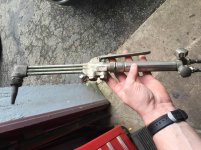
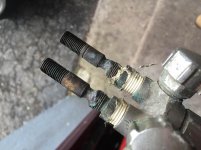
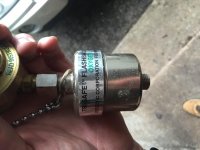
I have some questions about the pictures below. The flashback arrestor on my oxy gauge is really big. Is this an old, outdated type?
Also, the connectors on my torch look like they were welded on. Are those arrestors or check valves? Or just welded on threads? Is it common to weld them on like that? It is a Smith setup.
 

Attachments

  • IMG_2328.jpg
    IMG_2328.jpg
    147.8 KB · Views: 31
  • IMG_2327.jpg
    IMG_2327.jpg
    133.5 KB · Views: 31
  • IMG_2326.jpg
    IMG_2326.jpg
    129.1 KB · Views: 28
  • IMG_2325.jpg
    IMG_2325.jpg
    136.3 KB · Views: 28
Last edited:

trackwelder

Well-known member
Joined
Jun 22, 2005
Messages
2,608
Location
n.y
Does the torch happen to say lifetime on it?
Also I would eliminate whatever those cobbled ends are on that torch. There should be no need to use any Teflon tape on a torch setup. I have seen a little tape used on the pressure gauge dial threads on the regulators.
 
To avoid these ads, REGISTER NOW!
Top Bottom