To avoid these ads, REGISTER NOW!

Pouring slab in existing garage

bodyguy16

Well-known member
Joined
Nov 8, 2009
Messages
1,016
Location
QC, Canada
Hi everyone,

As the title states i need to pour a slab in my garage, dimensions are 10ft wide x 18 deep and and extra 11 ft passed the back wall for a small dry storage area.

The perimeter are footings 2ft by 5 deep, the center is dirt covered by rubber mats. The house was built in '49 and the soil in the center seems very well tapped and settled by time.

Keep in mind i do not need a drain as rarely will i store my car inside and never during winter.

Here are my thoughts/ questions:

First recommendation from a local contractor was to not touch the soil in the center level low spots with 0-3/4 gravel then plastic sheathing, 4x8 wire mesh sheets followed by a 4 inch pour on top of all incl footings. My concern with this is i will have an obvious step walking in the garage.

Second scenario my preference is: dig out center a good 6 inches and level out with 0-3/4 gravel,vapor barrier then drill into footing on each side about every foot for rebar then add a layer on top and tie it down with wire. Pour center only with 4 inch slab/ maybe level out top of footings with a small amount to make it purdy.

What are your thoughts? Experience with these scenarios and advice for what i should do. Here are some pictures of the said garage,

uploadfromtaptalk1464742634819.jpguploadfromtaptalk1464742647647.jpguploadfromtaptalk1464742661374.jpguploadfromtaptalk1464742667428.jpg

In the second picture the two lower holes are for acces to the crawl space under the main building and the one ahead is for the "dry storage space" i want to create. I will cut the osb at the height of the floor joists it will give me a good 2 1/2 feet of ground clearence to go under.

Thanks!

Sent from my SM-G903W using Tapatalk
 
To avoid these ads, REGISTER NOW!

DougWil

Well-known member
Joined
Dec 29, 2015
Messages
545
Location
NW Montana
Bit bewildered why your 5 ft deep footings have such a wide stemwall, then topped by a CMU stemwall??
Did someone pour a footing say 2 ft wide all 5 ft of it?
^ If so, God bless them for not being cheap on concrete. LOL

Any way, excavate down to where you have compacted soil (after excavation), 5" of compacted gravel base, 4-5" of minimum 3500psi concrete, #4 bars at 16-18" on center, with a perimeter bar 2" away from the wall all the way around to give you the finished elevation you want.
Like at the bottom of the door panel unless you what to buy a new door and raise the height of the slab.
Garage slab should be higher than the driveway so water doesn't flood in.

Don't dowel into the stemwall you want the slab to float.
Vapor barrier is optional in most areas in garages.

Don't forget a sawed or trowel crack control joint!!
I would put one right at the 9ft mark and use a 5" slab. That is right on the max point of slab size per joint. Two 10'x9' slabs.
 
Last edited:
OP
B

bodyguy16

Well-known member
Joined
Nov 8, 2009
Messages
1,016
Location
QC, Canada
Thanks for replying, i have a couple questions,

First the footings are 2ft al the way around, seems to be the norm aroumd here, anyways its good and solid.

Here are my questions, when you say dont dowel the stem wall what exactly do you mean? What i gathered is dont drill into footing for steel bar, correct? And should the bar be in the center of the slab? Right. And the premeter bar tied onto the first layer or bar?
Now why not drill into? Is it for not disturbing the existing footings? If i did would it stop the slab from settling down? Even if i dont add to the existing footing (top) and just the center.

Sorry just want to be on he mark and sure for when it gets done .

Thanks again


Sent from my SM-G903W using Tapatalk
 
OP
B

bodyguy16

Well-known member
Joined
Nov 8, 2009
Messages
1,016
Location
QC, Canada
Bit bewildered why your 5 ft deep footings have such a wide stemwall, then topped by a CMU stemwall??
Did someone pour a footing say 2 ft wide all 5 ft of it?
^ If so, God bless them for not being cheap on concrete. LOL

Any way, excavate down to where you have compacted soil (after excavation), 5" of compacted gravel base, 4-5" of minimum 3500psi concrete, #4 bars at 16-18" on center, with a perimeter bar 2" away from the wall all the way around to give you the finished elevation you want.
Like at the bottom of the door panel unless you what to buy a new door and raise the height of the slab.
Garage slab should be higher than the driveway so water doesn't flood in.

Don't dowel into the stemwall you want the slab to float.
Vapor barrier is optional in most areas in garages.

Don't forget a sawed or trowel crack control joint!!
I would put one right at the 9ft mark and use a 5" slab. That is right on the max point of slab size per joint. Two 10'x9' slabs.
Thank you!

Sent from my SM-G903W using Tapatalk
 

DougWil

Well-known member
Joined
Dec 29, 2015
Messages
545
Location
NW Montana
Thanks for replying, i have a couple questions,

First the footings are 2ft al the way around, seems to be the norm aroumd here, anyways its good and solid.

Here are my questions, when you say don't dowel the stem wall what exactly do you mean? What i gathered is don't drill into footing for steel bar, correct? And should the bar be in the center of the slab? Right. And the perimeter bar tied onto the first layer or bar.
Now why not drill into? Is it for not disturbing the existing footings? If i did would it stop the slab from settling down? Even if i dont add to the existing footing (top) and just the center.

Sorry just want to be on he mark and sure for when it gets done .

Thanks again


Sent from my SM-G903W using Tapatalk

Normally concrete footings for a house or garage are 1.5-2ft wide and 8-10" high. From there a concrete or CMU stemwall continues up.
They usually don't just pour a block 2ft wide, 5ft high.

stemwallslab.gif

^Like this.

You don't want to drill into the stemwall or footing and dowel into those drilled holes with rebar etc. You want the slab to float. If it settles a bit, it shouldn't be much IF you compacted well.

Otherwise if the slab settles or heaves from frost and the edge can't settle because it is fixed to the footer you get a crack in the slab. That is why if you pour over the footer with the slab you should put down something compactable like low density foam so the slab edge doesn't bear directly on the existing footing.

Yes the rebar goes in the center of the slabs thickness. So 2.5 inches from the bottom or top of the slab to the center of the rebar.

You put a bar at the same level as all the other rebar all the way around the perimeter. Bending four L shaped bars for the corners, 2 inches in from the final slab edge. It gives the slab strength at that vulnerable edge.

I wouldn't put anything in between the slab edge and the stemwall. When the slab shrinks during curing you will have a very small gap for clearance. It is enough. The filler usually doesn't stay in place in the long term.
 
Last edited:
OP
B

bodyguy16

Well-known member
Joined
Nov 8, 2009
Messages
1,016
Location
QC, Canada
Normally concrete footings for a house or garage are 1.5-2ft wide and 8-10" high. From there a concrete or CMU stemwall continues up.
They usually don't just pour a block 2ft wide, 5ft high.

stemwallslab.gif

^Like this.

You don't want to drill into the stemwall or footing and dowel into those drilled holes with rebar etc. You want the slab to float. If it settles a bit, it shouldn't be much IF you compacted well.

Otherwise if the slab settles or heaves from frost and the edge can't settle because it is fixed to the footer you get a crack in the slab. That is why if you pour over the footer with the slab you should put down something compactable like low density foam so the slab edge doesn't bear directly on the existing footing.

Yes the rebar goes in the center of the slabs thickness. So 2.5 inches from the bottom or top of the slab to the center of the rebar.

You put a bar at the same level as all the other rebar all the way around the perimeter. Bending four L shaped bars for the corners, 2 inches in from the final slab edge. It gives the slab strength at that vulnerable edge.

I wouldn't put anything in between the slab edge and the stemwall. When the slab shrinks during curing you will have a very small gap for clearance. It is enough. The filler usually doesn't stay in place in the long term.
Thank you for clarifying everything, i appreciate it. As for the trowel line or cut in the center to make break line should i just score over the concrete or go down deep?

As for the footings they are supposedly 2 ft wide the whole depth, the man that buildt he house is my neighbors uncle she had the same model before getting a basement.i guess ill find out how true that is when i dig.

Sent from my SM-G903W using Tapatalk
 

DougWil

Well-known member
Joined
Dec 29, 2015
Messages
545
Location
NW Montana
Thank you for clarifying everything, i appreciate it. As for the trowel line or cut in the center to make break line should i just score over the concrete or go down deep?

As for the footings they are supposedly 2 ft wide the whole depth, the man that buildt he house is my neighbors uncle she had the same model before getting a basement.i guess ill find out how true that is when i dig.

Sent from my SM-G903W using Tapatalk
Maybe he owned his own concrete plant. :lol:

Crack control cuts/joints are 1/4 the slab thickness, so 5"/4 =1.25".
The joints if sawn are put in as soon as possible!
 
OP
B

bodyguy16

Well-known member
Joined
Nov 8, 2009
Messages
1,016
Location
QC, Canada
Maybe he owned his own concrete plant. [emoji38]

Crack control cuts/joints are 1/4 the slab thickness, so 5"/4 =1.25".
The joints if sawn are put in as soon as possible!
If i ever meet him ill ask! Lol

Another question arised in my mind, should i lay the rebar width wise or lenght wise and how far to the footings should i lay it ? ( not the perimeter that i got) real close but not touching?

I can't tell you how much i apreciate your help!

-Julian

Sent from my SM-G903W using Tapatalk

 

DougWil

Well-known member
Joined
Dec 29, 2015
Messages
545
Location
NW Montana
If i ever meet him ill ask! Lol

Another question arised in my mind, should i lay the rebar width wise or lenght wise and how far to the footings should i lay it ? ( not the perimeter that i got) real close but not touching?

I can't tell you how much i apreciate your help!

-Julian

Sent from my SM-G903W using Tapatalk

Both!
Each way on 18" on center. The ends on the bars should end about 1.5 inches from the edges of the slab. Just enough to tie the perimeter bar on at 2 inches from the edge.
 

bczygan

Well-known member
Joined
Nov 4, 2009
Messages
22,002
Location
DETROIT! Arsenal of Scrappers
When choosing your base material, be careful.

The description of "gravel" isn't good enough.

You need a stone material that is angular rather than rounded. A limestone is ideal. And it must include a range of sizes including fines, so that it will compact into a solid concrete like mass. I like to place a landscape fabric over the compacted subsurface material after excavating all loose and organic material. Then install the gravel, compacting in 4" lifts.

Bill
 
To avoid these ads, REGISTER NOW!
OP
B

bodyguy16

Well-known member
Joined
Nov 8, 2009
Messages
1,016
Location
QC, Canada
When choosing your base material, be careful.

The description of "gravel" isn't good enough.

You need a stone material that is angular rather than rounded. A limestone is ideal. And it must include a range of sizes including fines, so that it will compact into a solid concrete like mass. I like to place a landscape fabric over the compacted subsurface material after excavating all loose and organic material. Then install the gravel, compacting in 4" lifts.

Bill
Thanks Bill, i should of specified instead of using he term "gravel" i will be using 0-3/4 amd it will be compacted thoroughly.


As for the concrete i called around and we have a lot of mobile concrete companies around here, they have the dry ingredients and mix what you need on the spot. I was told if i were to use a fiber reinforced concrete i would have no need for rebar!?. Is this entirely true should i skip rebar and go for fiber?

Sent from my SM-G903W using Tapatalk
 

DougWil

Well-known member
Joined
Dec 29, 2015
Messages
545
Location
NW Montana
As for the concrete i called around and we have a lot of mobile concrete companies around here, they have the dry ingredients and mix what you need on the spot. I was told if i were to use a fiber reinforced concrete i would have no need for rebar!?. Is this entirely true should i skip rebar and go for fiber?


NO!

Kick in the nutz, anybody who tells you that fibermesh is a replacement for PRIMARY reinforcement (like rebar)!
 
OP
B

bodyguy16

Well-known member
Joined
Nov 8, 2009
Messages
1,016
Location
QC, Canada
NO!

Kick in the nutz, anybody who tells you that fibermesh is a replacement for PRIMARY reinforcement (like rebar)!
Thanks for the heads up!

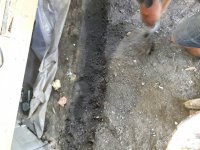
Started to clean out garage and dig a bit and it seems to all be small crushed stone like 0-1/4 no earth... can i just dig and compact that then pour over ? Or do i absolutely have to get 0-3/4 gravel to compact first?

Heres a picture for reference.

Thanks
ac2c45e08f46d18750a0e5482fa68dcf.jpg5a6fff980ab9a82aa6deac50e8874b5a.jpguploadfromtaptalk1464984274915.jpg

Sent from my SM-G903W using Tapatalk
 

Attachments

  • uploadfromtaptalk1464984274915.jpg
    uploadfromtaptalk1464984274915.jpg
    140.3 KB · Views: 21

DougWil

Well-known member
Joined
Dec 29, 2015
Messages
545
Location
NW Montana
Well base should contain 10-30% fines.
Yours looks much higher than that.

I would put a handful in a large glass container filled with water.
Shake it up good.

If it is just sand and gravel it will settle out in minutes.
Slit, clay and organic material will take much longer to settle.
I think you have more of those undesirables than meets the eye.
 
OP
B

bodyguy16

Well-known member
Joined
Nov 8, 2009
Messages
1,016
Location
QC, Canada
Well base should contain 10-30% fines.
Yours looks much higher than that.

I would put a handful in a large glass container filled with water.
Shake it up good.

If it is just sand and gravel it will settle out in minutes.
Slit, clay and organic material will take much longer to settle.
I think you have more of those undesirables than meets the eye.
I beleive your right, mostly small stuff. It is very well packed though. I had to break it up with a pick to dig a shovel wouldn't suffice. It has been there for many years untouched under heavy rubber mats. I dont want to skip steps but could i just compact this base out or rake it level set rebar and pour over, or even add some bigger material and compact it in the base although i don't see how it could really go in the base much.


Sent from my SM-G903W using Tapatalk
 

lakeroadster

Well-known member
Joined
Jan 19, 2015
Messages
5,166
Location
Central Colorado
I dont want to skip steps but could i just compact this base out or rake it level set rebar and pour over, or even add some bigger material and compact it in the base although i don't see how it could really go in the base much.

From the photo's you've posted... it's highly unlikely that the existing sub-grade is ok-as-is. Can you easily push a 1" steel pin into the base or do you need a 5 lb hammer and a considerable amount of effort to drive the pin in? Consistently hard for about 8"-12" of depth, or just a hard crust on the surface? Does the pin pull back out easily, or is it really, really hard to pull the pin back out?

Want to know for sure if the existing sub-grade is acceptable? Have it tested. Find a local lab that performs moisture/density testing on compacted soils.

I had this done after the contractor compacted the sub-grade in preparation for the slab on my barn. Testing cost was $160. Pretty cheap insurance compared to the thousands of dollars you are planning to lay out for concrete.

Without having it tested.... you'll never know if it is good.

What are you going to be using your shop for? Heavy equipment or simply for parking vehicles? Heavy vehicles like dually diesel trucks, or just light duty vehicles such as cars and light trucks?
 
Last edited:
OP
B

bodyguy16

Well-known member
Joined
Nov 8, 2009
Messages
1,016
Location
QC, Canada
Want to know for sure if the existing sub-grade is acceptable? Have it tested. Find a local lab that performs moisture/density testing on compacted soils.

I had this done after the contractor compacted the sub-grade in preparation for the slab on my barn. Testing cost was $160. Pretty cheap compared to the thousands of dollars you are planning to lay out for concrete.

Without having it tested.... you'll never know if it is good.

What are you going to be using your shop for? Heavy equipment or simply for parking vehicles? Heavy vehicles like dually diesel trucks, or just light duty vehicles such as cars and light trucks?
Light cars and trucks, tool storage etc its not necessarily big enough for anything more. I also have acces to my work shop for any repairs i might need so the oddds of me parking the car inside for extended periods are slim. Just want to be on the safe side and have a nice looking and functional garage.

Sent from my SM-G903W using Tapatalk
 
To avoid these ads, REGISTER NOW!
Top Bottom