To avoid these ads, REGISTER NOW!

Raising the Roof of a 20x24ft Garage

rathersmart

Active member
Joined
Nov 8, 2015
Messages
38
Hi all!

I am moving into a new place in a few days and I couldn't be more excited!

One thing that is not meeting the spec is the garage - it has 9ft walls/ceiling.

Unfortunately that is not tall enough for a lift :(

This is why I am planning to raise the roof of the garage.

I am planning to disassemble the roof carefully, while preserving the trusses.

Then I am planning to add a 3-foot frame on top of the existing frame.

The construction of the frame addition will mimic the existing frame in terms of stud spacing and 2x4.

The question is: what kind of fasteners should I use to attach the new frame section to the existing frame?

Is there anything else I should avoid or do while adding the additional frame?
 
To avoid these ads, REGISTER NOW!

DougWil

Well-known member
Joined
Dec 29, 2015
Messages
545
Location
NW Montana
Then I am planning to add a 3-foot frame on top of the existing frame.

The construction of the frame addition will mimic the existing frame in terms of stud spacing and 2x4.

Doing so will create a hinge point around the entire perimeter of your building since you don't have a diaphragm at that level.

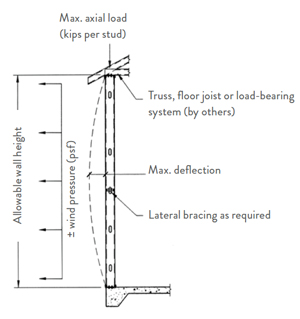
LoadBearingWallSection.jpg

^ Envision cutting that stud mid height and then tacking it back together. The wind load is no longer transferred to the footing or to the roof diaphragm but folds over.

Better would be to raise the walls too and add a 3' CMU wall on top of your footing if it is strong enough and wide enough to take the additional load.

Either way, you need to hire an engineer to properly design the retrofit with the additional gravity (CMU) and lateral loads.

Or maybe a scissor truss if the building geometry works.
 
Last edited:

captain14

Well-known member
Joined
Dec 19, 2012
Messages
7,050
Location
Near College Park Maryland 20740
Doing so will create a hinge point around the entire perimeter of your building since you don't have a diaphragm at that level.

Better would be to raise the walls too and add a 3' CMU wall on top of your footing if it is strong enough and wide enough to take the additional load.

Either way, you need to hire an engineer to properly design the retrofit with the additional gravity (CMU) and lateral loads.

Or maybe a scissor truss if the building geometry works.

Several members have did that and documented their progress here.
 

unslow1

Well-known member
Joined
Mar 3, 2012
Messages
7,880
Location
Illinois
Raising the wall as well is what I was looking at on mine. That is what was suggested by a couple of guys that looked at it.
 

jdsac

Well-known member
Joined
Mar 2, 2011
Messages
565
Would it work if he installed shear paneling X_________ distance on each side of the new joint ?

Another option might be to frame some high shed dormers onto the existing roof if that would give you the clearance you need.
 

DougWil

Well-known member
Joined
Dec 29, 2015
Messages
545
Location
NW Montana
Would it work if he installed shear paneling X_________ distance on each side of the new joint ?

Sheathing would be a poor choice, metal strapping on each stud face would be better and I have seen this on older homes with 8ft ceilings that wanted to raise the ceiling only 1 ft. But they put a solid sawn 4x12 on the existing top plate and strapped it inside and out on every stud.
But it is a poor solution and you still have that hinge point with eventual sheet rock tearing and popping along there.
But these were remodel and flip homes, so they didn't care about how well it looked or functioned in the future.

Metal strapping works good for shear wall hold downs many feet apart.
But with straps only 3.5 inches apart with nail slippage and wood compression it is a pretty wobbly connection with time.

All that is moot if the OP needs a permit, because the city will require an engineer to sign off on anything like this which is far out of the prescriptive code.
 
Last edited:

K'ledgeBldr

Well-known member
Joined
Aug 22, 2011
Messages
1,925
Location
Johns Creek, GA
You have a few choices-

One, you might be able to use Simpson's Tie-Down system-
http://www.strongtie.com/strongrodsystems_lateralsystems/landing
That is if the AHJ will allow you- some of those muckety-mucks have probably never seen it or wouldn't believe it works. So, they'll want something else...

Build the kneewall on top of the existing wall, then cut-through the top plates of the original wall to allow a sistered stud to go from the original sill plate to the underside of the new top plate of the kneewall. Usually every third stud will suffice. And if that doesn't cut the cheese with the AHJ you still have two other choices...

Reframe the entire walls the correct height; OR, since you're going to be removing the trusses- you did say TRUSSES- replace them with scissor/vaulted trusses.
 
OP
R

rathersmart

Active member
Joined
Nov 8, 2015
Messages
38
there is already about 1 foot of CMU wall done, which is how we got to 9ft from the usual 8ft ceiling. i suppose adding another 3 feet to the existing CMU wall is another option.
 

MrBalll

Well-known member
Joined
Mar 8, 2016
Messages
318
Location
West Texas
Could preserve the trusses by just lifting the entire garage. Few members on here have done that to. One member put up a detailed video of him and some friends doing it. I'm not sure where that topic may be, but just a matter of searching on your end.
 

matt_i

Well-known member
Joined
Mar 14, 2008
Messages
10,728
Location
SE Michigan
I suggest doing this, Right Now, before you move *anything* into the garage, as having it opened up is akin to letting your stuff sit outside in the rain (for awhile).

If you remove the trusses you are looking at the double top plate all around. Its not much more work to nail a diagonal 2x4 on all of the studs to preserve their alignment, then hammer up and take off the double-top plate. (The people who raised, knocked off the bottom plate and sistered or added full height new studs, you are just doing this in reverse). I can't tell you a nailing schedule but its going to be a fair number of #10s, but if you sister an 8 foot new stud, vertically offset by 24" (? or whatever dimension you decide) the walls will be solid again, in my opinion. Paring down a bit, I wouldn't go back with more than 1/3 stickout + 2/3 nailed, so 6 foot (2ft stickout + 4ft nailed) timber would be minimum, buy 12' timber and saw in half for some slight economy. Then put the double-top back on, nail this to schedule or better, put the trusses back on, resheath and reroof, then reside, and finally, move some stuff in.

Drawings, permitting + inspection, etc will be in your court, but I would feel confident with that concept on my own property, it is merely the reverse of what other people have done when raising the entire structure.
 

astroracer

Well-known member
Joined
Jun 22, 2005
Messages
3,001
Location
Mid_Michigan
You can modify some trusses to get a full height lift in there.
This is what I did for my hoist area.
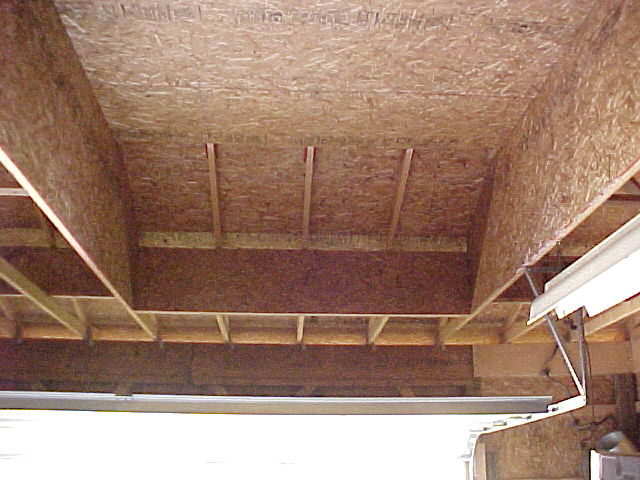
Looking toward the garage door you can see I plated the entire truss on either side of the bay I was opening up with OSB.
MVC004F-vi.jpg

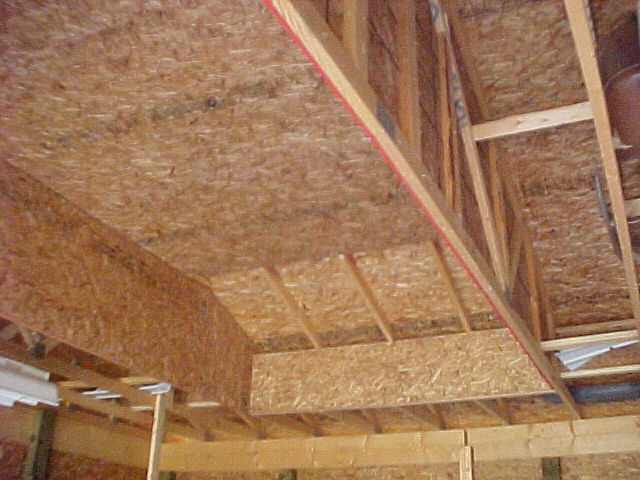
Added collar ties to the three rafters I was cutting out. After the middle of the truss was removed I plated the entire top of the opening with OSB. You can also see the verticles I added to the two end trusses to give the added OSB something to attach to and give it some robustness.
MVC002F-vi.jpg

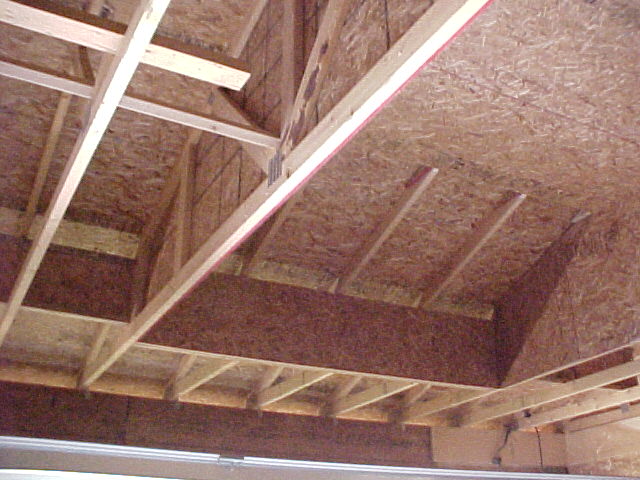
I also added 16" engineered floor joists at both ends of the opening.
MVC006F-vi.jpg

These go thru three sets of trusses on both sides of the new opening.
In this pic you can see where the three trusses were cut of at the engineered floor joist.
MVC009F-vi.jpg

The cut off trusses were tied into the new structure with joist hangers on the back side.
If you do something along these lines you should be okay. :) And it is much less tear up then raising the entire roof.
Mark
 

DougWil

Well-known member
Joined
Dec 29, 2015
Messages
545
Location
NW Montana
^ By doing that you no longer have a truss and all the advantages that a proper truss design offers.

Instead you have about the equivalent of a 2x4? 2x6? rafter spanning 1/2 the width of your garage which can't be adequate for a MI snow load.
 

astroracer

Well-known member
Joined
Jun 22, 2005
Messages
3,001
Location
Mid_Michigan
^ By doing that you no longer have a truss and all the advantages that a proper truss design offers.

Instead you have about the equivalent of a 2x4? 2x6? rafter spanning 1/2 the width of your garage which can't be adequate for a MI snow load.

Not really... The only span the upper rafters see is about 3 ft wide. The rafters you can "see" in the last pic. It's about three feet and is fully supported by the collar ties above and the cross-joist below. It's no different then the span between the webs on the other rafters. Look at it like a hip roof that has been boxed in. This has been in place for 7 years or so with no issues. There is no real snow load to worry about. The rest of the barn will fall down before this will. :)
Mark
 

NUTTSGT

Super Moderator
Staff member
Joined
Sep 14, 2009
Messages
50,968
Location
Northern Central Ohio
there is already about 1 foot of CMU wall done, which is how we got to 9ft from the usual 8ft ceiling. i suppose adding another 3 feet to the existing CMU wall is another option.

It's been done and is a viable option. Keep in mind that you will have to reframe your door openings, adding a short stud wall would probably work as long as the original header is still in place above. However, you could chose to buy a new overhead door with a taller height (custom ?) and install it.


Any windows you have will effectively be 3' higher, which may make it a deterrent form theives too. ...unintentional bonus.
 

DougWil

Well-known member
Joined
Dec 29, 2015
Messages
545
Location
NW Montana
Not really... The only span the upper rafters see is about 3 ft wide. The rafters you can "see" in the last pic. It's about three feet and is fully supported by the collar ties above and the cross-joist below. It's no different then the span between the webs on the other rafters. Look at it like a hip roof that has been boxed in. This has been in place for 7 years or so with no issues. There is no real snow load to worry about. The rest of the barn will fall down before this will. :)
Mark

No really.

When you cut out the lower chord you no longer have a truss.
You have a rafter.
You have shortened the span of the now rafter by transferred the load those 3 trusses carried over to the adjacent trusses down by the wall, something I doubt those trusses were designed to carry.

The collar tie does little to nothing to reduce the bending and shear forces on those upper chords which are now rafters.

What is the snow load in your area of MI and why do you think it doesn't apply to your roof?
 
OP
R

rathersmart

Active member
Joined
Nov 8, 2015
Messages
38
since you're going to be removing the trusses- you did say TRUSSES- replace them with scissor/vaulted trusses.

This got me thinking - how do you guys feel about ridge beams and retrofitting them into the existing truss roof structure?

I might be able to get away with that since the lift will be in the middle of the garage.

The only problem would be the garage door rolling up at the original 9ft height, but I'm sure there are solutions to this too.
 

matt_i

Well-known member
Joined
Mar 14, 2008
Messages
10,728
Location
SE Michigan
This got me thinking - how do you guys feel about ridge beams and retrofitting them into the existing truss roof structure?

For the ridge beam itself, LVL all the way. I wouldn't even mess with 2x lumber. Supporting the end of the ridge at the center of the building would be a bit tricky, but some good structural work with a set of 4 trusses ganged together as a large assembly would be a good starting point. And, they would be extra/spare if carefully removed.
 

K'ledgeBldr

Well-known member
Joined
Aug 22, 2011
Messages
1,925
Location
Johns Creek, GA
This got me thinking - how do you guys feel about ridge beams and retrofitting them into the existing truss roof structure?

I might be able to get away with that since the lift will be in the middle of the garage.

The only problem would be the garage door rolling up at the original 9ft height, but I'm sure there are solutions to this too.


The problem is supporting the ridge- as previously mentioned.

If the lift is going to be "in the middle" just replace those few trusses with scissor trusses and be done with it.

Granted, there's probably a hundred different ways to achieve the final result. But, what is the most economical for the end result? Labor is your ENEMY! All these different methods of raising the structure, removing roof, and so on, and so on, just eat away at your wallet.

The least evasive that I see is removing the center section of decking, and the trusses; then replacing them with scissor trusses- reinstall decking, roofing, done.
 
To avoid these ads, REGISTER NOW!

DougWil

Well-known member
Joined
Dec 29, 2015
Messages
545
Location
NW Montana
OP
R

rathersmart

Active member
Joined
Nov 8, 2015
Messages
38
Yes and created a hinge point in the wall.
Good thing it is a small building, not out exposed in a windy plain. He looks like he used full height studs sprinkled around and a addition with full height stubs to help strengthen it.

I was going to comment on the same thing! After your diagram, the hinge points make sense and avoiding them is really the game plan.

Do you feel that adding the full length studs is sufficient strengthening?
 

DougWil

Well-known member
Joined
Dec 29, 2015
Messages
545
Location
NW Montana
I was going to comment on the same thing! After your diagram, the hinge points make sense and avoiding them is really the game plan.

Do you feel that adding the full length studs is sufficient strengthening?

The only way to know is have an engineer analyze the loads and the stresses on the various members.

However, the prescriptive part of the building code (cookbook design for simple residential structures) where you don't analyze, just pretty much look in a chart, the max stud length for a 2x4 wall is 10' at 16" oc Max for a load bearing wall.
http://publicecodes.cyberregs.com/icod/ibc/2012/icod_ibc_2012_23_par170.htm


And note this.....
a. Listed heights are distances between points of lateral support placed perpendicular to the plane of the wall. Increases in unsupported height are permitted where justified by an analysis. ie, an engineer.

and
The size, height and spacing of studs shall be in accordance with Table 2308.9.1 except that utility-grade studs shall not be spaced more than 16 inches (406 mm) o.c., or support more than a roof and ceiling, or exceed 8 feet (2438 mm) in height for exterior walls and load-bearing walls or 10 feet (3048 mm) for interior nonload-bearing walls. Studs shall be continuous from a support at the sole plate to a support at the top plate to resist loads perpendicular to the wall. The support shall be a foundation or floor, ceiling or roof diaphragm or shall be designed in accordance with accepted engineering practice.
In short you can't have cobbled together studs. :)

Any why you can't build a residential structure with studs taller than a 10' wall w/o a engineer, IF the local building official adheres to the code.

That is why way back at the beginning of this thread I said you need an engineer. Because you want 12' stud walls and you only currently have 2x4 studs, and why I suggested going CMU if you footing is adequate.
 
Last edited:
OP
R

rathersmart

Active member
Joined
Nov 8, 2015
Messages
38
Thanks DougWil! I was hoping to get most of this done myself, but I'll reach out to some engineers.
 
OP
R

rathersmart

Active member
Joined
Nov 8, 2015
Messages
38
OK - all moved in :)

I'm in touch with an engineer to design a ridge beam that runs the length of the roof.

I did some drawings.
Currently it looks like this:
garage1
With ridge beam:
garage2withbeam
I also found an online beam calculator:
http://design.medeek.com/resources/beam/beam_calculator.pl

I ran the numbers on a 3 1/2" x 12" x 24' glulam ridge beam and it looks good. However I am still paying the engineer company to confirm it's good.
 

DougWil

Well-known member
Joined
Dec 29, 2015
Messages
545
Location
NW Montana
I ran the numbers on a 3 1/2" x 12" x 24' glulam ridge beam and it looks good. However I am still paying the engineer company to confirm it's good.

What did you use for DL, LL and SL if you have snow.
What keeps the walls from spreading with that layout?
^That is one of the functions of the bottom chord of a truss.

They would, because here again that is basically a hinge.
It is difficult to make moment resistant (not hinged) connections with wood.
Any sagging between the beams posts would spread the walls.
Because of the geometry a little sagging = a lot of spreading. What is the roof slope?

The garage header would need to be bigger too.
 
Last edited:
OP
R

rathersmart

Active member
Joined
Nov 8, 2015
Messages
38
What did you use for DL, LL and SL if you have snow.
What keeps the walls from spreading with that layout?
^That is one of the functions of the bottom chord of a truss.

They would, because here again that is basically a hinge.
It is difficult to make moment resistant (not hinged) connections with wood.
Any sagging between the beams posts would spread the walls.
Because of the geometry a little sagging = a lot of spreading. What is the roof slope?

The garage header would need to be bigger too.
one thing I wasn't able to draw on the pictures are two beams that support the ridge beam at the front and the back of the garage.

those beams would be identical to the ridge beam in size. they would be supported by 4x4 posts in each corner of the garage. i was not planning on using the existing header to support the beam
 

DougWil

Well-known member
Joined
Dec 29, 2015
Messages
545
Location
NW Montana
one thing I wasn't able to draw on the pictures are two beams that support the ridge beam at the front and the back of the garage.

those beams would be identical to the ridge beam in size. they would be supported by 4x4 posts in each corner of the garage. i was not planning on using the existing header to support the beam

However you have the ends of the beam supported, it is still spanning 24'.
That is long for a 12" deep beam.


2nd time. :)
What did you use for DL, LL and SL if you have snow?
And what is the slope?
 
OP
R

rathersmart

Active member
Joined
Nov 8, 2015
Messages
38
for DL I used 75plf
LL = L/180
TL = L/120

Although in Seattle we get no snow at all...
 
OP
R

rathersmart

Active member
Joined
Nov 8, 2015
Messages
38
:thumbup:

What pitch is the roof? If it is 5-12 or more your other option is to upgrade to (2) free span trusses using purlins.

the roof pitch is 4/12

sorry for the slow and incomplete info to your questions. pretty much all of this is new information to me so I have to actually google what you're asking for and then go and calculate it.
 

lakeroadster

Well-known member
Joined
Jan 19, 2015
Messages
5,166
Location
Central Colorado
for DL I used 75plf
LL = L/180
TL = L/120

Although in Seattle we get no snow at all...

http://www.trusstech.com/pdf/ttbdrawing.pdf

http://www.rltruss.com/trusseducation.html

the roof pitch is 4/12

Sorry for the slow and incomplete info to your questions. pretty much all of this is new information to me so I have to actually google what you're asking for and then go and calculate it.

Even with a ridge beam, a 9 ft wall... at a 4/12 pitch... will that be enough when the vehicle is raised to full lift height?

And with using a ridge beam, the end trusses will need to be modified or replaced to king style trusses... and the gable end door complicates this a bit.
 
Last edited:

MJD1

Well-known member
Joined
Dec 28, 2014
Messages
607
In my opinion your best bet would be raising the structure. The most labor I spent was on removing drywall so far. My thread on it, HTTP:/weldingweb.com/showthread.php?613051
garage-modification.
 
OP
R

rathersmart

Active member
Joined
Nov 8, 2015
Messages
38
http://www.trusstech.com/pdf/ttbdrawing.pdf

http://www.rltruss.com/trusseducation.html

Even with a ridge beam, a 9 ft wall... at a 4/12 pitch... will that be enough when the vehicle is raised to full lift height?

And with using a ridge beam, the end trusses will need to be modified or replaced to king style trusses... and the gable end door complicates this a bit.

The lift will be in the center of the garage and I should get about 11ft of clearance at the width of the car.

The engineer is going to be designing a new header that incorporates support for the ridge beam. I think that will act like a king truss.
 
OP
R

rathersmart

Active member
Joined
Nov 8, 2015
Messages
38
In my opinion your best bet would be raising the structure. The most labor I spent was on removing drywall so far. My thread on it, HTTP:/weldingweb.com/showthread.php?613051
garage-modification.

You're probably right - I am trying to keep the appearance of the garage unchanged during this whole process and I am making compromises with that.
 

KDXSR5

Well-known member
Joined
May 17, 2015
Messages
281
Location
Wyoming
Doug was asking for:
DL - Dead Load
LL = Live Load
SL - Snow Load (if applicable)

The L/# figures you provided are allowable deflection designations.
 

Falcon67

Well-known member
Joined
Jun 11, 2009
Messages
18,371
Location
Merkel, TX
Even with a ridge beam, a 9 ft wall... at a 4/12 pitch... will that be enough when the vehicle is raised to full lift height?

Depends on the car. I have 8' ceiling, 4/12 pitch, height to the bottom of the ridge board is about 11' 6". I could get the Mustang to about full height on a lift, the Falcon - no, because it's every bit of 5' at the center of the roof.
 

lakeroadster

Well-known member
Joined
Jan 19, 2015
Messages
5,166
Location
Central Colorado
Depends on the car. I have 8' ceiling, 4/12 pitch, height to the bottom of the ridge board is about 11' 6". I could get the Mustang to about full height on a lift, the Falcon - no, because it's every bit of 5' at the center of the roof.

I always "assume" a full size extended cab pickup truck (Silverado), with a cap when looking at clearances on my stuff... even though the "largest" thing I own is a Tacoma extended cab. :)
 
To avoid these ads, REGISTER NOW!
Top Bottom