

You are using an out of date browser. It may not display this or other websites correctly.
You should upgrade or use an alternative browser.
You should upgrade or use an alternative browser.
Forgot closures!
- Thread starter nterry1957
- Start date
TMcCay
Well-known member
If your talking about the foam piece under the metal it will prevent birds and wasp from getting in under the and building nest. A friend didn't get any installed by his builders and is now battling birds.
I'm curious though. When I built my shop the stuff that came with my kit was compressed. I installed it after the roof was put down. It has a tar like adhesive and was slow to decompress. Worked great. I bought my shop from Mueller. You may want to check out something like this. It would be a lot easier then taking the roof edge up.
I'm curious though. When I built my shop the stuff that came with my kit was compressed. I installed it after the roof was put down. It has a tar like adhesive and was slow to decompress. Worked great. I bought my shop from Mueller. You may want to check out something like this. It would be a lot easier then taking the roof edge up.
mitusa
Well-known member
I installed mine after I had the roof on.....easy to do; just take out the screws and slide the enclosure in and put the screws back in the hole.
You'll have to have them or your roof will leak water in the "high wind" rainstorms.
You'll have to have them or your roof will leak water in the "high wind" rainstorms.
OP
nterry1957
Well-known member
Thanks for the replies fellas...
I don't think they will be hard to install either way. And the birds and wasps thing makes sense.
I don't think they will be hard to install either way. And the birds and wasps thing makes sense.
larry4406
Well-known member
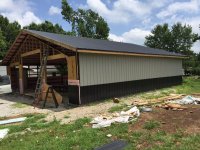
Nice shop!
bczygan
Well-known member
Nice shop!
Yes, very nice, especially the three doors on the gable end. But do you have shear wall details there because of the very narrow end wall panels?

Bill
Last edited:
mitusa
Well-known member
Just now looking at the picture of your shop....Do you have some flashing, or better yet, some metal they supplied to match your barn to go on the plate underneath the edge of your roof???
You need something there to slide under the eave and to hang down past the edges of your rafter edges. The people that made your kit should have something pre-bent to fit. It will keep the wind and rain off the edges of your roof to prevent rotten ends. I always let them hang a little lower than the bottom of your rafter.
You probably already know this; but maybe others don't. HTH's
You need something there to slide under the eave and to hang down past the edges of your rafter edges. The people that made your kit should have something pre-bent to fit. It will keep the wind and rain off the edges of your roof to prevent rotten ends. I always let them hang a little lower than the bottom of your rafter.
You probably already know this; but maybe others don't. HTH's
OP
nterry1957
Well-known member
Nice shop!
Thanks Larry! It's a work in progress
OP
nterry1957
Well-known member
Yes, very nice, especially the three doors on the gable end. But do you have shear wall details there because of the very narrow end wall panels?
Bill
I don't have details... It is a re-purposed poultry house frame. so it has proven engineering.
OP
nterry1957
Well-known member
Just now looking at the picture of your shop....Do you have some flashing, or better yet, some metal they supplied to match your barn to go on the plate underneath the edge of your roof???
You need something there to slide under the eave and to hang down past the edges of your rafter edges. The people that made your kit should have something pre-bent to fit. It will keep the wind and rain off the edges of your roof to prevent rotten ends. I always let them hang a little lower than the bottom of your rafter.
You probably already know this; but maybe others don't. HTH's
I do have metal fascia panels that go there. I just don't have them up yet. Going to tackle the soffit and fascia when I get the rest of the building covered.
Here is a build thread if you guys are interested.
http://www.garagejournal.com/forum/showthread.php?t=329478
OP
nterry1957
Well-known member
Here is a build thread if ya'll want to check it out
http://www.garagejournal.com/forum/showthread.php?t=329478
http://www.garagejournal.com/forum/showthread.php?t=329478
Shiftless
Well-known member
nterry;
I know you originally asked only about the closures to keep out bugs and birds, but I'm with Bill on questioning the end wall. Did the original poultry house structure have the 3 big openings? If it did, and withstood a little bit of snow and some windstorms, I guess you're OK. Are there trusses to support the roof carrying the load to the side walls?
Out here with earthquakes, we gotta have shear walls.
I know you originally asked only about the closures to keep out bugs and birds, but I'm with Bill on questioning the end wall. Did the original poultry house structure have the 3 big openings? If it did, and withstood a little bit of snow and some windstorms, I guess you're OK. Are there trusses to support the roof carrying the load to the side walls?
Out here with earthquakes, we gotta have shear walls.
Last edited:
OP
nterry1957
Well-known member
I'm with Bill on questioning the end wall. Did the original poultry house structure have the 3 big openings? If it did, and withstood a little bit of snow and some windstorms, I guess you're OK.
Out here with earthquakes, we gotta have shear walls.
I guess we will find out.
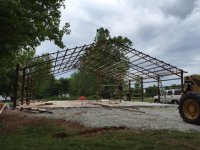
There are 5 steel trusses total. One on each end and 3 throughout the building spaced 10'.
The chicken houses were 300 to 500' long with a sliding door on each end. I have a couple of friends who have built buildings with these trusses and have had good results.
Here is a pic of the frame with no end walls or sheeting.
Attachments
Shiftless
Well-known member
Thanks for adding that shot of the basic frame. It will be fantastic to have all that open floor space and the wide open headroom for lifts or whatever you want. Good luck with the rest of your build.
bczygan
Well-known member
I don't have details... It is a re-purposed poultry house frame. so it has proven engineering.
Not there, it doesn't have any engineering. Those are narrow width gable end wall panels, stick built by you, between and on either side of the three door openings. They need to be shear panels because of their narrow width. It's just prudent to detail them that way, and not just in earthquake country. It's just the cost of plywood, screws, glue and metal ties and straps.
And on another thread I see where you added length to the column portion of those trusses. Was that engineered, or jury rigged?
When you add length to a column, you are essentially adding length to a vertical beam. You are also adding load to that beam without increasing the section of the beam, or it's load carrying capabilities. In this case, the wind loads are the critical factor. Here again, I might have erred on the side of caution and added a member to the entire length of the modified column, to increase the section modulus. That's something you can still do BTW.
You see, if you don't at least do some rough calculations, you will never know the real capabilities of your structure. You don't know when or where it will fail.
I have to ask, what were the engineering specs for a chicken house? Are they the same load requirements for a building inhabited by people, like a workshop or garage?
And that engineering was for the chicken house as originally built, with the same exact cladding, roofing, length of columns, truss spacing, purlins and end wall construction etc.
You may be perfectly fine for many years, maybe for the rest of your life. You will just never know for sure.
Here's why. Buildings are designed and engineered to withstand a particular set of conditions, for your location. When this is done, you know how they will perform, and when they are in danger of damage.
End of day, I will say that I envy your clear span tall center height space and the initiative it took to build it.Were permits required?
Bill
Last edited:
OP
nterry1957
Well-known member
Not there, it doesn't have any engineering. Those are narrow width gable end wall panels, stick built by you, between and on either side of the three door openings. They need to be shear panels because of their narrow width. It's just prudent to detail them that way, and not just in earthquake country. It's just the cost of plywood, screws, glue and metal ties and straps.
And on another thread I see where you added length to the column portion of those trusses. Was that engineered, or jury rigged?
When you add length to a column, you are essentially adding length to a vertical beam. You are also adding load to that beam without increasing the section of the beam, or it's load carrying capabilities. In this case, the wind loads are the critical factor. Here again, I might have erred on the side of caution and added a member to the entire length of the modified column, to increase the section modulus. That's something you can still do BTW.
You see, if you don't at least do some rough calculations, you will never know the real capabilities of your structure. You don't know when or where it will fail.
I have to ask, what were the engineering specs for a chicken house? Are they the same load requirements for a building inhabited by people, like a workshop or garage?
And that engineering was for the chicken house as originally built, with the same exact cladding, roofing, length of columns, truss spacing, purlins and end wall construction etc.
You may be perfectly fine for many years, maybe for the rest of your life. You will just never know for sure.
Here's why. Buildings are designed and engineered to withstand a particular set of conditions, for your location. When this is done, you know how they will perform, and when they are in danger of damage.
End of day, I will say that I envy your clear span tall center height space and the initiative it took to build it.Were permits required?
Bill
No permits required where I live.
Explain to me what I would need to do to include a shear panel. I guess I don't understand how they work.
My definition of Jerry rigged and yours may be different but I don't think anything in this building is Jerry rigged.
I certainly understand engineering is important but I am comfortable with the design. Like I said, I have friends who have used this design with a 14' sidewall and the building has stood like a rock for years through some pretty hairy weather.
This building has already been through 60 mph winds.
bczygan
Well-known member
No permits required where I live.
Explain to me what I would need to do to include a shear panel. I guess I don't understand how they work.
My definition of Jerry rigged and yours may be different but I don't think anything in this building is Jerry rigged.
I certainly understand engineering is important but I am comfortable with the design. Like I said, I have friends who have used this design with a 14' sidewall and the building has stood like a rock for years through some pretty hairy weather.
This building has already been through 60 mph winds.
https://www.google.com/search?newwindow=1&tbm=isch&sa=1&q=garage+shear+panel&oq=garage+shear+panel&gs_l=img.3...34274.36738.0.36975.7.7.0.0.0.0.0.0..0.0....0...1c.1.64.img..7.0.0.Aw-LyCJ1fhE
Anything that is not engineered, is by definition, jury rigged. "Stood like a rock" is not a measurement of capacity. That said, you may find great service from this building. What engineering could do for you though, is to determine exactly the capacity AND the weakest point of potential failure.
Let's say that the building as a whole is capable of resisting a steady state wind of 60 MPH, but the restructured columns were only capable of momentarily resisting that force. Wouldn't you want to know that, so you could make the columns as capable as the rest of the building?
Bill