To avoid these ads, REGISTER NOW!

Movement in gable end wall - Need Advise

spencerb

Member
Joined
Dec 22, 2015
Messages
12
I recently had my 35x28 attached garage built. While I was hanging wall decorations for a birthday party for my daughter I noticed what I thought was excessive movement in the gable end wall. You could easily shake the entire wall and it looked like the header was bowing out where it met the gable portion. I was concerned about it and contacted my builder and architect.

My builder initially suggested running bracing along the trusses to stiffen the wall. The scissor drawings specify bottom chord bracing of a rigid ceiling or 9-8-9 OC bracing. I planned to get drywall up eventually so bottom chord bracing was not installed initially. I need finish many other things before I get to drywall so it might not be up for awhile. So I was planning to get some bracing in but I have no idea what 9-8-9 OC bracing is that is specified on my truss drawing.

My architect then contacted me and and said the scissor truss should not have been used to form the gable end wall. Her remedy was to remove the scissor truss and stick build the gable end wall. Keep in mind that sheathing, siding and roof have all been installed on the exterior so this would be a significant job.

Not sure what to do now. My builder contacted me again and suggested running sistered 2x4s along the existing 2x4s that are flat to match the truss width and nailing to the top plate if I want to stiffen up the gable end. I was also thinking about running 2x6s 16 OC from the top plate and notching them out in where they meet up with the scissor. Looking for suggestions on what would be the best route. Also planning on running some bracing on the bottom chord of the trusses to tie everything together once I finish beefing up the gable ends. Still have no idea what was meant by 9-8-9 bracing on my truss drawings.

Here is my gable end wall
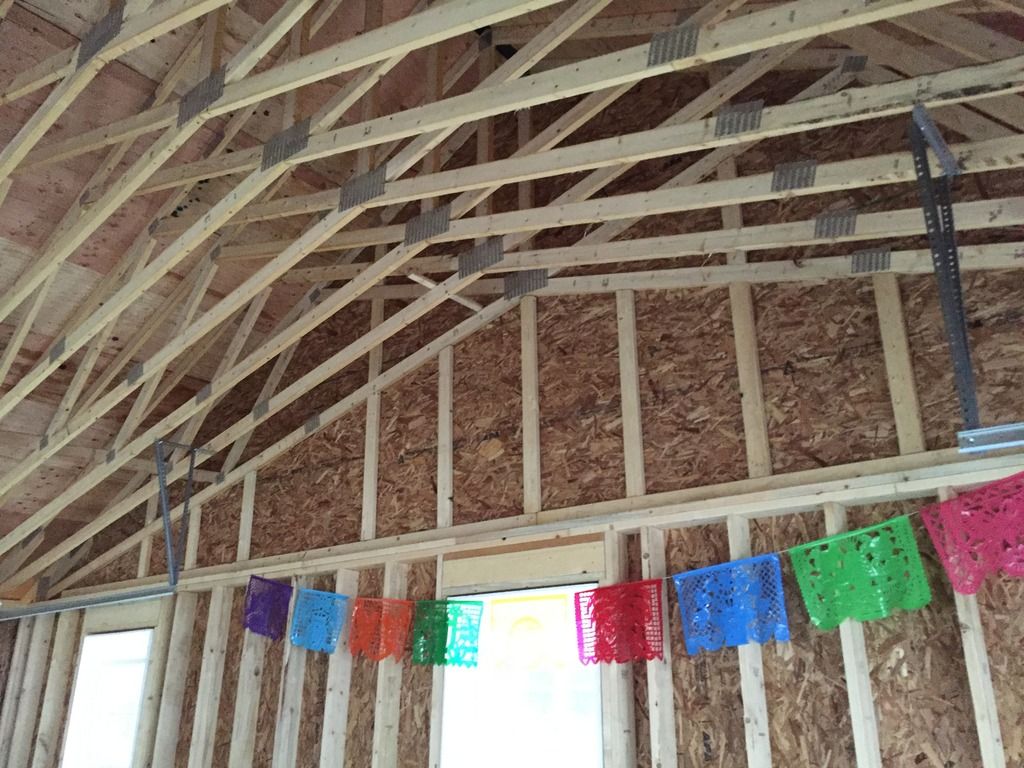
IMG_6566_zpsogd62j4y.jpg


Another look at gable end wall
IMG_6519_zpschutjrmu.jpg


Front corner
IMG_6571_zpshoqyjiu4.jpg


House end with attic trusses
IMG_6573_zps43l2xile.jpg


Scissor truss drawing
truss%20drawings.unlocked_zps0yaz57nm.jpg
 
Last edited:
To avoid these ads, REGISTER NOW!

BillK

Well-known member
Joined
Aug 24, 2006
Messages
9,321
Location
Beautiful Southern Maryland
Part of the problem in my opinion is that they put all of the "joints" in the top plate right near the center of the wall. If they had used longer 2x4's instead of a bunch of short ones, and staggered the joints better it would probably be a lot sturdier. I am pretty sure you can get 2x4's up to 24 ft long.

I would personally find someone who can give you a second opinion, other than your builder.

I am not an expert in this subject but it is almost common sense to me.
 
Last edited:

BillK

Well-known member
Joined
Aug 24, 2006
Messages
9,321
Location
Beautiful Southern Maryland
Look at the three joints I have arrows going to. They are all right near the center of the wall, allowing a lot of movement.
 

Attachments

  • IMG_6566_zpsogd62j4y.jpg
    IMG_6566_zpsogd62j4y.jpg
    126.7 KB · Views: 535

Zeke

Well-known member
Joined
Aug 13, 2009
Messages
17,176
Location
Long Beach CA, the sewer by the sea.
Part of the problem in my opinion is that they put all of the "joints" in the top plate right near the center of the wall. If they had used longer 2x4's instead of a bunch of short ones, and staggered the joints better it would probably be a lot sturdier. I am pretty sure you can get 2x4's up to 24 ft long.

That is the problem. And since that end got the scissor truss it won't be easy to fix that and have a nice flush drywall job to the bottom of the truss. Personally, I'd lay a piece of square or rectangular steel tubing up on top of the 2 plates and lag in down to the plates No need to go all the way, about 10 or 12 feet of steel should stiffen that right up.

I think the OP's notched 2 x's is also a good idea but there will still be a horizontal break at the plate line. You need to fur out that part above the plate anyway for a flush wall.

Don't use that builder again. He doesn't get it.

BTW, I don't know what 9-8-9 is either.

BillK, I think the center 'break' you have an arrow to is a pencil line. But you're sure correct that that is poor planning AFA framing goes. Also, IIRC, the minimum overlap is 4'.
 
Last edited:

Chris705

Well-known member
Joined
Nov 1, 2012
Messages
834
Location
The Finger Lakes of NY
Spencer - the 989 bracing is flat bracing (2x4) installed on the top side of the bottom chords. In a horizontal plane measure over 9' and plumb up from there to the top of the bottom chord and fasten 2x4 along this line. Lap 2x4's to ensure continuous brace. Measure over 8' and repeat, then another 9'. This roughly divides the length of the truss in quarters and therefore three lines of bracing. The bracing should extend out to the gable end and attach there solidly. At your attic truss end I would run horizontal bracing behind the vertical webs that form the attic. These hopefully would align close to where the scissor truss bracing runs. Additionally I would encourage you to run a 12' diagonal brace from gable end peak down at an angle to peak of vaulted ceiling.

Where in NY are you?
 
Last edited:

raddksn

Well-known member
Joined
Oct 3, 2011
Messages
1,304
Location
south central upper peninsula michigan
Look at the three joints I have arrows going to. They are all right near the center of the wall, allowing a lot of movement.
over a window as well! I had similar situation on house addition. I did all the framing with double top plate and the joints were at least 8 studs apart. my gable end was a scissor truss and I had no movement. hope you can get this worked out without too much headache!
 

aar_man

Well-known member
Joined
Apr 28, 2012
Messages
110
Location
Pennsylvania
When they sheathed the exterior wall, did they osb the "box" then add the trusses and sheath the truss portion? How thin was the osb
In my mind it acts like a hinge. I like to stagger the osb (add use a little thicker on the gable end)on the bottom and run the full sheet up to the truss. It seems to tie the two components together.
Perhaps some of the metal strapping that is used for truss spacing attached to the bottom chord of some of the trusses or a 2x4 on a diagonal on the top of the bottom chord(tight to install). Might take some of the wiggle out until you are able to tie things together.
 

BillK

Well-known member
Joined
Aug 24, 2006
Messages
9,321
Location
Beautiful Southern Maryland
BillK, I think the center 'break' you have an arrow to is a pencil line.

Zeke,
You might be right, the o.p. can tell us for sure but I just enlarged it pretty good and I am pretty sure it is a joint also. That's all three of them right in the center of the wall and it looks like they used a bunch of 6 ft ones to make up the top plate :( I would have used a couple of 20 ft 2x4's for the top and bottom of the three myself.
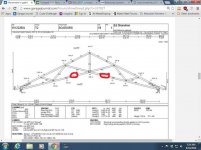
You really have to wonder how someone who is a "builder" does not realize that ? I am pretty much a diy as far as construction goes, not a pro, but that is simple mechanics if you ask me.
 

RocketScott

Well-known member
Joined
Jul 20, 2016
Messages
262
Location
Lexington, KY
9 feet
8 inches
9 sixteenths

That's the maximum distance between 'rat runs', or bottom chord bracing. True that it's not needed if Sheetrock is installed. I put them in for the reason you discovered depending on the house. That number is the max so whatever is balanced and easy to get in works.

That wall would have been better if the studs ran all the way up to the truss but it's not bad the way it is now. I've framed some houses that were exactly like that except the gable was a regular truss, not scissored.

I would brace the bottom chord of the scissors and go with your idea of 2x6 from the top plate to the truss. You don't have to go with 16 oc. Forming an L with those 2x4 uprights you already have will probably make it stiffer.

Your architect is an idiot. That is not how it should have been done, even if starting from scratch.
 

Vintage Veloce

Well-known member
Joined
Feb 27, 2015
Messages
1,076
Location
San Diego
Call the PE whose stamp is on the truss design.
If you can't get to him, call this guy: he helped me with my truss issues:

Aaron M. Reed, PE, MBA
DEADLINES ENGINEERING
601 Morro Bay Blvd, Suite F
Morro Bay, CA 93442
805-771-9649 (P)
805-771-9673 (F)
805-400-9390 cell
Fixmytruss.com
Fixmyjoist.com
 

RocketScott

Well-known member
Joined
Jul 20, 2016
Messages
262
Location
Lexington, KY
So.

I'm a professional framer. Been doing this for, a while.

I'm not going to call anyone out but there is some really, really bad information and assumptions that have been presented here.

I know everyone wants to help.
 

larry4406

Well-known member
Joined
Jan 27, 2006
Messages
19,249
Location
Northern Virginia
I think the posts above are are on point - The double top plate splices are in the center of the wall and too close together creating a hinge. Also the scissor truss used as the gable is not stiff enough.

It looks like your walls are 2x6? If so, then you can add a long 16 to 20' 2x4 to the top of the top plate significantly overlapping the center plate splices. Do this only after string lining the wall to ensure it is straight and not bowed. Same concept as Zeke's metal stiffener.

The gable scissor truss has its 2x4's turned so the 1.5' dimension is in the plane of the gable. This is the weak axis for flexing of the gable. The framers that build for me all nail a 2x4 (2x6 in your case?) to the side of these vertical 2x4's to create an "L". This L-stiffener runs all the way down to the double top plates (triple plate for you) and is nailed to the plate. In some cases, a horizontal 2x6 is then nailed to the face of L-stiffeners in the attic area to "strong back" the L-s. Upward diagonal bracing is then added to this strong back and anchored to the adjacent trusses.

Your truss drawing does not show any lateral bracing. Typically the gables are braced to react large wind loads. I would add 2x4's laid flat to the top of the bottom chord as indicated and run these out to and nailed to the scissor gable and towards the other end of the garage to the extent possible so as to not interfer with your attic. If necessary, these added 2x4's can be run at a diagonal as viewed from above.
 

Attachments

  • Truss Brace.jpg
    Truss Brace.jpg
    90.4 KB · Views: 226

ms fowler

Well-known member
Joined
Jun 27, 2012
Messages
450
Location
Littlestown, PA _ 6 miles south of Gettysburg
larry4406 nailed it (ha ha)--you have a hinge--actually 2, in the top plate. One hinge is the break in the end wall at the 10' level-or whatever the ceiling height is. The other hinge is where they spliced the top plates. IMO, the builder should have run the studs for that end wall all the way to the bottom chord of the truss, all the way to the roof and not used the truss at all. The solution is to run some studs the full height of the wall.

As for the lateral bracing....yes it should be installed if you are not immediately installing the dry wall. It is amazing how much stiffness the drywall adds to typical wood framing. The easy rule-of-thumb is to install the lateral bracing on the top side of the bottom chord as close to the splice plates. Looking at your truss drawing, that would give you three (3) rows of lateral bracing. It is also a good idea to install "W" bracing on the end walls--also on the bottom chord. This would be another row of 2X4 run at an angle from the end wall back about 5 trusses, also on the bottom chord, on top of the lateral bracing.
Your building is right now in the weakest state that it will ever be in. It is in danger from strong winds until you add the bracing, or the drywall, but you need to do something quickly.
 

sierradmax

Well-known member
Joined
Sep 5, 2005
Messages
461
Location
Rhode Island
+1 for diagonal & lateral truss bracing. Add 3/4" CDX ply on the inside wall and lay it out so you lap a full sheet over the double top-plate.
 

CTyankee

Well-known member
Joined
Jan 13, 2013
Messages
3,795
Location
CT
+1 for diagonal & lateral truss bracing. Add 3/4" CDX ply on the inside wall and lay it out so you lap a full sheet over the double top-plate.

I'd do that plus furr out the fill in framing of the truss to match the plane of the wall and run the plywood right up into the attic area.
 

coldh2o

Well-known member
Joined
May 21, 2013
Messages
1,432
Location
Ontario, Canada
Spencer - the 989 bracing is flat bracing (2x4) installed on the top side of the bottom chords. In a horizontal plane measure over 9' and plumb up from there to the top of the bottom chord and fasten 2x4 along this line. Lap 2x4's to ensure continuous brace. Measure over 8' and repeat, then another 9'.

Not this^^^.

This:

9 feet
8 inches
9 sixteenths
 

astroracer

Well-known member
Joined
Jun 22, 2005
Messages
3,001
Location
Mid_Michigan
Have the BUILDER fix this... it is his responsibility!
I would have him add the bracing in the gable as described above PLUS a 12' piece of "C" channel glued and lagged into the header plate and gable. Make sure this is all done with the gable end plumb.
IMG_6566_zpsogd62j4y-vi.jpg

Mark
 

Orionrising

Well-known member
Joined
Nov 16, 2012
Messages
960
Location
Western Maine
Is there any linear bracing at all or just the sheeting? I dont see any truss spacers or anything I am surprised they managed to sheeth it. Without proper bracing trusses are dominoes

Sent from my ALCATEL A564C using Tapatalk
 

KnurledNut

Well-known member
Joined
Jan 28, 2011
Messages
8,130
Location
n/a
If i was in your shoes, i would install the rat runs first.
Dont over think the spacing.
You need three runs across the bottom chord. One at the big gusset at the center, and one on each side at the gusset halfway down.

With that strengthened, you will know better how to proceed with the rest.
 
To avoid these ads, REGISTER NOW!
OP
S

spencerb

Member
Joined
Dec 22, 2015
Messages
12
No lateral bracing installed at the moment. I was planning on putting in two lateral runs where they can tie right into the attic truss vertical brace so the bracing is continuous from gable to gable. It will not satisfy the 9-8-9 requirement but I will eventually be putting in a rigid ceiling.

As far as the top plate, I believe it is composed of 2x6 10' members. My walls are all 2x6 9' height. Couldnt go 10' as it was critical to get the roofline under a existing window. I assume they just used the 10' 2x6s for the top plate. Getting a 12' 2x4 and bolting it down to the existing top plate sounds like a good idea.

Also now thinking I will put up vertical 2x4 runs that meet at the existing 2x4s to create Ls.
ls_zpszkyynxdt.jpg
 

Kevin54

MEMBER EMERITUS
Joined
Jan 12, 2005
Messages
29,341
Location
Urbana, Ohio
Are you going to finish off the inside of the garage? If you are, once you get your drywall, OSB, or whatever you are going to use on the inside, the movement will stop. I have a 28' wide garage with (2) 10' garage doors, and the three wall sections divided up evenly with each at a little over 2'. I had all sorts of gable end wall movement. Plus I have scissor trusses. Once I ran a 2x4 on each side on top of the rafter bottom, on each side, then drywalled, I have no movement at all.
 
OP
S

spencerb

Member
Joined
Dec 22, 2015
Messages
12
I am planning to hang drywall eventually. I do believe that will stiffen things up. I rather have the walls stiffened up before the drywall goes in so that just provides extra support.
 

astroracer

Well-known member
Joined
Jun 22, 2005
Messages
3,001
Location
Mid_Michigan
Drywall is not structural so don't rely on that to strengthen the wall. It won't. Any itching between the drywall and the studs (think wind moving the wall) will loosen the fasteners.
Mark
 

pstnbly

Well-known member
Joined
Jul 20, 2010
Messages
766
Location
So. Vermont
Look at the three joints I have arrows going to. They are all right near the center of the wall, allowing a lot of movement.

IMHO the gable wall should have been framed with continuous vertical members (studs) from the bottom plate to the top cord of the truss and the scissor truss applied to the inside of the framing. This shows a very common framing error, having a "knee" joint in a gable wall.
 

mbatarga

Well-known member
Joined
Sep 14, 2005
Messages
883
Location
GA
I experienced almost the exact same thing with my build -and I had a full gable truss used. Long story - but I noticed when installing exterior siding that the wall was bowing out. We were able to use a come-along and pull the wall plumb from the inside of the building and I installed 4 framing straps diagonally and that solved about 95% of the issue. I don't think the work crew that installed the OSB sheathing made notice of the problem - and I wasn't around when it was put up.

This link has a diagram showing installation:
http://www.finehomebuilding.com/2011/05/19/4-options-for-shear-bracing-foam-sheathed-walls

Edit: the pictures looked almost like my shop - as I have 7 scissor trusses on that end of the shop which is the car garage section - the other trusses over my woodworking area are attic trusses. I believe the lack of being able to tie in the scissor trusses to the attic trusses prevents solid bracing at that end, hence offering the bowing out issue.
 
Last edited:
OP
S

spencerb

Member
Joined
Dec 22, 2015
Messages
12
Zeke,
You might be right, the o.p. can tell us for sure but I just enlarged it pretty good and I am pretty sure it is a joint also. That's all three of them right in the center of the wall and it looks like they used a bunch of 6 ft ones to make up the top plate :( I would have used a couple of 20 ft 2x4's for the top and bottom of the three myself.
.

To clarify the top plate is a double 2x6 and there are only 2 joints above the window.
 
OP
S

spencerb

Member
Joined
Dec 22, 2015
Messages
12
I think the posts above are are on point - The double top plate splices are in the center of the wall and too close together creating a hinge. Also the scissor truss used as the gable is not stiff enough.

It looks like your walls are 2x6? If so, then you can add a long 16 to 20' 2x4 to the top of the top plate significantly overlapping the center plate splices. Do this only after string lining the wall to ensure it is straight and not bowed. Same concept as Zeke's metal stiffener.

The gable scissor truss has its 2x4's turned so the 1.5' dimension is in the plane of the gable. This is the weak axis for flexing of the gable. The framers that build for me all nail a 2x4 (2x6 in your case?) to the side of these vertical 2x4's to create an "L". This L-stiffener runs all the way down to the double top plates (triple plate for you) and is nailed to the plate. In some cases, a horizontal 2x6 is then nailed to the face of L-stiffeners in the attic area to "strong back" the L-s. Upward diagonal bracing is then added to this strong back and anchored to the adjacent trusses.

Your truss drawing does not show any lateral bracing. Typically the gables are braced to react large wind loads. I would add 2x4's laid flat to the top of the bottom chord as indicated and run these out to and nailed to the scissor gable and towards the other end of the garage to the extent possible so as to not interfer with your attic. If necessary, these added 2x4's can be run at a diagonal as viewed from above.

Yes my walls are 2x6

I am thinking about adding a long 2x4 to the top plate

Not sure what you mean by this - In some cases, a horizontal 2x6 is then nailed to the face of L-stiffeners in the attic area to "strong back" the L-s. Upward diagonal bracing is then added to this strong back and anchored to the adjacent trusses.

Definitely adding lateral bracing to the trusses. They will probably end up going right over the lower splice plates on the bottom chord. It looks like that is where they will end up in order to tie them into the attic trusses vertical members so I can go gable to gable.
 

wssix99

Well-known member
Joined
Mar 2, 2011
Messages
5,160
Location
Chicago, IL
IMHO the gable wall should have been framed with continuous vertical members (studs) from the bottom plate to the top cord of the truss and the scissor truss applied to the inside of the framing. This shows a very common framing error, having a "knee" joint in a gable wall.

^ This. Was this building inspected? This wall wasn't even built right to begin with... (I can't imagine this is to code.)

The stud wall should extend all the way to the ceiling - just like every other building on the planet! In this case, the ceiling is the bottom of that scissor truss. (If a normal truss was there, everything would be fine with this wall.) This structure is acting like there is nothing between the top of the wall and the bottom of the truss - because that's the situation. The builder just slapped some sticks flat against wall and sheathing up there for decoration. There is no structure in that triangle of space between the truss and the wall - it's acting like a giant hole! This wouldn't even be safe in a bad storm - that section of wall could blow right in!

The roof and trusses are laterally stable. If the wall extends all the way up to the actual roof assembly, it will be stable also.

I'd have the builder come back out to fix the problem by properly extending the stud wall. I'd also have them bring me a case of beer and a cattle prod for use while I sit by and make sure they get it right. (It should be easy to do, except for taking down the exterior siding to nail properly in to the new wall section.)
 
Last edited:

Zeke

Well-known member
Joined
Aug 13, 2009
Messages
17,176
Location
Long Beach CA, the sewer by the sea.

Yep, good read. The last framing I did was in 2009 and it was all custom hillside room add. Been a contractor for over 45 years and never built a home. Every part of one and commercial too. But never did anything but remodels including the concrete, framing, elec, HVAC and in some cases, light plumbing (no sewer work).

I've done my share of plastering, drywall and painting as well as tile work. I don't know it all by any means and learn something every day. I like what they did in the .pdf ^^^^^ tying the gable wall back into 3-4 trusses top and bottom.

Seems like that would help here instead of my cockamamie idea about square steel tubing.
 

WNYflyer

Well-known member
Joined
Sep 13, 2009
Messages
2,119
Location
Lockport, NY
^ This. Was this building inspected? This wall wasn't even built right to begin with... (I can't imagine this is to code.)

The stud wall should extend all the way to the ceiling - just like every other building on the planet! In this case, the ceiling is the bottom of that scissor truss. (If a normal truss was there, everything would be fine with this wall.) This structure is acting like there is nothing between the top of the wall and the bottom of the truss - because that's the situation. The builder just slapped some sticks flat against wall and sheathing up there for decoration. There is no structure in that triangle of space between the truss and the wall - it's acting like a giant hole! This wouldn't even be safe in a bad storm - that section of wall could blow right in!

The roof and trusses are laterally stable. If the wall extends all the way up to the actual roof assembly, it will be stable also.

I'd have the builder come back out to fix the problem by properly extending the stud wall. I'd also have them bring me a case of beer and a cattle prod for use while I sit by and make sure they get it right. (It should be easy to do, except for taking down the exterior siding to nail properly in to the new wall section.)

Yep,

Gable wall should have been designed with studs that where continous from floor to roof. At least that is one common way of handling a gable end wall. If you can afford to lose the floor space you could probably still do that inside and tie the joint off to that system. You would need blocking tied to the sheeting to keep the long studs from buckling. That is one possible way of handling the problem, probably other ways but all ugly, pick your poison. Of course best way would be to take the wall down and rebuild it properly. You would need to do that in sections though since the present wall is still working as a shear wall for wind loads on the side walls since the building is buttoned up

Bottom chord bracing should have been installed already, they are especially important for any wind uplift on the roof that could cause the trusses to bend upwards rather the typical downwards. The problem with the bracing is now you will be tying off to an unstable wall caused by the hinge so that bracing really won't work as intended.

If you get a good wind on that end wall it could come down and since that is also the shear wall that takes the wind on the side walls down to the ground then you whole structure is compromised.

Better get your contractor on the stick and have him come up with a solution. Given how it looks now I would have a professional review and possibly observe the fix he comes up with.

If your architect specified the building then let them handle it with the contractor.
 
Last edited:

larry4406

Well-known member
Joined
Jan 27, 2006
Messages
19,249
Location
Northern Virginia
Yes my walls are 2x6

....Not sure what you mean by this - In some cases, a horizontal 2x6 is then nailed to the face of L-stiffeners in the attic area to "strong back" the L-s. Upward diagonal bracing is then added to this strong back and anchored to the adjacent trusses....
.

I will try to further explain.

On the scissor gable, you have flat vertical 2x4's at all but a few locations (add where missing on the left side). Put these at 16" on center. To the sides of these 2x4's, add a vertical 2x6 in the plane of the wall extending from the plate to the top of the truss and nail it to the side of the vertical 2x4's to create an L brace (you will have to notch the 2x6 to pass the bottom chord of the scissor). Then add a horizontal 2x6 above the pitch of the ceiling (6" dimension vertical) which then nails to the edge of the vertical 2x6's. Lastly, add a 2x6 horizontal to this to create another L-brace; this boxes the gable and add's rigidity. This horizontal assembly is the strong back. You can then run diagonals and nail off to the strong back.

I agree the end wall and scissor could have been balloon framed with taller studs and the scissor truss not used, but that ship has sailed and I think you already have the siding on.

I am pretty certain that if you add the continuous top plate to bridge the hinge area, the vertical L-braces, the strong back, the lateral bracing, and diagonals to the strong back, your wall will be rock solid. A competent framer should be well versed in all of this.
 

Attachments

  • gable scissor truss.jpg
    gable scissor truss.jpg
    113.4 KB · Views: 163

cdestuck

Well-known member
Joined
Nov 13, 2013
Messages
1,462
Location
Altoona, Pa
No lateral bracing installed at the moment. I was planning on putting in two lateral runs where they can tie right into the attic truss vertical brace so the bracing is continuous from gable to gable. It will not satisfy the 9-8-9 requirement but I will eventually be putting in a rigid ceiling.

As far as the top plate, I believe it is composed of 2x6 10' members. My walls are all 2x6 9' height. Couldnt go 10' as it was critical to get the roofline under a existing window. I assume they just used the 10' 2x6s for the top plate. Getting a 12' 2x4 and bolting it down to the existing top plate sounds like a good idea.

Also now thinking I will put up vertical 2x4 runs that meet at the existing 2x4s to create Ls.
ls_zpszkyynxdt.jpg

This is exactly what came to my kind as I saw the OP pics. As a woodworker, I'd also be using a good coat of wood glue of poly construction adhesive.
 
OP
S

spencerb

Member
Joined
Dec 22, 2015
Messages
12
I will try to further explain.

On the scissor gable, you have flat vertical 2x4's at all but a few locations (add where missing on the left side). Put these at 16" on center. To the sides of these 2x4's, add a vertical 2x6 in the plane of the wall extending from the plate to the top of the truss and nail it to the side of the vertical 2x4's to create an L brace (you will have to notch the 2x6 to pass the bottom chord of the scissor). Then add a horizontal 2x6 above the pitch of the ceiling (6" dimension vertical) which then nails to the edge of the vertical 2x6's. Lastly, add a 2x6 horizontal to this to create another L-brace; this boxes the gable and add's rigidity. This horizontal assembly is the strong back. You can then run diagonals and nail off to the strong back.

I agree the end wall and scissor could have been balloon framed with taller studs and the scissor truss not used, but that ship has sailed and I think you already have the siding on.

I am pretty certain that if you add the continuous top plate to bridge the hinge area, the vertical L-braces, the strong back, the lateral bracing, and diagonals to the strong back, your wall will be rock solid. A competent framer should be well versed in all of this.

Going to be lots of notching 2x6s when I get into the web of the scissor with the 2x6s that go from the plate to the top chord of the scissor.

I think I am following everything your saying through adding the 2x6 above the ceiling line. Not sure what you meant by then adding a 2x6 horizontal to this to create another L-brace; this boxes the gable and add's rigidity?
 

red61cj5

Well-known member
Joined
Mar 31, 2016
Messages
3,749
Location
West Virginia
Some linear truss bracing, along the bottom chords,( I cant see any), would go a long way toward stiffening up that gable. Just 2x4's run along the top side of the bottom chords, from gable to gable, also some diagonal braces on the web chords wouldn't hurt either, and should be specified in the paperwork that came with the trusses.
 

Falcon67

Well-known member
Joined
Jun 11, 2009
Messages
18,371
Location
Merkel, TX
Going to be lots of notching 2x6s when I get into the web of the scissor with the 2x6s that go from the plate to the top chord of the scissor.

I think I am following everything your saying through adding the 2x6 above the ceiling line. Not sure what you meant by then adding a 2x6 horizontal to this to create another L-brace; this boxes the gable and add's rigidity?

Yea, you notch the boards - that's SOP for a gable end as far as I've ever done it. Makes a rigid gable and a continuous nailing surface from bottom to top, if needed.

Framing32.jpg


Strong back - not quite what you'd need for those trusses but similar. I have two running down both sides all the way from one end to the other. Locks the rafters on center and ties in the gable ends.

Framing36.jpg
 
OP
S

spencerb

Member
Joined
Dec 22, 2015
Messages
12
I experienced almost the exact same thing with my build -and I had a full gable truss used. Long story - but I noticed when installing exterior siding that the wall was bowing out. We were able to use a come-along and pull the wall plumb from the inside of the building and I installed 4 framing straps diagonally and that solved about 95% of the issue. I don't think the work crew that installed the OSB sheathing made notice of the problem - and I wasn't around when it was put up.

This link has a diagram showing installation:
http://www.finehomebuilding.com/2011/05/19/4-options-for-shear-bracing-foam-sheathed-walls

Edit: the pictures looked almost like my shop - as I have 7 scissor trusses on that end of the shop which is the car garage section - the other trusses over my woodworking area are attic trusses. I believe the lack of being able to tie in the scissor trusses to the attic trusses prevents solid bracing at that end, hence offering the bowing out issue.[/QUOTE

Do you have pics of the straps installed? I strung a line on the wall today and it's bowed out about an inch or so in the middle. Plan to use a come along to get it plub again. If it could strap it to stay plub for the rest of the bracing work I plan to do that would be ideal.
 

jives

Well-known member
Joined
Jan 4, 2013
Messages
2,807
Location
Central NY
Pics of the diagonal bracing along the top of the bottom chord of my garage. There is also straight braces along the whole length of the barn. The diagonal braces tie in the peak of the gable down to the girders. The scissor trusses are only prevented from racking and bowing out by the PBR metal roof panels and the bracing. There is no wood sheathing on the roof.


Mustang1167

Well-known member
Joined
Aug 29, 2011
Messages
949
Location
Pittsburgh, PA
I had the same issue with a cheap build garage I own. I ran what another poster called a "rat run" and the garage seems more stable then when new.
 

SH7mi

Well-known member
Joined
Feb 3, 2014
Messages
186
Location
SE Pennsylvania
IMHO the gable wall should have been framed with continuous vertical members (studs) from the bottom plate to the top cord of the truss and the scissor truss applied to the inside of the framing. This shows a very common framing error, having a "knee" joint in a gable wall.

This is the correct framing method. The fix can be done with minimal effort.
Get the proper length studs, 2x6 I believe you said. Install 2 double studs from sill to lower member of scissor truss. Divide the gable wall in thirds and cut the top plates and lower plate of gable to install the double studs. Then run a latteral brace at both double stud locales atop the lower member of scissor truss connecting all the trusses. This will stiffen the gable.
 
To avoid these ads, REGISTER NOW!
Top Bottom