Hi all, have been looking at air compressors and noted that they are quite expensive and had a thought what would be the drawbacks of multiple less expensive compressors hooked up in series? would 4 2.5 hp 21 gallon compressors at $600.00 really be as good as 1 10 horse 84 gallon?

You are using an out of date browser. It may not display this or other websites correctly.
You should upgrade or use an alternative browser.
You should upgrade or use an alternative browser.
Multiple air compressors
- Thread starter panxerox
- Start date
CompressorPros.com
Well-known member
Those consumer units are 50% duty at best. A decent professional compressor should be able to run 70-75%, so even if they made the same amount of air, which I'm guessing the 2.5 HP units are somewhere around 6 cfm each, you would really get 25% more usable air with a decent compressor. A 10 HP should make about 35 CFM, so you wouldn't even be anywhere near getting the air delivery.
Also, you would probably make any neighbors withing a 40 mile radius pretty upset with the noise those little things would make.
Also, you would probably make any neighbors withing a 40 mile radius pretty upset with the noise those little things would make.
bsaint
Well-known member
Also cheaper consumer units have lower efficiency than a more expensive 10 hp.
Hi all, have been looking at air compressors and noted that they are quite expensive and had a thought what would be the drawbacks of multiple less expensive compressors hooked up in series? would 4 2.5 hp 21 gallon compressors at $600.00 really be as good as 1 10 horse 84 gallon?
In theory yes but as CP pointed out your looking at overrated consumer units. Compare the WATTS power consumption of the 4 units to the single 10. I think you'll find there not equal.. Show us a lik to the two different compressors your working with.
That said you can connect compressors together for more air.
Good luck
lg
no neat sig line
md21722
Well-known member
These 21 gallon units you are looking at for $600 total must be single stage oilless direct drive. The noise will be maddening for you or your neighbors (who may not be wearing ear protection even if you are). Plus 10 HP is going to be dual stage, they make compressed air pretty linear all the way up to 175 psi. Single stage loose efficiency big time after 110 psi. What they say is 5.9 CFM @ 90 PSI may only be 3.7 CFM @ 135-150.
I have done the multiple compressor thing, with a couple Jenny/Emglo 2 HP K pumps, which are some of the highest single stage pumps made in this HP rating. I sold them off and replaced with a pair of Champion R15 pumps running at 5 HP each. The difference is staggering. Quieter, more air, and no problems. Was it cheap? No. Was it worth it? Yes.
You are talking about running them in parallel, not series. When doing this on these cheapie and they are running hard, they will make a lot of water. You will probably need an extra tank just to help trap it all. Otherwise it will go straight through your filtration system unless you have a drier or after cooler at the end or after coolers on each compressor (unlikely).
A single 10 HP would be more efficient but it will cost you some coin. They are typically rated around 35CFM. With 4 cheapie's you are probably looking at 16 CFM at 135-150 PSI.
If you are using air tools that actually require 7.5-10HP worth of compressor, the pressure drop across the regulator/filter and hose will be about 25-30 PSI even on a standard 25-35 foot hose. So you need to set that regulator around 115. If these cheapie don't come on until 90 you are already robbing your tools of power.
I have done the multiple compressor thing, with a couple Jenny/Emglo 2 HP K pumps, which are some of the highest single stage pumps made in this HP rating. I sold them off and replaced with a pair of Champion R15 pumps running at 5 HP each. The difference is staggering. Quieter, more air, and no problems. Was it cheap? No. Was it worth it? Yes.
You are talking about running them in parallel, not series. When doing this on these cheapie and they are running hard, they will make a lot of water. You will probably need an extra tank just to help trap it all. Otherwise it will go straight through your filtration system unless you have a drier or after cooler at the end or after coolers on each compressor (unlikely).
A single 10 HP would be more efficient but it will cost you some coin. They are typically rated around 35CFM. With 4 cheapie's you are probably looking at 16 CFM at 135-150 PSI.
If you are using air tools that actually require 7.5-10HP worth of compressor, the pressure drop across the regulator/filter and hose will be about 25-30 PSI even on a standard 25-35 foot hose. So you need to set that regulator around 115. If these cheapie don't come on until 90 you are already robbing your tools of power.
Last edited:
I happen to have 2 consumer home workshop style units, although I only use the newer one. If you where to hook them together, I'm thinking the only advantage would come about if you had them both feeding one larger tank (2 smaller pumps filling the large tank in a reasonable period)? Also, you couldn't actually relize higher working pressure. It's not the same effect as hooking batteries in series Vs. parallel. I'm more asking this than making a statement. Any feedback or comments?
Sent from my SM-G900V using Tapatalk
Sent from my SM-G900V using Tapatalk
dkroth
Well-known member
The Challenge is controlling them.
For instance, do you want them all to come on at the same time? Do you want one to start and then the next 15/30/60 seconds later?
For instance, do you want them all to come on at the same time? Do you want one to start and then the next 15/30/60 seconds later?
md21722
Well-known member
I happen to have 2 consumer home workshop style units, although I only use the newer one. If you where to hook them together, I'm thinking the only advantage would come about if you had them both feeding one larger tank (2 smaller pumps filling the large tank in a reasonable period)? Also, you couldn't actually relize higher working pressure. It's not the same effect as hooking batteries in series Vs. parallel. I'm more asking this than making a statement. Any feedback or comments?
You don't really "need" an additional tank for plumbing. Where the extra tank comes in is either for additional air storage, or as a water trap, or both. As an example, my 5 HP Champions are sitting on 60 gallon tanks without after coolers. If they run for a while the top of the tank will get up to 180F. Air comes out at 125F, goes 25 feet, where it measures 95-100F, and enters an additional 60 gallon tank. The outlet of this tank goes into an air filter/regulator where it measures 82F. I get zero condensation out of my 1 HP air tools that use 30-35 CFM.
In order to get water out of compressed air, it needs to be as cool as possible because hot air holds more water. The other flip side is that higher pressure air holds less water. Its "squeezed out" of the air so to speak and collects in the tank.
You don't get higher working pressure. You get more CFM. Nothing is going to blow up by hooking a two compressors in parallel. This is routinely done in industry.
My system is not perfect, but it met the requirements and limitations. I was leery of starting a 10 HP single phase motor where I am. I was also leery of moving something that weighs 900 pounds. Otherwise, I probably would've sprung for a 10 HP compressor with after cooler.
The Challenge is controlling them.
For instance, do you want them all to come on at the same time? Do you want one to start and then the next 15/30/60 seconds later?
Most pressure switches are adjustable. Some are not. Pretty much all Condor, Furnas, and Square D pressure switches are you going to see are adjustable so you can time them 5 PSI apart on start, with the same shutoff pressure.
Last edited:
dkroth
Well-known member
Most pressure switches are adjustable. Some are not. Pretty much all Condor, Furnas, and Square D pressure switches are you going to see are adjustable so you can time them 5 PSI apart on start, with the same shutoff pressure.
That's the challenge, isn't it?
Getting both switches to trigger on at the same time is challenging, depending on your air consumption.
If one compressor is set on at 90 and the other 85, unless you're really letting the air out the second one may never come on.
A contactor or solid state relay would allow control of both compressors from one switch, but only if you're ok with them coming on at the same time.
Schurkey
Well-known member
If you actually need a 10-hp compressor, you're barking insane to think that multiple consumer-**** compressors will compare. Single-stage compressors STINK for hard use.Hi all, have been looking at air compressors and noted that they are quite expensive and had a thought what would be the drawbacks of multiple less expensive compressors hooked up in series? would 4 2.5 hp 21 gallon compressors at $600.00 really be as good as 1 10 horse 84 gallon?
TWO-STAGE, baby.
finn
Well-known member
You don't "need " hp, you "need " cfm at the pressure your regulator is set to.
There should be no control issues run two smaller compressors in parallel. The compressor with the regulator set to the highest pressure will do all the work until it can't maintain its set point, at which time the second compressor wit the lower set point will kick in.
There should be no control issues run two smaller compressors in parallel. The compressor with the regulator set to the highest pressure will do all the work until it can't maintain its set point, at which time the second compressor wit the lower set point will kick in.
sberry
Banned
4 sets of wires, 4 circuits, 8 current conductors to 4 pieces of **** plus all the connectors and pipe to hook it all up when 1 cheap 7.5 and maybe even a good 5 hp would serve the load with 1 tool last 10x as long from 1 adequate circuit from 1 set of wires and 2 breaker spaces, a single service valve a single connection.
md21722
Well-known member
That's the challenge, isn't it?
Getting both switches to trigger on at the same time is challenging, depending on your air consumption.
If one compressor is set on at 90 and the other 85, unless you're really letting the air out the second one may never come on.
A contactor or solid state relay would allow control of both compressors from one switch, but only if you're ok with them coming on at the same time.
The reality is that factoring in pressure drop across the filter/regulator and hoses, the pressure switches should come on well above 90. Before I had this current setup, I just staggered them a little. They would come on and off within seconds of each other. Now I have an alternating relay in my setup that controls each magnetic starter coil in a true lead/lag fashion. Whichever compressor starts first is the second one to start on the next cycle. For more advanced applications, with timers and the like, one would need to bump up to programmable relays or PLCs.
Last edited:
sberry
Banned
Or a guy could get 1 compressor.

2mJps
Well-known member
I have 2 that i would like to hook together one is a 7hp and the other is a 5hp both 60 gallon tanks. The 7 is alot faster what would be the best time or presser to have the 5 come on?
md21722
Well-known member
Or a guy could get 1 compressor.
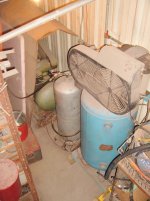
A guy could. In my case I didn't want to deal with moving a 900 pound air compressor and was concerned about the 230A inrush of a 10 HP motor. The 2 x 5 HP units I have work well, don't irritate neighbors, and unless I'm doing some heavy work with angle grinders only one runs at a time. It runs longer, but fewer starts. The alternating relay was about $30 and another few dollars to put it in an enclosure. Works well enough for me.
A single larger compressor should be less expensive overall. I suggest a TEFC motor if used in a dirty/dusty environment, and an after cooler. At 10HP, I would go with Champion or Saylor Beall. Eaton/Polar Air sells Saylor Beall import clones and will probably be more reasonably priced. Check with your local compressor dealers as their prices may better than online and they will generally deliver and put it where you want it for not a lot of money. My local dealer gave me the option for lift gate direct ship from manufacturer, or have it sent to them and they deliver and place for $100.
If you really need 10 HP, you will need a 60A-100A breaker and #6 THHN (in conduit) or #4 NM-b (Romex). I have 10 HP because I live at 6,500 feet and anything naturally aspirated that uses air gets downrated for altitude. Heck, our regular unleaded gas is 85 octane for the same reason.
Last edited:
md21722
Well-known member
I have 2 that i would like to hook together one is a 7hp and the other is a 5hp both 60 gallon tanks. The 7 is alot faster what would be the best time or presser to have the 5 come on?
Whatever you want it to be. If you want the the "7 hp" to lead, I'd suggest setting the 5 hp to 5 psi less, same cutoff for both. In duplex compressors there are usually 2 pressure switches, lead and lag, with about a 5 psi cut-in differential.
sberry
Banned
I understand the 2 5hp and one can be set for demand. I have 2 also, the second is set just below the kick of the first and would only come on if air was way down, I turn the breaker off unless I anticipate use such as blasting and with 200 gallons of tank on I am really done with most work before its ever an issue.
I also agree about starting large motors, on residential would way rather have a couple 5's over a 10. I also agree the OP should figure out what he needs, this is beyond a wag.
I use a 3 and a 5, the 3 is way nicer for motor starts. I am out on a rural line.
There is also some difference if this is a hobby and a guy is farting around with stuff he has but to head out to buy 4 comps to cobble something like this together is a brain fart.
I also agree about starting large motors, on residential would way rather have a couple 5's over a 10. I also agree the OP should figure out what he needs, this is beyond a wag.
I use a 3 and a 5, the 3 is way nicer for motor starts. I am out on a rural line.
There is also some difference if this is a hobby and a guy is farting around with stuff he has but to head out to buy 4 comps to cobble something like this together is a brain fart.
Attachments
Last edited: