To avoid these ads, REGISTER NOW!

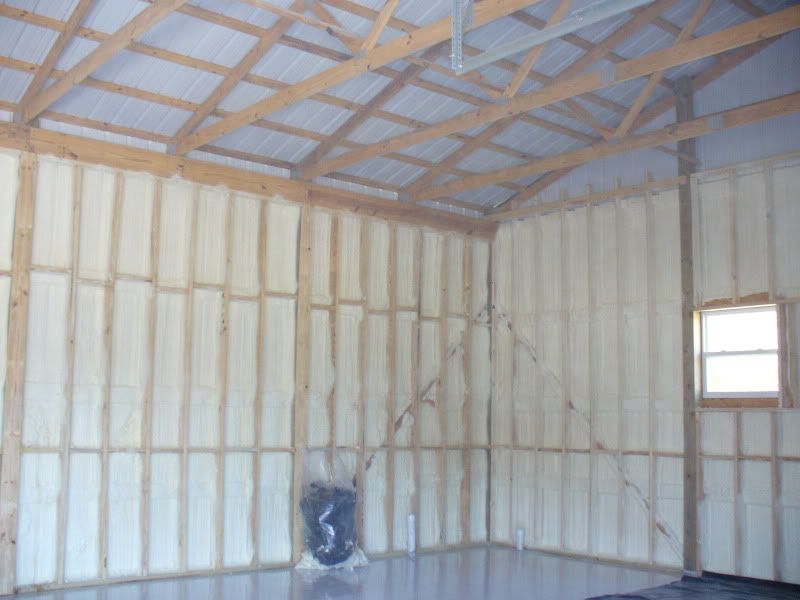
40x60 DONE! Now just need insulation. Spray Foam!??

Repsolracer22

Well-known member
Joined
Jan 4, 2012
Messages
238
Location
central MD
Hey guys, read everything there is to know about insulation. Im thinking that closed cell spray foam is the way to go. I want it done right & efficiently, not trying to pinch pennies.

My building is brand new and I want to use it regularly. Im in MD so it gets cold for multiple months out of the year. I plan on installing a Reznor propane heater because I dont have natural gas. 85% efficient or so.

Anyone done spray foam in a building like this where they spray the foam directly onto the metal roof and walls? I have also read that the way to go is to have them seal up the ridge vents and soffit and everything. That true?
 
To avoid these ads, REGISTER NOW!
OP
R

Repsolracer22

Well-known member
Joined
Jan 4, 2012
Messages
238
Location
central MD
i like that spray foam seals up the place, but if we are spray foaming the entire back side of the metal roof, what happens if the roof springs a leak at some point? I wouldnt know for a long while because the water would have to penetrate all the way through the foam before we'd even notice.
 

Voi

Well-known member
Joined
Oct 10, 2010
Messages
5,147
Location
Western South Dakota
Hey guys, read everything there is to know about insulation. Im thinking that closed cell spray foam is the way to go. I want it done right & efficiently, not trying to pinch pennies.

My building is brand new and I want to use it regularly. Im in MD so it gets cold for multiple months out of the year. I plan on installing a Reznor propane heater because I dont have natural gas. 85% efficient or so.

Anyone done spray foam in a building like this where they spray the foam directly onto the metal roof and walls? I have also read that the way to go is to have them seal up the ridge vents and soffit and everything. That true?

Is this a pole barn? What is your truss spacing and do you plan to put in a ceiling?

Does the building have ventilated soffits and ridge vent?
 

BadgerBoilerMN

Well-known member
Joined
Aug 4, 2011
Messages
837
Location
Minneapolis
I used foamed from the roof to the floor in my 1921 farm house, but the pole shed does not require that level of insulation since you will not be keeping it at 72F.

In my own 40 x 60 pole shed I started with 1/2" Thermax on all but the north side and 1/2" XPS on all other surfaces tacked to the perlins. Then 6" of fiberglass with rock or OSB to finish. At the ceiling I hung 2x4's on 2' centers with 5/8" rock and 20" of blown cellulose over all.

Here in Minneapolis, where we get a month below zero and a month above 85F, this serves us well.

Most insulated pole barns have few windows and if you get a good commercial door, mine is 2" thick-R20, then you will have a tight structure with very modest heat loads in the teens. Mine ended up at 12 btu/sq.ft. as predicted in the Manual 'J' I performed before starting the inside finish.

Air quality is never assured by doing sloppy work but higher fuel bills are.

If are ready to spend what it takes to get a good envelope consider a radiant slab and/or an air-to-air mini-split.

If you insist on an open flame unit heater, the bane of all professional heating men, you might consider the sealed combustion, direct vent low-intensity infrared in a two-stage LP configuration.

This is the unit best suited for most insulated pole shed applications and the one I specify when the slab is poured before the PEX is installed. It will take care of the "response time" questions and if properly sized will be the safest, most comfortable and most energy efficient gas-fired heat sources lacking the noise, dust an inherent inefficiency of blown air and no need to calculate combustion air.

http://www.reverberray.com/wp-content/uploads/2016/05/LBLD3_LD3-Brochure_2-14.pdf
 

DC73

Well-known member
Joined
Dec 27, 2014
Messages
1,627
Location
Lubbock TX
I have also read that the way to go is to have them seal up the ridge vents and soffit and everything. That true?

Yes, seal the ridge vents and soffit vents when going with spray foam. Given your location, you'll want to go with closed cell foam. They do buildings like you propose all the time.

DC
 

haugy

Well-known member
Joined
Dec 1, 2009
Messages
783
Location
Nashville, TN
I had my metal pole barn spray foamed (40x30x14), but only on the walls. I framed in and put a ceiling in mine though so I wanted to let my soffits and ridge vents breathe. However, if I did it again, I'd seal up the roof too as well. It would have been worth it big time. But I had planned to do insulation in the ceiling I made so I wanted to allow air to move. Big mistake. Should have just sealed it up. I could have still done insulation in the ceiling if I had wanted to.

The spray foam is awesome. It deadened so much noise from outside, and from inside-out (grinders etc). It also made it air tight which was great. When I first had the building up, I could feel drafts on windy days. Spray foamed it and they were GONE. The only air movement in there was what I controlled. Some don't like that, but with items in my shop that I want to regulate humidity exposure to, it was great. In winter it helped a lot. I put in R19 batts on the studs I framed in, on top of the spray foam. It only took a 5000w Farenheat heater to keep it around 55-60 in there. And when it was 19 degrees outside, it never got below 30 inside when I would occasionally run a safety heater for the boat.

You could tell a big difference too just by the walls. Knock on your walls now, nice and metal banging sound right? Once you spray foam it's a dead thud. Definitely go with closed cell if you can. I only did 1" of closed cell and it was a big difference. To be honest, it was plenty, I'm not sure another 1" would have done that much more.

For what you asked, I would definitely seal that building up, soffits, ridge vents, etc. They can spray directly onto the ceiling and walls with no issue. You will get some drips while spraying the ceiling, but they'll put a tarp down and you're good. After about 15 minutes it's pretty firm.

P1050934.jpg


P1050933.jpg


These are the batts that went over the spray foam to really insulate the hell out of the place. Then drywall covered them up.

IMG_20101215_190211.jpg
 
Last edited:
OP
R

Repsolracer22

Well-known member
Joined
Jan 4, 2012
Messages
238
Location
central MD
those pics are awesome. thanks.

the problem in the back of my mind with the spray foam, is that once you spray it to the back of the metal, its there. its basically permanent. if you have an issue with that wall or that roof panel and have to replace it, then there goes your foam.

more importantly, the roof deck. if there even is a leak sprung, id never know it. Closed cell foam WONT absorb water, so if theres a leak it would trap water in between the roof deck and the foam and the water would run down to the side somewhere and you'd EVENTUALLY see it weeks or months later (depending on leak size). If it was a small leak, it might be longer. All the while that water just trapped in there molding up.

everything else about the foam im ok with. my 40x60 building was quoted by several different people at an avg of $12,000. This was for 3" on roof deck and 2" on walls. I was ok with that. Its pricey but good ****. The air sealing, the added strength to building, no bugs, good r value, etc etc etc are all great. but i just havent been able to get over that one negative thing which i stated above.

going with traditional would be to stud out the building walls 24" on center with R21 batts, and on my metal ceiling (not roof deck, but ceiling) just put 12" thick of the blown cellulose. That will cost a total of about $3000-$3500 tops for everyting. Probably a little less because I can do some of it myself and this type of labor is cheap and easy to come by. If theres a leak, its very easy to remedy and throw out old insulation and buy new. Cheap & easy. The building is only a year old roughly, but you never know.

But I LOOOOOOOVVVVEE the idea of the spray foam and all the positives. I have the money to do it too. But I just cant shake the issue in my head about the mold possibility from a leak that is very hard to detect. PLUS if/when you notice the leak on the side of your roof because the water ran down, you wont even know where the leak started and how much of your expensive foam to remove/destroy.
 
Last edited:
OP
R

Repsolracer22

Well-known member
Joined
Jan 4, 2012
Messages
238
Location
central MD
by the way, before i get blasted for saying 24" on center for the studs and not smaller ... let me say that the reason 24"OC will be completely fine, is because the building is already built and the way it stands currently is completely structurally sound. So the 24"OC studs would only serve the purpose to hold/space the r21 batts. save some lumber costs!

(some guys i know go even further spaced, but those batts go up in price significantly at that point)
 
OP
R

Repsolracer22

Well-known member
Joined
Jan 4, 2012
Messages
238
Location
central MD
now here's a question ............ if i do traditional insulation with studs and r21 batts .... is there any issues with condensation on walls or anywhere? Is there supposed to be some sort of vapor barrier paper installed first? Because my building has no paper or wrapping on it of any kind. Just exposed metal and wood on inside
 

Todd.Brock

Well-known member
Joined
Jul 15, 2008
Messages
4,250
Location
Cincinnati
You pose an interesting concern that no one foam installer can really answer. They probably will just say hope you got a good builder!

On the 24" OC thing- when I did my basement , I found that r-13 for 16 OC rolls was much cheaper than pre cut bats and still cheaper per square ft for the r-13 that was for 24"OC walls. Something to compare if you go that route - extra studs vs higher insulation cost may be a wash
 
OP
R

Repsolracer22

Well-known member
Joined
Jan 4, 2012
Messages
238
Location
central MD
You pose an interesting concern that no one foam installer can really answer. They probably will just say hope you got a good builder!

On the 24" OC thing- when I did my basement , I found that r-13 for 16 OC rolls was much cheaper than pre cut bats and still cheaper per square ft for the r-13 that was for 24"OC walls. Something to compare if you go that route - extra studs vs higher insulation cost may be a wash

thanks for the info on the stud/r13 thing. I will consider that and do the math on that.

Back to the spray foam ....

I actually had a national company do one of my estimates. I asked him about my concerns and he couldnt respond at all. Except to say, yes, that's a possibility.

My building is practically new, and its built very well by a reputable builder. So no concern there. But you just never know with other things that come up like heavy winds or damage from a tree etc etc
 

BadgerBoilerMN

Well-known member
Joined
Aug 4, 2011
Messages
837
Location
Minneapolis
Thermax next to the metal, fiberglass inside, no barrier. Cellulose in the ceiling rafters for more R-value per foot, better sound barrier and less cost than fiberglass.

You get natural air flow in the corrugated channels and the Thermax serves as a true vapor and radiant barrier with fiberglass to the inside to add to your stacked up R-value.

You will have little solar gain, everyone in the southwest should be doing this, and you can work on the tin if you need to.

Foam is great for certain applications, every inch of my 1921 balloon-frame farm house is foamed, but this is not one of them.
 
OP
R

Repsolracer22

Well-known member
Joined
Jan 4, 2012
Messages
238
Location
central MD
More R Value, vapor and air barrier. Any condensation on metal doesn't affect batts.

agreed on the extra little Rvalue AND condensation not getting absorbed by fiberglass. that makes sense. those pieces of rigid foam being an air and vapor barrier?? uuuhhh not so sure about that. unless they are sealed somehow, which they wont be.

regardless though. i get the point for condensation reasons. however the thickness of the rigid foam board is a good inch or more correct? Then stacking a 6" batt on top will "overfill" my cavity so to speak wouldn't it? or maybe they have foam board thats 1/2" thick or smaller possibly?
 
To avoid these ads, REGISTER NOW!

walrus

Well-known member
Joined
Nov 12, 2008
Messages
11,679
Location
Maine
agreed on the extra little Rvalue AND condensation not getting absorbed by fiberglass. that makes sense. those pieces of rigid foam being an air and vapor barrier?? uuuhhh not so sure about that. unless they are sealed somehow, which they wont be.

regardless though. i get the point for condensation reasons. however the thickness of the rigid foam board is a good inch or more correct? Then stacking a 6" batt on top will "overfill" my cavity so to speak wouldn't it? or maybe they have foam board thats 1/2" thick or smaller possibly?
They have 1/2 inch but I'd go thicker not thinner. I always wanted to put up sheets as tight as possible and then have a spray foam outfit come in and make it tight. Cheaper than spraying it thicker.
 

BadgerBoilerMN

Well-known member
Joined
Aug 4, 2011
Messages
837
Location
Minneapolis
Polyisocyanurate to be exact.

https://www.awarehousefull.com/dow-thermax-sheathing/

This give you a true radiant and vapor barrier just under the tin. I foam and tape the edges to make it air-tight. The un-face fiberglass is then stacked between the Iso and the finished wall. Having designed many HVAC systems over the years the Manual 'J' heat loads tell the story when you model various insulating stack ups.

Moreover, the radiant barrier afforded by Thermax, or a similar Iso will amaze you. My shop will not get hot enough to run the mini-splits unless the doors are open. I had to add a dedicated de-humidifier to get the rH down below 60%.

This is more effective R-value per dollar, than 2# foam and a more reliable product since foam is only as good as the applicator.

Most pole shed people do not recommend foaming the tin directly for reason previously mentioned.
 

lazer50

Well-known member
Joined
Aug 12, 2016
Messages
606
Location
east central indiana
My situation is similar but less specific but hope something might help.i put my son thru school then he did his intern,partnered with a dr that was retiring,bought him out,bought property built new building got his practice strong all that time lived at home.so he decided to build me a new garage.so we figured 40 by60 14 ft ceilings.now here is where specifics are vague ive worked with my builder for years and he has done r're models on houses that i own etc.so i rely and trust him.im in indiana winters are cold here not like where your at but my point is my builder knows what the weather does.since i wasn't pinching pennies either he used the best materials available.my walls and ceiling are finished and the insulation was blown in.i haven't installed heat yet as i need to run gas lines.but know its insulated well because i store water base paint in a paint cabinet and no issues with freezing.when its 90 and 90 percent humidity its cool in the shop.and when its freezing out i can start my salamander for 20 minutes and shops warm then shut off.sorry for lengthy post but in my case i live in a fairly small community where i trust the builder for recommendations i relied on the local Kirby risk for lighting.but.if your not using a local builder they may not be familiar with your needs.the guys on here obviously know more of specifics than i do lol.
 

mygarageone

Well-known member
Joined
Oct 16, 2013
Messages
2,691
Location
Munising , Mich
Did I miss something ? What I have been reading is you will not have a ventilated roof ?

I don't care what anyone says , no matter how much you insulate that roof , you will have ice build up on the Eve's .
I have client's who were told no ventilation is needed when you have X inches of foam insulation on the roof. Sorry but it won't work .
 

DC73

Well-known member
Joined
Dec 27, 2014
Messages
1,627
Location
Lubbock TX
I have client's who were told no ventilation is needed when you have X inches of foam insulation on the roof. Sorry but it won't work .

Actually, it works very well when done correctly. They do it all the time in Canada and it's now becoming much more prevalent in the U.S.

Search for "unvented attics" on BuildingScience.com or GreenBuildingAdvisor.com for more information.

DC
 

BadgerBoilerMN

Well-known member
Joined
Aug 4, 2011
Messages
837
Location
Minneapolis
Frost is a frozen water vapor.

You want to spend some time with dew point.

I did have fiberglass blown in the walls of my office area and used bats in the garage and shop areas to save money.

Most will be happy with bats in the side walls and cellulose at the roof.

Here in Minnesota we get the worst of everything with 20F below winters, 95F summers, with snow or rain nearly every week.
 

fishspike57

Well-known member
Joined
Sep 11, 2011
Messages
58
Location
Hudson WI
Hey all I live in Wi. Just put up a 36x48 shed. I been thinking 1 inch of foam on everything. Walls and ceiling (ceiling is all ready in). Then r19 in walls and r34 blown in ceiling. I already put in inside girt so. Any advice or thoughts

Thanks
 

Cybeast

Member
Joined
Jan 1, 2016
Messages
5
Location
Iowa
Here in iowa for wood built pole sheds foam insulators only use open cell if you get a leak it will seep out and you will be able to see it. Open cell will hold moisture and start rotting the wood.
 

meathooker

Well-known member
Joined
Dec 10, 2013
Messages
254
Location
Iowa
I’ve always planned on spray foaming my soon to be built metal building. This thread has me re thinking. Time for more research.
 

Fix Until Broke

Well-known member
Joined
Feb 21, 2016
Messages
794
Location
SE Wisconsin
The OP's concern of replacing a metal sheet is valid. My friends shop is 90x100x20 and this is what he did...

Stick build on top of a poured floor with ~12" tall walls. 1) 18x24 overhead door, 1) 18x14 overhead door, 1) 12x12 overhead door, 4 man doors and a couple windows. 2" foam on the ground, floor heat on the foam, 2" of sand on top of the floor heat, concrete above that. Walls are 2x6's with 1/2" foil faced foam board on the outside, tyvek wrap outside of that and tin as the final outside finish. Inside is closed cell foamed full 5.5" thick, another 1/2" foil faced foam board inside and then tin as the final inside finish. I'll have to ask him what he did in the ceiling/trusses, but I'm pretty sure they were foamed as well.

With this, a sheet can be easily replaced without damaging any insulation. As mentioned above, the foil faced insulation provides a radiant barrier, the closed cell provides a vapor barrier along with all the other benefits. This shop is cooled with a 5 ton (60k BTU/hr) unit in the summer - which is ridiculously undersized, but if you keep the doors shut it'll keep the shop in the upper 60's even if it's 90+ and high humidity outside. Heat is from a 350k BTU waste oil boiler that runs at ~150k BTU and only about 2-3 days a week if it's above zero.

It's ridiculously well insulated and heats and cools with less energy than his other building that is half the size and uses blown in cellulose. I think he's got $40-50k in insulation, but it's paid for itself in energy and equipment savings.
 

dcg9381

Well-known member
Joined
Jun 20, 2018
Messages
11,778
Location
Austin, TX
40x50, spray foam (open) straight to the walls, pulins, etc.
You end up with a non-vented building. Same construction is used in residential down here - where attics become "semi-heated" space. No vents in soffit, etc.

Make sure your building doesn't leak, I imagine that foam makes it very hard to find a leak..
 

Fix Until Broke

Well-known member
Joined
Feb 21, 2016
Messages
794
Location
SE Wisconsin
.......... I'll have to ask him what he did in the ceiling/trusses, but I'm pretty sure they were foamed as well...........

Roof trusses are left open, vented through the soffit all the way to the peak. Ceiling trusses have a 1/2" foil faced board on the bottom, tin under that. The trusses were then sprayed 12" deep closed cell foam. It was expensive (~$40k if I recall for the insulation), but has already paid for itself in <5 years, not to mention the comfort and convenience factor.
 

MrSurly

Well-known member
Joined
Jan 15, 2014
Messages
1,671
Location
East Texas
I’m a big fan of spray foam and the details of my build are posted https://www.garagejournal.com/forum/showthread.php?p=6587097. I used open cell in the roof (straight to the metal) and the upper walls, then switched to closed cell for the lower half of the walls. I talked to several foam sprayers and foam customers to guide me on my choices.

My experience is limited so far (year and a half) but I love the stuff.
With open cell on the roof metal, if there is a roof leak, the foam will get wet over a foot or so area and then it will drip. This locates the leak... replace a screw or use a sealer if needed to repair the source of the leak and then *slowly* the foam will dry out. I haven’t found, in talking with many foam customers (I’ve been casually quizzing owners about foam at every opportunity for years before building mine) that anyone has reported rotted wood OR that their “warranty was void” because of foam. I haven’t seen that poll where “most pole barn guys” say don’t use foam on the metal.
In fact, I think that claim is pure BS.
The worry that folks have that foam makes replacing metal 'impossible' is unfounded. While I haven't removed an entire sheet, I have removed metal from window-sized sections of both open and closed cell. It's about as difficult as Velcro. Closed cell is actually EASIER than open.
There’s always speculation about these topics, tho.
With closed cell, you won’t likely see or have a leak through the foam.
A foam seller did tell me that closed cell with a leaking screw could trap a small amount of water at the leak site that would not be detectable. That could lead to rust around that area given a bunch of time. That worry was among the reasons that I went with open on the roof.
The sound attenuating property of the foam is impressive. The wind-proofing is amazing. The air sealing is hard to put a dollar figure on. The pest-proofing is comforting (no critter access at all).
Open cell = more R per dollar (Stays soft, easily torn/displaced by impact/kids/pets)
Closed cell = more R per inch ( Dries much harder, far more rugged, kids/pets, ladders don't bother it)
My build is in Texas, so I can’t tell you how it might perform in your climate, but I love the many benefits of foam. Other than cost, I have not found any downside to the stuff, yet.


Sent from my iPhone using Tapatalk
 
Last edited:

EricVonHa

Well-known member
Joined
Oct 30, 2005
Messages
167
Location
Eastern Pa
Closed cell all the way. Find a Lapolla rep and they will give you the straight answer on applying directly to metal. My .02 is there should not be an air gap to the insulated surface. Air gaps cause an exchange of air which then bleeds condensation.

For the above reason, you want to make sure you watch the installers carefully or DIY by renting a spray rig. Air pockets in tight transitions are a big no-no and can occur where it is most inconvenient to reach that extra few inches while on top of a ladder or climbing thru joists

My building is 2x6 construction and the entire envelope is completely sealed. It is seriously tight with R30+ ceilings and 2x6 wall cavities completely foam filled. I waaaay overdid it. The garage door windows are the main temperature exchange areas and they seriously sweat.

The building is seriously rock solid and after 3 years-- no nail pops yet on the drywall!
 

protegeV

Well-known member
Joined
Apr 18, 2018
Messages
13,363
Location
DFW
I'm currently trying to put funds together to get my building insulated. Coworker has a metal building half the size of mine and just 1" of closed cell with no hvac. The difference is amazing.

I plan on also doing batt insulation before covering with osb or plywood in prep for a full HVAC system, but that's all down the road.
 
To avoid these ads, REGISTER NOW!
Top Bottom