To avoid these ads, REGISTER NOW!

Hot Water Storage Tank Piping Question Please

Cemoto

Well-known member
Joined
Aug 26, 2012
Messages
427
Location
Central Massachucetts
Guys,

I can use a little help please.

We are having our boiler replaced this very minute and they are replacing the 40 gal hot water storage tank.
The old HWS tank was feed with 3/4" and it's outlet was 3/4" as well.

The plumber here today used 1/2" to feed the tank (from the boiler) and 1/2" out to the existing 3/4" main feed line which has 1/2" coming off to the utilities (faucet, shower, etc.).

He tells me I will not notice a difference.

Something tells me that does not seem right. Is he B/S me?

Sorry to bother, but any feedback is appreciated!

Thanks!
 
To avoid these ads, REGISTER NOW!

buddyboy

Well-known member
Joined
Oct 8, 2007
Messages
616
make him agree (in writing) that if you do see a difference he'll come back out and switch it to 3/4"
 

zmaxmotorsports

Well-known member
Joined
Jan 11, 2013
Messages
11,948
Location
South of omaha
Guys,

I can use a little help please.

We are having our boiler replaced this very minute and they are replacing the 40 gal hot water storage tank.
The old HWS tank was feed with 3/4" and it's outlet was 3/4" as well.

The plumber here today used 1/2" to feed the tank (from the boiler) and 1/2" out to the existing 3/4" main feed line which has 1/2" coming off to the utilities (faucet, shower, etc.).

He tells me I will not notice a difference.

Something tells me that does not seem right. Is he B/S me?

Sorry to bother, but any feedback is appreciated!

Thanks!
It will reduce the volume of water ,you'll also notice a pressure difference since it will be choked down before returning back to the 3/4".
Why is he using the tank with smaller supply/return fittings?
 

toyotadriver

Well-known member
Joined
Dec 30, 2010
Messages
1,586
It has 3/4in lines. He should have replaced them with 3/4in lines. He probably only had 1/2in on the truck. There is absolutely no valid reason to do what he did. It will DEFINITELY affect flow. How much it'll affect YOUR house depends on how many hot water lines run at one time.
 

James-W

Well-known member
Joined
Feb 3, 2013
Messages
12,432
Location
Southeastern Wisconsin
I agree, it should be 3/4 inch lines and not 1/2 inch ones. I really don't get why the plumber went with the 1/2 inch lines. I mean, even if he only had 1/2 inch on the truck he could have gotten some 3/4 piping and come back. It's not like it would take a week to get the right stuff.
 

gregtwojeeps

Well-known member
Joined
Jul 30, 2013
Messages
5,096
Location
Ky
I can hear that plumber now. " Well, Boss, all I had on my truck was 1/2" pipe and fittings ! :lol:
 
OP
C

Cemoto

Well-known member
Joined
Aug 26, 2012
Messages
427
Location
Central Massachucetts
It will reduce the volume of water ,you'll also notice a pressure difference since it will be choked down before returning back to the 3/4".
Why is he using the tank with smaller supply/return fittings?

When I asked the supervisor why he did not use 3/4" as it was before he said "Because I was not here" "If you see a difference I will change it out"

They still need to connect the outside air and have the electrician come to do the permanent wiring.

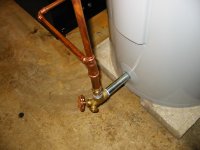
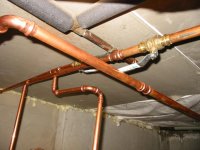
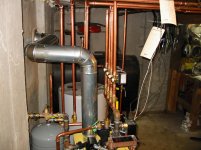
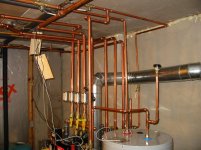
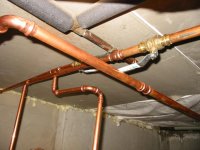
Here are some pics. This set-up w/ tank is $10k

If you want any other pics please ask. Thanks for the help.

Best Regards,

.
 

Attachments

  • IMG_9841.jpg
    IMG_9841.jpg
    130.3 KB · Views: 65
  • IMG_9843.jpg
    IMG_9843.jpg
    139 KB · Views: 65
  • IMG_9846.jpg
    IMG_9846.jpg
    139 KB · Views: 58
  • Img_9838.jpg
    Img_9838.jpg
    131.6 KB · Views: 80

zmaxmotorsports

Well-known member
Joined
Jan 11, 2013
Messages
11,948
Location
South of omaha
When I asked the supervisor why he did not use 3/4" as it was before he said "Because I was not here" "If you see a difference I will change it out"

They still need to connect the outside air and have the electrician come to do the permanent wiring.

Here are some pics. This set-up w/ tank is $10k

If you want any other pics please ask. Thanks for the help.

Best Regards,

.
Looks like a nice install,not a big fan of pro press fittings but still looks decent.
 

CNGsaves

Well-known member
Joined
Sep 26, 2012
Messages
13,233
Location
KS and OK
Is it just me, or is that piece of galvanized pipe at tank drain just asking for galvanic rust problems ?? Heck, now I'd never use any galvanized steel anywhere with water. I'd rather have brass stub pipe down there.

+1 that overall the install looks well done.
 
OP
C

Cemoto

Well-known member
Joined
Aug 26, 2012
Messages
427
Location
Central Massachucetts
The stub coming from the bottom of the HW storage tank looks like stainless to me not galvanized.

We have a deep well which is why the re-sized pipe concerned me as the shower most commonly used is two floors above the boiler. When I had the house built 30 years ago I told the plumber then that I wanted to run the dishwasher, washing machine and take a 30 min. shower without running out of HW. Suffered too long as a kid with no HW.

Are you guys all of the same mind that I should have him re-plumb the tank outlet to the main feed line to be 3/4?

Many thanks for the help and comments!!!

Regards,

Al
 

Attachments

  • IMG_9840.jpg
    IMG_9840.jpg
    141.3 KB · Views: 23
  • IMG_9847.jpg
    IMG_9847.jpg
    138.9 KB · Views: 24
  • IMG_9841.jpg
    IMG_9841.jpg
    130.3 KB · Views: 21
  • IMG_9846.jpg
    IMG_9846.jpg
    139 KB · Views: 22
To avoid these ads, REGISTER NOW!

gregtwojeeps

Well-known member
Joined
Jul 30, 2013
Messages
5,096
Location
Ky
Most likely a dielectric ****** on the bottom. JMO


th
 

buddyboy

Well-known member
Joined
Oct 8, 2007
Messages
616
that tank should hold more than enough hot water for you, so it's not a question of running out of hot water, it's more a question of how much hot water makes it to the destination.

your cold water should flow like it always has, you may or may not notice a difference in the hot water side of your faucets. if you have separate knobs for hot and cold at a sink you will be able to compare and notice, if it's one mixing valve then you'll just have to adjust it for less cold and more hot, but you may not notice a pressure difference.

basically in the mixing type faucets you'll see a pressure drop as you increase the amount of hot water you call for.

it could be noticeable, and if you do notice a difference at least you know why it's different and who to call to have come out and rectify it.

suggest to the plumber that you would like to have him stop out 10 days after everything is up and running to collect last payment. at least that way you can get him back out if you need it fixed, when you suggest that I bet he'll just say "how bout i switch them out today and just get that final payment now?"
 

gregtwojeeps

Well-known member
Joined
Jul 30, 2013
Messages
5,096
Location
Ky
The OP's HW pressure will be fine if not increased some. As the Zman rightfully pointed out above... when stepping down from a 3/4 in. to a 1/2 in. pipe, the amount of water flow volume (GPM) to the fixtures will be affected. JMO
 
Last edited:

buddyboy

Well-known member
Joined
Oct 8, 2007
Messages
616
oh i thought it went from 3/4 down to 1/2 to tank. then 1/2 out of tank then back up to 3/4
 

gregtwojeeps

Well-known member
Joined
Jul 30, 2013
Messages
5,096
Location
Ky
oh i thought it went from 3/4 down to 1/2 to tank. then 1/2 out of tank then back up to 3/4

Doesn't matter how the step ups and down in pipe/fittings sizes are done. Any point in a pipe line system to where a piece of pipe or fitting is stepped down from the larger parts of line...the volume of water allowed to pass through the line as a whole...is reduced to whatever the smallest fitting will allow through it. JMO
 

buddyboy

Well-known member
Joined
Oct 8, 2007
Messages
616
Doesn't matter how the step ups and down in pipe/fittings sizes are done. Any point in a pipe line system to where a piece of pipe or fitting is stepped down from the larger parts of line...the volume of water allowed to pass through the line as a whole...is reduced to whatever the smallest fitting will allow through it. JMO

that's what i understand was well

i thought that when you step down you increase pressure and decrease volume, and when you step up you decrease pressure, since it's being stepped down then back up again there has to be conversion/efficiency losses in pressure
 

gregtwojeeps

Well-known member
Joined
Jul 30, 2013
Messages
5,096
Location
Ky
that's what i understand was well

i thought that when you step down you increase pressure and decrease volume, and when you step up you decrease pressure, since it's being stepped down then back up again there has to be conversion/efficiency losses in pressure

Correct. If a pipe originates from a pump or pressurized tank, the pressure and volume can be changed by the pipe size. If a system's pump/source is designed with a 3/4 in. outlet, then attaching a 3/4 in. pipe to it will be correct and the pressure/volume will be fixed. Somewhere down stream of the 3/4 in. line, if one installs a 1/2" fitting... then the pressure will be increased coming out of that 1/2 in. fitting, but the volume (GPM ) of water flowing will be decreased....

My own example of what I am trying to say follows. I used the exact same pump in the pic below last week to water my grass while pumping out of a creek that runs along my property. I put a 100 ft. of 3/4 in. hose on it and walked out in my yard and just used my thumb over the end of the hose to make a "fountain spray ". I ran it for an hour and a half, no problem....

The next time I watered, I somehow got the bright idea that I could get it to spray further by using the standard garden hose sprayer with the trigger. Yep, it sprayed a lot further out in a smaller stream, but after about 20 minutes I started noticing the water coming out of the sprayer was surging....

So I go back to the creek and see blue smoke bellowing out from my pump's end bell of the motor and it was red hot. Duuh... the little pump is designed to flow a fixed GPM of water through 3/4 in discharge pipe. NOT the little 3/8 in. opening in a hand held garden hose sprayer nozzle. :eyecrazy:

10945_400x400.jpg
 
Last edited:

Radix2

Well-known member
Joined
May 28, 2014
Messages
1,853
Location
the thumb!, MI
Correct. If a pipe originates from a pump or pressurized tank, the pressure and volume can be changed by the pipe size. If a system's pump/source is designed with a 3/4 in. outlet, then attaching a 3/4 in. pipe to it will be correct and the pressure/volume will be fixed. Somewhere down stream of the 3/4 in. line, if one installs a 1/2" fitting... then the pressure will be increased coming out of that 1/2 in. fitting, but the volume (GPM ) of water flowing will be decreased....

My own example of what I am trying to say follows. I used the exact same pump in the pic below last week to water my grass while pumping out of a creek that runs along my property. I put a 100 ft. of 3/4 in. hose on it and walked out in my yard and just used my thumb over the end of the hose to make a "fountain spray ". I ran it for an hour and a half, no problem....

The next time I watered, I somehow got the bright idea that I could get it to spray further by using the standard garden hose sprayer with the trigger. Yep, it sprayed a lot further out in a smaller stream, but after about 20 minutes I started noticing the water coming out of the sprayer was surging....

So I go back to the creek and see blue smoke bellowing out from my pump's end bell of the motor and it was red hot. Duuh... the little pump is designed to flow a fixed GPM of water through 3/4 in discharge pipe. NOT the little 3/8 in. opening in a hand held garden hose sprayer nozzle. :eyecrazy:


Not quite. The restriction in the line (say where you put the 1/2in above) will cause the pressure loss through the restriction to rise, driving the flow down. The pressure downstream from the 1/2 section will also fall (as does the flow) since it would be lost in the thinner tube. - if the source was a fixed pressure source like a muni supply.

Having said that - You could get a rising pressure (as in your explanation) if using a pump that has a pressure curve that rises faster than the losses in restriction being added - but this is a product of the pump characteristics, not the losses/flow in the piping.

In your hose example, the exit pressure from the restriction is zero (the atmosphere)The distance the spray reaches is a product of the increase in the local flow rate(momentum) of the jet produced by the restriction - even though the restriction actually causes a reduction in the flow rate overall (through the hose). You also benefit from running against a pump that will have a flow-pressure curve resulting a higher pressure as flow decreases, giving an additional boost to the jet.
 
Last edited:

zmaxmotorsports

Well-known member
Joined
Jan 11, 2013
Messages
11,948
Location
South of omaha
The OP's HW pressure will be fine if not increased some. As the Zman rightfully pointed out above... when stepping down from a 3/4 in. to a 1/2 in. pipe, the amount of water flow volume (GPM) to the fixtures will be affected. JMO
I don't see his pressure increasing any,they reduced size before increasing it again.
If they reduced it after the 3/4 that would increase the pressure,I see it as a restriction to flow as its currently done.;);)
 
OP
C

Cemoto

Well-known member
Joined
Aug 26, 2012
Messages
427
Location
Central Massachucetts
Thanks for all the posts guys, here is where we stand.

The shower we use is two floors above the boiler/tank set up and we are on a deep well. In this mornings shower it took me quite a few mins. longer to bathe as the flow had diminished quite noticeably. that being said, I also had the shower mixer on full hot. The water tank was set too cool. When the supervisor returned today to hook up the outside air draw he said that full hot will not flow as much water than when mixed with cold. He turned the tank holding temp up.

He says he will return next week and change the piping to be the 3/4" as it should be.

I have not paid him the total yet, and will wait until it is all square. I'm also getting a $2,100. rebate from National Grid's early boiler replacement program so am happy about that. The money for the rebate comes from a roughly $8. energy efficiency charge we get monthly on our electric bill here in MA, so in a way I've already paid into the rebate program.

So we are grateful to you guys for confirming my initial thoughts.

May you all live long and prosper!

Best regards,

Al
 
To avoid these ads, REGISTER NOW!
Top Bottom