To avoid these ads, REGISTER NOW!

VISE REPAIR 101 all vise repairs, lubricants, sources for parts and the tricks to fix

To avoid these ads, REGISTER NOW!

G-ManBart

Well-known member
Joined
Jan 24, 2015
Messages
2,059
Location
Michigan
Having trouble finding the correct vise jaws for this utility Wilton. Wilton tech support can't find much but this catalog page. Mine is a 645 with 5" jaws that need replacing. One side is missing and one side is worn badly.

I have attached the flyer Wilton tech sent me for your review.

Vise jaw measures 5"L X 3/4"H X 1/4"W (thicker would be ok) with 1/4" -20 threads and holes spaced 3 1/4" apart.

Even the guy from wiltonparts.net didn't stock but could make me a set for about $70.00 he said the common Wilton holes are 2 3/8"

My question: I can use the ones I bought from Wilton, $40 all correct but the screw holes don't align. they are 2 3/8" center

If I did use them would you tap new holes in the vise itself or drill new holes in the jaws?

Thanks,

Will

Send a PM to KMScott here and see if he has a better solution. It may cost a few bucks more, but his jaws are definitely better than factory.
 

Tomthumb717

Well-known member
Joined
Aug 5, 2016
Messages
179
Location
Hanover, PA
Just bought a Reed 204 1/2 swivel vise that is in pretty nice shape. However, it is missing the handle bar for the locking mechanism. Since this is my first Reed vise, what would be the best way to go about trying to either find a used one (preferably) or create a new one.
 

Outlawmws

Well-known member
Joined
Aug 9, 2011
Messages
39,284
Location
The Badlands
Just bought a Reed 204 1/2 swivel vise that is in pretty nice shape. However, it is missing the handle bar for the locking mechanism. Since this is my first Reed vise, what would be the best way to go about trying to either find a used one (preferably) or create a new one.

Locking lever:
Get a 5-6” bolt the size of the hole in the locking nut; also get a matching Jam nut. Grind the points off the hex of the bolt (cosmetic cleanup), and string it through the hole.

Run the jam nut down and jam it into the bottom of the threads of the bolt. Cut off most of the excess bolt. Peen the remainder of the bolt threads into the nut as flush as you can, and file flat.
The last step is again cosmetic: Grind the points off the now captive Jam nut. You have just made a new locking lever for the swivel base…
 
OP
D

drivesitfar

Well-known member
Joined
Oct 23, 2013
Messages
36,036
Location
Pacific Northwest
Tom: until you make the lever like Outlaw mentioned or like other members have done on this thread you can also find a screwdriver that is pretty stout and fits the hole to use for now.

any pictures of your new Reed please post and i use the paperclip just above where we write our posts to attach pictures sort of like attaching pics to an email.
 

david ELDER

Member
Joined
Sep 13, 2016
Messages
8
Location
north carolina
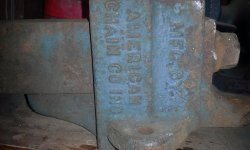
great reading . have you guys ever seen this vice company american chain co found in dads barn. cant seem to find any info.
 

Attachments

  • 20160915_145733.jpg
    20160915_145733.jpg
    147.6 KB · Views: 72
  • 20160915_145748.jpg
    20160915_145748.jpg
    140.6 KB · Views: 62
  • 20160915_145917.jpg
    20160915_145917.jpg
    143.7 KB · Views: 59
  • 20160915_145937.jpg
    20160915_145937.jpg
    144.3 KB · Views: 59
  • 20160915_150004.jpg
    20160915_150004.jpg
    141.6 KB · Views: 52

G-ManBart

Well-known member
Joined
Jan 24, 2015
Messages
2,059
Location
Michigan
great reading . have you guys ever seen this vice company american chain co found in dads barn. cant seem to find any info.

I don't know that brand, but the mechanism is very much like the L.M. & V vises, which aren't common either (although Drives has about three of them...LOL).
 
OP
D

drivesitfar

Well-known member
Joined
Oct 23, 2013
Messages
36,036
Location
Pacific Northwest
DAVID: GMan has been paying attention and i'm not even sure i own 3 L.M. & V vises, but i know i own a few and Fulton is another maker that had that design where the dynamic's screw is attached to the back of the vise. i'm guessing very early 1900's and if you want to post the vise up on the main vise thread maybe one of the members has a catalog or can give you another post or information on your vise.

http://www.garagejournal.com/forum/showthread.php?t=44782

with it's history don't let it get too far from you and looks like it just might need a good cleaning and some grease to last for another 100+ years. also welcome to the forum and glad you stopped by for a visit and maybe you'll stick around to share what you know while we teach you something too.
 

Tomthumb717

Well-known member
Joined
Aug 5, 2016
Messages
179
Location
Hanover, PA
Good day at the auction picked up a Littlestown 3.5" No. 112; Prentiss 4.5" No. 53 and an old Lewis Tool No. 55. Does anyone have any info on the Lewis i believe it is from the late 1800's. More pics to follow as i restore them.
 

Attachments

  • IMG_1545 (1).JPG
    IMG_1545 (1).JPG
    110.3 KB · Views: 68

Tomthumb717

Well-known member
Joined
Aug 5, 2016
Messages
179
Location
Hanover, PA
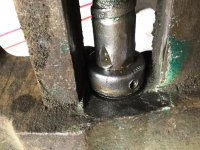
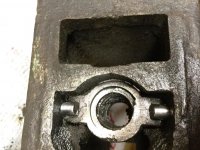
Started to tear down the Lewis 55 today and although seems pretty straight forward i have run into two issues. First, the main screw is held in place with a collar and screw similar to the setup on a Reed. However immediately behind and against said collar there seems to be 3 areas where they gouged out the surface of the screw in a wedge shape creating 3 raised areas that would prohibit the removal of the collar. (see pics below) Second the screw nut is being held in place by two pins and i cant get them to budge. Any ideas on how two address these two issues as i would really like to dissemble the unit completely for restoration.
 

Attachments

  • IMG_1549.jpg
    IMG_1549.jpg
    147.8 KB · Views: 64
  • IMG_1548.jpg
    IMG_1548.jpg
    144.2 KB · Views: 64
  • IMG_1550.jpg
    IMG_1550.jpg
    145.1 KB · Views: 60

Carla

MEMBER EMERITUS
Joined
Nov 27, 2010
Messages
672
Started to tear down the Lewis 55 today and although seems pretty straight forward i have run into two issues. First, the main screw is held in place with a collar and screw similar to the setup on a Reed. However immediately behind and against said collar there seems to be 3 areas where they gouged out the surface of the screw in a wedge shape creating 3 raised areas that would prohibit the removal of the collar. (see pics below) Second the screw nut is being held in place by two pins and i cant get them to budge. Any ideas on how two address these two issues as i would really like to dissemble the unit completely for restoration.

Well.......this is a good example of 'there's no free lunch'.....those issues are a 'not-nice' job, to be sure, but if I was doing it, I'd split the collar on the screw, remove it, and make a new one for re-assembly.

What I would do is to use a small Carboloy rotary file in a die-grinder to notch deeply, at the set-screw bore, and at 180deg. from it (half-way-round), then use a small chisel to break the thin section. I'd use the rotary file to file down the raised areas on the screw, til the screw would pass out of the front jaw, and then file or turn the screw to completely remove the upset areas, to allow the new collar to fit correctly.

For the nut-pins, I'd use the rotary file to notch the pin nearly through, and then use a small chisel to cut through the pins, and bring them down to the casting, enough to free the nut. It seems from the photo that those pins drive in from the outside of the casting, so, with the nut removed, the pins can be driven in far enough to free them.

I'd make new pins of soft mild steel, and taper the ends to suit, for starting that same bend the existing ones have, when driven against the nut, and drive them likewise, at re-assembly.

If you don't have/can't get a suitable die-grinder, the common, cheap 'Dremel' will do the job, if care is taken to stop and allow the Dremel motor to cool back to ambient, as needed.

Added on edit......measure the diameter of the main screw, and get an 'enclosed' ball-thrust bearing of suitable I.D., to fit between the flange of the screw and the outside of the movable jaw, when re-assembling. Losing the friction of that plain flange will make the vise much nicer to use.

cheers

Carla
 
Last edited:

Tomthumb717

Well-known member
Joined
Aug 5, 2016
Messages
179
Location
Hanover, PA
Thanks Carla for the insight. So much for thinking id be done this evening with the restoration. One note, I will check this evening but I believe the nut pins have been driven from the inside and do not extend through the casting. If so, any ideas on how to remove said pins
 

CwazyWabbit

Well-known member
Joined
Jan 9, 2015
Messages
1,189
Location
Surrey, UK
Thanks Carla for the insight. So much for thinking id be done this evening with the restoration. One note, I will check this evening but I believe the nut pins have been driven from the inside and do not extend through the casting. If so, any ideas on how to remove said pins

If that is the case how did they drill the holes in which the pins have been placed? Try sanding the outside where the pin would come through to make it easier to see.
 

Outlawmws

Well-known member
Joined
Aug 9, 2011
Messages
39,284
Location
The Badlands
TT, For the two pins, get a small coupler nut, and a couple of bolts for it, and make a jack screw for it, and see if you can get some spreading pressure going. if they are swelled, this may not work...

On the collar, is the set screw stuck? if not you should able to get flat file in there and work those raised divots down to "not raised"
 
Last edited:

KMScott

Well-known member
Joined
Feb 14, 2012
Messages
4,642
Location
Daufuskie Island, South Carolina
Tom Thumb, Carla and Outlaw have great ideas. If I had to remove the two pins I would look close and be sure they are not threaded in from the inside. Kind of looks that way in your pic. By not showing the Static side view we can only assume there is through holes from the out side in. If threaded then I would drill and ream new holes using a few dimensions taken from the face to the nut and subtracting 1/2 of the pin you would use. The pin can be soft but a dowel pin would work. Good luck and post your success.
 

Attachments

  • Threaded_nut_removal.jpg
    Threaded_nut_removal.jpg
    146 KB · Views: 53

Tomthumb717

Well-known member
Joined
Aug 5, 2016
Messages
179
Location
Hanover, PA
Kudos to everyone for their assistance in helping me solve this issue. With some heavy wire brushing (i reckon it is 100 plus years old) i did locate the pins holding the screw nut in place and as stated they were through and through. Problem solved. The divots holding the collar in place were filed down while managing to salvage the collar. I can now resume the restoration as it has been completely disassembled at this point. I will take Carla's advice and install a new ball-thrust bearing before its all said and done. The knowledge, expertise and willingness to share here is unsurpassed. More pics to follow soon.
 
To avoid these ads, REGISTER NOW!
OP
D

drivesitfar

Well-known member
Joined
Oct 23, 2013
Messages
36,036
Location
Pacific Northwest
454: i remember taking huge bearings apart when i was a kid and getting steel balls up to 1.5 inches and i never lost a game of marbles. not sure how many auctions you go to with BIG STUFF, but you might see if any old tools might have stuff you can use their parts for if cheap. plus i think the steel might be better because that was in the late 50's so WWII bearings and maybe a bit earlier that i was hammering apart.

Tom: you've heard the expression THESE GUYS ARE GOOD and this is part of the reason.

Carla of course you are not a GUY, but you have skills and thanks again for sharing your knowledge with us. how's your health? hopefully you are feeling great and if not i hope you get well soon.
 

454ragtop

Well-known member
Joined
Mar 24, 2008
Messages
5,011
Location
Carver, MA
Drives, the problem with bearing balls is they are hard as a rock, no drilling or tapping them. Pretty sure they're not really weldable either.
 

GETRIDAONE

Well-known member
Joined
May 21, 2013
Messages
1,549
Location
Auburn, GA
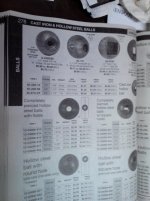
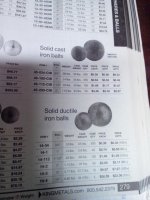
Try King Architectural Metals, they have an online catalog
 

Attachments

  • IMG_20160922_090519.jpg
    IMG_20160922_090519.jpg
    130.7 KB · Views: 34
  • IMG_20160922_090632.jpg
    IMG_20160922_090632.jpg
    135.4 KB · Views: 32
Last edited:
OP
D

drivesitfar

Well-known member
Joined
Oct 23, 2013
Messages
36,036
Location
Pacific Northwest
Get: thanks for posting the catalog page. just curious have you ordered any from this supplier? also it looks like you might have to buy a case or can you just buy one or a few?

454: good point. i had an 80 year old lifetime machinist drill my Rock Island 577 jaw holes a bit bigger for bigger screws a couple years ago and he told me it was the toughest/hardest steel he'd ever drilled.

ALL: i don't own very many of these little clamp on vises and wondering if i can just unscrew them apart to clean and re grease or is there a clamp or a trick/tip i might need to know. this is a 2 inch wide jaw Wilton 1113 out of Chicago so if anybody has one or any history on them please post cause i thought Wilton only made baby bullets as their small vises.
 

Attachments

  • WP_20160921_019.jpg
    WP_20160921_019.jpg
    136.9 KB · Views: 34
  • WP_20160921_020.jpg
    WP_20160921_020.jpg
    107.2 KB · Views: 25
  • WP_20160921_021.jpg
    WP_20160921_021.jpg
    115.6 KB · Views: 27
  • WP_20160921_022.jpg
    WP_20160921_022.jpg
    123.4 KB · Views: 28

GETRIDAONE

Well-known member
Joined
May 21, 2013
Messages
1,549
Location
Auburn, GA
The Atlanta area warehouse is only about 20 minutes from my house. You can buy one at a time. They sell mostly wrought iron fence supplies. The prices seem real reasonable to me but I don't have to pay shipping.
 

Carla

MEMBER EMERITUS
Joined
Nov 27, 2010
Messages
672
Try King Architectural Metals, they have an online catalog

It looks to me as tho the 1" dia. plain steel balls they list @ 85cts. would be an excellent component for replacement vise handles in the 1/2", 9/16", and 5/8" diameters, as used on a very large variety of vises, in the 3-1/2", 4", and, in some makes, 4-1/2", jaw sizes.

My own preference would be to drill/tap the ball 1/2-20 x 3/4" dp., and thread the handle ends to suit. Assembly with Loctite would keep the ball ends from coming loose in service, but allow disassembly by gently warming the parts, should that ever be desired.

I'd suspect that a much easier way to do this job might be to simply bore the steel balls to suit the handle diameter, x that same 3/4" dp., and silver-solder (silver-braze, if you prefer) the ball ends to the handle stock.

Its a matter of personal taste, to be sure, but another option would be to purchase solid brass balls from a lamp supply firm, which can be found on the internet. Those are available cheaply in 1" dia., drilled/tapped 3/8-27, the old NPS thread used in electrical work, and easily re-tapped 1/2-20 (or 9/16-18, if one prefers) if one likes to use threaded ends.

There's no reason, of course, why the brass parts couldn't be simply bored and silver-soldered as noted above.

Added on edit.......yes, I know, there are doubtless some here who would chuckle at the 'silly over-kill' image of a re-finished vise with neatly polished brass tips to its handle......yes, its a bit of 'cute', with, maybe a certain loss of 'industrial dignity' or some such thing.....just a personal taste item........ : )

cheers

Carla
 
Last edited:

Carla

MEMBER EMERITUS
Joined
Nov 27, 2010
Messages
672
i don't own very many of these little clamp on vises and wondering if i can just unscrew them apart to clean and re grease or is there a clamp or a trick/tip i might need to know. this is a 2 inch wide jaw Wilton 1113 out of Chicago so if anybody has one or any history on them please post cause i thought Wilton only made baby bullets as their small vises.

Hi, DIf,

There are many makes of that style of those little clamp-on vises, of varying finish quality, but identical in basic design. The 'Goodell-Pratt' works made very nicely finished ones, a century ago. Quite a few of them will turn up with Sears Roebuck 'Craftsman' badging.....I've no idea as to who made those, but they were still being sold in the 1960's.

Its possible, I suppose, the the Wilton Co. might have contracted with an established maker of those, to have a run done with the Wilton name, which could then be an 'economy' option in the Wilton line, much cheaper than the 'baby bullet' model.....but that's only 'speculation'...... : )

Having it apart for cleaning/refinishing is really obvious, once one looks closely. The main screw is retained by a cross-pin, and easily removed, but the lower clamp screw 'pad' will be rivetted-over, and should only be removed if really necessary.

cheers

Carla
 

IHmachinery

Well-known member
Joined
Apr 28, 2015
Messages
134
Location
Pacific Northwest, Canada
It looks to me as tho the 1" dia. plain steel balls they list @ 85cts. would be an excellent component for replacement vise handles in the 9/16" and 5/8" diameters, as used on a very large variety of vises, in the 3-1/2", 4", and, in some makes, 4-1/2", jaw sizes.

My own preference would be to drill/tap the ball 1/2-20 x 3/4" dp., and thread the handle ends to suit. Assembly with Loctite would keep the ball ends from coming loose in service, but allow disassembly by gently warming the parts, should that ever be desired.


cheers

Carla


Just a small addition to this for what it's worth ...

While turning down and threading a small stub on the end of a bar (onto which the balls will be screwed) is easy if you have a lathe, it is a bit of a challenge if you don't. What is often easier (even if you have a lathe) is to drill a hole in the end of the bar at each end, using the correct tap drill size. Tap the hole, 1/2-20 in Carla's example, screw in a bolt or piece of threaded rod, using loctite. Then cut of at the right length (3/4" in Carla's example), and clean up the end with a file. That gives you the threaded ends on the bar/handle. Then you can proceed to drill, tap, and screw on the ball as she outlines.

Getting the hole drilled in centre and parallel with the handle shaft is of course easy in a lathe, but can be done in a drill press or even with a hand-held drill with a bit of care. It doesn't have to be super precise for this application.

Anyway, just another way to go about it ...


Sent from my iPad using Tapatalk
 

scooternut

Well-known member
Joined
Jul 31, 2013
Messages
684
Location
Pittsburgh, PA
Anybody have a source for steel balls that can be machined or welded to make replacement handles? Found this place http://bearingballstore.com/ , price of the soft steel balls seems a little steep.
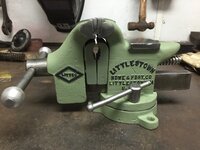

I used threaded steel balls from Mcmaster Carr on an old 6 Reed, huge balls. They were quite hard and fully polished. I scuffed em up with scotch brite and they worked real nice. Pretty certain I posted some pics somewhere in this thread.

Forgot to add, I filed the threaded side flat to the diameter of the handle. looked pretty clean.
 
Last edited:

markbugno

Well-known member
Joined
Jan 8, 2015
Messages
196
Location
Boardman, Ohio
Not sure if anyone has tried this or not: Needed a super small brush to paint lettering on vise. Took a q tip, removed the cotton and ground it to a point on the bench grinder. Worked awesome, pinpoint accuracy. The cardboard handle was absorbent and soft enough to hold and spread paint.

Marke09d1d91b0d19de448b61a271879c277.jpg


Sent from my iPhone using Tapatalk
 

IHmachinery

Well-known member
Joined
Apr 28, 2015
Messages
134
Location
Pacific Northwest, Canada
Not sure if anyone has tried this or not: Needed a super small brush to paint lettering on vise. Took a q tip, removed the cotton and ground it to a point on the bench grinder. Worked awesome, pinpoint accuracy. The cardboard handle was absorbent and soft enough to hold and spread paint.

Marke09d1d91b0d19de448b61a271879c277.jpg


Sent from my iPhone using Tapatalk


Great tip! I have struggled to get anywhere near acceptable results using an artist paint brush (obviously, I'm no artist!)


Sent from my iPad using Tapatalk
 

Carla

MEMBER EMERITUS
Joined
Nov 27, 2010
Messages
672
Not sure if anyone has tried this or not: Needed a super small brush to paint lettering on vise. Took a q tip, removed the cotton and ground it to a point on the bench grinder. Worked awesome, pinpoint accuracy. The cardboard handle was absorbent and soft enough to hold and spread paint.

Mark
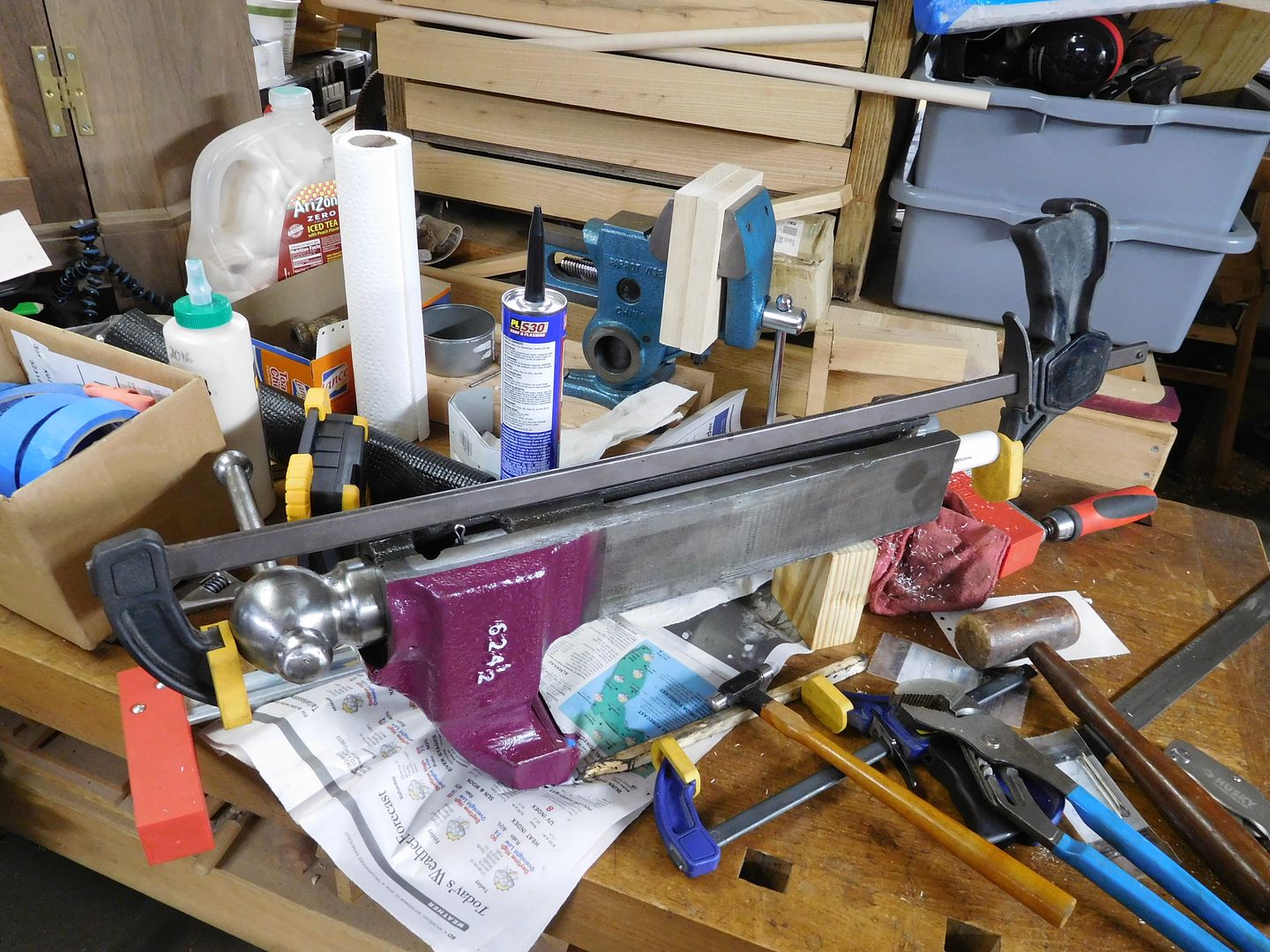
Another technique for 'tipping' or 'frosting' raised cast letters is to get some small diameter 'corks' (aka 'cork stoppers') with which to 'pat' the enamel onto the lettering.

I found that a local hardware store carried 3/8" and 1/2" dia. cork stoppers, and they were quite cheap in small box lots. I would keep small quantities of the various small sizes of these, on hand, as I used the small corks to plug drilled or tapped holes when masking parts for painting.

Its a bit tricky to get 'just the right amount' of a fairly thick enamel on the cork, at first, but, with some practice, this technique becomes quick and easy. I found that gluing the corks to a short length of wooden dowel stock, to form a handle, makes the 'cork tip' easier to use.

cheers

Carla
 
Last edited:

jimreed2160

Well-known member
Joined
Aug 7, 2016
Messages
3,589
Location
Tallahassee FL
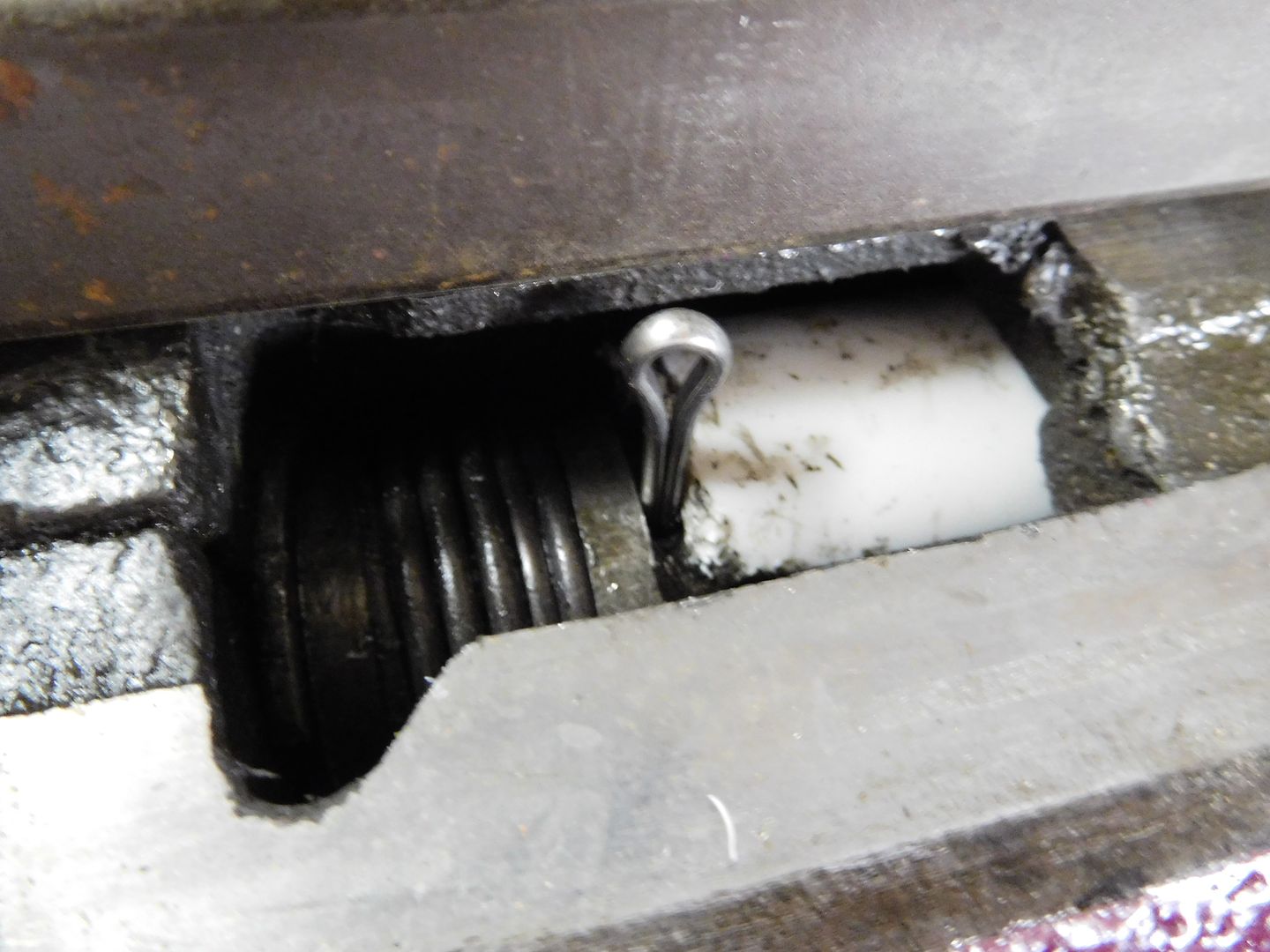
So I am sending a hearty "THANKS" to all who have posted here. I have been working on an Athol all summer and finally got to the finish line before I was stumped on the mainscrew spring tension. I remembered a post where someone used PVC pipe to relieve the tension. My issue here was clearance in the tight passage, so I got a 3/4 pipe (for a 3/4 leadscrew) and split it. It barely fit but a wooden mallet convinced it to go the extra distance.

DSCN0654.jpg


I was able to tease the cotter pin in pretty easily on the top.

DSCN0655.jpg


But the bottom was problematic. I removed the pipe and used a piece of flat stock.

DSCN0656.jpg


DSCN0657.jpg


DSCN0661.jpg


Pretty good for a woodworker. I posted the before and after over on the VISES thread. Thanks again for all your tips.
 
OP
D

drivesitfar

Well-known member
Joined
Oct 23, 2013
Messages
36,036
Location
Pacific Northwest
Jim: just an FYI. if you cut a slot in the PVC the next time you put together an Athol or another vise with that sort of spring it will let you push the spring and then have the pin without any pressure on it.

when you mount your vises to wood what is the plan for using them? are you going to clamp them to a wood or steel bench or do you just mount on a nice piece of wood so you can display them on a shelf.

WELL DONE and looks like you made a nice improvement with your Athol.

Carla: i'll take a closer look at my little Wilton and maybe post up few pictures after i clean it up and take the red off and put on some BLO.

thanks
 

jimreed2160

Well-known member
Joined
Aug 7, 2016
Messages
3,589
Location
Tallahassee FL
DRIVESITFAR--Yes. A slot would have been very convenient. I did not have 1" PVC to try, but I don't think it would have fit through the small hole at the head of the dynamic. As it was, the split 3/4 pipe needed much persuasion.

I mount most of my vises to wood so that I do not have to adapt my benches or drill a bunch of holes. My layouts change frequently but this strategy works best on the smaller vises. This big Athol is very heavy and needs a secure mount if it is going to be seriously used. In addition, it is too high to be practical unless Lebron James needs to punch rivets into his sneakers. I think I need to build a stout stand for it, out of wood, of course.
 

jimreed2160

Well-known member
Joined
Aug 7, 2016
Messages
3,589
Location
Tallahassee FL
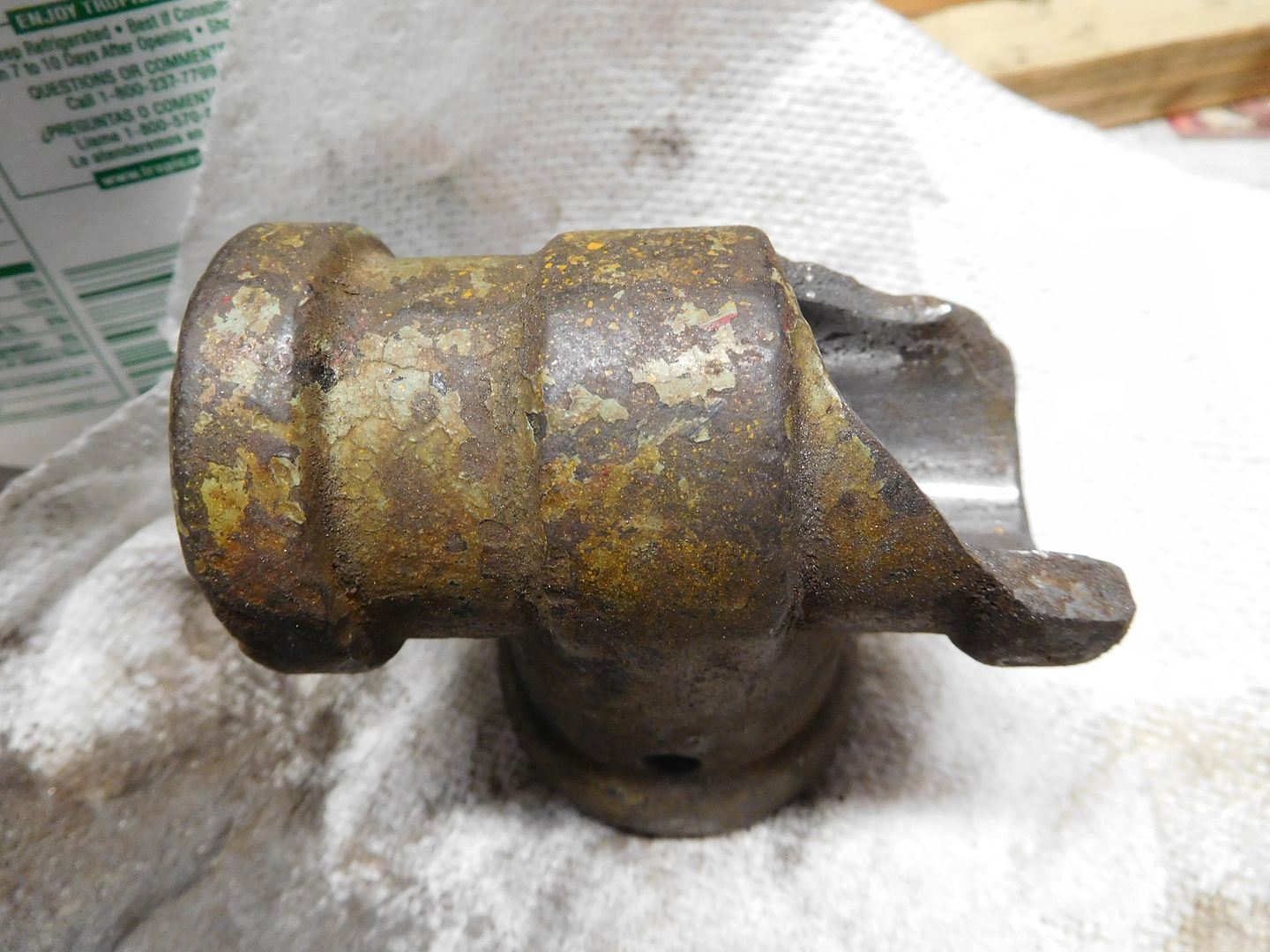
I recently acquired a Rock Island woodworking vise with a busted nose.
DSCN0670.jpg


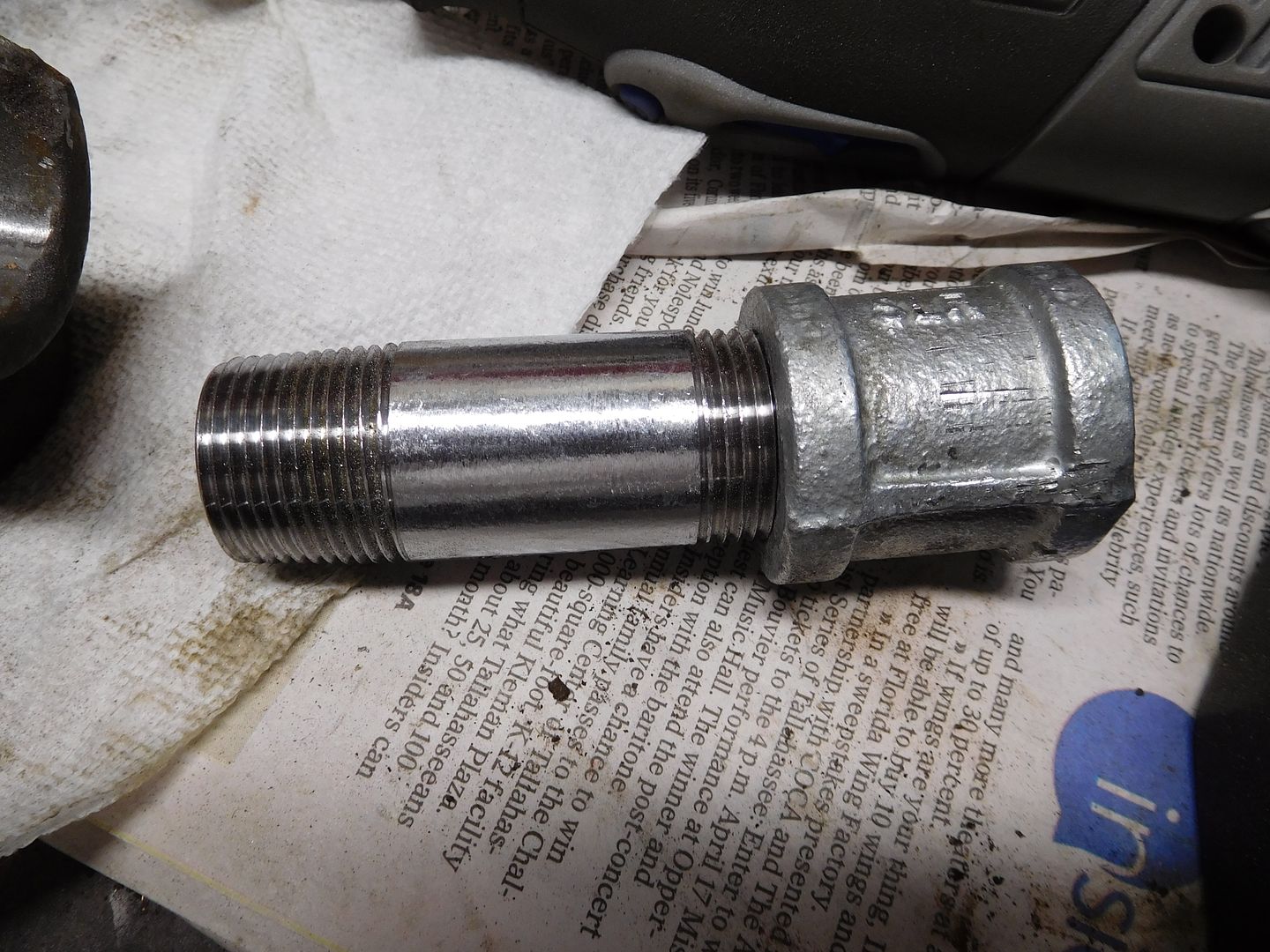
Found some pipe fittings at HD. I filed the outside of the pipe and ground the inside of the broken Tee with my Dremel.

DSCN0671.jpg


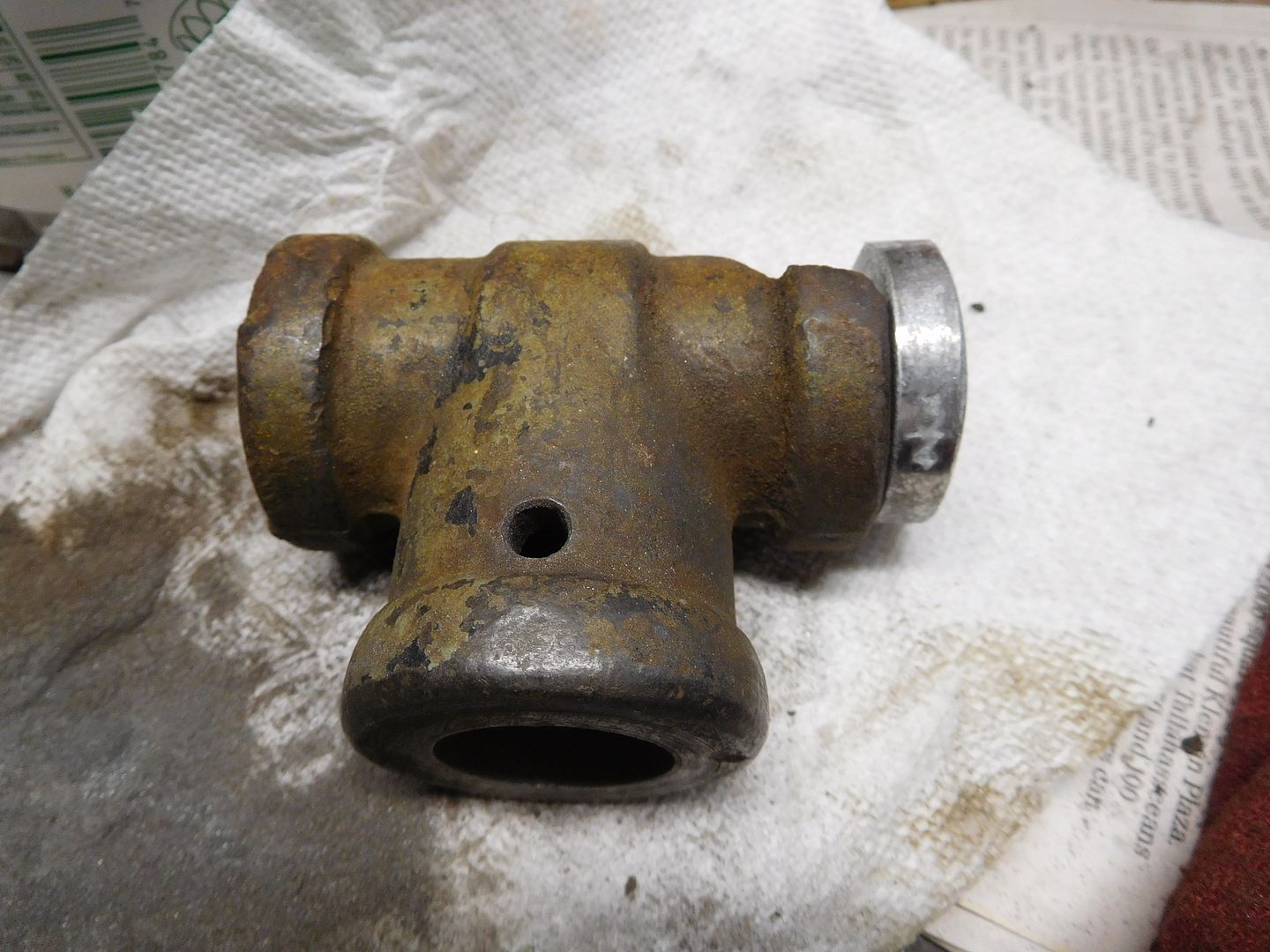
And then, bada-bing, bada-boom...
DSCN0676.jpg


At this point, it is just a tight interference fit. I plan to insert a few random pins to keep it from moving.
 

454ragtop

Well-known member
Joined
Mar 24, 2008
Messages
5,011
Location
Carver, MA
I recently acquired a Rock Island woodworking vise with a busted nose.
DSCN0670.jpg


Found some pipe fittings at HD. I filed the outside of the pipe and ground the inside of the broken Tee with my Dremel.

DSCN0671.jpg


And then, bada-bing, bada-boom...
DSCN0676.jpg


At this point, it is just a tight interference fit. I plan to insert a few random pins to keep it from moving.
Jim, I wonder if you could mod a pipe tee to replace the whole broken part?
 
To avoid these ads, REGISTER NOW!
Top Bottom