To avoid these ads, REGISTER NOW!

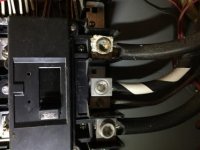
Corrosion on lug in Main Panel

Zippercat

Well-known member
Joined
Jul 13, 2013
Messages
828
Location
TN
My main electrical panel is in the garage and is a 200 amp Square D Homeline. I believe it was installed in 2008 by prior owner when large addition was constructed. We moved in last January.

When I took panel cover off yesterday I noticed one of the feed line lugs has some corrosion on it; others are clean. Hopefully a pic is attached.

Not sure if this is related: took cover off to replace 40 amp 2 pole breaker for clothes dryer. Dryer started tripping breaker when run on any setting except Fluff (no heat). When resetting breaker noticed it felt warm. Used infrared thermometer and discovered dryer breaker was about 105 F, about 30+ deg F warmer than all other breakers in panel. Others all within about 1 degree of each other and air temp. Replaced dryer breaker with new one and all seems to be working ok now.

Dryer breaker is on the same side of the panel, right side, as the corroded lug. No other corrosion seems visible in the panel.

I've done a lot of DIY wiring, including work that was inspected and approved by city inspectors. I'm comfortable replacing or adding a breaker with main breaker off and using insulated screwdrivers. But dealing with the main feed is outside my comfort zone.

Is the corroded lug a concern? If so I'll call in a pro. Thanks!
 

Attachments

  • image.jpg
    image.jpg
    16.3 KB · Views: 192
To avoid these ads, REGISTER NOW!

dw1

Well-known member
Joined
Jan 26, 2015
Messages
1,335
Location
Ky
You will have to pull your meter to de-energize that conductor, I would try to take the wire out, clean it up and put some penetrox/anti oxidizing lube on it.
(Will your Power Company get mad if you pull the meter?) I would also pull your dryer breaker and see if the buss bar its plugged into is corroded
 
OP
Z

Zippercat

Well-known member
Joined
Jul 13, 2013
Messages
828
Location
TN
You will have to pull your meter to de-energize that conductor, I would try to take the wire out, clean it up and put some penetrox/anti oxidizing lube on it.
(Will your Power Company get mad if you pull the meter?) I would also pull your dryer breaker and see if the buss bar its plugged into is corroded

Thanks for the fast reply. I did check the bar when I replaced the dryer breaker and everything was clean and shiny. Pulling a meter is beyond my skill/experience level. Sounds like time to call a pro.
 

dw1

Well-known member
Joined
Jan 26, 2015
Messages
1,335
Location
Ky
Thanks for the fast reply. I did check the bar when I replaced the dryer breaker and everything was clean and shiny. Pulling a meter is beyond my skill/experience level. Sounds like time to call a pro.

Good Call!!
 

sberry

Banned
Joined
Jun 18, 2005
Messages
35,747
Location
Brethren, Michigan
The dryer is pulling from both sides. Common dryers are 30A. Covers can remain on for years, I would want to look on occasion. I found something recently wasn't right, somehow absolutely missed tightening a screw and I am a paranoid ********.
But the case above is surely a poster case why to lube up the wires and the screws on main lugs. Any threaded connector squeaks when its put together has a problem and all that stuff is fine thread, bout 1/2 of them seize when installed if they are tight enough.
I use a little fuzz of nolox on copper and the threads also but aluminum should be weighed and tightened in a couple stages. Ideally tightened a pinch in a day or so.
I know I will hear about it but even a little whiz of wd40 on the wire lug and screw at installation will prevent that from happening.
 

alfredeneuman

Well-known member
Joined
Mar 3, 2011
Messages
4,593
Location
Fullerton, CA
As to cleaning the lug:
The aluminum lug has a VERY thin (on the order of 20 microns) coating of tin on it. So thin that if you try to clean it with anything abrasive you'll rub through the plating.
It looks like it's water damaged.
 

sberry

Banned
Joined
Jun 18, 2005
Messages
35,747
Location
Brethren, Michigan
I have now replaced a couple services I installed when I was a kid, other peoples too. Most of it had to be trashed due to seized screws. Stuff we installed a little later where we gently whizzed a little spray around the bars/screws and lugs still looks really good. Kind of like checking lug nuts, the **** aint all seized up gives a guy a chance to check it after some service.
Here the OP found it when he went to do other work. There aint no oil to check in a panel but it doesn't hurt to take a look on occasion.
 

sberry

Banned
Joined
Jun 18, 2005
Messages
35,747
Location
Brethren, Michigan
As to cleaning the lug:
The aluminum lug has a VERY thin (on the order of 20 microns) coating of tin on it. So thin that if you try to clean it with anything abrasive you'll rub through the plating.
It looks like it's water damaged.
I ran in to one the other day that was brutally dry and the same thing, hadn't been checked or moved in long time and had one corroded. We had disconnect ahead of it so it was easy. It seems I have seen it with equipment not that old, as the op said 2008.
I think its kind of a weakest link kind of a virus. The parts are so steril and dry, they never tighten correctly and any humidity immediately attacks the surface and starts action. Adding a film and lubricant adds a barrier to simple humidity. We see this with pipe in to enclosures from the ground and outdoor on poles it seems.
I went to neighbors for a trouble shoot to a well and the guy didn't even ground it due to the fact the bar was seized, he put a breaker on at 240.
 

rlitman

Well-known member
Joined
Oct 18, 2010
Messages
24,662
Location
Long Island
...
It looks like it's water damaged.

It sure does. I'd get an electrician in ASAP.
Is the picture oriented correctly? Is the panel in your basement, or at a lower level than your meter?

Here's a guess. The feed wire enters your meter pan from above, and is carrying water in. The meter pan is filling up with water inside, and water is wicking between the strands of that wire and appearing at the other end where you're seeing corrosion of the main. If this is the case, you need to replace that wire (and I'd suggest the main breaker at least too) before your house burns down, and you need to stop the water issue.
 
To avoid these ads, REGISTER NOW!

rlitman

Well-known member
Joined
Oct 18, 2010
Messages
24,662
Location
Long Island
I have now replaced a couple services I installed when I was a kid, other peoples too. Most of it had to be trashed due to seized screws...

So? Ok, so you had to throw it out, but just because a screw is seized, doesn't mean that it wasn't safe while in service. It just means that you couldn't re-use it later.

...Any threaded connector squeaks when its put together has a problem and all that stuff is fine thread, bout 1/2 of them seize when installed if they are tight enough.
I use a little fuzz of nolox on copper and the threads also but aluminum should be weighed and tightened in a couple stages. Ideally tightened a pinch in a day or so.
I know I will hear about it but even a little whiz of wd40 on the wire lug and screw at installation will prevent that from happening.

Personally, when it comes to electrical connections (where I want them assembled permanently), I like hearing that squeak. It's a frictional form of thread locker. To me, I don't really care if the connection is threaded or crimped, I want it permanent for all intents and purposes, and protecting the threads is immaterial. If I wanted an electrical connection that was meant to be taken apart and re-assembled more than once, I'd choose a proper disconnect.

Still, I have no problem with your methods, and agree that a film of something that prevents oxidation is desirable. WD-40 is a decent choice for this, though it's technically flammable (it gets better as it dries; and the aerosol propellant is the most flammable part), so I wouldn't go spraying it on live connections, but for assembly or stuff that's out of service, have at it. I'll admit to using it too.

At work, I use DeOxit Dn5. It's outrageously overpriced, but the cost is still pocket change compared to the equipment it gets used on, and it is certified as both non-flammable and non-conductive, and also plastic safe. I've also seen it have near magical powers on both copper and silver alloy surfaces in reversing oxidation.
 
OP
Z

Zippercat

Well-known member
Joined
Jul 13, 2013
Messages
828
Location
TN
It sure does. I'd get an electrician in ASAP.
Is the picture oriented correctly? Is the panel in your basement, or at a lower level than your meter?

Here's a guess. The feed wire enters your meter pan from above, and is carrying water in. The meter pan is filling up with water inside, and water is wicking between the strands of that wire and appearing at the other end where you're seeing corrosion of the main. If this is the case, you need to replace that wire (and I'd suggest the main breaker at least too) before your house burns down, and you need to stop the water issue.

Panel is in garage. Picture is turned 90 deg. Panel is below level of meter, as are nearly all the residential panels I've noticed. Feed comes into panel from bottom of the panel, so water would need to wick uphill. No other corrosion noticed.

IF the lug was not properly tightened on the original install and/or it was not properly protected with the correct lube, there's plenty of humid air in Tennessee to help it corrode without rain water.
 

rlitman

Well-known member
Joined
Oct 18, 2010
Messages
24,662
Location
Long Island
...Feed comes into panel from bottom of the panel, so water would need to wick uphill...

No, remember that the wire's insulation forms a continuous tube. It acts as a siphon, so the uphill on the bottom of the panel is not going to stop water.
 

mm08822

Well-known member
Joined
Jan 13, 2012
Messages
6,051
Location
NJ
During installation, Pull the set screws from the lugs and give the threads a shot of penetrox. Has worked well for me for years. Haven't siezed one since i started doing that.
 

wyliesdiesels

Well-known member
Joined
Aug 14, 2012
Messages
20,071
Location
Modesto, CA
Why is your dryer being fed with a 40a breaker? Thats not to code as a dryer circuit is suppose to be 30a and outlet is 14-30 or 10-30 usually fed with 10/2 NM-b.

There is no 40a outlet and there are no dryers that require a 40a circuit.

Who put in the 40a breaker?
 
OP
Z

Zippercat

Well-known member
Joined
Jul 13, 2013
Messages
828
Location
TN
Why is your dryer being fed with a 40a breaker? Thats not to code as a dryer circuit is suppose to be 30a and outlet is 14-30 or 10-30 usually fed with 10/2 NM-b.

There is no 40a outlet and there are no dryers that require a 40a circuit.

Who put in the 40a breaker?

Dryer wiring was in place when we bought the house. We'll be gutting and remodeling laundry room in a few weeks so I'll now put checking out what wire was used, etc. on my list. Was already planning on changing dryer outlet from floor mount to wall; dryer outlet fed from above so will be (now maybe was?) easy to move.

Best guess: 40 amp breaker installed when new panel was added in 2008 during construction of addition to house.
 

rlitman

Well-known member
Joined
Oct 18, 2010
Messages
24,662
Location
Long Island
Why is your dryer being fed with a 40a breaker? ...

Interesting question. So is why was the dryer tripping the 40A breaker.

The breaker being hot is interesting too.
Zippercat, was it tripping as soon as the dryer turned on the heat, or only after time time (I'm expecting the latter, if it was tripping on the thermal)?

I'd love to see what a thermal image of what this panel looks like. Was the heat in the dryer breaker coming from within, or was corrosion behind the main heating up that bus bar?
 
OP
Z

Zippercat

Well-known member
Joined
Jul 13, 2013
Messages
828
Location
TN
Interesting question. So is why was the dryer tripping the 40A breaker.

The breaker being hot is interesting too.
Zippercat, was it tripping as soon as the dryer turned on the heat, or only after time time (I'm expecting the latter, if it was tripping on the thermal)?

I'd love to see what a thermal image of what this panel looks like. Was the heat in the dryer breaker coming from within, or was corrosion behind the main heating up that bus bar?

The dryer breaker would trip about 7 to 10 minutes after the dryer was turned on with any setting other than Fluff, which is no heat. No trips running on Fluff. New breaker does not heat up or trip on any setting. Sure seems like the old breaker was bad to me.

I don't have a thermal imager (but maybe now have an excuse to get one!). But I used an infrared thermometer and no other breakers got even a few degrees warmer than air temp. I even turned the electric oven on. That breaker did not get warmer either.

Thanks for all the replies. When I start the laundry room demo in a couple weeks I'll update what wire and outlet are used for the dryer.
 

rlitman

Well-known member
Joined
Oct 18, 2010
Messages
24,662
Location
Long Island
The dryer breaker would trip about 7 to 10 minutes after the dryer was turned on with any setting other than Fluff, which is no heat. No trips running on Fluff. New breaker does not heat up or trip on any setting. Sure seems like the old breaker was bad to me.


Sure does. Though it doesn't explain the source of he corrosion.
 
To avoid these ads, REGISTER NOW!
Top Bottom