To avoid these ads, REGISTER NOW!

Question on 220 V power plugs change..

Robby321

Well-known member
Joined
Jan 22, 2015
Messages
607
Location
Olympia, WA
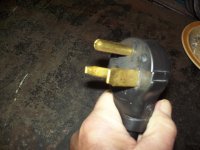
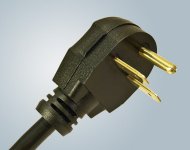
I'm a mechanical whiz, but a dufuss house electrics. I have 220 in the shop for my welder and 2 outlets. Wood stove for dry heat here rainy PNW winter. I want to buy a 220 heater for some zone heat a paint booth. But as far as I can tell looking into this, I have NEMA 6-50 (?) plug welder as outlets. This one wanted has a NEMA 6-30P plug.
Question is can I cut the 6-30P plug off, and do a 6-50? Pix, and a link what wanted. Actually I damn good at electric...I'm good at "letting the smoke out"! Thanks any help in advance!
Link first..

https://www.menards.com/main/heatin...4432295017-c-6328.htm?tid=6723583107743307321

Last pic is the 6-30P plug.
 

Attachments

  • 100_0795.jpg
    100_0795.jpg
    144.7 KB · Views: 58
  • 100_0792.jpg
    100_0792.jpg
    139 KB · Views: 53
  • 100_0794.jpg
    100_0794.jpg
    133.4 KB · Views: 50
  • 6-30p-full.jpg
    6-30p-full.jpg
    92.3 KB · Views: 46
To avoid these ads, REGISTER NOW!

laser3kw

Well-known member
Joined
Nov 17, 2012
Messages
7,276
Location
northen IL
the purpose of the 6-50 is to connect a circuit with the correct wire size and breaker for 50 amp. If you modify a 30 amp device to plug into the 50 amp circuit, you will lose the over current protection for the device.
In other words 30 amp device overloads, circuit will not trip until it it exceeds the 50 amp breakers capacity. There is a chance of the device catching fire.
Please be safe and run a dedicated 30 amp circuit with properly sized wire, breaker and receptacle for the 30 amp device. It's a little more work, but it's way safer
 
Last edited:
OP
R

Robby321

Well-known member
Joined
Jan 22, 2015
Messages
607
Location
Olympia, WA
the purpose of the 6-50 is to connect a circuit with the correct wire size and breaker for 50 amp. If you modify a 30 amp device to plug into the 50 amp circuit, you will lose the over current protection for the device.
In other words 30 amp device overloads, circuit will not trip until it it exceeds the 50 amp breakers capacity. There is a chance of the device catching fire.
Please be safe and run a dedicated 30 amp circuit with properly sized wire, breaker and receptacle for the 30 amp device. It's a little more work, but it's way safer

OK, and that whats i had in mind also. Have 50 amp breakers the panel. Gonna put the kabosh that idea. Thanks!
 

theoldwizard1

Well-known member
Joined
Feb 22, 2011
Messages
43,198
Location
SE MI
the purpose of the 6-50 is to connect a circuit with the correct wire size and breaker for 50 amp.
Not always true !

Almost all 240V welders come with a 6-50 plug, regardless of the amount of power they really need. Why ? Because welding shops with multiple different sized machines don't want to have multiple different size outlets.

While you might think a 6-50 outlet can handle a 50A, continuous, load, in many cases it can not. The breaker is sized to protect the wire between the breaker and the outlet. So yes, you might find a location where there is a 6.-50 outlet wired with 12/2 and and protected by a 20A 2 pole breaker.


The other issue is "duty cycle". Very few (if any) welders are designed to run near max power CONTINUOUSLY ! The people who set the electrical standards know this and allow a certain amount of leeway. So a welder that can draw a maximum of 30A, but is rated rate at say a 30% duty cycle probably does not need 10 AWG wire and a 30A breaker, because for 3 minutes of continuous welding, you should have 7 minutes of no welding.

Motors and heaters DO RUN CONTINUOUSLY ! So before you swap that plug, make sure the wire going to that 6-50 outlet is capable of 30A continuously and it is protected by a 30A breaker.
 
OP
R

Robby321

Well-known member
Joined
Jan 22, 2015
Messages
607
Location
Olympia, WA
Not always true !

Almost all 240V welders come with a 6-50 plug, regardless of the amount of power they really need. Why ? Because welding shops with multiple different sized machines don't want to have multiple different size outlets.

While you might think a 6-50 outlet can handle a 50A, continuous, load, in many cases it can not. The breaker is sized to protect the wire between the breaker and the outlet. So yes, you might find a location where there is a 6.-50 outlet wired with 12/2 and and protected by a 20A 2 pole breaker.


The other issue is "duty cycle". Very few (if any) welders are designed to run near max power CONTINUOUSLY ! The people who set the electrical standards know this and allow a certain amount of leeway. So a welder that can draw a maximum of 30A, but is rated rate at say a 30% duty cycle probably does not need 10 AWG wire and a 30A breaker, because for 3 minutes of continuous welding, you should have 7 minutes of no welding.

Motors and heaters DO RUN CONTINUOUSLY ! So before you swap that plug, make sure the wire going to that 6-50 outlet is capable of 30A continuously and it is protected by a 30A breaker.

Got it! Thanks!:thumbup:
 

Daedalus

Well-known member
Joined
Sep 28, 2009
Messages
6,020
Can you put a 50A plug on a 30A device? Yes. I had the same issue with my plasma cutter. I didn't want to hack off the factory plug, so I spent a little more $$$ and made an adapter that has a L6-30 receptacle. Bought the plug and receptacle off amazon, and bought 2' of cable from Lowes.
 

wyliesdiesels

Well-known member
Joined
Aug 14, 2012
Messages
20,025
Location
Modesto, CA
Not always true !

Almost all 240V welders come with a 6-50 plug, regardless of the amount of power they really need. Why ? Because welding shops with multiple different sized machines don't want to have multiple different size outlets.

While you might think a 6-50 outlet can handle a 50A, continuous, load, in many cases it can not. The breaker is sized to protect the wire between the breaker and the outlet. So yes, you might find a location where there is a 6.-50 outlet wired with 12/2 and and protected by a 20A 2 pole breaker.


The other issue is "duty cycle". Very few (if any) welders are designed to run near max power CONTINUOUSLY ! The people who set the electrical standards know this and allow a certain amount of leeway. So a welder that can draw a maximum of 30A, but is rated rate at say a 30% duty cycle probably does not need 10 AWG wire and a 30A breaker, because for 3 minutes of continuous welding, you should have 7 minutes of no welding.

Motors and heaters DO RUN CONTINUOUSLY ! So before you swap that plug, make sure the wire going to that 6-50 outlet is capable of 30A continuously and it is protected by a 30A breaker.


Where did u read that a 50a plug cant handle 50a continuously?

And there is no guessing when it comes to sizing wire for welder circuits.

The NEC has a table specifically for this. See Table 630.11(a)

Heres a short primer on welder circuits:

http://m.ecmweb.com/qampa/code-qa-45

And why would a 6-50 use 30a wire?

BTW a welder circuit for a welder with a 50a input would have a 50a breaker and 6-50p along with the correct wire size based on the duty cycle. U wouldnt reduce the breaker size because the welder takes 50a.
 
Last edited:

6PTsocket

Well-known member
Joined
Mar 12, 2014
Messages
4,593
What laser3k is saying is that you should not plug a low current device into a circuit protected by a much higher current breaker. That is far from the truth. I plug in lamps that draw less than an amp into circuits protected by a 20 amp breaker every day and so does everybody else. The breaker is sized for the maximum the line can handle. If you have 20 amp receptacles in your house you are plugging in 15 amp plugs. They accept either one. I have only seen 20 amp plugs once in my life and I work in the field. The breaker protects the wiring. If a device draws less, the protection is internal and AFTER the plug. On the other hand, putting a 30 amp plug on a fifty amp device so you can plug it into 30 amp circuit is not acceptable. Many homes have 15 amp receptacles on a 20 amp breaker and is perfectly acceptable.

Sent from my SM-G900V using Tapatalk
 

RocketScott

Well-known member
Joined
Jul 20, 2016
Messages
262
Location
Lexington, KY
Can't say much about the plugs but I have a 220 wall heater. It's yours if it will do what you need.

I'm up in Tacoma.


Sent from my iPhone using Tapatalk
 

sberry

Banned
Joined
Jun 18, 2005
Messages
35,747
Location
Brethren, Michigan
In a welder circuit the breaker isn't providing thermal protection, that is due to the limited load of the appliance being plugged in. The 30 on the heater isn't to thermal limit the load either, again, the heater only draws what it will and is the limiting factor. On both these circuits the breaker is there for short circuit interruption.
On a dedicated 120V circuit it may be limited by the appliance, a UL listed with a 15 end will draw less than that. On a general with multiple outlets available the breaker does both, protects against shorts and overload should too many things be applied to it.
The welder circuit would have an outlet could handle 50 a breaker can deliver 50 bujt the wire may not be good for it continuously. If we use a number 10 wire and plug a machine in to it with a 12 cord this is what protects the wire. The machine has its own thermal, if it draws enough to overheat the cord it shuts down.
 
Last edited:

theoldwizard1

Well-known member
Joined
Feb 22, 2011
Messages
43,198
Location
SE MI
Where did u read that a 50a plug cant handle 50a continuously?
I never said I read it any where, but it is a LOGICAL ASSUMPTION !

And why would a 6-50 use 30a wire?
To save a buck ! I'll bet there are a lot of 6-50 outlets wired for 30A service.

BTW a welder circuit for a welder with a 50a input would have a 50a breaker and 6-50p along with the correct wire size based on the duty cycle. U wouldnt reduce the breaker size because the welder takes 50a.
I am not sure how you came to that conclusion be what I wrote ("English is an imprecise language !")

My point was somewhat the opposite. There is no guarantee that a 6-50 outlet is wired for 50A continuous service and protected by a 50A breaker/fuse.
 

theoldwizard1

Well-known member
Joined
Feb 22, 2011
Messages
43,198
Location
SE MI
In a welder circuit the breaker isn't providing thermal protection, that is due to the limited load of the appliance being plugged in. The 30 on the heater isn't to thermal limit the load either, again, the heater only draws what it will and is the limiting factor. On both these circuits the breaker is there for short circuit interruption.
IANALE, and I am NOT trying to make this into a ******* contest (I will always yield to licensed electrician). If a breaker is only to protect for "short circuits" to me that implies that you could connect a 6,000W heater to a circuit protected by a 15A breaker and expect it to not trip, even after continuous operation.


I will repeat the point I am trying to make. There is no guarantee that a 6-50 outlet can provide 50A @ 240V, continuously ! It depends on the breaker and the assumption that the wire gauge is appropriate for that breaker.
 

sberry

Banned
Joined
Jun 18, 2005
Messages
35,747
Location
Brethren, Michigan
This I agree with.
There is no guarantee that a 6-50 outlet is wired for 50A continuous service and protected by a 50A breaker/fuse
. And nothing prevents a smaller breaker and in the case of some welders with the minimum wire it is required.
There is some caution for welders, evidently this all must not end up in a problem or it would have been changed some time ago.
Part of it is there are so few things come cord ready it would be an issue, the one exception with welders being a 250 feeder.
I sat thru a course on this but its been so long ago and before I was very proficient but the guy had a good explanation of this he must have given a lot and made sense.
I have a 6 wire 50, a couple but also have 2 10/50 and a couple 10/30 with a 50 recept. I do mark the cover, it was simply easier and 2 ft runs, the machines going on them are fine.
 

theoldwizard1

Well-known member
Joined
Feb 22, 2011
Messages
43,198
Location
SE MI
I have a 6 wire 50, a couple but also have 2 10/50 and a couple 10/30 with a 50 recept. I do mark the cover, it was simply easier and 2 ft runs, the machines going on them are fine.

I understand completely. At least you mark the covers !!

Now let's say you got a nice 3 HP 240V table saw with a 6-20 (or maybe 6-30) plug and you were going to locate it near one of your 6-50 outlets wired 10/30. Would you run a new circuit there, change the outlet (and loose the capability of running your welder there) or put a 6-50 plug on the saw ?

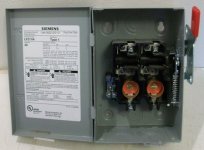
Bussman makes a metal cover for a handi box that has a fuse holder and a switch. Never seen anything like that with a breaker. Of course, you would need 2 for 240V ! ;)

BUS_Ele_Box_Cover_Units_1_220_FS.jpg
 
Last edited:

Alchymist

Well-known member
Joined
Mar 1, 2009
Messages
4,423
Location
Central PA
I understand completely. At least you mark the covers !!

Now let's say you got a nice 3 HP 240V table saw with a 6-20 (or maybe 6-30) plug and you were going to locate it near one of your 6-50 outlets wired 10/30. Would you run a new circuit there, change the outlet (and loose the capability of running your welder there) or put a 6-50 plug on the saw ?]

Neither, I'd pull the 6-50 outlet off and use the 10/30 to feed a small sub panel. Then come out from the sub panel with whatever outlets needed.
 

laser3kw

Well-known member
Joined
Nov 17, 2012
Messages
7,276
Location
northen IL
The breaker protects the wiring.

???

Anyway, In the area of 240v, Usually each receptacle is on its own circuit. That's why the 120v, multiple device on a circuit / branch circuit doesn't fit here.
If we plug in a 30 amp device into a properly size 50am circuit, what is the function of the breaker? Isn't one of the functions of a breaker is to safe guard over current?
The device is engineered to conduct a function and all it's components sized to safely handle a 30 amp capacity. The device has a malfunction (internal thermostat fails) and starts to draw more current. The device can draw 50 amp until the breaker thermo cuts out or the current level rise to a trip point. How long before the device melts down and possible catches fire? Is it ok for device to draw more than its rated capacity? Isn't that a function of the breaker to safe guard against over current? Remember using a penny to by pass a socket type fuse?
If it were me I would run a separate circuit with the proper size wire, receptacle and breaker.
Or put a 30 amp breaker on the intended ciruit and then swap plugs. At least then you will have the correct breaker ration and you can go back if you wish.
 
Last edited:

sberry

Banned
Joined
Jun 18, 2005
Messages
35,747
Location
Brethren, Michigan
Now let's say you got a nice 3 HP 240V table saw with a 6-20 (or maybe 6-30) plug and you were going to locate it near one of your 6-50 outlets wired 10/30. Would you run a new circuit there, change the outlet (and loose the capability of running your welder there) or put a 6-50 plug on the saw ?
Ideally I change the outlet to match the saw or run a new circuit.
The device is engineered to conduct a function and all it's components sized to safely handle a 30 amp capacity. The device has a malfunction (internal thermostat fails) and starts to draw more current. The device can draw 50 amp until the breaker thermo cuts out or the current level rise to a trip point. How long before the device melts down and possible catches fire? Is it ok for device to draw more than its rated capacity? Isn't that a function of the breaker to safe guard against over current?
Its late and I been on my feet since noon. But not sure this is a statement or question. Remember a motor circuit or AC unit wire isn't sized by breaker but by load, the breaker isn't for thermal. In many of these circuits the breaker does not protect against overload but the threshold is low enough for shorts.
Look at cooking, oven or cook top may be a 14 wire on a 30 and a 12 on a 50, 2 appliances wired to one circuit. Its basically what an electric range is, a bunch of calculated loads all assembled in to one appliance thru a wire heavy enough for it all, all the internal wire must carry the load but be number 12 for example, rated for faults for 50A and possibly matched to conductor sizing etc and disclaimer for this being a generalization .
 
Last edited:
To avoid these ads, REGISTER NOW!

sberry

Banned
Joined
Jun 18, 2005
Messages
35,747
Location
Brethren, Michigan
Bussman makes a metal cover for a handi box that has a fuse holder and a switch. Never seen anything like that with a breaker. Of course, you would need 2 for 240V !
I stock one, SDQO, 70A. Its really the same box as the air cond disconnect and I believe it actually has a listing as suitable for service disconnect.
 

Alchymist

Well-known member
Joined
Mar 1, 2009
Messages
4,423
Location
Central PA
???

Anyway, In the area of 240v, Usually each receptacle is on its own circuit. That's why the 120v, multiple device on a circuit / branch circuit doesn't fit here.
If we plug in a 30 amp device into a properly size 50am circuit, what is the function of the breaker? Isn't one of the functions of a breaker is to safe guard over current?
The device is engineered to conduct a function and all it's components sized to safely handle a 30 amp capacity. The device has a malfunction (internal thermostat fails) and starts to draw more current. The device can draw 50 amp until the breaker thermo cuts out or the current level rise to a trip point. How long before the device melts down and possible catches fire? Is it ok for device to draw more than its rated capacity? Isn't that a function of the breaker to safe guard against over current? Remember using a penny to by pass a socket type fuse?
If it were me I would run a separate circuit with the proper size wire, receptacle and breaker.
Or put a 30 amp breaker on the intended ciruit and then swap plugs. At least then you will have the correct breaker ration and you can go back if you wish.

The function of the breaker is to prevent the circuit from drawing more current than the wire is rated for. It is not omniscient and does not know what the current limits are for any given device plugged in. Witness a table lamp, radio, cell phone charger, etc plugged into a 12/20 amp circuit.

If a device malfunctions and draws more than it's rated current, as long as the trip rating of the breaker is not exceeded, the device will sit there drawing excessive current until it burns, shorts completely, whatever. Matters not if it's a 120 or 240 circuit.
 

sberry

Banned
Joined
Jun 18, 2005
Messages
35,747
Location
Brethren, Michigan
This is only generalization so fwiw. some wire sizing may be only for shorts. The leads in my pressure washer furnace motor are 14 vs 16 on a 120V model, they carry half the current but are bigger due to the fact there is no other protection for the machine but for the 30A circuit its connected to. This is why many are not to be connected to a higher circuit and in some cases adding additional controls to machines, lights and valves to compressors etc without additional ocpd is not always a great idea.
Anything 120V has to withstand being connected to 20A, Christmas tree lights. Old ones used heavy lamps and heavy cords, new ones have a plug with a 2A fuse in it to allow this tiny wire to be connected to 20A. Protects both against thermal in case too many are connected, will open and will short over a couple amps.
 

Norcal

Well-known member
Joined
Mar 16, 2008
Messages
13,758
Edison base fuses are not permitted for new installations, they are only permitted in existing installations where there no evidence of overfusing or tampering, the use type S adapters would be required, personally have no use for them.
 

Alchymist

Well-known member
Joined
Mar 1, 2009
Messages
4,423
Location
Central PA

Edison base fuses are not permitted for new installations, they are only permitted in existing installations where there no evidence of overfusing or tampering, the use type S adapters would be required, personally have no use for them.

My point in posting that pic was that they are (or were) used in 240 volt situations.
 

FrancisJ

Well-known member
Joined
Mar 18, 2015
Messages
93
I've seen several welding shops plug various 30A-50A welders into their standard 6-50 receptacle (4-wire, grounding, rated at 50AMPS). More and more of these machines are inverter based (vice the older transformer-based) and have circuit cards that are "taken out" long before current draw exceeds 80% of the machine's rating.

Shops appear to be standardizing around the NEMA 6-50 and 14-50 receptacles.
 

sberry

Banned
Joined
Jun 18, 2005
Messages
35,747
Location
Brethren, Michigan
I've seen several welding shops plug various 30A-50A welders into their standard 6-50 receptacle (4-wire, grounding, rated at 50AMPS). More and more of these machines are inverter based (vice the older transformer-based) and have circuit cards that are "taken out" long before current draw exceeds 80% of the machine's rating.

Shops appear to be standardizing around the NEMA 6-50 and 14-50 receptacles.

I don't think so. It's more of a diy idea, the standard for welders in 50 a is 6 50
 
To avoid these ads, REGISTER NOW!
Top Bottom