To avoid these ads, REGISTER NOW!

picts of your in-floor heat set ups.

Burl

Well-known member
Joined
Sep 21, 2007
Messages
791
Location
Where Mountaineers are free
Re: picts of your in floor heat set ups.

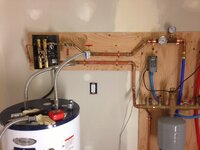
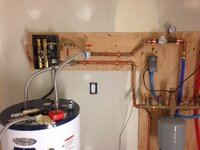
Great looking system have much the same Sq footage
Have you had any issues since posted?
Do you have the details of all the components in the system?
Would you change anything ?

Thank You

Very similar to my system, many pages back (actually first page). I'm on my 2nd HWH, first one had a lot of rust falling from the vent tube, so I just called Whirlpool and they replaced it.
 
To avoid these ads, REGISTER NOW!

BadgerBoilerMN

Well-known member
Joined
Aug 4, 2011
Messages
837
Location
Minneapolis
You need two things when using a dedicated tank-type water.

1st a source of outside combustion air in the same room and the WH.

2nd a mixing valve at he water heater to assure higher return water temperatures to keep the stack and water heater from condensing and rusting out prematurely...if the CO doesn't kill you first.

Keeping the water heater at 140F and mixing supply below 100F takes care of most applications.
 

bimmer1980

Well-known member
Joined
Feb 5, 2009
Messages
2,104
Location
York, PA
Guys,
Can you make some recommendations for me? I'm working towards setting up my Radiant floor heat in a 1600 sq ft garage. All the tubes are placed in the concrete.

I need to size and source a boiler. I'm working on getting the gas line set up in the next few weeks.

I calc'd about 15,670 Btu's for heat loss through the walls, windows, etc.
I'm a bit concerned about the infiltration calc tho. I came up with 33,814 btus for infiltration. This was based on using estimated CFM's for windows and doors. CFM x Delta T x 1.1 = BTU's.

I think 1" HDPE pipe to go 80' underground and about 75' of pipe inside the buildings would be sufficient, but I'm thinking about upsizing to 1-1/4" pipe. Thoughts??

BTW--I've enjoyed seeing all the installations. It's been helpful!
 

theoldwizard1

Well-known member
Joined
Feb 22, 2011
Messages
43,156
Location
SE MI
2nd a mixing valve at the water heater to assure higher return water temperatures to keep the stack and water heater from condensing and rusting out prematurely...if the CO doesn't kill you first.
Wouldn't a power vent through stainless or PVC solve most of this ?
 

morehead

Active member
Joined
Dec 21, 2007
Messages
32
Location
southwestern ontario
You need two things when using a dedicated tank-type water.

1st a source of outside combustion air in the same room and the WH.

2nd a mixing valve at he water heater to assure higher return water temperatures to keep the stack and water heater from condensing and rusting out prematurely...if the CO doesn't kill you first.

Keeping the water heater at 140F and mixing supply below 100F takes care of most applications.

What about using a power vent HWH?
What make and model mixing valve would you recommend ?
Thank you
 

Radix2

Well-known member
Joined
May 28, 2014
Messages
1,853
Location
the thumb!, MI
Wouldn't a power vent through stainless or PVC solve most of this ?

What about using a power vent HWH?
What make and model mixing valve would you recommend ?
Thank you

Why do you think a power vent would solve the issue ?

You have to allow the hot exhaust to have sufficient contact with the flue (which is also the heat exchanger in a HWH) to heat up the water. If the surface is below the dew point of flue gas, it will condense. Having more flow will just condense more. Condensing burners all use power vents because the efficient heat exchangers cool the exhaust so much it is not light enough to rise and cause a natural chimney draft.

The only solution is to either keep the heat exchanger hot or to allow it to condense and make the heat exchanger out of a non corroding material.

By the time you buy the mixing valves and expensive stainless steel tank, you probably could have bought a condensing boiler -and enjoyed the 95% efficiency that is easy to get with radiant floors since they use low temperature water which is good for condensing.
 
Last edited:

Darko9000

Member
Joined
Jan 31, 2014
Messages
13
Location
NC USA
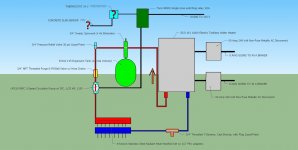
Didn't mean to hijack this thread but I'm looking for some guidance and advice on my system hook up.
This is my original thread that I started http://www.garagejournal.com/forum/showthread.php?t=345823

I am not quite clear on how to wire certain things.

1.Does my mechanical layout in my sketch of drawing looks okay?

2.Does the concrete floor sensor gets hooked up directly to a thermostat?

3.This is going to be a heat only application, how would I go about deciding what thermostat and what floor sensor to get?

Parts im getting

ECO 18 | 18kW Electric Tankless Water Heater http://www.ecosmartus.com/products/radiant-floor-heater/eco-18/#product-tab2
3/4" Sweat, Spirovent Jr Air Eliminator http://www.pexuniverse.com/spirotherm-vjs075-spirovent-3-4-air-eliminator
Extrol #15 Expansion Tank (2.0 Gal Volume) http://www.pexuniverse.com/amtrol-extrol-15-expansion-tank
UPS15-58FC 3-Speed Circulator Pump w/ IFC, 1/25 HP, 115V http://www.pexuniverse.com/grundfos-ups15-58fc-circulator-pump-59896341
3/4" NPT Threaded Purge & Fill Ball Valve w/ Hose Drains http://www.pexuniverse.com/webstone-pro-pal-48613-purge-and-fill-valve
3/4" Pressure Relief Valve 30 psi (Lead-Free) http://www.pexuniverse.com/wilkins-p1000axl-30c
3/4" Threaded Y-Strainer, Cast Bronze, with Plug (Lead-Free) http://www.pexuniverse.com/3-4-threaded-y-strainer-cast-bronze-with-plug-lead-free-bronze
60 Amp 240-Volt Non-Fuse Metallic AC Disconnect http://www.homedepot.com/p/GE-60-Amp-240-Volt-Non-Fuse-Metallic-AC-Disconnect-TFN60RCP/100674085
8-branch Stainless Steel Radiant Heat Manifold Set w/ 1/2" PEX adapters http://www.pexuniverse.com/ssm108-steel-radiant-heat-manifold
Taco SR501 Single zone switching relay http://www.pexuniverse.com/taco-sr501-4-switching-relay


Thanks for your helpradiant2.jpg
 

jlckmj

Well-known member
Joined
Dec 7, 2009
Messages
732
Location
SE Wiscosin
Great looking system have much the same Sq footage
Have you had any issues since posted?
Do you have the details of all the components in the system?
Would you change anything ?

Morehead,

The system has been working well, UNTIL TODAY!.
Actually the 17 YEAR OLD water heater just now gave out, the intellivent system started acting up so I am replacing it. I put the water heater in used, and it still has worked well for 5 years now.

I would not change anything major, but since I am draining the water today, I would have placed a water drain along with the return water from the manifold (lower manifold where the original drain was located) to aid in getting the water out.

Jim
 

hercules633

Well-known member
Joined
Jan 12, 2012
Messages
52
I need some help in the designing of my radiant panel. I have a few items and know a few more items I need to purchase along with copper fittings. I will give you the info on what I have currently and then what items I am looking at purchasing.
Have

32x56 slab, 6" thick, pex 2 1/2" down from top of slab
2" ridgid foam under and around perimeter or slab
7 loops of 1/2" pex 260 to 275' in length
1 zone closed loop
Grundfos pump ups 15 58 fc
A.O. Smith ATI-540H-N on demand water heater natural gas

Needed

Taco 501 controller- would this be needed or will just the thermostat control it by itself?
Thermostat
Condensate pump
7 port supply and return manifold Rifing
Taco Air separator that I can attach ex tank to bottom of
Expansion tank (size I don't know?any input would help)
Valves, not sure how many or where to place-know I need some on each side of the pump for change out
Not sure if I should use antifreeze or water or a mixture
I'm in South Central Montana and it gets cold here
Insulation will be at minimum R19 in 2x6 walls and R30 in ceiling

I have looked at many systems on here and would like to keep it as simple and efficient as possible. Any input from you experts would be very much appreciated. I know some will want the heat loss calc and window and door specs but want to get parts ordered. Don't want another cold winter shop season!
 

Attachments

  • 20160517_205751.jpg
    20160517_205751.jpg
    152.9 KB · Views: 264
  • 20161226_170319.jpg
    20161226_170319.jpg
    145.7 KB · Views: 225
  • 20160928_131718.jpg
    20160928_131718.jpg
    150.8 KB · Views: 207

hercules633

Well-known member
Joined
Jan 12, 2012
Messages
52
On my question about possibly not needing a Taco controller and just using thermostat to run/stop on demand heater. The description for Taco says that controller is needed to power up the circulator/pump. Curious though, doesn't your thermostat tell your furnace to kick on in your home and also tell it to shut off? If so why couldn't the thermostat be used in place of the Taco controller?
 

kj_mustang

Well-known member
Joined
Feb 9, 2011
Messages
1,213
Location
Harrisonburg, VA
Thermostat is wired to the controller and the pumps are wired to the controller. Thermostat uses low voltage from a transformer usually built into the controller and the pumps use 120V.
 

Flexia

Well-known member
Joined
Mar 8, 2013
Messages
215
Location
Akron/Canton Ohio
On my question about possibly not needing a Taco controller and just using thermostat to run/stop on demand heater. The description for Taco says that controller is needed to power up the circulator/pump. Curious though, doesn't your thermostat tell your furnace to kick on in your home and also tell it to shut off? If so why couldn't the thermostat be used in place of the Taco controller?
Most thermostat cannot handle the 120v load of the pump. So you need to taco controller to turn the 120v pump on. The thermostat calls for heat and tells the pump controller to turn the pump on. Basically the controller is a big relay to handle the pump on and off.

Sent from my Pixel XL using Tapatalk
 

hercules633

Well-known member
Joined
Jan 12, 2012
Messages
52
Kj Mustang and Flexia
I appreciate the input. I have seen a few without the controller, but yes the load the thermostat would take is too big. I don't want this thing shutting down in the middle of winter next year. Do you both have radiant systems, If so any advice?
thanks Mike
 

Radix2

Well-known member
Joined
May 28, 2014
Messages
1,853
Location
the thumb!, MI
Kj Mustang and Flexia
I appreciate the input. I have seen a few without the controller, but yes the load the thermostat would take is too big. I don't want this thing shutting down in the middle of winter next year. Do you both have radiant systems, If so any advice?
thanks Mike

Google "line voltage thermostat". There are all kinds of thermostats that can directly power fans, circulators or heaters. If you just have a simple pump you want to drive when the temp drops, no need for a fancy Taco controller.
 

hercules633

Well-known member
Joined
Jan 12, 2012
Messages
52
Radix2
Perfect, just what I was looking for. You save me 54$ thank you

"Line voltage thermostats are typically used for radiant, convection or resistance heaters that are powered by electricity. "
 

kj_mustang

Well-known member
Joined
Feb 9, 2011
Messages
1,213
Location
Harrisonburg, VA
That type of thermostat will cost you $50 -$100, versus a cheap $15 heat only thermostat plus the cost of the controller. Don't see where you are saving much. Yes I have radiant installed in my Pole building. Honeywell single zone switching relay and cheap Honeywell thermostat works fine for me. Cost about $65 -$75 for both.
 

Radix2

Well-known member
Joined
May 28, 2014
Messages
1,853
Location
the thumb!, MI
That type of thermostat will cost you $50 -$100, versus a cheap $15 heat only thermostat plus the cost of the controller. Don't see where you are saving much. Yes I have radiant installed in my Pole building. Honeywell single zone switching relay and cheap Honeywell thermostat works fine for me. Cost about $65 -$75 for both.

Nah, a $18 robertshaw 802 will run a circulator no probs. Rated up to 1hp 120vac
 

hercules633

Well-known member
Joined
Jan 12, 2012
Messages
52
Kj- what I am thinking is that it is once less piece to worry about issues with. I'm sure the Taco 501 is a great controller. Then if it ever comes time to troubleshoot anything it's one less thing to look into. Looking for a simple system that functions well.

Radnix2- keep the good ideas coming. Thanks again
 

wolverine22391

Well-known member
Joined
Oct 16, 2014
Messages
109
Location
South Bend, IN
I have a NG Bosch 940 Es tankless water heater, and as of now it's only used for hot water use. I am planning on going radiant in my basement soon, and was curious if I should use this water heater as they got it written up in the Manuel or go with a complete separate system all by itself. I am just curious and wanting input. Thanks for the help

http://www.bosch-climate.us/files/6720644930_940ES_Installation_Instructions_en_05.2016_US.pdf

Go to page 32 too see setup.
 

Attachments

  • image.jpg
    image.jpg
    18.7 KB · Views: 120
Last edited:
To avoid these ads, REGISTER NOW!

Aquamoose

Well-known member
Joined
Jan 28, 2014
Messages
365
I originally used a 40gal water heater and learned hard & fast that it was inadequate so it got replaced with an on-demand electric water heater set for 80 degrees and the thermostat set for 60 which runs the pump. The heater kicks on whenever there's flow.

Been incredibly effective this way.

4c6d023bf4293e16ef2a952851e1da67.jpg


Sent from my iPhone using Tapatalk
 

Attachments

  • 4c6d023bf4293e16ef2a952851e1da67.jpg
    4c6d023bf4293e16ef2a952851e1da67.jpg
    453.6 KB · Views: 10

Aquamoose

Well-known member
Joined
Jan 28, 2014
Messages
365
It is simple. Here's my final setup. You don't need the switch box on the upper left. I needed to switch power between this and another device.

86a32fe15419fd19f7fc78fbc8909912.jpg


Sent from my iPhone using Tapatalk
 

Attachments

  • 86a32fe15419fd19f7fc78fbc8909912.jpg
    86a32fe15419fd19f7fc78fbc8909912.jpg
    372.2 KB · Views: 16

Wook660

Active member
Joined
Jan 17, 2011
Messages
29
Location
CT
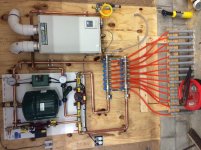
Little different set up here. I use a 1050 gallon wood fired boiler with oil backup. I start a fire once every 2 days that burns for about 5 hours to get the 1050 gallons of water up to 220 degrees. That water is then circulated through the floors to heat the house and there is a heat exchanger in the back of it that provides my domestic hot water.
View media item 67468View media item 67469Holes are for future two post lift location
View media item 64102
 

Jon_E

Well-known member
Joined
Aug 19, 2015
Messages
575
Location
Southwestern Vermont
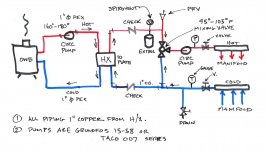
I have a different setup than most of you, as my garage hot water supply is coming from an outdoor wood furnace 160' away from my garage. As a result I have simply 2, 1" dia. PEX tubing lines entering the garage flowing 160- to 180-degree water in.

For the record, the space is 800 square feet, with 900 feet of 1/2" PEX tubing centered in a 6" slab. Insulated underneath and on the sides.

Before I start putting my piping together (this is a work in progress, not completed) I thought I would post a picture of my proposed plumbing diagram for a single zone and get some feedback from this group on it. Hopefully you guys who have a good grasp of this stuff can read this and understand what I am trying to do. I have read all 38 pages of this thread and just trying to get it right the first time.
 

Attachments

  • garage diagram 012317.jpg
    garage diagram 012317.jpg
    122.5 KB · Views: 245

Nhermanson

Member
Joined
Jul 23, 2015
Messages
8
Are you going to run antifreeze in the boiler? If not I wonder why you need a heat exchanger and the mixing valve.
 

Gooch

Well-known member
Joined
May 30, 2009
Messages
676
Location
Petersberg, IA
Are you going to run antifreeze in the boiler? If not I wonder why you need a heat exchanger and the mixing valve.

The OWB is an open system and you really want to operate a heating system as a closed system. Only way to do that is to isolate them. The mixing valve is there because 160-180* water is way to hot for a radiant slab.
 

Gooch

Well-known member
Joined
May 30, 2009
Messages
676
Location
Petersberg, IA
Are you going to run antifreeze in the boiler? If not I wonder why you need a heat exchanger and the mixing valve.

The OWB is an open system and you really want to operate a heating system as a closed system. Only way to do that is to isolate them. The mixing valve is there because 160-180* water is way to hot for a radiant slab.

Jon, are you planning on any type of auto fill for the OWB?
 

bams50

Well-known member
Joined
Feb 23, 2012
Messages
2,784
Location
Central NY State
My question is, why would you have the boiler 160 feet away from the building?? There has to be a huge amount of heat loss in those lines, no matter what you do.
 

Jon_E

Well-known member
Joined
Aug 19, 2015
Messages
575
Location
Southwestern Vermont
To answer questions. First, the boiler is indeed an open system. There are closed loop boilers available but mine is not one of them. I have been heating my house this way for over ten years. Second, the boiler is 160 feet from the garage because that's where the boiler was, and that's where I built the garage. The lines are 1" insulated PEX tubing, specifically for outdoor wood boilers, and the heat loss is allegedly less than one degree per hundred feet. I will be able to check that claim once the garage system is in place.

I already have an autofill for the OWB in my house.

I run the loop in my house similar to what I sketched up, but I have five zones in the house, with a plate exchanger, a primary circulation loop, and five secondary circulation loops with zone controls. With a single zone in the garage, I wasn't sure if I needed the heat exchanger or the mixing valve. I know that the incoming water from the OWB is too hot not to have a mixing valve.

In my sketch, where would be the best place to put a fill/purge valve? Also, I'm not sure if the check valves are in the right place.
 

kj_mustang

Well-known member
Joined
Feb 9, 2011
Messages
1,213
Location
Harrisonburg, VA
If you are only using the hot water from the owb for the heating system and not for domestic hot water in the garage, than I don't see the need for the heat exchanger. You would need a check valve before the mixing valve on the domestic cold water side.
 
Last edited:

Gooch

Well-known member
Joined
May 30, 2009
Messages
676
Location
Petersberg, IA
If you are only using the hot water from the owb for the heating system and not for domestic hot water in the garage, than I don't see the need for the heat exchanger. You would need a check valve before the mixing valve on the domestic cold water side.

An open system would require corrosion resinstant materials.
 

theoldwizard1

Well-known member
Joined
Feb 22, 2011
Messages
43,156
Location
SE MI
Last edited:
To avoid these ads, REGISTER NOW!
Top Bottom