To avoid these ads, REGISTER NOW!

J.M. Carpenter Tap & Die Company

woody 73

Well-known member
Joined
Apr 14, 2009
Messages
11,547
Location
The Great State Up North
This next story is so low under the Radar screen, it's like looking for the SR-71 Blackbird spy plane several miles up in the sky...

The following is a Quote from the Electrical World on June the 12th 1897.

"The J. M. Carpenter Tap & Die Company of Pawtucket R.I., was founded by Mr. J. M. Carpenter in 1870 and incorporated in 1891 and is claimed to be the oldest house in the Country Manufacturing a general line of screw cutting tools".

That was the easy part but I had trouble finding out when the company ended; I have a few clues, one link reports they were still active in 1925 and 1939.

Another old link that I am having problems reading and understanding , and hopefully someone on the GJ can help me fill in the blanks. It reads in part April the 25th 1936 The Greenfield T&D has acquired the J. M. Carpenter T&D Branch and then something about the Whitman & Barnes Corporation (Please see the link maybe some of you can understand it better then my old eyes).

As an update many thanks to GJ member bob15 The Company was acquired by Union Twist & Drill co. at an unknown date after 1900; see the very last link page 122.

Of Special Note I could not find any trademark information but they used a large letter "V" with a small letter "c" inside the large V, I will keep hunting for it.

I also found a nice link about a set that Henry Ford used to build his first Quadricycle that you might enjoy seeing.

Some links for you, a few nice pictures and yet another tool to look for in your many hunts.

https://books.google.com/books/about/Catalogue_and_Price_Lists_of_the_J_M_Car.html?id=IItQQwAACAAJ

http://www.datamp.org/patents/displayPatent.php?id=44562

http://www.google.com.na/patents/US560083

https://books.google.com/books?id=Q...QAhXH34MKHcWjAZwQ6AEIKDAD#v=onepage&q&f=false

http://socialarchive.iath.virginia.edu/ark:/99166/w6ns5vtn

https://books.google.com/books?id=P...e&q=j m carpenter tap and die company&f=false

https://books.google.com/books?id=p...e&q=j m carpenter tap and die company&f=false

https://www.thehenryford.org/collections-and-research/digital-collections/artifact/53055/

http://www.rifoundation.org/Transfo...rsofCommunity/TheFoundationsFirst10Funds.aspx

https://www.newspapers.com/newspage/1394381/

http://www.davistownmuseum.org/PDFs/Vol8_AmToolmakers.pdf
 

Attachments

  • GEDC2235.jpg
    GEDC2235.jpg
    136.2 KB · Views: 56
  • GEDC2239.jpg
    GEDC2239.jpg
    136.2 KB · Views: 45
  • GEDC2236.jpg
    GEDC2236.jpg
    141.9 KB · Views: 39
  • GEDC2237.jpg
    GEDC2237.jpg
    139.2 KB · Views: 50
  • GEDC2238.jpg
    GEDC2238.jpg
    134.8 KB · Views: 48
Last edited:
To avoid these ads, REGISTER NOW!

Cadman56

Well-known member
Joined
Sep 17, 2007
Messages
144
Location
SE Pa
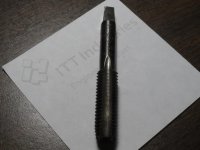
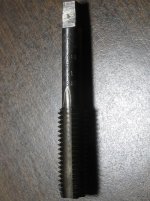
I know this thread is a year old but I just found something today that hopefully someone can shed some light on. I purchased a wooden box of taps recently at an auction. Today I was cleaning some of them up and putting them in containers by size. Most of the taps are R&N and Greenfield with a few Vermont. After cleaning this one tap I looked at the stamping on it and didn't recognize anything about this tap so I thought I'd put aside and search the internet for any information I could find on it. That's how I found this thread. Here is what is stamped on the tap:
J. M. CARPENTER
TAP & DIE CO
PAWT. R.I. U.S.A.
33/64
a big "V" with a small "c" in it
13
U.S.F.

As a mechanical designer, I never heard of a 33/64 tap. Also, what does U.S.F. stand for? I couldn't find that in my old Machinery's Handbook. TIA for any help you can provide. I'd like to find out what this tap is all about.
 

Private Lugnutz

Well-known member
Joined
Mar 30, 2012
Messages
30,710
Location
The Authentic Jersey Shore
Cadman,

How clean is the marking after the threads per inch (TPI) number ("13")? Are you 100% positive it reads, "U.S.F.? Could it be "U.S.S. (United States Standard) instead?

Reason I ask is... Normally, the TPI would be followed by the standard, and, like you, I have never of U.S.F.

One might think, 'okay, the "F" could be "fine",' but that doesn't fit with the 13 TPI on the tap, which is coarse. A 13 TPI would very much fit with a "U.S.S." on a vintage tap, however. As you probably know, the old U.S.S. was adopted as National Coarse (N.C.) and the S.A.E. became National Fine (N.F.)
 

Cadman56

Well-known member
Joined
Sep 17, 2007
Messages
144
Location
SE Pa
The marking on the tap are very clear. I even looked at it with my eye lope to make sure I read it right. The tap itself looks like it was hardly used. Thanks for the reply.
 

Cadman56

Well-known member
Joined
Sep 17, 2007
Messages
144
Location
SE Pa
Here are a few pics I just took at my desk. Let me know if these are OK, or if you want other shots. Thanks. :beer:
 

Attachments

  • IMG_0856.jpg
    IMG_0856.jpg
    132.1 KB · Views: 56
  • IMG_0855.jpg
    IMG_0855.jpg
    140.8 KB · Views: 47
  • IMG_0854.jpg
    IMG_0854.jpg
    147.4 KB · Views: 56
  • IMG_0853.jpg
    IMG_0853.jpg
    140.3 KB · Views: 79
OP
W

woody 73

Well-known member
Joined
Apr 14, 2009
Messages
11,547
Location
The Great State Up North
Cadman 56, just not sure as of yet (too many mysteries yet to solve)?

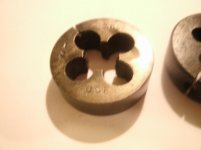
I picked up a few very old vintage dies some time back and I found two very old dies marked U.S.F, one is not marked with a company name and I believe the other one (looking through a strong eye glass) is an old Card made die.

I will keep looking for information but it might be put on the back burner for now as I am working on another story.
 

Attachments

  • GEDC4294.jpg
    GEDC4294.jpg
    132.8 KB · Views: 27
  • GEDC4297.jpg
    GEDC4297.jpg
    124.5 KB · Views: 26
  • GEDC4316.jpg
    GEDC4316.jpg
    129.3 KB · Views: 24

Cadman56

Well-known member
Joined
Sep 17, 2007
Messages
144
Location
SE Pa
Is it 9/16-18? cause that calls for a 33/64 drill hole.

I'll check the tpi with my thread gage in the shop tomorrow. I have other taps that have on them to use a certain diameter tap drill but this one doesn't say that, only 33/64 V 13.
 

Ole Slewfoot

Well-known member
Joined
Feb 22, 2016
Messages
5,098
Location
Freedom, CA
I read in a dark corner of the internet that before the unified threads(which we still wrongly call national) came around in 1949, the numbered screw threads went up to 14 instead of ending at 12. I'm guessing that would make a #13 just bigger than a #12 machine screw, but I couldnt find any chart old enough to say exactly.
 

twertsy

Well-known member
Joined
Jan 5, 2014
Messages
6,726
Location
Reedville, VA
This next story is so low under the Radar screen, it's like looking for the SR-71 Blackbird spy plane several miles up in the sky...

The following is a Quote from the Electrical World on June the 12th 1897.

"The J. M. Carpenter Tap & Die Company of Pawtucket R.I., was founded by Mr. J. M. Carpenter in 1870 and incorporated in 1891 and is claimed to be the oldest house in the Country Manufacturing a general line of screw cutting tools".

That was the easy part but I had trouble finding out when the company ended; I have a few clues, one link reports they were still active in 1925 and 1939.

Another old link that I am having problems reading and understanding , and hopefully someone on the GJ can help me fill in the blanks. It reads in part April the 25th 1936 The Greenfield T&D has acquired the J. M. Carpenter T&D Branch and then something about the Whitman & Barnes Corporation (Please see the link maybe some of you can understand it better then my old eyes).

As an update many thanks to GJ member bob15 The Company was acquired by Union Twist & Drill co. at an unknown date after 1900; see the very last link page 122.

Of Special Note I could not find any trademark information but they used a large letter "V" with a small letter "c" inside the large V, I will keep hunting for it.

I also found a nice link about a set that Henry Ford used to build his first Quadricycle that you might enjoy seeing.

Some links for you, a few nice pictures and yet another tool to look for in your many hunts.

https://books.google.com/books/about/Catalogue_and_Price_Lists_of_the_J_M_Car.html?id=IItQQwAACAAJ

http://www.datamp.org/patents/displayPatent.php?id=44562

http://www.google.com.na/patents/US560083

https://books.google.com/books?id=Q...QAhXH34MKHcWjAZwQ6AEIKDAD#v=onepage&q&f=false

http://socialarchive.iath.virginia.edu/ark:/99166/w6ns5vtn

https://books.google.com/books?id=P...e&q=j m carpenter tap and die company&f=false

https://books.google.com/books?id=p...e&q=j m carpenter tap and die company&f=false

https://www.thehenryford.org/collections-and-research/digital-collections/artifact/53055/

http://www.rifoundation.org/Transfo...rsofCommunity/TheFoundationsFirst10Funds.aspx

https://www.newspapers.com/newspage/1394381/

http://www.davistownmuseum.org/PDFs/Vol8_AmToolmakers.pdf

Woody,
Here are a couple quick finds from newspapers.com:

10/24/1932 - Michael J. Kearins is president of Latrobe Tool Co. and J. M. Carpenter.

7/27/1933 - Whitman & Barnes announces the acquisition of 3 new subsidiaries: Latrobe Tool Manufacturing Co. (Latrobe, PA), J. M. Carpenter Tap & Die Co. (Pawtucket, RI), and Valley Forge Steel & Tool Co. (Chicago). Mr. Kearins was elected president of Whitman & Barnes. Clarence Avildson was elected Chairman of the board, and had been Chairman for the 3 acquired companies since January 1932.

4/25/1936 - Greenfield Tap & Die announces the completion of the acquisition of J. M. Carpenter from Whitman & Barnes.

Also, here is the link for the Trademark, issued 4/3/1906, First Use 1876.
 

Private Lugnutz

Well-known member
Joined
Mar 30, 2012
Messages
30,710
Location
The Authentic Jersey Shore
Here are a few pics I just took at my desk.
Thanks, Cadman. That tap is in incredible condition for how old it is. The \c/ marking is the Carpenter trademark.

I picked up a few very old vintage dies some time back and I found two very old dies marked U.S.F.
Interesting, woody. I'll go through mine.

I read in a dark corner of the internet that before the unified threads(which we still wrongly call national) came around in 1949...
Not sure what you mean by "wrongly," Slew. Even after they were unified they were still called Unified National Coarse (UNC) and Unified National Fine (UNF) in formal specifications, and marked that way on many taps and dies, and all federal specifications in the late 1930's and 1940's refer to U.S.S. as "National Coarse" and S.A.E. as "National Fine".

I'm guessing that would make a #13 just bigger than a #12 machine screw, but I couldnt find any chart old enough to say exactly.
Interesting theory, but a #13 machine screw would be at least 24 TPI (his doesn't look close to that) and less than half the diameter of this tap. And if the "13" is signifying a #13 machine screw, that doesn't jibe with the "33/64" marking being a drill size, either.

I'll check the tpi with my thread gage in the shop tomorrow.
I'd be very shocked if it was anything other than 13 coarse, which is typical for a tap around that size (if the 33/64 is the cutting diameter) (e.g., 9/16"-12, 1/2"-13). Measure the diameter of the tap while you're at it.

EDIT: I don't have any vintage editions of Machinery's Handbook contemporary to when this tap was made. That might be useful.
 
Last edited:

Cadman56

Well-known member
Joined
Sep 17, 2007
Messages
144
Location
SE Pa
Measured the tap today. Diameter is 0.519" and the tpi is 13 just to confirm what is stamped on the tap. How old do you think this tap is?
 

Private Lugnutz

Well-known member
Joined
Mar 30, 2012
Messages
30,710
Location
The Authentic Jersey Shore
Measured the tap today. Diameter is 0.519" and the tpi is 13 just to confirm what is stamped on the tap. How old do you think this tap is?
I was thinking early part of the century, and no newer than 1933, but I guess it's possible that Whitman & Barnes and then GTD in turn continued to sell Carpenter taps and dies as a managed brand/subsidiary, with only the Carpenter markings on them.

Your measured diameter is slightly larger than 33/64 (0.5156), but I am still thinking that marking ("33/64") is the tap size. If that marking was a nominal drill size, the tap would be somewhere between 9/16" and 5/8" in diameter, right?

Perhaps the odd tap size is related to the apparent and still unidentified standard marking ("U.S.F.")
 

MShaw

Well-known member
Joined
Mar 2, 2015
Messages
1,014
Location
York, Pa.
A quick excursion on Google yields the meaning of United States Form. This is a quote from Geometric tool co that made and still makes thread cutting die heads. The quote was from a very old article.
 
To avoid these ads, REGISTER NOW!
OP
W

woody 73

Well-known member
Joined
Apr 14, 2009
Messages
11,547
Location
The Great State Up North
A quick excursion on Google yields the meaning of United States Form. This is a quote from Geometric tool co that made and still makes thread cutting die heads. The quote was from a very old article.

Is there any way you could post a link to that article which you were reading ?
 

Private Lugnutz

Well-known member
Joined
Mar 30, 2012
Messages
30,710
Location
The Authentic Jersey Shore
A quick excursion on Google yields the meaning of United States Form.
Go figure. In reference to the thread pitch geometry instead of the standard (U.S.S.). Nice work, MShaw.

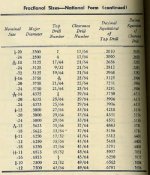
By the way, I did find a few references on-line to modern 33/64 taps, and in several of my references, including the Wartime Supplement to the American Machinists' Handbook (1942), and the table below (see thumbnail 1), from TM 11-453, Shop Work, published 11 March 1942 by the War Department. Apologies for the scan, but I didn't want to bend the book too strenuously, which is from my collection and original. It's not nominally paired with 13 TPI, which is a little puzzling. And, prompted by MShaw's post, I just threw in a diagram of the "National Form" (as it's called in this technical manual) for grins. It's the same as the "U.S. Form".
 

Attachments

  • 1942 TM 11-453 Shop Work tap chart.jpg
    1942 TM 11-453 Shop Work tap chart.jpg
    60.9 KB · Views: 42
  • 1942 TM 11-453 National or US Form diagram.jpg
    1942 TM 11-453 National or US Form diagram.jpg
    136.4 KB · Views: 33
Last edited:

DuroChrome

Well-known member
Joined
Apr 24, 2015
Messages
323
Location
Oregon
Could it be possible that it was a metric equivalent? Some of my old SK and Plomb socket sets have odd sizes that I've been told were designed to be used on metric equipment so the mechanic wouldn't have to buy an entire set, just a few extras to fill in. Just an idea...
 

Ole Slewfoot

Well-known member
Joined
Feb 22, 2016
Messages
5,098
Location
Freedom, CA
Not sure what you mean by "wrongly," Slew. Even after they were unified they were still called Unified National Coarse (UNC) and Unified National Fine (UNF) in formal specifications, and marked that way on many taps and dies, and all federal specifications in the late 1930's and 1940's refer to U.S.S. as "National Coarse" and S.A.E. as "National Fine".

In the US, the standard mainly got a new name,while our Brit and Canadian fellows had more noticeable changes. Apparently We unified in the aftermath of WWII in response to poor fastener interchange being a hassle.


Interesting theory, but a #13 machine screw would be at least 24 TPI (his doesn't look close to that) and less than half the diameter of this tap. And if the "13" is signifying a #13 machine screw, that doesn't jibe with the "33/64" marking being a drill size, either.

Separate theories.

I'd be very shocked if it was anything other than 13 coarse, which is typical for a tap around that size (if the 33/64 is the cutting diameter) (e.g., 9/16"-12, 1/2"-13). Measure the diameter of the tap while you're at it.

EDIT: I don't have any vintage editions of Machinery's Handbook contemporary to when this tap was made. That might be useful.

Posts 5 and 11 get into some meat.
https://www.garagejournal.com/forum/showthread.php?t=246647
 

Cadman56

Well-known member
Joined
Sep 17, 2007
Messages
144
Location
SE Pa
Thanks everyone answering the questions and supplying info on the mystery tap! One thing I still don't understand is the odd ball tap size of 33/64. What application would they use this tap for? Is it just an oversized 1/2-13? :headscrat
 

MShaw

Well-known member
Joined
Mar 2, 2015
Messages
1,014
Location
York, Pa.
Just a wild guess, but the 33/64 may be for a part that subsequently shrunk in heat treatment although this is doubtful since it was a documented size, not a special.
 

leg17

Well-known member
Joined
Aug 11, 2011
Messages
1,374
Location
Kentucky
Go figure. In reference to the thread pitch geometry instead of the standard (U.S.S.). Nice work, MShaw.

By the way, I did find a few references on-line to modern 33/64 taps, and in several of my references, ..... and the table below (see thumbnail 1), from TM 11-453, Shop Work, published 11 March 1942 by the War Department........

The 33/64 in the tap drill column?
 

Cadman56

Well-known member
Joined
Sep 17, 2007
Messages
144
Location
SE Pa
It's late and I'm tired but correct me if I'm wrong here. In the chart the 33/64, (0.515), is the tap drill for a 9/16 - 18 thread. The O.D. of the tap I have is 0.519. If I drilled a hole using a 33/64 diameter drill then ran my tap in it, I wouldn't be cutting any threads.
0.519 - 0.515 = 0.004 /2 = 0.002 per side thread height???
 

leg17

Well-known member
Joined
Aug 11, 2011
Messages
1,374
Location
Kentucky
Thanks everyone answering the questions and supplying info on the mystery tap! One thing I still don't understand is the odd ball tap size of 33/64. What application would they use this tap for? Is it just an oversized 1/2-13? :headscrat

It could be but that is quite a bit oversize.
It is common to tap holes in tool steel and case-hardened items maybe .003-.005 oversize to allow for distortion, but .015 over seems to be a lot.

I doubt it was intended as metric something or other. If so, it would have simply been marked with the metric size.

Like Nutz reported, 33/64-13 taps are available new today. Must be a market for them or these toolmakers would not market or inventory them.

What is the usual application?
Who knows. It's a big world out there in industry.
You just never know what some design application might require.

I have a small accumulation of oddball taps.
I will never know what the original need was.
 

leg17

Well-known member
Joined
Aug 11, 2011
Messages
1,374
Location
Kentucky
I got a lead on another site.
Could be way oversize, for 1/2-13, to allow for heavy hot-dip galvanizing.
(Quite a bit heavier coating than say, black oxide)
Sounds plausible. Didn't think of it myself.
I will keep watching.
 

leg17

Well-known member
Joined
Aug 11, 2011
Messages
1,374
Location
Kentucky
I'm convinced.
I see now that 1/64 over taps are available for 5/8 and 3/4 as well as the 1/2 we have been talking about.

Been a good day.
Learned something new and didn't spit up my breakfast.
 

Fuji269

New member
Joined
Apr 28, 2018
Messages
1
Thank you for this information. I have some of my Grandfather's tools and it is great to learn the history on them.
 

dzarren

New member
Joined
Jul 23, 2019
Messages
4
Location
Canada
Hi I know this is an old thread, but I found it very interesting.

I recently picked up what I thought was a complete set of 5/8-11 taps.

The Brand is J M Carpenter of course.
When I got it back, I looked more closely at the suspicious smaller diameter heavily tapered tap. It looked to have similar pitch as the others, so i assumed it was part of the set.

Turns out it is a different brand of tap, and has 12 pitch threads.

The box was cleaned with some beeswax orange oil thing before I got pictures of it. The box was quite greasy.
Here is what the taps looked like when I first got them (warning, i think i make a boo boo)

67078959_10156485802966732_3516793073927454720_n.jpg


67237020_10156485803016732_6386366041278119936_n.jpg


I decided I wanted to use them, or at least clean them, and I first tried using just WD 40 to clean it, but that did nothing at all.
I didn't have any real degreaser, so i tried using a gel paint stripper i had, which is probably my first mistake. I put the in a beaker with the gel, and left the square portion of the taps sticking out for me to grab after. It did take the grease off, and there was a little bit of rust under it, but not much at all.

This is where the taps looked their best. Probably should have stopped here, after some oil.

Anyway, I ended up putting the things in Evaporust, but for a bit too long, and they turned quite black. I left it in for maybe 3 hours, which was great, but for some reason i decided to leave it in for another 4 hours or so after that. They came out very blackened, and that was my fault.

For some reason, it appears that the paint stripper altered the appearance of the metal as well, it seems that where the taps were left out of it, the blackening from the evaporust did not take full effect. You can see this especially clearly on the right most smaller tap.

Here they are. I think i went a bit too far on this one.

67121450_10156485802886732_1757332151725981696_n.jpg


67302941_10156485802851732_7067791439198945280_n.jpg
 
To avoid these ads, REGISTER NOW!
Top Bottom