To avoid these ads, REGISTER NOW!

Need help/suggestions with an outdoor antenna ground

flyin99

Well-known member
Joined
Nov 20, 2006
Messages
87
Location
Central Ky.
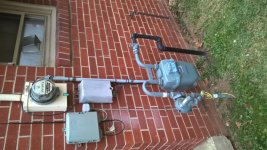
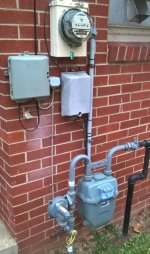
Have an older (60 year old) house.....can't find an outside ground. Just installed a roof antenna and want to ground it and was told it needed to be with the house ground and not separate. Pics included. I see a mess of aluminum wires inside the breaker box, but they don't go outside. There is also a pipe outside that previous Directv installer used, but it doesn't go in the ground either. I just don't want to cause electrical problems or make the static or lightning more likely......Thoughts? Thank you all!!
 

Attachments

  • outpanel.jpg
    outpanel.jpg
    154.9 KB · Views: 127
  • whground.jpg
    whground.jpg
    155.6 KB · Views: 116
  • panel.jpg
    panel.jpg
    149.3 KB · Views: 120
To avoid these ads, REGISTER NOW!

Movover

Well-known member
Joined
Jan 14, 2015
Messages
585
Location
Central Maine
You should have at least 1 and code I believe is 2 8' grounds rods out there connected to your meter pan. Install those or have them installed and then you have a common ground point for all the stuff :)
 

urbanG33K

Active member
Joined
Feb 14, 2015
Messages
35
Location
Cayuga, Ontario
out door water faucet is a good ground around these parts. As a telecom technician, that's our preferred grounding point, after the actual copper hydro braid for the hydro panel.

The pic with the water pipe and the grounding ******** it is probably perfect, SO LONG AS you trace that pipe back inside and ensure that it's a cold water pipe tied to the rest of the cold water plumbing.

If by chance, the interior plumbing has been fully or partially converted to pex, you must ensure there are no pex sections between the main shut off, and that exterior pipe.

Given there is no valve on that pipe, I would be suspicious of it's purpose. Perhaps it's for hot water tank pressure relief, or a drain for an A-coil in a furnace plenum?? In those cases, it is not a good ground.
 
Last edited:
OP
F

flyin99

Well-known member
Joined
Nov 20, 2006
Messages
87
Location
Central Ky.
out door water faucet is a good ground around these parts. As a telecom technician, that's our preferred grounding point, after the actual copper hydro braid for the hydro panel.

The pic with the water pipe and the grounding ******** it is probably perfect, SO LONG AS you trace that pipe back inside and ensure that it's a cold water pipe tied to the rest of the cold water plumbing.

If by chance, the interior plumbing has been fully or partially converted to pex, you must ensure there are no pex sections between the main shut off, and that exterior pipe.

Given there is no valve on that pipe, I would be suspicious of it's purpose. Perhaps it's for hot water tank pressure relief, or a drain for an A-coil in a furnace plenum?? In those cases, it is not a good ground.


Here is the back side of that pipe.....it is valved and runs into the water heater....
 

Attachments

  • WP_20161216_17_44_05_Pro.jpg
    WP_20161216_17_44_05_Pro.jpg
    134.9 KB · Views: 64

Falcon67

Well-known member
Joined
Jun 11, 2009
Messages
18,371
Location
Merkel, TX
You should have at least 1 and code I believe is 2 8' grounds rods out there connected to your meter pan. Install those or have them installed and then you have a common ground point for all the stuff :)

Yea, well - I know of two houses in this neighborhood built and occupied (for years) that have "none of the above". We're living in one, since repaired. So make no assumptions about "should have".
 
OP
F

flyin99

Well-known member
Joined
Nov 20, 2006
Messages
87
Location
Central Ky.

I guess I don't understand how that grounds it, being attached to the outside of the meter....People keep telling me you don't want to direct it back into the house.....but isn't that what happens here? The breaker box is on the back side of the meter and then everything inside the house........I know I'm over analyzing this......just trying to learn and get it all through my head.....sorry:confused:
 

urbanG33K

Active member
Joined
Feb 14, 2015
Messages
35
Location
Cayuga, Ontario
no, the electricity will follow the path of least resistance. Which would mean it would go up the aerial neutral/ground from the hydro company. Your entire house is grounded to that neutral according to what I'm seeing inside the electrical panel.

I'm making the assumption that the metal meter box is bonded to the neutral, just like the grounds in your electrical branch circuits are in your breaker panel.
 
OP
F

flyin99

Well-known member
Joined
Nov 20, 2006
Messages
87
Location
Central Ky.
no, the electricity will follow the path of least resistance. Which would mean it would go up the aerial neutral/ground from the hydro company. Your entire house is grounded to that neutral according to what I'm seeing inside the electrical panel.

I'm making the assumption that the metal meter box is bonded to the neutral, just like the grounds in your electrical branch circuits are in your breaker panel.

I think I got it....lol. I'm sorry for being ignorant about that stuff. Since the bunch of wires in the top right of panel are grounding somewhere and since the panels is connected to the meter, outside. If I attach to the cover of the meter.....it's grounded. Makes sense to me, know. Thank you!!!!!!!!!
 

urbanG33K

Active member
Joined
Feb 14, 2015
Messages
35
Location
Cayuga, Ontario
You can also trace where the phone company grounded too.

See the left side of the large demarc box? there is a black cable going in the side, as well as a beige ground. it loops over to the little grey binding post terminal. pull the cap off that, and trace where the ground goes from there. It appears to go down the outside wall along with a piece of beige phone wire, and is drilled into your basement/crawl space. Find it on the inside and figure out where that ground bonds to.

You should be able to use the same grounding point inside.

To talk more directly to you question on directing it inside the house or not....

Electrically speaking it doesn't matter, the surge will find it's way to ground following the path of least resistance. It may even arc to a stronger ground path on it's journey.

Use #10, or #8 solid core copper (or whatever code is for antennas in your state) running to whatever ground source you choose.

The ground rod may sound like a great idea, but it's not always. If your soil is particularly sandy, or if you have a lot of gravel, it's not going to be very conductive and the surge may be inclined to jump/arc to something else anyways.

At work we look for....

Hydro panel ground.
Hydro meter ground.
Cold water pipe.
Ground rod.

in that order.
 
OP
F

flyin99

Well-known member
Joined
Nov 20, 2006
Messages
87
Location
Central Ky.
You can also trace where the phone company grounded too.

See the left side of the large demarc box? there is a black cable going in the side, as well as a beige ground. it loops over to the little grey binding post terminal. pull the cap off that, and trace where the ground goes from there. It appears to go down the outside wall along with a piece of beige phone wire, and is drilled into your basement/crawl space. Find it on the inside and figure out where that ground bonds to.

You should be able to use the same grounding point inside.

To talk more directly to you question on directing it inside the house or not....

Electrically speaking it doesn't matter, the surge will find it's way to ground following the path of least resistance. It may even arc to a stronger ground path on it's journey.

Use #10, or #8 solid core copper (or whatever code is for antennas in your state) running to whatever ground source you choose.

The ground rod may sound like a great idea, but it's not always. If your soil is particularly sandy, or if you have a lot of gravel, it's not going to be very conductive and the surge may be inclined to jump/arc to something else anyways.

At work we look for....

Hydro panel ground.
Hydro meter ground.
Cold water pipe.
Ground rod.

in that order.

Interesting stuff, indeed! Could it be just run over to that box, where the tan wire is and connected there? Leaving everything outside? Antenna is mounted directly above this area, is why I asked...
 

Attachments

  • outpanel.jpg
    outpanel.jpg
    125.4 KB · Views: 52
Last edited:

urbanG33K

Active member
Joined
Feb 14, 2015
Messages
35
Location
Cayuga, Ontario
If I understand you question...

No that phone box should be getting a ground from somewhere.

Unlike the hydro company, the phone companies drop cables do not normally carry a wire with a conductor big enough to ground back to the phone network outside.

Grounding in the phone network almost always happens at the station (site premises).

So that box should indeed be pulling it's ground from some point on/in the house.
 

urbanG33K

Active member
Joined
Feb 14, 2015
Messages
35
Location
Cayuga, Ontario
Also, you should resist the urge to ground directly to the phone hardware.

Although electrically there is probably nothing wrong with it. If a phone tech comes by and sees that, at very least, he's going to disconnect your ground from his terminal and possibly not even tell you he did it.
 
OP
F

flyin99

Well-known member
Joined
Nov 20, 2006
Messages
87
Location
Central Ky.
Also, you should resist the urge to ground directly to the phone hardware.

Although electrically there is probably nothing wrong with it. If a phone tech comes by and sees that, at very least, he's going to disconnect your ground from his terminal and possibly not even tell you he did it.

To be honest and I'm going to go in the crawl space tomorrow and confirm. I think, since that mess of aluminum looking wires in the top right side of breaker box is probably grounding to something under the house and since the breaker box is connected to the outside meter, I will just use the outside of the panel with one of those clamps you sent a link to. It should be ok, I think.....or supposed to be
 

Attachments

  • attachment.jpg
    attachment.jpg
    129.8 KB · Views: 46
Last edited:

dw1

Well-known member
Joined
Jan 26, 2015
Messages
1,335
Location
Ky
If you add a ground rod to your electrical system, you need to add an ICBT
https://www.erico.com/catalog/literature/E803S-NAEN.pdf

Run a # 6 copper wire from your panels ground bar, outside and to a ground rod, this ICBT goes inline with it, you can mount it on your wall, this will take care of your issue and meets code.
 
To avoid these ads, REGISTER NOW!

wyliesdiesels

Well-known member
Joined
Aug 14, 2012
Messages
20,038
Location
Modesto, CA
Wow lots of dangerous assumptions in this thread. :shocking: :wtf: :headscrat:

Have an older (60 year old) house.....can't find an outside ground. Just installed a roof antenna and want to ground it and was told it needed to be with the house ground and not separate. Pics included. I see a mess of aluminum wires inside the breaker box, but they don't go outside. There is also a pipe outside that previous Directv installer used, but it doesn't go in the ground either. I just don't want to cause electrical problems or make the static or lightning more likely......Thoughts? Thank you all!!

The loose aluminum wire DOES go outside as it is the neutral in the service entrance wire that goes to the meter lugs.

Can u snap a pic of the pipe that Direct TV used and post it here. Any GE(grounding electrode) used for telecom/cable TV sytems, needs to be bonded with the main service GES(grounding electrode system) to avoid step potential. All GESs on a house need to be connected together. The inter-system bond posted above is a great idea that gives telecom companies easy access for bonding their systems.

A lot of times, the telco or cable company will drive their own rod if they cant find an existing GE(grounding electrode) or have easy access to a bonded piece of metal such as a meter pan, electrical panel, or bonded metal conduit. This rod should be bonded to the GES but many times the phone company doesnt do this.

Your main service panel(the one inside the house) or in some cases, the meter pan (where the PoCo allows this which is rare in the states) SHOULD have a GES which can consist of either 1-2 ground rods, a UFER ground(concrete encased electrode; no other GEs required if used), and/or main metal water line within 5' of where it enters the house. ALL GEs and the GECs(grounding electrode conductors; the wire that ties the GEs to the service panel neutral) have specific requirements for length and type of wire used.

Where does the main water line(if metal) enter the house?

If u have no GEs connected to the main service panel or meter pan whatsoever, u should drive in 2 rods and connect them, with #6 solid cu wire, to the bonded neutral bar in your inside main service panel.

The antenna ideally should be connected direct to the GEs with a rod clamp.

If thats not possible, a panel clamp, like the one posted above should suffice. But if u do this u need to make sure that your panel has a properly connected GES/GEs. I have done inspections on houses that didnt have any GEs at all. I have also seen telco DEMARC boxes connected to standalone rods that werent connected to the main GES, which can create problems.

The main purpose of the GEs/GES is to ground lightning as well as shunt PoCo primary high voltage lines when/if they contact lower secondary lines, and limit the voltage to ground potential.

The reason the antenna should be connected to ground is for lightning.

Odd. I would expect that demarc (phone box) to have a very good ground (they're pretty stickler about that around here.

It should but who knows what has happened to it since it was installed. Ive seen all sorts of weirdness when it came to bonding GESs. Thats why i dont expect anything especially on older houses as any number of people couldve monkeyed around with the wiring.

You should have at least 1 and code I believe is 2 8' grounds rods out there connected to your meter pan. Install those or have them installed and then you have a common ground point for all the stuff :)

Only some PoCos allow the GEC to be bonded in the meter pan. For the majority of PoCos the GEC is terminated on the neutral bar in the main service panel.

out door water faucet is a good ground around these parts. As a telecom technician, that's our preferred grounding point, after the actual copper hydro braid for the hydro panel.

The pic with the water pipe and the grounding ******** it is probably perfect, SO LONG AS you trace that pipe back inside and ensure that it's a cold water pipe tied to the rest of the cold water plumbing.

If by chance, the interior plumbing has been fully or partially converted to pex, you must ensure there are no pex sections between the main shut off, and that exterior pipe.

Given there is no valve on that pipe, I would be suspicious of it's purpose. Perhaps it's for hot water tank pressure relief, or a drain for an A-coil in a furnace plenum?? In those cases, it is not a good ground.

Using a water faucet as a grounding electrode may be fine in canada but definitely not kosher or to code in the states.

When using the main water line as a grounding electrode in the states, code requires the bond to be done within 5' of where the pipe enters the building.

That pipe in the pic SHOULD NOT be used as a GE as it is the drain line for the water heater pressure relief valve. Notice how it doesnt go into the ground?

Someone incorrectly used this pipe as there is clamp on it.

Here is the back side of that pipe.....it is valved and runs into the water heater....

DONT USE THIS for a GEC.

I guess I don't understand how that grounds it, being attached to the outside of the meter....People keep telling me you don't want to direct it back into the house.....but isn't that what happens here? The breaker box is on the back side of the meter and then everything inside the house........I know I'm over analyzing this......just trying to learn and get it all through my head.....sorry:confused:

Panel clamps like that one are perfectly fine. However as i said above, it will only work properly in a lightning strike IF whatever panel its connected to is properly connected to a GES and GEs.

Bonding to the main service panel or meter pan wouldnt direct it into the house IF those panels have a properly connected GEC/GE.

This is why its prudent to check for a properly connected GE.

I think I got it....lol. I'm sorry for being ignorant about that stuff. Since the bunch of wires in the top right of panel are grounding somewhere and since the panels is connected to the meter, outside. If I attach to the cover of the meter.....it's grounded. Makes sense to me, know. Thank you!!!!!!!!!

Thats a dangerous assumption. Those are the neutral wires in the service entrance wire. Unless you have seen a properly connected GEC in the meter pan or main service panel(i dont see one), that is properly connected to a GE on the other end, I would NEVER ASSUME that it is grounded to earth.

You can also trace where the phone company grounded too.

See the left side of the large demarc box? there is a black cable going in the side, as well as a beige ground. it loops over to the little grey binding post terminal. pull the cap off that, and trace where the ground goes from there. It appears to go down the outside wall along with a piece of beige phone wire, and is drilled into your basement/crawl space. Find it on the inside and figure out where that ground bonds to.

You should be able to use the same grounding point inside.

To talk more directly to your question on directing it inside the house or not....

Electrically speaking it doesn't matter, the surge will find it's way to ground following the path of least resistance. It may even arc to a stronger ground path on it's journey.

Use #10, or #8 solid core copper (or whatever code is for antennas in your state) running to whatever ground source you choose.

The ground rod may sound like a great idea, but it's not always. If your soil is particularly sandy, or if you have a lot of gravel, it's not going to be very conductive and the surge may be inclined to jump/arc to something else anyways.

At work we look for....

Hydro panel ground.
Hydro meter ground.
Cold water pipe.
Ground rod.

in that order.

I would not assume that whatever the phone system is bonded to is a proper grounding electrode. Inspection and investigation is prudent especially with a metal antenna involved.

The smallest size wire allowed for a GEC is #8 and must be ran in conduit.

TELCO is allowed to use smaller wire for their inter-system bonding.

Your info about ground rods is FUD. Nothing in code dictates what to do about the type of soil and whether certain types shouldnt be grounded to. This is why code requires a second rod to be driven if 25ohms or less of resistance cant proven. Most just drive a second rod.

Interesting stuff, indeed! Could it be just run over to that box, where the tan wire is and connected there? Leaving everything outside? Antenna is mounted directly above this area, is why I asked...

DO NOT USE the phone DEMARC box for grounding anything. U should be using the main service panel or meter pan or GEs.

To be honest and I'm going to go in the crawl space tomorrow and confirm. I think, since that mess of aluminum looking wires in the top right side of breaker box is probably grounding to something under the house and since the breaker box is connected to the outside meter, I will just use the outside of the panel with one of those clamps you sent a link to. It should be ok, I think.....or supposed to be

As said above "mess of aluminum looking wire" is the nuetral wire in the service entrance wire. It is connected to the neutral lug in the meter pan and SHOULD NOT be directly connected to any ground under the house.

And your last sentence is a BAD assumption.

Please check for proper GE before using ANY grounding point including the meter pan.

I dont see any GEC on the neutral bar in the main service panel.
 
Last edited:

wyliesdiesels

Well-known member
Joined
Aug 14, 2012
Messages
20,038
Location
Modesto, CA
Heres some pics:

GES

506ecm1701.jpg


groundingelectrode04.jpg


Intersystem bonding termination

106ecmCBfig4.gif


Intersystem bonding device

103ecmCBfig2.gif
 
Last edited:

urbanG33K

Active member
Joined
Feb 14, 2015
Messages
35
Location
Cayuga, Ontario
South of the border you guys have some tougher/better codes for sure, according to what your posting Wyliesdiesels.

Flyin99 - wyliesdiesels is your guy. I'd direct all further questions to him. He should be able to guide you through this endeavour.
 

Jess

Well-known member
Joined
Oct 22, 2006
Messages
430
Location
Vancouver Island, BC Canada
Its been pretty well covered in the above post. In the past, metallic water services were acceptable to use for grounds but with the advent of plastic water supply pipes and unknown repairs, ground rods are now the norm. If you are grounding an antenna array that is attached to your house, you want that bonded to the electrical ground because of the real possibility of a lightening strike. If you can't find the existing ground, drive a couple of new ones and make sure they are bonded to your electrical ground. The communication boxes for Tel and CATV would not provide any protection since the wire is insufficient for higher current. Over the years, there have been more than a few homes and businesses burned down as a result of power hits on Tel cables and drops that were not properly grounded. If you don't bond all the grounds together, you risk creating safety issues that are more technical in nature than bear discussion here.
 

sberry

Banned
Joined
Jun 18, 2005
Messages
35,747
Location
Brethren, Michigan
Read 880, you can use rods if there is nothing available and they don't need to be bonded to the electric, if the electric is available then you must use it and the ideal situation is to bug on the wire going to the rods.
Dont assume the phone co did it right. Been down that road with the "I don't understand why" installers that feel since they don't know it doesn't matter.
 

Infinia

Banned
Joined
Oct 2, 2016
Messages
845
Location
SoCal
A ground for an antenna as mentioned is for lightning strikes only. The lightning's discharge is going to take the shortest route to earth, If the service panel ground is some distance it aint all going to go where you want it. If it were me id consult a lightning rod installation kit or source info from a chimney sweep guy. Keep the lightning rod grounding wire on exterior of the home and away from any interior wiring. I'm pretty sure the whole idea is to keep as much energy from exiting down the feed coax as possible.
Codes are for local municipalities AFAIK NEC is a guideline. IDK if adding text to a unknown sourced image "5 feet from water pipes" is probably not helpful esp. when the city inspector comes. I know my home uses the hot water heaters cold water pipe 7' high from the slab inside a interior wall in the garage.
 
Last edited:

Infinia

Banned
Joined
Oct 2, 2016
Messages
845
Location
SoCal
this diagram and images should be all you need ( I'd locate the antenna on the roof side near a hose bib but I have a slab foundation)
 
Last edited:
OP
F

flyin99

Well-known member
Joined
Nov 20, 2006
Messages
87
Location
Central Ky.
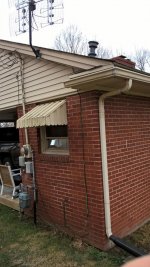
So if the antenna is mounted us this....I've got a ground running down, beside the coax, then I could drive a ground rod on the back corner of the house then attach the green ground to that with a clamp, correct?.
 

Attachments

  • WP_20161218_12_07_19_Pro.jpg
    WP_20161218_12_07_19_Pro.jpg
    122.6 KB · Views: 18

Infinia

Banned
Joined
Oct 2, 2016
Messages
845
Location
SoCal
yeah drive a ground rod away from the utilities. note> the coax ground block is important too.
the whole exercise is route the lightning from coupling into the wires going inside the home.
The coax shield is a really good conductor so your ground path should be << it's conductors.
 
Last edited:

sberry

Banned
Joined
Jun 18, 2005
Messages
35,747
Location
Brethren, Michigan
It says you have to use the electric ground if its available, looks like it is here. Phones are ART 880, don't recall what section antenna is in.
 
OP
F

flyin99

Well-known member
Joined
Nov 20, 2006
Messages
87
Location
Central Ky.
no i'd keep them somewhat apart. note> the coax ground block is important too.
the whole exercise is route the lightning from coupling into the wires going inside the home.
The coax shield is a really good conductor so your ground path should be << it's conductors.

Would a foot apart between coax and green ground wire be sufficient? I do have a ground block at the bottom of the coax, where it enters the house.....kind of hard to see in the picture.
 

Infinia

Banned
Joined
Oct 2, 2016
Messages
845
Location
SoCal
yeah just visualize lighting strike seeking earth ground. The shortest & lowest conductance path gets most current. Spacing is needed because parallel conductors electro-magnetically couple well.
One idea if you want neater appearance, use a short piece of metal conduit with coax inside w/ bare ground wire outside> the metal conduit aids ground conduction. Me I would just used a long piece of pipe for an antenna mast and use the roof eaves for support. That way you can rotate the whole mess for best reception.
 
Last edited:
OP
F

flyin99

Well-known member
Joined
Nov 20, 2006
Messages
87
Location
Central Ky.
Wow lots of dangerous assumptions in this thread. :shocking: :wtf: :headscrat:


The loose aluminum wire DOES go outside as it is the neutral in the service entrance wire that goes to the meter lugs.

Can u snap a pic of the pipe that Direct TV used and post it here. Any GE(grounding electrode) used for telecom/cable TV sytems, needs to be bonded with the main service GES(grounding electrode system) to avoid step potential. All GESs on a house need to be connected together. The inter-system bond posted above is a great idea that gives telecom companies easy access for bonding their systems.

A lot of times, the telco or cable company will drive their own rod if they cant find an existing GE(grounding electrode) or have easy access to a bonded piece of metal such as a meter pan, electrical panel, or bonded metal conduit. This rod should be bonded to the GES but many times the phone company doesnt do this.

Your main service panel(the one inside the house) or in some cases, the meter pan (where the PoCo allows this which is rare in the states) SHOULD have a GES which can consist of either 1-2 ground rods, a UFER ground(concrete encased electrode; no other GEs required if used), and/or main metal water line within 5' of where it enters the house. ALL GEs and the GECs(grounding electrode conductors; the wire that ties the GEs to the service panel neutral) have specific requirements for length and type of wire used.

Where does the main water line(if metal) enter the house?

If u have no GEs connected to the main service panel or meter pan whatsoever, u should drive in 2 rods and connect them, with #6 solid cu wire, to the bonded neutral bar in your inside main service panel.

The antenna ideally should be connected direct to the GEs with a rod clamp.

If thats not possible, a panel clamp, like the one posted above should suffice. But if u do this u need to make sure that your panel has a properly connected GES/GEs. I have done inspections on houses that didnt have any GEs at all. I have also seen telco DEMARC boxes connected to standalone rods that werent connected to the main GES, which can create problems.

The main purpose of the GEs/GES is to ground lightning as well as shunt PoCo primary high voltage lines when/if they contact lower secondary lines, and limit the voltage to ground potential.

The reason the antenna should be connected to ground is for lightning.


It should but who knows what has happened to it since it was installed. Ive seen all sorts of weirdness when it came to bonding GESs. Thats why i dont expect anything especially on older houses as any number of people couldve monkeyed around with the wiring.


Only some PoCos allow the GEC to be bonded in the meter pan. For the majority of PoCos the GEC is terminated on the neutral bar in the main service panel.


Using a water faucet as a grounding electrode may be fine in canada but definitely not kosher or to code in the states.

When using the main water line as a grounding electrode in the states, code requires the bond to be done within 5' of where the pipe enters the building.

That pipe in the pic SHOULD NOT be used as a GE as it is the drain line for the water heater pressure relief valve. Notice how it doesnt go into the ground?

Someone incorrectly used this pipe as there is clamp on it.


DONT USE THIS for a GEC.


Panel clamps like that one are perfectly fine. However as i said above, it will only work properly in a lightning strike IF whatever panel its connected to is properly connected to a GES and GEs.

Bonding to the main service panel or meter pan wouldnt direct it into the house IF those panels have a properly connected GEC/GE.

This is why its prudent to check for a properly connected GE.


Thats a dangerous assumption. Those are the neutral wires in the service entrance wire. Unless you have seen a properly connected GEC in the meter pan or main service panel(i dont see one), that is properly connected to a GE on the other end, I would NEVER ASSUME that it is grounded to earth.


I would not assume that whatever the phone system is bonded to is a proper grounding electrode. Inspection and investigation is prudent especially with a metal antenna involved.

The smallest size wire allowed for a GEC is #8 and must be ran in conduit.

TELCO is allowed to use smaller wire for their inter-system bonding.

Your info about ground rods is FUD. Nothing in code dictates what to do about the type of soil and whether certain types shouldnt be grounded to. This is why code requires a second rod to be driven if 25ohms or less of resistance cant proven. Most just drive a second rod.


DO NOT USE the phone DEMARC box for grounding anything. U should be using the main service panel or meter pan or GEs.


As said above "mess of aluminum looking wire" is the nuetral wire in the service entrance wire. It is connected to the neutral lug in the meter pan and SHOULD NOT be directly connected to any ground under the house.

And your last sentence is a BAD assumption.

Please check for proper GE before using ANY grounding point including the meter pan.

I dont see any GEC on the neutral bar in the main service panel.

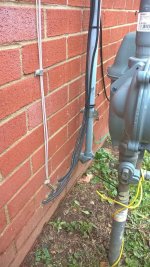
There is nothing coming out of the meter box, on the outside of the house, that I see. That conduit line running next to the meter, just contains the white insulated 10/2 or 12/2 wire. I went under the house to see where it comes back in the house.....no ground in there......checked where the water pipe enters the house.....no ground there. I have found nothing going into the earth, unless they've hid it well. Looking toward the ground in the other pic, shows 3 old TWC coax cables going into the house (2 no longer used) and one for internet...phone lines and there is the gas meter toward the front. The black cable that looks to wrap around the meter is just the TWC cable that comes from the pole, down into the TWC cable (gray box) there on the house. I don't know where else to look in the ground.
 

Attachments

  • WP_20161218_13_57_58_Pro.jpg
    WP_20161218_13_57_58_Pro.jpg
    136.1 KB · Views: 10
  • WP_20161218_13_58_10_Pro.jpg
    WP_20161218_13_58_10_Pro.jpg
    158.8 KB · Views: 10

mm08822

Well-known member
Joined
Jan 13, 2012
Messages
6,004
Location
NJ
Ok, so it looks and reads like you never had grounding electrodes or conductor installed for the electric service. Perfect time to add it with your little project. At the same time you can connect up your antenna. I wouldnt skip connecting the service b/c you are putting a big target in the air, so you should be properly prepared.
 

Dagny

Well-known member
Joined
Jul 25, 2014
Messages
3,013
Location
Northern Wi.
Grounding an antenna with just a rod is a bad idea. I have seen several receptacles blown right out of the wall inside the house. The diesel man has the correct pictures make it look like that. If every piece of metal on your land is hooked together with a wire you greatly reduce the likelihood of lightning damage.

The grounds and neutral wires in your house in theory are hooked electrically to all the other ground rods in north america along with all the metal objects as well lightning prefers this path, a very small wire can handle the small currents involved, the damage and fires are caused when it jumps.
 
OP
F

flyin99

Well-known member
Joined
Nov 20, 2006
Messages
87
Location
Central Ky.
Yeah. Antenna's coming down. Sounds more involved than I'm capable of doing, as far as electricity goes. Appreciate the input.
 

wyliesdiesels

Well-known member
Joined
Aug 14, 2012
Messages
20,038
Location
Modesto, CA
Yeah. Antenna's coming down. Sounds more involved than I'm capable of doing, as far as electricity goes. Appreciate the input.

wait after all that youre giving up? U give up to easily.

The thing is, it appears that u have no GEC or bonded plumbing which is dangerous.

So regardless how u feel about how much work it is to ground the antenna, u DEFINITELY need to ground your electrical service.

If u go with rods, u will need to get the #6 cu wire from the outside to the inside of the house and into the electrical panel.

This means drilling the brick or using an existing hole.

Its a couple hours of work tops.
 

wyliesdiesels

Well-known member
Joined
Aug 14, 2012
Messages
20,038
Location
Modesto, CA
A ground for an antenna as mentioned is for lightning strikes only. The lightning's discharge is going to take the shortest route to earth, If the service panel ground is some distance it aint all going to go where you want it. If it were me id consult a lightning rod installation kit or source info from a chimney sweep guy. Keep the lightning rod grounding wire on exterior of the home and away from any interior wiring. I'm pretty sure the whole idea is to keep as much energy from exiting down the feed coax as possible.
Codes are for local municipalities AFAIK NEC is a guideline. IDK if adding text to a unknown sourced image "5 feet from water pipes" is probably not helpful esp. when the city inspector comes. I know my home uses the hot water heaters cold water pipe 7' high from the slab inside a interior wall in the garage.

The GEC is to be bonded to the neutral bar. Since his panel is inside the home there is no way around bringing the GEC inside.

And u need to read 250.68(c)(1)

Most of the pics are from EC&M which is written by among others Mike Holt. If u dont know who he is then there is no point in discussing this further.
 
Last edited:
To avoid these ads, REGISTER NOW!
Top Bottom