
You are using an out of date browser. It may not display this or other websites correctly.
You should upgrade or use an alternative browser.
You should upgrade or use an alternative browser.
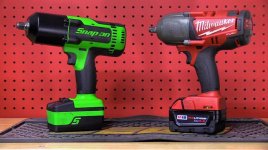
New Video Snap-on vs Milwaukee Cordless
- Thread starter DFB
- Start date

gdocktor3
Well-known member
I mean, didn't everyone already know that would be the outcome?
The good thing is that the Milwaukee had almost the exact same results when he did the test a year ago between the Dewalt, IR and Milwaukee. Oh and the Dewalt beat the Milwaukee by 2 ft lbs. Just saying....
The good thing is that the Milwaukee had almost the exact same results when he did the test a year ago between the Dewalt, IR and Milwaukee. Oh and the Dewalt beat the Milwaukee by 2 ft lbs. Just saying....
Last edited:
rice rocket
Well-known member
- Joined
- Mar 24, 2011
- Messages
- 3,175
I mean, didn't everyone already know that would be the outcome?
What was the outcome? I watched and I'm not entirely sure how to translate the "lab" results into real world working examples.
The Snap-On hits 25% harder forward (100 ft-lbs more dynamic torque) and 17% harder in reverse (+70 ft-lbs), but doesn't achieve as much bolt tension? I'm not sure what bolt tension is in real world (especially in reverse).
I assume dynamic torque is really the important measurement here, since almost all of us are using these to rip off stuck fasteners, not assemble bridges. Does this also mean the previous bolt-tension-only based torque results don't have validity either?
Last edited:
Strouty
Well-known member
That Snap On impact sure is pretty. 
Westozfixer
Banned
Only 2? In Australia its more like 4, don't get me wrong I like SO and have a lot of it but I can't justify the price of its cordless equipment and own only Milwaukee.
I was more interested when he pulled them apart. Snap-on seemed like it was much better built buttttt, you can buy 2 of the Milwaukee ones for the price of the snap-on.
Milwaukee is closer to $350 than $400 if you wait patiently for a Zoro sale.
-Snap-On also has a terrible warranty.
-Its also huge (length).
-18v Lithium impact reliability is pretty awful.
Im not a Milwaukee fan in the slightest but I could never recommend anything 18v snap-on after my brief but damning experiences (trigger reliability problems) and im far from alone. Wouldn't sting as much if they backed it with something like 5 years against premature failure but the reality is its 1 year and then you're forking out $130 flat rate fees for their shoddy quality.
Last edited:
Dagny
Well-known member
1 new 1 2 years old?
WWheeler
Well-known member
1 new 1 2 years old?
That's what I was thinking. Every impact I've ever had didn't seem to have the same umph after a couple years as it did when new.
Now I want to know how the Dewalt DCF899 20v compares to these two. He already did a video on it but unless I missed it he didn't do the dynamic torque test. In the working torque test in forward and reverse it fared rather well against them.
DEWALT DCF899 20V MAX XR Brushless High Torque 1/2" Impact Wrench
As I compared it to this video ...
Working torque
Dewalt DCF899 : 914 ft lbs fwd, 1024 ft lbs reverse
Milwaukee M18 FUEL 2763 : 867 ft lbs fwd, 1010 ft lbs reverse
Snap On CT8850 : 788 ft lbs fwd, 724 ft lbs reverse
Dynamic torque
Dewalt DCF899 : 411 ft lbs fwd, 418 ft lbs reverse***
Milwaukee M18 FUEL 2763 : 421 ft lbs fwd, 415 ft lbs reverse
Snap On CT8850 : 526 ft lbs fwd, 486 ft lbs reverse
*** Edit: I was looking for an answer to rice rocket's questions posted above (and quoted in the post below) and came across this 3 month old Real Tool Reviews video where he debuts his new Digital torque meter to add dynamic torque testing to his reviews. In it he just happens to test the Dewalt DCF899 so i was able to add the values from that vid above.
NEW! Electronic Torque Testing (Impact Wrenches) Skidmore Wilhelm T-3000
Last edited:
WWheeler
Well-known member
What was the outcome? I watched and I'm not entirely sure how to translate the "lab" results into real world working examples.
The Snap-On hits 25% harder forward (100 ft-lbs more dynamic torque) and 17% harder in reverse (+70 ft-lbs), but doesn't achieve as much bolt tension? I'm not sure what bolt tension is in real world (especially in reverse).
I assume dynamic torque is really the important measurement here, since almost all of us are using these to rip off stuck fasteners, not assemble bridges. Does this also mean the previous bolt-tension-only based torque results don't have validity either?
This vid (and the "NEW! Electronic Torque Testing" vid I just linked above) might help answer your questions:
THE BIG LIE -- Nutbusting / Breakaway Torque (What is it?) - Impact Wrench Torque Ratings
From what I gather, and someone please correct me if I'm interpreting this wrong, but the working torque rating should more accurately apply to real world use being that it's measuring the accumulative max force applied in a 15 sec burst, as opposed to the dynamic torque is how hard it hits with each hit. If two torque wrenches are seemingly equal in working torque ratings then the dynamic torque might help determine which is the better of the two.
In the case of this Milwaukee vs Snap On where the Milwaukee has a better working torque but lower dynamic torque, the Milwaukee should be able to break free some hypothetical really stuck fastener that the Snap On wasn't be able to, but on fasteners that they both are capable of breaking free the Snap On might be able to do it faster - less time pulling the trigger - since it hits harder with each hit.
That's if I understand all that correctly. If not (quite possible) I wait to be schooled.
Last edited:
rice rocket
Well-known member
- Joined
- Mar 24, 2011
- Messages
- 3,175
In the case of this Milwaukee vs Snap On where the Milwaukee has a better working torque but lower dynamic torque, the Milwaukee should be able to break free some hypothetical really stuck fastener that the Snap On wasn't be able to, but on fasteners that they both are capable of breaking free the Snap On might be able to do it faster - less time pulling the trigger - since it hits harder with each hit.
That's if I understand all that correctly. If not (quite possible) I wait to be schooled.
The opposite seems more intuitive, as in the gun with the higher dynamic torque should be applying more impact force on the fastener. The higher working torque should be able to tighten the bolt more, given enough time?
So the Milwaukee does more work in less time, but with less impact force? Assuming that's true, does that mean the Snap-On gun hasn't reached it's ultimate fastening tension after 15 seconds, and if the test was run longer, it would've reached a higher bolt tension?
tl;dr, can we do the good ole rusty bolt test?

Last edited:
WWheeler
Well-known member
The opposite seems more intuitive, as in the gun with the higher dynamic torque should be applying more force the fastener.
So the Milwaukee does more work in less time, but with less impact force? Assuming that's true, does that mean the Snap-On gun hasn't reached it's ultimate fastening tension after 15 seconds, and if the test was run longer, it would've reached a higher bolt tension?
I believe I wrote the opposite of what you interpreted.
If I understand it correctly I interpreted it to show that the Milwaukee is capable of building up to and applying more cumulative force over time (more working force) so should be able to break free a stuck fastener that the Snap On can't, but the Snap On hits harder with each hit (more dynamic force) so could be faster to break free a fastener that both impacts are capable of removing.
I feel like I just said the exact same thing above.
tl dr:
Milwaukee stronger but sometimes slower
Snap On not as strong but sometimes faster
Last edited:
rice rocket
Well-known member
- Joined
- Mar 24, 2011
- Messages
- 3,175
I believe I wrote the opposite of what you interpreted.
If I understand it correctly I interpreted it to show that the Milwaukee is capable of building up to and applying more cumulative force over time (more working force) so should be able to break free a stuck fastener that the Snap On can't, but the Snap On hits harder with each hit (more dynamic force) so could be faster to break free a fastener that both impacts are capable of removing.
I feel like I just said the exact same thing above.
How does an impact wrench "build up torque" in a unfastening situation though?
You build bolt tension when you're stretching a bolt as it gets tighter and tighter, where by the test, the Milwaukee is better. When you're ripping off fasteners though, I don't see how you're putting any force in the bank. Hence, the dynamic torque is more relevant in this situation.
WWheeler
Well-known member
How does an impact wrench "build up torque" in a unfastening situation though?
You build bolt tension when you're stretching a bolt as it gets tighter and tighter, where by the test, the Milwaukee is better. When you're ripping off fasteners though, I don't see how you're putting any force in the bank. Hence, the dynamic torque is more relevant in this situation.
If they didn't build up torque over time then the working torque reading would be the same as the dynamic torque. Certainly never higher. Seems pretty simple to me.
rice rocket
Well-known member
- Joined
- Mar 24, 2011
- Messages
- 3,175
If they didn't build up torque over time then the working torque reading would be the same as the dynamic torque. Certainly never higher. Seems pretty simple to me.
They do build up over time...when you're tightening down a bolt and stretching it.
When you're un-stretching a bolt though, if nothing budged, nothing budged. Impact guns aren't like plasma rifles. It doesn't create more energy the longer you hold the trigger.
WWheeler
Well-known member
They do build up over time...when you're tightening down a bolt and stretching it.
When you're un-stretching a bolt though, if nothing budged, nothing budged. Impact guns aren't like plasma rifles. It doesn't create more energy the longer you hold the trigger.
So you say. It's not what I've seen in practice nor do I think the video testing bears your theory out.
I'm sure others around here understand all this a lot better than I do and will weigh in to settle it. I'm just going off of what I just saw in those vids and RTR's explanation of what the torque test results mean.
Last edited:
Patrick73RS
Active member
Maybe it's just me however using my half-inch impact I've never stayed on a bolt with the trigger pulled for 15 seconds so I don't know how that's relevant. I understand that the 15 second test enables that there is a constant for comparing the two units but my half-inch impact typically breaks it free within one or two seconds.
bmwpowere36m3
Well-known member
- Joined
- Nov 8, 2012
- Messages
- 1,125
They do build up over time...when you're tightening down a bolt and stretching it.
When you're un-stretching a bolt though, if nothing budged, nothing budged. Impact guns aren't like plasma rifles. It doesn't create more energy the longer you hold the trigger.
+1
In a loosening situation... there is NO build-up of torque. You start at a certain bolt tension and it only decreases with each impact. My guess, dynamic is more applicable to loosening and working torque to tightening.
bmwpowere36m3
Well-known member
- Joined
- Nov 8, 2012
- Messages
- 1,125
Maybe it's just me however using my half-inch impact I've never stayed on a bolt with the trigger pulled for 15 seconds so I don't know how that's relevant. I understand that the 15 second test enables that there is a constant for comparing the two units but my half-inch impact typically breaks it free within one or two seconds.
Same here... but its just a consistent point of comparison. I'd have probably gone with 5 seconds, but its all relative.
FigureItOut
Well-known member
That definitely seems more intuitive to me, and I believe I recall Daniel explaining it that way, either in a video or a podcast, when he first got the digital Skidmore. Not that he's the authority on the physics, but I gather that he's educated himself on it and probably gotten a lot of info from the folks at Skidmore-Wilhelm.+1
In a loosening situation... there is NO build-up of torque. You start at a certain bolt tension and it only decreases with each impact. My guess, dynamic is more applicable to loosening and working torque to tightening.
Patrick73RS
Active member
Same here... but its just a consistent point of comparison. I'd have probably gone with 5 seconds, but its all relative.
While I agree with you on it I think the 15 seconds is a little irrelevant if the rate at which it climbs is not constant. Especially if it is being used for 1 to 5 seconds only. I'm certainly not going to sit there with it hammering away for 15 seconds hoping the bolt/nut is going to come off.
I put on lug nuts at 125 foot/pounds and my 3/8 impact rips them off with ease. I am not working on 18 wheelers so my 1/2 inch has gone through everything I've thrown at it (easily).
Last edited:
rice rocket
Well-known member
- Joined
- Mar 24, 2011
- Messages
- 3,175
You also live in Houston.
WWheeler
Well-known member
That definitely seems more intuitive to me, and I believe I recall Daniel explaining it that way, either in a video or a podcast, when he first got the digital Skidmore. Not that he's the authority on the physics, but I gather that he's educated himself on it and probably gotten a lot of info from the folks at Skidmore-Wilhelm.
I had linked that video in this thread (and have embedded it below) and was working off of what he says in it when coming the opposite conclusion. He definitely does not explain "it that way". He says the 15 second tests on the mechanical Model W Skidmore-Wilhelms (which are meant to be used to calibrate torque wrenches) shows "the maximum amount that any of these could ever achieve" in forward or reverse, but what they don't show is the dynamic (instantaneous) torque which is what the digital Model T Skidmore-Wilhelm measures.
He never does say one value is a better indicator than the other, but I take it he implies that the working torque is a more real-life indication of what the guns are capable of achieving. In watching the testing the guns definitely do build up torque in both directions over the 15 seconds above what they are able to do instantaneously which is what yields a much higher 'working torque' than the 'dynamic torque'.
Exactly what he says is:
What we'll typically use is the bench-mounted Skidmore-Wilhelm or the one mounted over in the shop press. I can measure forward and reverse torque with these and the number that we normally come up with is reverse or forward working torque. That's after 15 seconds of runtime, and that is the maximum amount that any of these could ever achieve. However, it does not show you exactly what the dynamic torque, or instantaneous torque ratings are, and for that you would need something like this which is a digital torque meter made by Skidmore-Wilhelm and it's a model T-3000.
<iframe width="560" height="315" src="https://www.youtube.com/embed/a8jQX3k-5bc" frameborder="0" allowfullscreen></iframe>
I've given it a google and not found a definitive answer to this. There is this from wikipedia which doesn't seem to have a footnote to a source:
https://en.wikipedia.org/wiki/Impact_wrench
"Maximum torque" is the number most often given by manufacturers, which is the instantaneous peak torque delivered if the anvil is locked into a perfectly solid object. "Working torque" is a more realistic number for continually driving a very stiff fastener. "Nut-busting torque" is often quoted, with the usual definition being that the wrench can loosen a nut tightened with the specified amount of torque in some specified time period.
All in all I'm still left leaning right where I was before that the 'working torque' rating should more accurately apply to real world use being that it's measuring the accumulative max force applied in a 15 sec burst, as opposed to the dynamic torque is how hard it hits with each hit, and only if/when two torque wrenches are seemingly equal in working torque ratings then the dynamic torque might help determine which is the better of the two.
That's what I get from it anywho.
rice rocket
Well-known member
- Joined
- Mar 24, 2011
- Messages
- 3,175
the "working torque" values as the more practical
....if you're assembling bridges.
WWheeler
Well-known member
....if you're assembling bridges.
No, if I'm removing fasteners.
FigureItOut
Well-known member
He hasn't posted for a little over a year, which I think is a shame because I found him to be a valuable contributor for the short time of overlap we had.